Crocodiles, alligators, and caimans are all large reptiles in the order Crocodylia, so it is easy to see why people mix them up. They all have long tails, armored skin, powerful jaws, and eyes positioned high on the head for life in and around water.
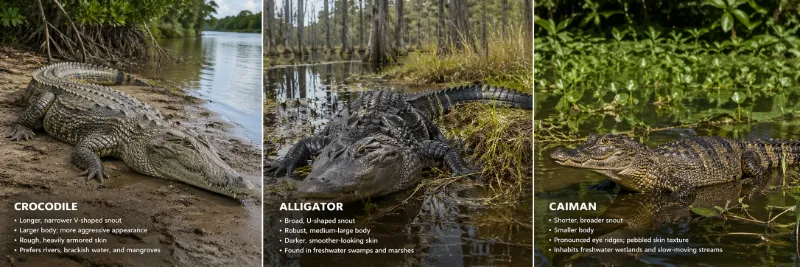
However, they are not the same animal. A crocodile belongs to the crocodile family, while an alligator and a caiman belong to the alligator family. They also differ in snout shape, size, habitat, color, range, and overall appearance.
This guide explains the main differences between crocodiles, alligators, and caimans in simple terms, so you can tell them apart more easily.
Quick comparison table
| Feature | Crocodile | Alligator | Caiman |
|---|---|---|---|
| Family | Crocodylidae | Alligatoridae | Alligatoridae |
| Snout shape | Usually narrower and more pointed | Usually broader and U-shaped | Often shorter and broader, but varies by species |
| Teeth when mouth is closed | Upper and lower teeth often visible | Lower teeth usually hidden | Often similar to alligators, but appearance varies |
| Typical size | Largest overall | Large, but usually smaller than the biggest crocodiles | Usually smaller, though some species get very large |
| Main range | Africa, Asia, Australia, and the Americas | Southeastern United States and eastern China | Central and South America |
| Saltwater tolerance | Best salt tolerance | Mainly freshwater | Mainly freshwater |
| Body armor | Tough skin and scales | Heavy body with tough skin | Often especially rugged and bony-armored |
| Examples | Nile crocodile, saltwater crocodile, American crocodile | American alligator, Chinese alligator | Spectacled caiman, black caiman, yacare caiman |
They belong to different families
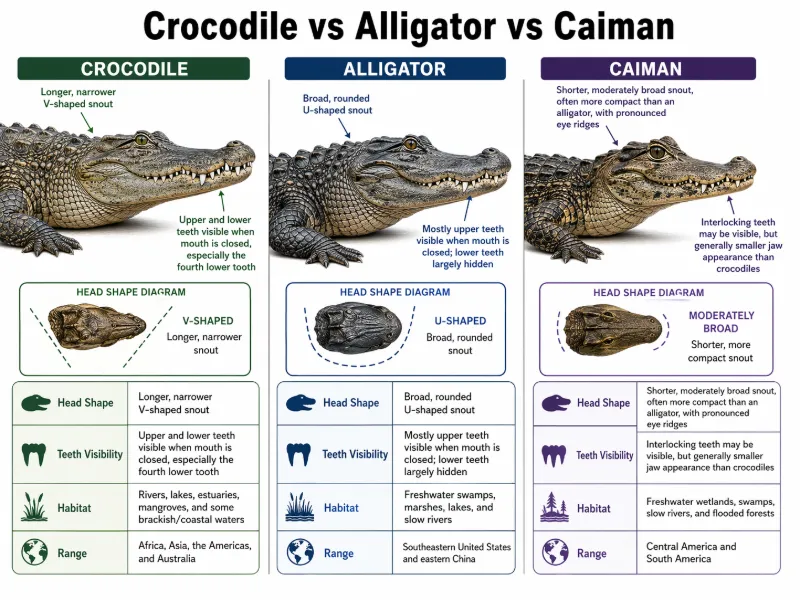
The most important difference is classification. Crocodiles belong to the family Crocodylidae. Alligators and caimans belong to the family Alligatoridae.
This means alligators and caimans are more closely related to each other than either one is to a true crocodile. In simple terms, a caiman is more like an alligator than a crocodile, even though all three are crocodilians.
That family relationship explains why caimans and alligators often share certain body features, while crocodiles often look leaner and more pointed.
Snout shape is one of the easiest clues
If you are trying to identify one quickly, the snout is a good place to start.
Crocodiles usually have a narrower, longer, and more pointed snout. In many species, it looks more V-shaped than the head of an alligator. This gives crocodiles a sleeker profile.
Alligators usually have a broader, more rounded U-shaped snout. Their heads often look wider and heavier, especially in large adults.
Caimans often fall somewhere in between, depending on the species. Many caimans have a shorter, broader head than many crocodiles, but their snout can still look narrower or more compact than that of a classic American alligator.
So the basic pattern is this: pointed often suggests crocodile, broad often suggests alligator, and a smaller rugged freshwater crocodilian in tropical America may be a caiman.
Teeth look different when the mouth is closed
Another classic clue is how the teeth show when the mouth is shut.
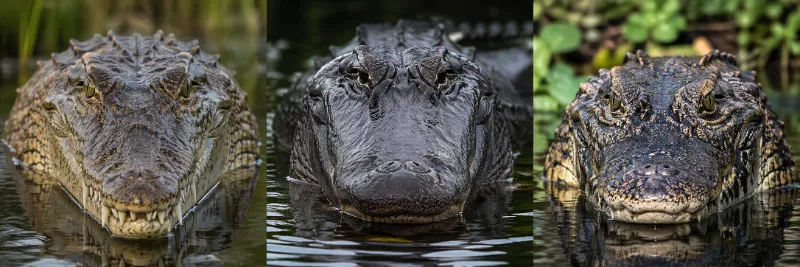
In crocodiles, the upper and lower jaws are closer to the same width, so teeth from both jaws are often visible even when the mouth is closed. One of the most noticeable features is the large fourth tooth on the lower jaw, which can often be seen from the outside.
In alligators, the upper jaw is broader than the lower jaw. That means the lower teeth usually fit inside and are less visible when the mouth is closed.
Caimans are more similar to alligators in family relationship, but tooth visibility can still vary depending on head angle, size, and species. For most casual observers, crocodiles tend to look more obviously “toothy” when the mouth is shut.
Size differences can be dramatic
Crocodiles include the largest of the three groups. The saltwater crocodile is generally considered the largest living crocodilian, and the Nile crocodile is also extremely large.
Alligators can become very large too, especially big male American alligators, but they are usually smaller overall than the largest crocodiles.
Caimans are often smaller than both, especially the more common species people see in tropical America. However, the black caiman is an important exception because it can grow very large and is one of the top predators in South American wetlands.
So if you compare the maximum size of the biggest species, crocodiles usually come first, large alligators come next, and most caimans are smaller, though there is some overlap.
Habitat and water type also help
All three groups live around water, but they do not use exactly the same kinds of habitats.
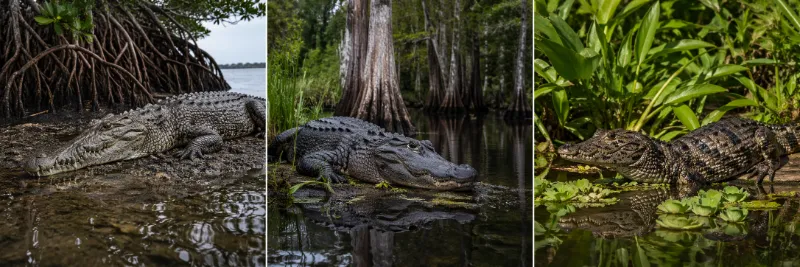
Crocodiles are the most tolerant of brackish and salty environments. Many species can live in estuaries, coastal lagoons, mangroves, and other habitats influenced by salt water. This is one reason crocodiles have such a wide global range.
Alligators are mostly freshwater reptiles. They are commonly found in swamps, marshes, rivers, lakes, and ponds. The American alligator is strongly associated with the southeastern United States, while the Chinese alligator survives in a much smaller range in eastern China.
Caimans are also mainly freshwater animals. They are common in rivers, flooded forests, marshes, wetlands, and other inland tropical habitats in Central and South America.
So if you see one in a coastal mangrove or estuary, crocodile is often the strongest possibility. If you see one in a South American wetland, it may be a caiman. If you see one in a Florida freshwater marsh, it is very likely an alligator.
Range is another major difference
Crocodiles have the broadest global distribution. Different species live in Africa, Asia, Australia, and the Americas.
Alligators are much more limited. Today, only two living alligator species remain: the American alligator and the Chinese alligator.
Caimans are restricted to Central and South America. That narrower range is one of the easiest ways to narrow down identification.
Location does not tell the whole story, but it is one of the most useful clues. A crocodilian seen in Australia is a crocodile, not an alligator or caiman. A crocodilian seen deep in the Amazon basin is much more likely to be a caiman than an alligator.
Body armor and overall appearance can look different
Caimans often look especially rugged and heavily armored. Many species have strong bony plates in the skin, giving them a rough, hard appearance. Some, such as the spectacled caiman, also show a ridge between the eyes that gives the face a distinctive look.
Alligators often look broad-bodied, dark, and heavy-headed. They have a powerful, solid appearance, especially in still freshwater habitats.
Crocodiles often appear longer, leaner, and slightly more streamlined, with a narrower head and a somewhat sharper facial outline. Their color is often lighter than that of many alligators, with shades of olive, tan, or gray-brown.
These differences are not perfect in every species, but together they can make identification much easier.
Which one is most dangerous?
All three should be treated as dangerous wild animals and observed only from a safe distance.
Crocodiles generally include the species most often considered dangerous to humans, especially large species such as the Nile crocodile and saltwater crocodile. These animals are powerful apex predators and are involved in serious attacks in some parts of the world.
Alligators can also be dangerous, but American alligators are often considered less aggressive toward humans than some large crocodile species. That does not mean they are harmless.
Caimans vary widely by species and size. Many are smaller than large crocodiles, but large individuals, especially black caimans, are still formidable predators and should not be underestimated.
How to tell them apart quickly
If you need a simple memory guide, use these clues together:
Crocodile: narrower pointed snout, teeth often visible, broad tropical range, better salt tolerance, usually the largest overall
Alligator: broad U-shaped snout, darker color, lower teeth usually hidden, mainly freshwater, limited mostly to the southeastern United States and eastern China
Caiman: tropical American range, usually smaller, often more rugged and heavily armored, more closely related to alligators
No single feature is perfect every time, but the combination of snout shape, location, habitat, and overall build usually gives the best answer.
Why they look so similar in the first place
They look similar because they all belong to the crocodilian order and share an ancient body design that works extremely well for life near water. Their low bodies, powerful tails, camouflaged eyes, and strong jaws are all adaptations for ambush hunting.
From a distance, these shared features can make them seem almost identical, especially to people who do not often see them in the wild. That is why many people call every crocodilian a “crocodile,” even when that is not accurate.
Final takeaway
The main difference between a crocodile, alligator, and caiman is that crocodiles belong to a different family and usually have narrower snouts, better salt tolerance, and a wider global range. Alligators have broader snouts, are mostly freshwater animals, and have a much more limited range. Caimans are close relatives of alligators that live in Central and South America and often look smaller, rougher, and more heavily armored.
They may look alike at first, but once you compare the snout, teeth, habitat, and location, the differences become much easier to see.
FAQs
Is a caiman a crocodile?
No. A caiman is a crocodilian, but it belongs to the alligator family rather than the crocodile family.
Which is bigger, a crocodile, alligator, or caiman?
Crocodiles are usually the biggest overall, especially the saltwater crocodile. Large alligators can also be very big, while most caimans are smaller, though some black caimans can become impressive in size.
Which is more dangerous?
Crocodiles generally include the species most often considered highly dangerous to humans, but all three groups can be dangerous and should be avoided in the wild.
Do alligators and caimans live together?
No, not naturally. Alligators are native mainly to the southeastern United States and eastern China, while caimans live in Central and South America.