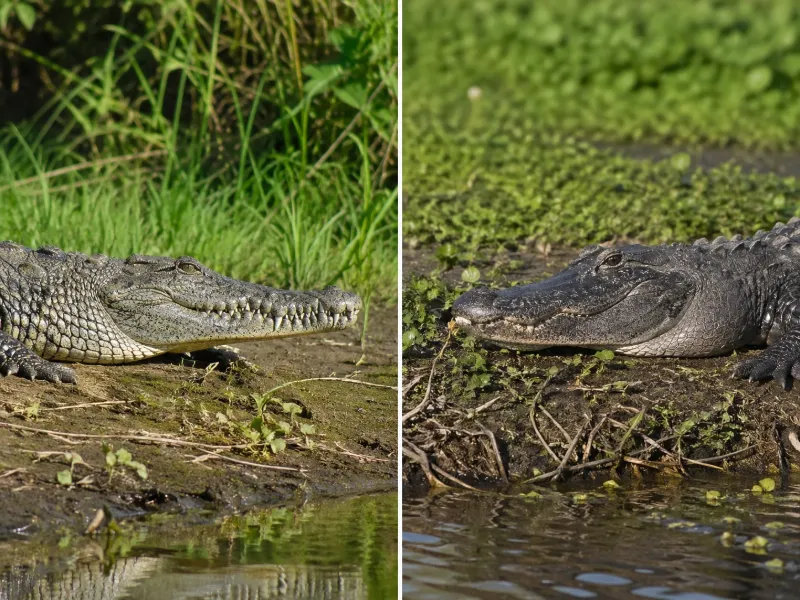
The main difference between a crocodile and an alligator is easy to remember once you know what to look for. Alligators usually have a broad U-shaped snout, darker color, and lower teeth that stay mostly hidden when the mouth is closed. Crocodiles usually have a narrower, more pointed snout, a lighter olive or gray-brown body, and visible upper and lower teeth when the mouth is shut. They also differ in habitat, salt tolerance, range, and overall temperament.
People mix up crocodiles and alligators because both are large semiaquatic reptiles in the order Crocodylia. From a distance, they can look very similar: long body, armored skin, heavy tail, and eyes and nostrils placed high on the head for life in the water.
In this guide, you will learn the clearest differences between crocodiles and alligators, how to identify them quickly, and why they are often confused.
Quick comparison table
| Feature | Crocodile | Alligator |
|---|---|---|
| Snout shape | Narrower and more pointed, often V-shaped | Broader and more rounded, often U-shaped |
| Teeth when mouth is closed | Upper and lower teeth often visible | Lower teeth usually hidden |
| Color | Often olive, tan, or gray-brown | Often darker gray to black |
| Salt tolerance | Better adapted to brackish and salty water | Mainly freshwater |
| Main range | Africa, Asia, Australia, and the Americas | Mainly southeastern United States and eastern China |
| Typical size | Includes the largest living crocodilians | Large, but usually smaller than the biggest crocodiles overall |
| Typical reputation | Often more defensive or aggressive | Often less aggressive, though still dangerous |
They belong to different families
Crocodiles and alligators are closely related, but they are not the same kind of crocodilian. Crocodiles belong to the family Crocodylidae, while alligators belong to the family Alligatoridae.
This is why they share the same general body plan but still show consistent differences in head shape, teeth, habitat, and behavior. They are relatives, not identical animals with different names.
Understanding that family difference helps explain why they overlap in appearance but not in every detail.

Snout shape is one of the easiest clues
If you are trying to tell them apart quickly, the head shape is usually the first thing to check. Crocodiles generally have a longer, narrower, more pointed snout. In many species, it looks more V-shaped.
Alligators usually have a broader, rounder, U-shaped snout. Their heads often look wider and heavier, especially in large adults.
This difference reflects feeding style as well. A broader snout can help generate powerful crushing force, while a narrower snout can be useful for gripping prey efficiently in different aquatic settings.
Teeth look different when the mouth is closed
Another classic difference is the way the teeth show when the jaws are shut. In crocodiles, the upper and lower jaws are closer in width, so teeth from both jaws are often visible from the outside. One of the easiest clues is the large fourth tooth on the lower jaw, which often sticks up clearly.
In alligators, the upper jaw is broader than the lower jaw. That means the lower teeth usually fit into the upper jaw and stay mostly hidden when the mouth is closed.
So if you see a closed-mouth reptile with visible interlocking teeth, it is more likely to be a crocodile.
Crocodiles usually look lighter in color
Color is not the best identification tool by itself, but it can still help. Crocodiles are often lighter in color, with shades of olive, tan, dusty green, or gray-brown. In strong sunlight, they may look paler and more sandy than alligators.
Alligators are often darker, ranging from deep gray to nearly black. This darker tone can make them look heavier and more solid in the water.
Juveniles of both groups may show stronger striping or banding, so color works best when combined with snout shape and teeth.
Habitat is a major difference
Alligators are mainly freshwater animals. They are commonly found in swamps, marshes, rivers, lakes, ponds, and slow-moving freshwater wetlands. The American alligator is especially associated with the southeastern United States.
Crocodiles are better adapted to brackish water and, in some species, even saltier coastal habitats. They are often found in estuaries, mangroves, river mouths, coastal lagoons, and tropical wetlands.
This difference in salt tolerance is important. Crocodiles have more effective salt-handling adaptations, which helps them live in places where alligators are less comfortable.

Range is another clear clue
Alligators have a much smaller modern range. Today, the two living alligator species are the American alligator and the Chinese alligator. That means alligators are limited mainly to the southeastern United States and a much smaller area in eastern China.
Crocodiles are much more widely distributed. Different species occur across Africa, Asia, Australia, and the Americas. This broad tropical and subtropical range makes crocodiles far more widespread globally.
So if you see one of these reptiles in Africa or Australia, it is a crocodile, not an alligator.
Which one is bigger?
Alligators can become very large, especially big male American alligators, but crocodiles include the largest living crocodilian species. The saltwater crocodile is generally considered the largest living crocodilian, and Nile crocodiles can also reach impressive sizes.
That means crocodiles usually win the overall size comparison when you compare the biggest species in each group. Even so, a large alligator is still an enormous and powerful reptile.
So the best answer is that both can be huge, but the largest crocodiles are generally bigger than the largest alligators.
Behavior and temperament are not identical
Crocodiles are often described as more defensive or aggressive overall, especially the largest species. This reputation is strongest in species such as the Nile crocodile and the saltwater crocodile, both of which are associated with serious attacks in some parts of the world.
Alligators can absolutely be dangerous too, and they should never be approached, fed, or treated casually. However, American alligators are often considered somewhat less aggressive toward humans than the most dangerous large crocodile species.
That said, behavior varies by species, season, nesting activity, location, and individual temperament. No large crocodilian should ever be considered safe just because it belongs to one group rather than the other.
Why people confuse them so easily
People confuse crocodiles and alligators because both are large armored reptiles that live around water and hunt in similar ways. From a distance, the overall shape looks almost the same: long tail, low body, strong jaws, and eyes just above the waterline.
Popular culture also tends to use the words loosely, which adds to the confusion. In movies, travel videos, and casual conversation, many people call any large crocodilian a crocodile.
Once you learn to check the snout, teeth, habitat, and location, the difference becomes much easier to spot.
How to tell them apart quickly
If you need a fast field guide, use these clues together:
Crocodile: narrower pointed snout, visible upper and lower teeth, lighter color, better salt tolerance, broader tropical range
Alligator: broader U-shaped snout, lower teeth mostly hidden, darker body, mainly freshwater, much more limited range
No single clue is perfect in every case, but this combination usually works well.
Which one is more dangerous to humans?
In general, crocodiles are considered more dangerous overall because the group includes some of the world’s most feared large crocodilian species. Blackwater estuaries, mangroves, and major tropical river systems with large crocodiles can be especially risky.
Alligators are still powerful predators and can injure or kill humans under the wrong circumstances. The idea that alligators are harmless is completely false. They are simply often described as less aggressive than the most dangerous crocodiles.
The safest rule is to treat both with full respect and never assume size, stillness, or familiarity means safety.
Final takeaway
The difference between a crocodile and an alligator comes down mainly to snout shape, teeth, habitat, range, and overall appearance. Crocodiles usually have a narrower pointed snout, visible teeth when the mouth is closed, lighter color, and better tolerance for brackish or salty water. Alligators usually have a broader U-shaped snout, darker color, and lower teeth that stay mostly hidden when the mouth is closed. They may look similar at first glance, but once you know the key clues, they are much easier to tell apart.
FAQs
Is a crocodile the same as an alligator?
No. They are related crocodilians, but they belong to different families and differ in snout shape, teeth, habitat, and range.
Which is more dangerous, a crocodile or an alligator?
Crocodiles are generally considered more dangerous overall, especially the largest species, but both can be very dangerous.
Can crocodiles and alligators live in the same place?
Yes, in a few areas such as parts of southern Florida, they can occur in the same broader region, though they often prefer somewhat different habitats.
How can I tell a crocodile from an alligator fast?
Look at the snout and the teeth. A pointed snout with visible teeth usually suggests a crocodile, while a broad U-shaped snout with hidden lower teeth usually suggests an alligator.