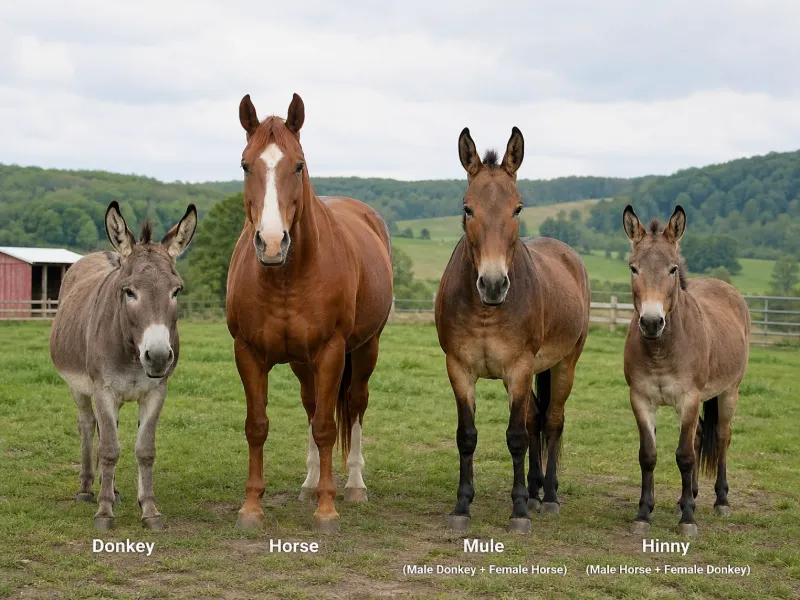
A mule and a hinny are both donkey-horse hybrids, but they are not the same. A mule is the offspring of a male donkey and a female horse, while a hinny is the offspring of a male horse and a female donkey. That difference in parentage affects how common they are, and it can also influence size, appearance, temperament, and how they are bred and raised.
Because both animals come from the same two species, people often assume they are simply two names for the same hybrid. In reality, a hinny and a mule are produced from the same species pair in opposite directions, and that matters biologically.
In this guide, you will learn how hinnies and mules differ, why one is much more common than the other, what they tend to look like, and whether these hybrids are fertile.
Quick comparison table
| Feature | Mule | Hinny |
|---|---|---|
| Parents | Male donkey x female horse | Male horse x female donkey |
| How common? | Much more common | Much rarer |
| Typical size | Often larger overall | Often smaller overall |
| Body influence | Often more horse-sized because the mother is a horse | Often more donkey-sized because the mother is a donkey |
| General appearance | Usually horse-like body with donkey traits | Often a more compact hybrid look |
| Fertility | Usually sterile | Usually sterile |
| Main use historically | Work, transport, endurance | Less common, fewer working lines |
What is a mule?
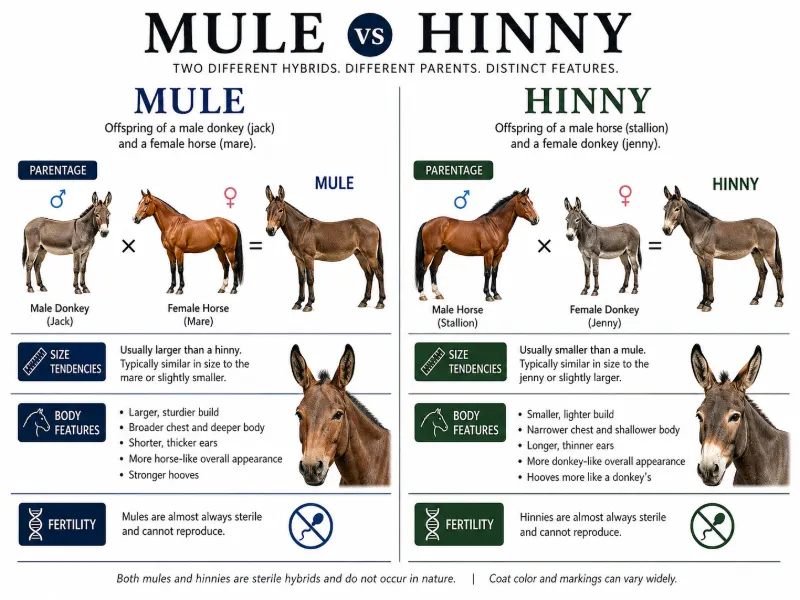
A mule is the hybrid offspring of a male donkey, called a jack, and a female horse, called a mare. This is the better-known and much more common of the two donkey-horse hybrid combinations.
Mules have been bred for a long time because they often combine useful traits from both parent species. Many are valued for strength, endurance, sure-footedness, and a practical temperament that can make them excellent working animals.
In many parts of the world, when people say “donkey-horse hybrid,” they usually mean a mule.
What is a hinny?
A hinny is the hybrid offspring of a male horse, called a stallion, and a female donkey, called a jenny or jennet. This is the reverse cross of a mule.
Hinnies are much less common than mules. Many people never see one in person, and some people do not even realize the animal has its own separate name.
Although hinnies and mules are made from the same two species, they are not identical in practice. The identity of the mother matters, and that changes the breeding process and often influences the offspring.
The main difference is the direction of the cross
The single most important difference between a mule and a hinny is the parent combination.
A mule comes from a donkey father and horse mother. A hinny comes from a horse father and donkey mother. This may sound like a small technical detail, but it affects pregnancy, body size, and how often the hybrid is successfully produced.
Because the mother carries the developing fetus, the body size and reproductive biology of the mother can influence the outcome. That is one reason the two hybrids are not just interchangeable mirror images.
Why mules are much more common than hinnies
Mules are far more common than hinnies for both biological and practical reasons. One major reason is that breeding a male donkey to a female horse has generally been more successful and more widely practiced than the reverse combination.
A mare is larger than a female donkey, which often makes carrying the hybrid foal more practical when the offspring may grow relatively large. By contrast, a female donkey is smaller, and breeding her to a stallion can be less straightforward.
Behavior and handling also matter. Donkeys and horses do not always court or mate in the same way, and breeders have historically found mule production easier and more useful to pursue at scale.
Size is often different
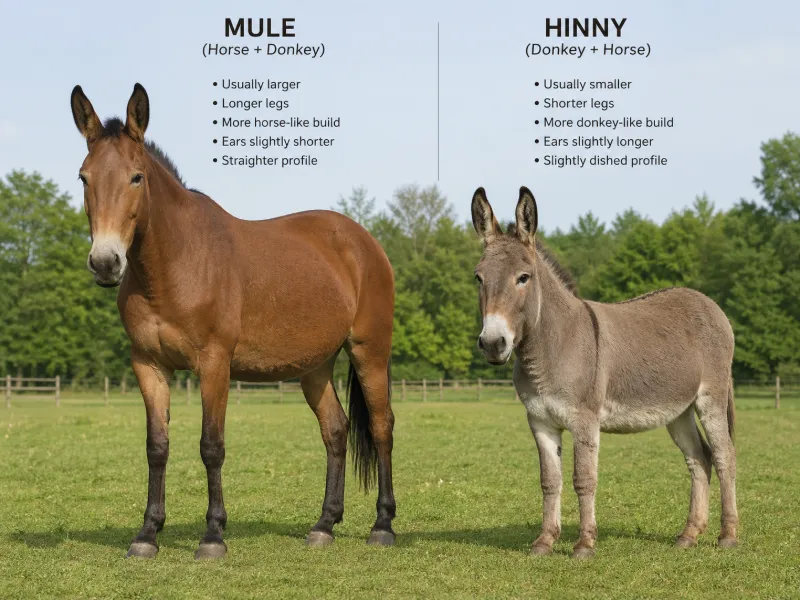
In general, mules are often larger than hinnies. One big reason is that the mother of a mule is a horse, and horses are usually larger than donkeys. This gives the developing mule more room to grow and often leads to a larger-bodied hybrid.
Hinnies are often smaller and more compact because the mother is a donkey. Even when the stallion is large, the jenny’s body places limits on pregnancy and foal development.
This does not mean every mule is bigger than every hinny, because breed size matters too. A small mare crossed with a donkey can still produce a smaller mule than a large jenny crossed with a small horse. But overall, mules are usually the larger and more familiar working hybrid.
Appearance can overlap, but not perfectly
Both mules and hinnies often show a mix of horse and donkey traits. They may have long ears, a sturdy body, a somewhat horse-like tail base, and a head shape that falls somewhere between the two parent species.
Mules often look more like a horse in body size and frame, but with clear donkey influence in the ears, mane, voice, and overall expression. Hinnies are often described as looking more compact and sometimes more donkey-like in overall proportions, although appearances vary.
Because appearance can overlap so much, it is not always easy to identify a mule or hinny correctly just by looking, especially without knowing the parents.
Temperament may differ, but individuals vary a lot
People often describe mules as intelligent, cautious, hardy, and less likely than horses to panic blindly into danger. Hinnies are less commonly discussed, mainly because they are rarer, but they are also often described as intelligent and hybrid in temperament.
It is tempting to make very strong personality claims, but behavior depends on more than parent species alone. Training, handling, early socialization, breed background, age, and sex all matter.
So while people may say a mule “acts more like this” or a hinny “acts more like that,” it is better to think in tendencies rather than absolute rules.
Do hinnies and mules sound different?
Both hybrids may produce vocalizations that seem to blend horse and donkey features. A donkey’s bray and a horse’s neigh are distinct, and hybrids can sound somewhere in between.
This can make their calls unusual to people hearing them for the first time. The exact sound varies by individual, and it is one of the many reminders that these animals are genuine hybrids rather than pure horses or pure donkeys.
Voice alone is not a reliable way to tell a hinny from a mule, but it does reflect their mixed ancestry.
Are mules and hinnies fertile?
Most mules and hinnies are sterile. This is because horses and donkeys have different chromosome numbers, and their hybrid offspring usually cannot form balanced reproductive cells in the normal way.
That is why mules and hinnies are generally produced by crossing horses and donkeys rather than by breeding hybrids to each other. Rare exceptions have been reported, especially involving female hybrids, but these cases are unusual and should not be treated as the normal pattern.
For practical purposes, both mules and hinnies are best understood as usually sterile hybrids.
Why horse-donkey hybrids are usually sterile
Horses and donkeys are closely related enough to produce offspring, but not closely matched enough for fertility to work smoothly in most hybrids. Their genetic differences are small enough to allow development of a living animal, but large enough to disrupt normal reproduction later.
This is a common pattern in hybrids across the animal world. A hybrid may survive and function well, but reproduction becomes difficult or impossible because the chromosomes do not pair properly.
That is one reason hinnies and mules are biologically fascinating. They show both the closeness and the limits of horse-donkey compatibility.
Why mules became famous working animals
Mules became widely known because they often combine useful features from both parent species. Many are strong like horses but also hardy, sure-footed, and efficient like donkeys. In rough terrain and demanding working conditions, that combination has been highly valued.
Historically, mules were used for transport, agriculture, pack work, military logistics, and travel in difficult landscapes. Their reputation spread so widely that the mule became far more famous than the hinny.
Hinnies existed too, but because they were rarer and less commonly bred at scale, they never gained the same broad working identity.
Can you tell a hinny from a mule just by looking?
Sometimes, but not always. Experienced breeders or handlers may notice clues in size, head shape, ear set, mane texture, and overall body proportions. Even so, visual identification can be uncertain.
The most reliable answer usually comes from knowing the parentage. Without that information, a mule and hinny can be hard to separate confidently, especially if the breeds involved are unusual or the hybrid has a strongly mixed appearance.
So while there may be visible hints, parent history is usually more useful than appearance alone.
Which hybrid is better?
There is no universal biological answer to which hybrid is “better.” Historically, mules were more widely used and more heavily bred for work, so they developed the stronger practical reputation. That does not mean hinnies are inferior animals. It mainly reflects how often people bred and used each type.
In modern settings, the better animal depends on the individual, its size, its training, its health, and the job expected of it. A well-handled animal will usually matter far more than the label alone.
For most readers, the most important point is not which one is better, but simply that a mule and a hinny are not the same hybrid.
Final takeaway
A mule and a hinny are both donkey-horse hybrids, but they differ in parentage. A mule comes from a male donkey and a female horse, while a hinny comes from a male horse and a female donkey. Mules are much more common, often larger, and historically far better known as working animals. Hinnies are rarer, often smaller, and less familiar to most people. Both are fascinating examples of how closely related species can produce hybrid offspring without being exactly interchangeable.
FAQs
What is the difference between a mule and a hinny?
A mule has a donkey father and horse mother, while a hinny has a horse father and donkey mother.
Why are mules more common than hinnies?
Mules are generally easier and more practical to produce, and they became more widely used as working animals.
Are hinnies sterile like mules?
Usually yes. Both hinnies and mules are generally sterile hybrids.
Which is bigger, a mule or a hinny?
Mules are often larger overall because the mother is a horse, though size still depends on the breeds involved.