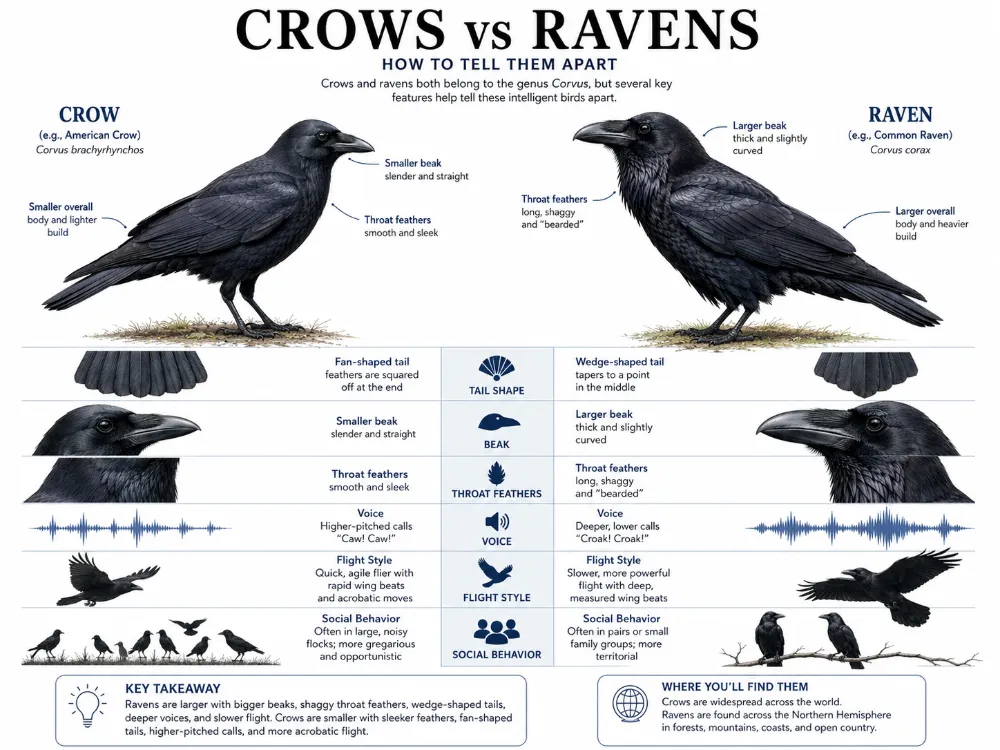
The easiest way to tell crows from ravens is to look at size, beak shape, tail shape, and voice. Ravens are usually larger, heavier-billed, shaggier around the throat, and more likely to give deep croaking calls. Crows are usually smaller, slimmer-billed, smoother-throated, and better known for sharp cawing sounds. Both are highly intelligent black birds in the corvid family, but they are not the same bird.
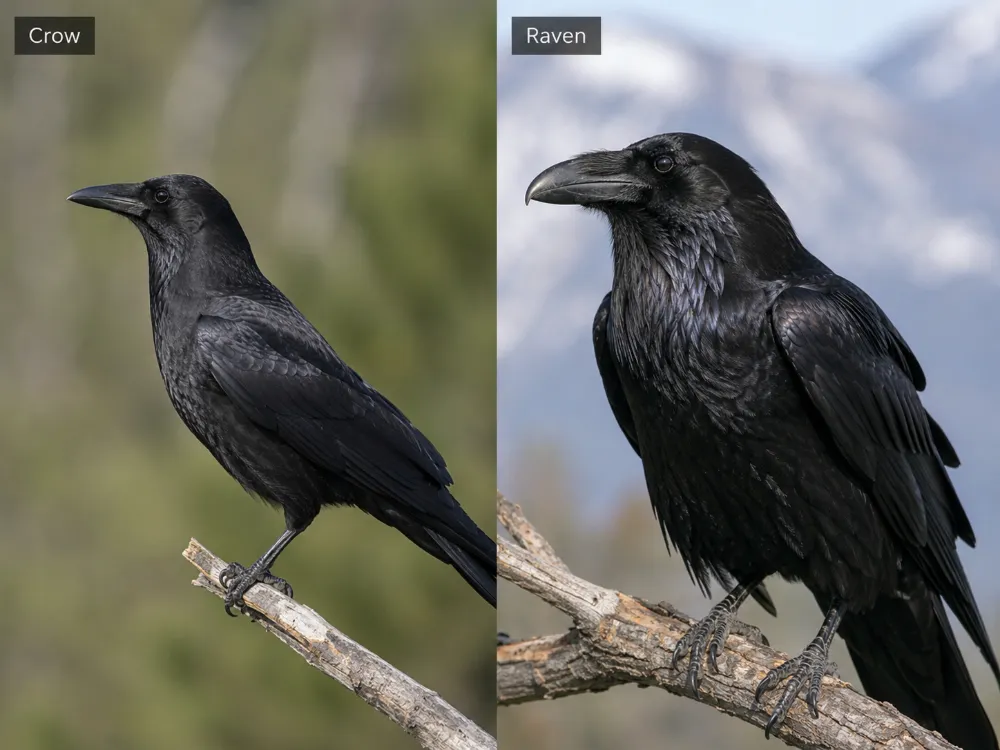
People confuse crows and ravens all the time because both are dark-feathered, clever, adaptable, and widely known from folklore, literature, and everyday life. From a distance, a lone black bird can be surprisingly hard to identify.
In this guide, you will learn how crows and ravens differ in appearance, voice, flight, behavior, habitat, and social life, plus the quickest ways to tell them apart in the field.
Quick comparison table
| Feature | Crow | Raven |
|---|---|---|
| Overall size | Smaller and slimmer | Larger and heavier |
| Beak | Smaller, straighter, less massive | Thicker, deeper, more powerful-looking |
| Throat feathers | Smoother | Often shaggy or loose-looking |
| Tail in flight | Fan-shaped | Wedge-shaped or diamond-like |
| Voice | Classic cawing call | Deeper croaks and guttural calls |
| Flight style | More regular flapping | More soaring, gliding, and playful aerial movement |
| Social pattern | Often seen in groups | Often seen alone or in pairs |
| Typical setting | Towns, suburbs, farms, parks, cities | Wilder country, mountains, coasts, open landscapes, though some also live near people |
They belong to the same bird family
Crows and ravens are both corvids, members of the family Corvidae. This family also includes magpies, jays, rooks, and jackdaws. Corvids are famous for intelligence, memory, problem-solving, and flexible behavior.
Because crows and ravens are close relatives, they share many traits. Both are mostly black, both are strong fliers, both can use tools or solve complex tasks in some settings, and both are highly observant birds that learn quickly from experience.
That close relationship is exactly why they can look so similar at first glance.
Ravens are usually much bigger
Size is often the first clue people notice. Ravens are usually larger, bulkier, and more powerful-looking than crows. A raven often feels heavy-bodied, long-winged, and more imposing overall.
Crows are still fairly large birds, but they usually look more compact and lighter. If you see the two side by side, the raven often looks closer to a hawk-sized bird, while the crow looks more moderate in scale.
When only one bird is present, size can be harder to judge, but a bird that seems unusually large for a black corvid is often a raven.
The beak is one of the best clues
Ravens usually have a much thicker and deeper beak. The bill often looks long, heavy, and slightly arched, giving the whole head a stronger profile.
Crows usually have a slimmer, straighter, and more refined beak. Their face often looks neater and less massive than a raven’s.
If the bird has a huge, rugged-looking bill that seems almost oversized, raven becomes the better guess.
Ravens often have shaggy throat feathers
Another strong clue is the throat. Ravens often show long, shaggy throat feathers, especially when they call. These feathers can make the neck area look rougher and more textured.
Crows usually have smoother throat feathers. Their neck and upper chest often look cleaner and less dramatic in outline.
This difference is especially useful in close views or clear photographs.
Tail shape matters in flight
If the bird is flying, the tail can be one of the most reliable identification marks. A crow usually shows a fan-shaped tail that spreads fairly evenly across the end.
A raven usually shows a more wedge-shaped or diamond-like tail. The center often appears longer, creating a pointed look rather than a broad fan.
Birdwatchers often rely on tail shape because size can be hard to judge in the air, but the tail often gives the answer quickly.
Their voices sound very different
Most people know a crow by its classic caw. Crow calls are often sharper, clearer, and more familiar in everyday urban or suburban life. They can be loud and repetitive, especially when several birds are calling together.
Ravens usually sound deeper, rougher, and more guttural. Their calls are often described as croaks, knocks, or hollow-sounding grunts rather than clean caws.
If the sound is deep and resonant, think raven. If it is sharper and more like the classic “caw-caw,” think crow.
Ravens often glide and soar more
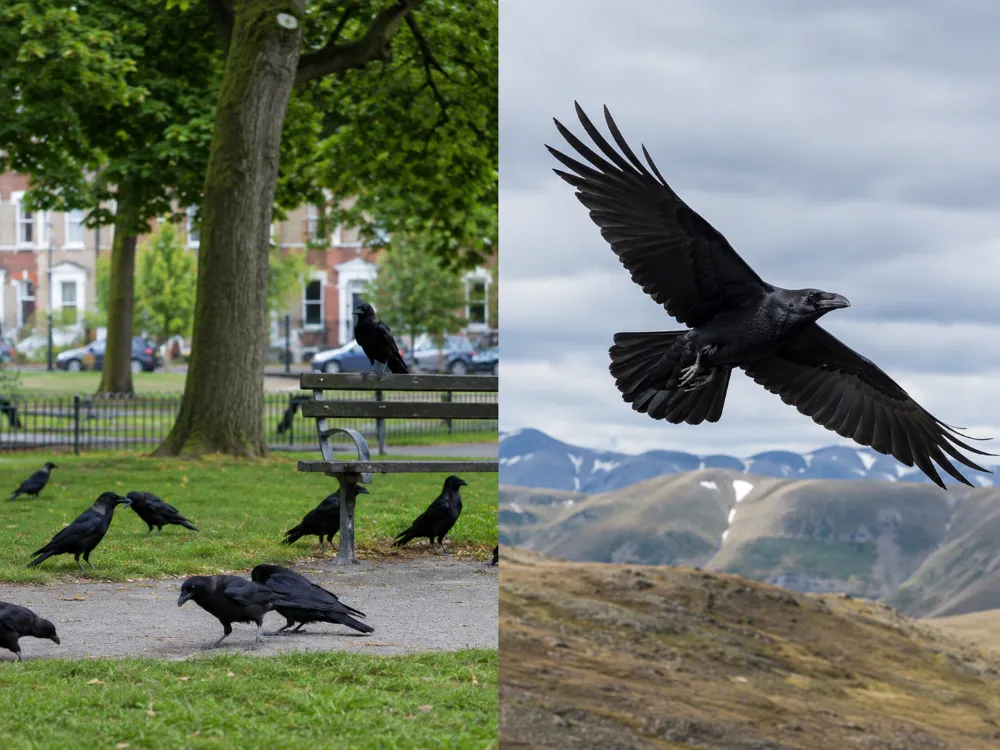
Ravens usually have a more dramatic flight style. They often glide, soar, and ride air currents more than crows do. In open country, ravens may look almost playful in the air, rolling, diving, or drifting on the wind.
Crows more often show steady flapping flight. They can glide too, but their movement usually feels more direct and less theatrical.
If the black bird overhead seems to be enjoying the sky, raven becomes a strong possibility.
Crows are often more social and more visible in groups
Crows are commonly seen in family groups, feeding groups, or larger gatherings. In many towns and cities, they are among the most visible social birds around people. They may gather on lawns, fields, rooftops, utility poles, or evening roosts in large numbers.
Ravens are often seen alone or in pairs, especially in open country. They can gather where food is abundant, but they often feel less group-bound in everyday sightings than crows do.
If you see several black birds together making a lot of noise, crow is often the better first guess.
Habitat can help
Crows are highly adaptable and thrive in cities, suburbs, farms, parks, school grounds, roadsides, and many other human-shaped environments. They are among the most successful birds around people.
Ravens are also adaptable, but they are often more strongly associated with open wilderness, mountains, cliffs, forests, coasts, and broad rural landscapes. In some places they do live near towns, but they often still feel more like birds of big country.
Habitat alone is never perfect, but it can support the other identification clues.
Ravens often seem bolder and more theatrical
Many birdwatchers describe ravens as dramatic birds. They may soar high, investigate unusual objects, make strange sounds, or behave in a way that seems almost playful. Their body language can feel confident and expressive.
Crows are also intelligent and curious, but they often seem busier, more practical, and more socially engaged in everyday settings. They may spend more time walking lawns, calling to flock members, or monitoring human activity from familiar places.
These are broad impressions rather than strict rules, but they help explain why ravens and crows feel different even when both are smart black corvids.
Both are extremely intelligent
Crows and ravens are among the smartest birds in the world. Both are capable of learning from experience, remembering human faces, solving problems, and adjusting behavior to new situations. This is one reason they appear so clever in both science and folklore.
Trying to decide which one is “smarter” is not very useful. Both are cognitively impressive, and each has evolved intelligence suited to its environment and social life.
The better conclusion is that both are exceptional corvids rather than one being clearly simple and the other clearly brilliant.
Why people confuse them so often
The confusion comes from a combination of shared black plumage, similar body plans, and quick sightings at a distance. Many people never get long, side-by-side views, so the details that separate the two are easy to miss.
Popular culture makes this worse by using crow and raven loosely in movies, stories, decorations, and online photos. A large black bird may be labeled as either one without much care.
Once you start checking size, bill, tail, voice, and social behavior, however, the difference becomes much easier to see.
How to tell them apart quickly
If you need a fast field guide, use these clues together:
Crow: smaller body, slimmer beak, smooth throat, fan-shaped tail, sharp cawing call, often seen in groups
Raven: larger body, heavier beak, shaggy throat, wedge-shaped tail, deep croaking call, often seen alone or in pairs
No single clue is perfect every time, but this combination is usually very reliable.
Which one is more common around people?
In many towns, suburbs, and cities, crows are more commonly noticed around people. They use lawns, roads, parks, trash areas, and roosting sites in very visible ways.
Ravens can also occur near people, especially in some regions, but they are often less urban in the public imagination and more strongly linked with larger open landscapes.
So if the question is which bird most people are likely to see every week in an ordinary neighborhood, the answer is often the crow.
Final takeaway
The main difference between crows and ravens is that ravens are usually larger, heavier-billed, deeper-voiced, and wedge-tailed, while crows are usually smaller, slimmer-billed, sharper-voiced, and fan-tailed. Ravens often feel more dramatic in flight and more solitary in behavior, while crows are often more social and more familiar around towns and suburbs. They are close relatives, but once you learn the key clues, they are much easier to tell apart.
FAQs
Is a raven bigger than a crow?
Yes. Ravens are usually larger and heavier than crows.
How can I tell a crow from a raven in flight?
Look at the tail. Crows usually have a fan-shaped tail, while ravens usually have a wedge-shaped tail.
Do crows and ravens sound the same?
No. Crows usually give sharper caws, while ravens usually make deeper croaks and guttural calls.
Are crows and ravens both intelligent?
Yes. Both are highly intelligent corvids known for memory, problem-solving, and adaptable behavior.