The short answer is that a gopher and a groundhog are not the same animal. A true gopher usually means a pocket gopher, a smaller burrowing rodent built for underground life, while a groundhog is a much larger marmot, also called a woodchuck, that spends more time above ground. Both dig burrows, but they belong to different rodent groups and live very different lifestyles.
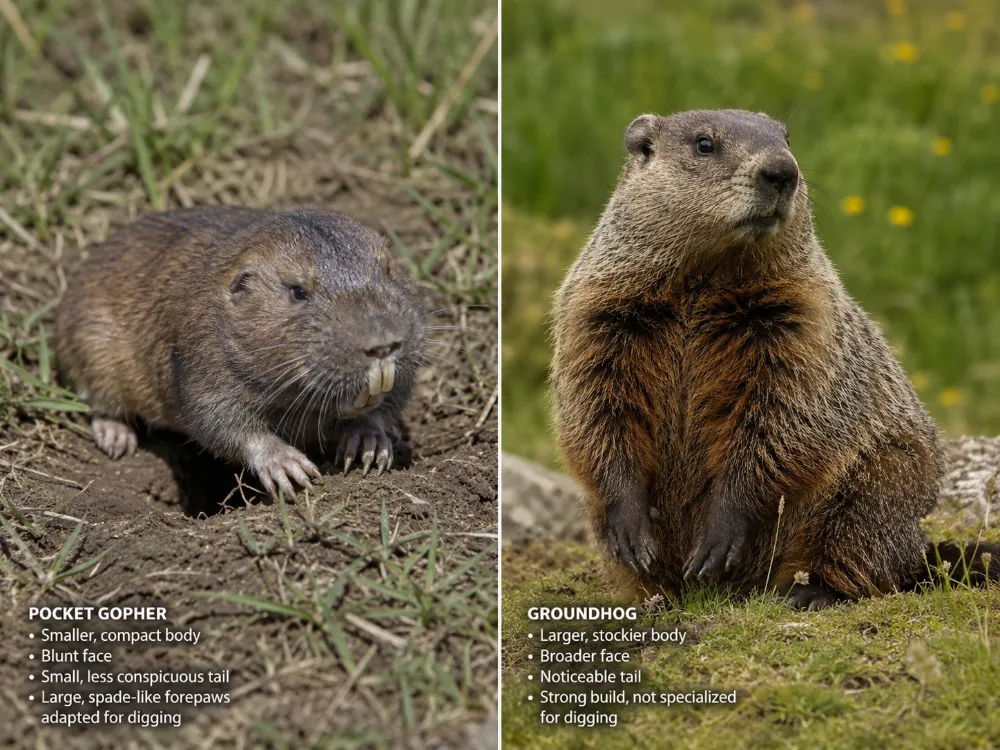
People often confuse gophers and groundhogs because both are stocky digging mammals that damage gardens, lawns, and fields. If all you notice is a hole in the yard or a brown animal near the ground, the difference may not seem obvious at first.
In this guide, you will learn how gophers and groundhogs differ in size, anatomy, habitat, diet, digging style, and behavior, plus the fastest ways to identify them correctly.
Quick comparison table
| Feature | Gopher | Groundhog |
|---|---|---|
| Main meaning | Usually a pocket gopher | A woodchuck, which is a type of marmot |
| Rodent group | Geomyidae | Squirrel family, Sciuridae |
| Body size | Smaller, more compact underground rodent | Larger, heavier, chunky marmot |
| Main lifestyle | Mostly underground | Burrow-based but often above ground |
| Cheek pouches | Yes, external fur-lined cheek pouches | No external cheek pouches |
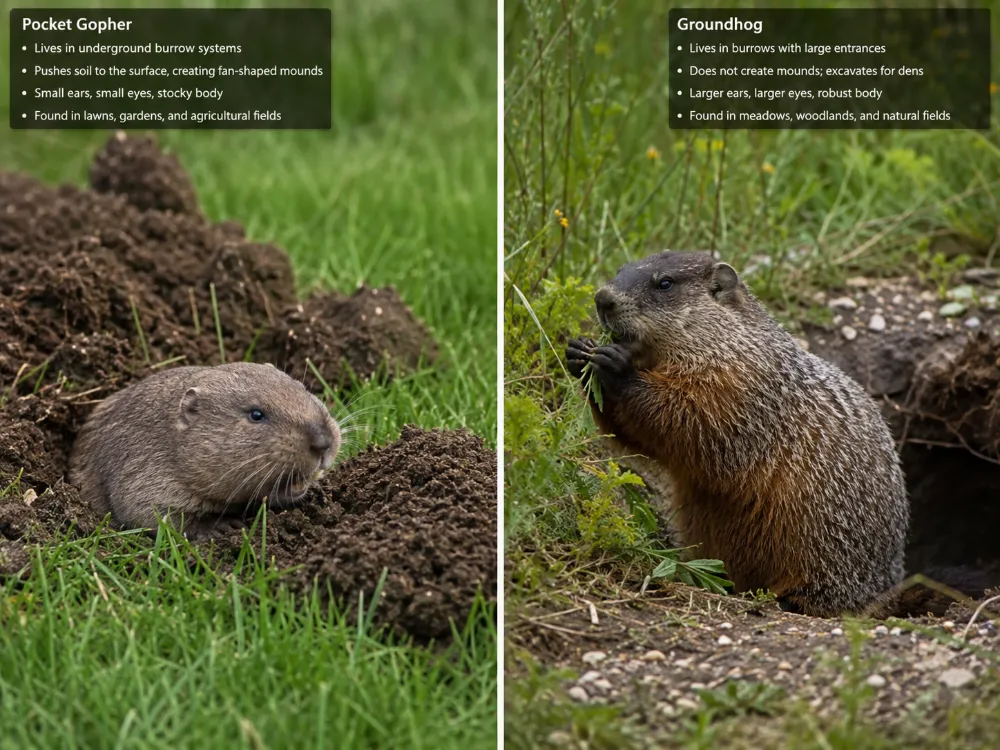
| Burrow sign | Fan-shaped or crescent soil mounds, plugged openings | Larger open burrow entrance, often with dirt pile nearby |
| Diet | Roots, tubers, underground plant parts, stems | Grasses, clover, leaves, crops, garden plants |
| Best quick clue | Smaller, rarely seen above ground, mound-maker | Much larger, often seen standing or feeding above ground |
They are different rodents, not two names for the same animal
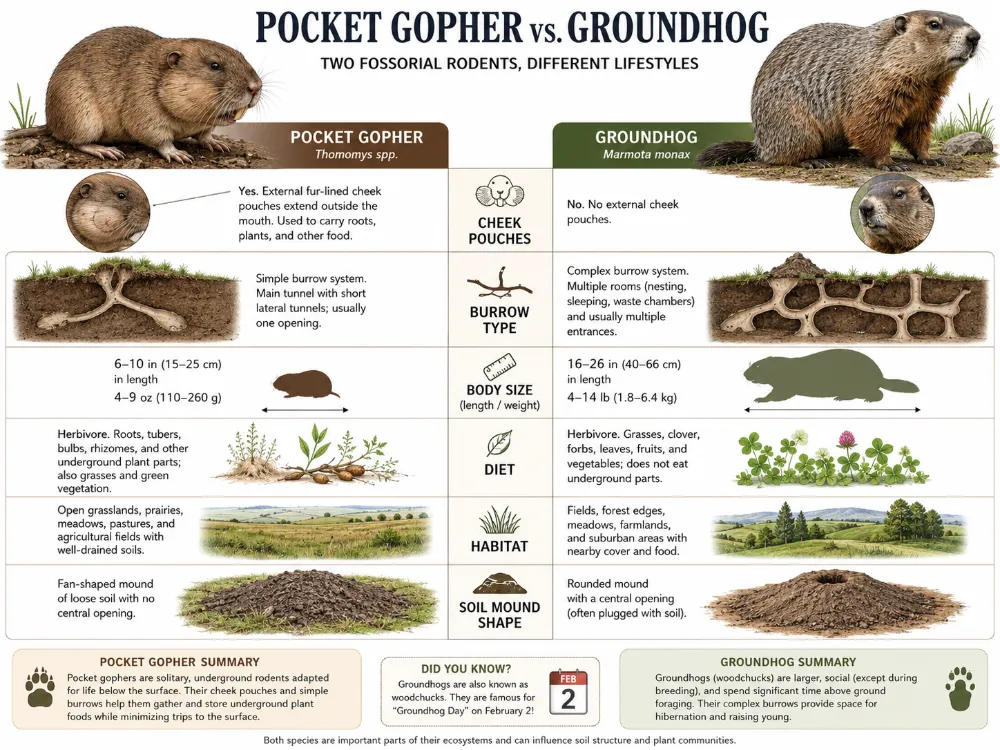
A gopher and a groundhog are both rodents, but they are not close lookalike versions of one species. A true gopher usually means a pocket gopher, which belongs to the family Geomyidae. A groundhog, also called a woodchuck, is the species Marmota monax, a member of the squirrel family.
This matters because it explains why they differ so much in body shape, behavior, and daily life. A pocket gopher is built for underground tunneling almost all the time. A groundhog is a large marmot that digs burrows but also spends a lot of time feeding and watching for danger above ground.
So even though both animals dig, they come from very different branches of the rodent world.
Groundhogs are much larger
One of the easiest differences is size. Groundhogs are usually much bigger than gophers. They have a chunky, heavy body, a broad head, and a thick neck and chest that give them a sturdy marmot shape.
Gophers are usually smaller and more compact. Their body is often shaped like a digging machine: short-necked, low to the ground, and designed for pushing through tunnels rather than standing in the open.
If the animal looks big enough to resemble a small, heavy-bodied ground squirrel or marmot, it is much more likely to be a groundhog than a gopher.
Gophers are built for underground life
True pocket gophers are specialized burrowers. Their body is shaped for tunneling, with powerful front limbs, strong claws, small eyes, and small external ears. They are not meant to spend long periods visible on the surface.
Many also have lips that can close behind the front teeth, which helps keep dirt out of the mouth while digging. This is a remarkable adaptation for a life spent pushing through soil.
A groundhog digs too, but it does not show the same extreme underground specialization as a pocket gopher.
Gophers have cheek pouches, groundhogs do not
This is one of the most important anatomical differences. Pocket gophers have external fur-lined cheek pouches used for carrying food and nesting material. These pouches are one of the defining features of the group.
Groundhogs do not have these external cheek pouches. As marmots, they belong to a different rodent family with a different body design and feeding style.
If you could examine the animal closely, the presence or absence of those cheek pouches would immediately separate a true gopher from a groundhog.
Groundhogs spend much more time above ground
Groundhogs are often seen in fields, along fence lines, near gardens, beside roads, or at the edge of woods. They come above ground regularly to feed, bask, and watch for danger. Many people recognize the classic groundhog posture of standing upright to scan the surroundings.
Gophers are much more secretive. In many cases, people notice their mounds and plant damage far more often than they ever see the animal itself. A gopher may spend most of its life underground and only rarely appear above the surface.
If you are regularly seeing the animal out in the open, especially in daylight, groundhog is usually the better guess.
The burrows look different
The signs around the burrow are often more useful than the animal itself. Pocket gophers typically leave fan-shaped or crescent-shaped mounds of fresh soil, and the actual tunnel opening may be plugged or offset from the mound. This is a classic gopher sign in lawns and fields.
Groundhogs usually create a larger, more obvious burrow entrance. The opening is often visible and may have a substantial dirt pile nearby. Because groundhogs move in and out above ground more often, their entrance usually looks more like an open tunnel than a plugged system.
If you see many low soil mounds with no obvious open hole, think gopher. If you see one big open burrow under a shed, tree, or fence line, think groundhog.
Groundhogs look more like large ground squirrels
Groundhogs are marmots, which places them within the squirrel family. That relationship helps explain their body shape. Even though they are much chunkier than tree squirrels, they still have a certain squirrel-like face and general marmot build.
Gophers do not look squirrel-like in the same way. Their body is more tube-shaped, their head often looks more tucked in, and their whole form seems more specialized for dirt and tunnels than for open-ground movement.
This is why a groundhog often feels like a large, heavy ground squirrel, while a gopher feels like a hidden underground rodent.
The tail is different too
Groundhogs usually have a short but clearly visible furry tail. It is not especially long, but it looks like a normal mammal tail covered in fur.
Gophers usually have a shorter, less showy tail that can look more sparsely haired and more functional than decorative. In some species, the tail also helps with feeling tunnel walls and moving backward underground.
If the tail looks obviously furry and part of a chunky above-ground body, groundhog becomes more likely.
Diet is not exactly the same
Both animals eat plants, but they often feed in different ways. Pocket gophers commonly eat roots, tubers, bulbs, underground stems, and lower plant parts. Because they live underground, they often feed from below and may pull plants down into tunnels.
Groundhogs usually feed above ground on grasses, clover, leaves, herbs, bark, crops, and garden plants. They are well known for browsing openly in vegetable patches and field edges.
So if plants seem clipped and eaten from above, groundhog may be involved. If roots are disappearing and plants collapse from below, gopher becomes more likely.
Groundhogs are famous for hibernation
Groundhogs are well known as true hibernators in colder parts of their range. They build up fat, retreat to burrows, and remain dormant for long winter periods. This seasonal pattern is one reason groundhogs became culturally famous in North America.
Pocket gophers are not famous for true hibernation in the same way. Many remain active underground through much of the year, protected by soil from extreme surface conditions.
This difference reflects their lifestyles. A surface-feeding marmot responds differently to winter than a deeply burrowing root-eater does.
Groundhogs are easier to spot in daylight
Because groundhogs spend so much time foraging above ground, they are much easier for people to notice. A groundhog may sit upright near its burrow, chew on plants, or run for cover when disturbed.
Gophers are much less visible. Their presence is usually discovered through damage patterns, fresh soil mounds, and disturbed plants rather than through direct observation.
This is why many people know exactly what a groundhog looks like but may never have seen a true pocket gopher clearly.
Range and language can cause confusion
The confusion gets worse because the word gopher is used loosely in some regions. In casual speech, people sometimes call other small burrowing rodents “gophers,” even when they are not true pocket gophers. That blurs the comparison even more.
Groundhog, by contrast, is more specific. It usually means the woodchuck, the North American marmot species. So the term groundhog is often clearer than the term gopher in everyday conversation.
For scientific accuracy, however, the real comparison is pocket gopher versus groundhog.
Why they damage yards differently
Gophers damage lawns and gardens mainly through tunneling, root feeding, and soil mounds. Their activity can kill plants from below, disrupt irrigation, and create uneven ground.
Groundhogs damage yards and gardens mainly by eating plants above ground and digging large burrows in inconvenient places such as under sheds, decks, walls, and garden edges. Their damage is often more visible because the animal itself is active above the surface.
This difference matters for identification. The kind of damage often tells you which animal is involved even when you never see it directly.
Why people confuse them so often
People confuse gophers and groundhogs because both are stocky brown rodents that dig and live low to the ground. If someone only knows “there is a burrowing animal in my yard,” the names easily get mixed up.
The confusion is also cultural. Some people use gopher loosely for almost any burrowing rodent, while others know groundhog mainly from folklore and not from natural history. That makes the words feel more interchangeable than they really are.
Once you focus on size, above-ground activity, and burrow style, the distinction becomes much clearer.
How to tell them apart quickly
If you need a fast field guide, use these clues together:
Gopher: smaller, rarely seen above ground, fan-shaped soil mounds, plugged tunnels, root-feeding underground rodent
Groundhog: larger, often seen feeding above ground, big open burrow entrance, chunky marmot body, common around fields and gardens
No single clue is perfect every time, but this combination usually works very well.
Which one is more likely in a garden?
Both can appear in gardens, but they usually cause different problems. Groundhogs are more likely to be seen eating leaves, stems, and vegetables directly. Gophers are more likely to damage roots and create mounds and collapsing soil.
If the gardener keeps seeing a big brown animal near the lettuce, beans, or fence line, groundhog is a strong possibility. If plants suddenly wilt and the yard fills with fresh mounds, gopher becomes more likely.
So the better question is not which one enters gardens, but what type of damage is happening.
Final takeaway
The main difference between a gopher and a groundhog is that a true gopher is a smaller pocket gopher specialized for underground life, while a groundhog is a much larger above-ground marmot, also called a woodchuck. Gophers are mostly hidden burrowers with cheek pouches, fan-shaped soil mounds, and root-based feeding. Groundhogs are large, visible plant-eaters with open burrow entrances, chunky bodies, and a much stronger presence above ground. They may both dig, but they are very different rodents.
FAQs
Is a groundhog the same as a gopher?
No. A groundhog is a woodchuck, which is a type of marmot, while a true gopher is usually a pocket gopher.
How can I tell a gopher from a groundhog fast?
Look at size and burrow signs. Groundhogs are much larger and often seen above ground, while gophers are smaller and usually known mainly from fan-shaped soil mounds.
Which one makes dirt mounds in the yard?
Pocket gophers are especially famous for making fresh fan-shaped dirt mounds, while groundhogs usually leave larger open burrow entrances with a dirt pile nearby.
Do groundhogs and gophers eat the same things?
Not exactly. Gophers often eat roots and underground plant parts, while groundhogs more often eat grasses, leaves, and garden plants above ground.