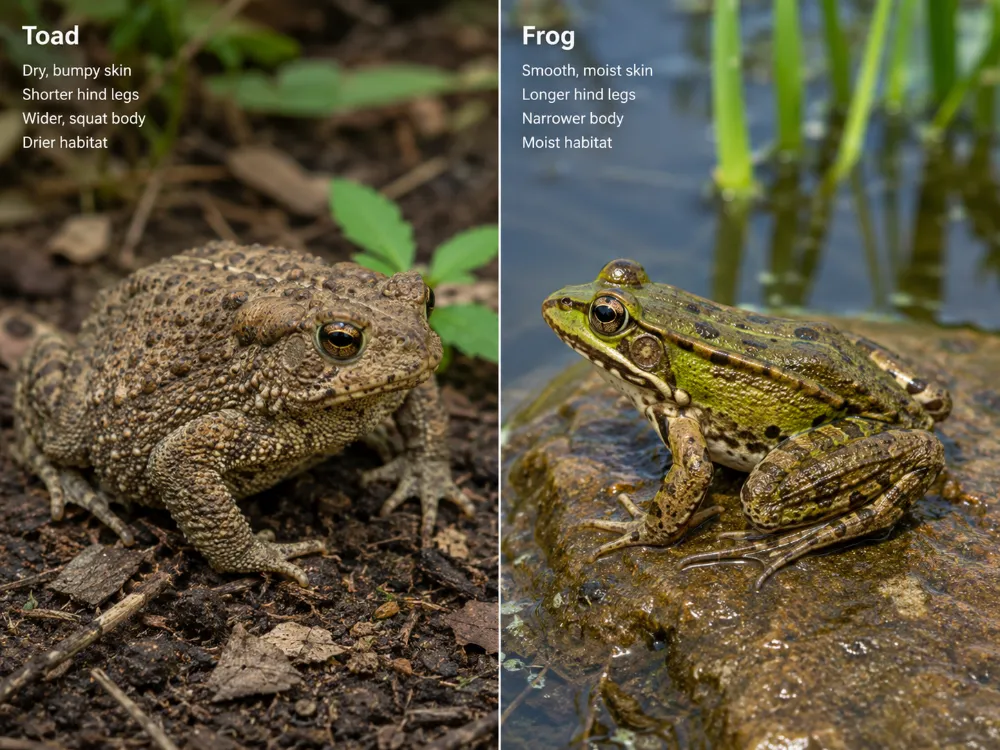
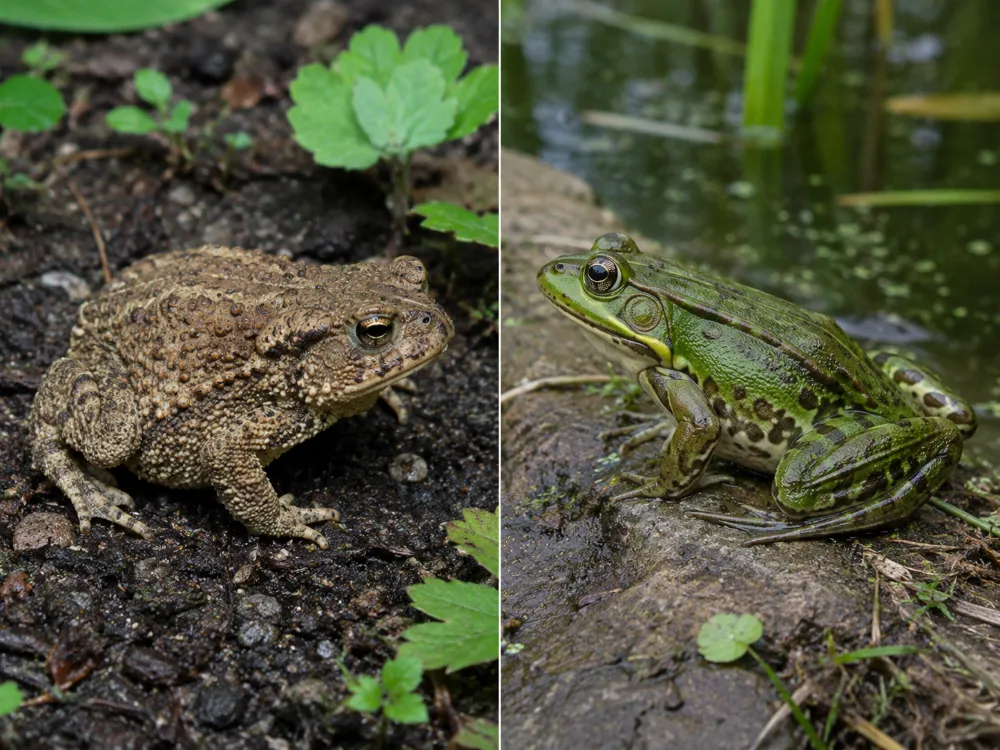
The short answer is that toads are a type of frog, but not all frogs are toads. In everyday use, toads usually have drier, bumpier skin, shorter legs, and a more squat body, while frogs usually have smoother, moister skin, longer legs, and stronger jumping ability. Toads also tend to spend more time on land. The difference is real in appearance and lifestyle, but scientifically the line is not always perfectly sharp.
People often talk about frogs and toads as if they are two completely separate animal groups. In practice, they are closely related amphibians, and “frog” is the broader term. Many animals called toads belong to the true toad family, but common names do not always match scientific classification perfectly.
In this guide, you will learn how frogs and toads differ in body shape, skin, movement, breeding, habitat, and behavior, plus the quickest ways to tell them apart in the wild.
Quick comparison table
| Feature | Toad | Frog |
|---|---|---|
| Basic meaning | Usually a sturdier, more land-adapted frog, often from the true toad family | Broader term covering many tailless amphibians |
| Skin | Drier, thicker, bumpier | Smoother, moister, often more slippery-looking |
| Body shape | Shorter, rounder, more squat | Slimmer, longer-bodied in many species |
| Legs | Usually shorter | Usually longer, especially the hind legs |
| Movement | More likely to walk, crawl, or make short hops | More likely to leap strongly |
| Habitat style | Often more comfortable on land away from water for part of life | Often more closely tied to moist habitats or water |
| Eggs | Often laid in long strings | Often laid in clusters or masses |
| Best quick clue | Bumpy skin and squat body | Smooth skin and long jumping legs |
Frogs and toads are both amphibians
Frogs and toads are both amphibians, which means they belong to a group of animals that usually begin life in water and later live partly or mostly on land. Like other amphibians, they have moist-sensitive skin, lay eggs without hard shells, and depend strongly on environmental conditions such as water, temperature, and humidity.
They also belong to the same broad amphibian order, the tailless amphibians. That is why they share so many features: powerful hind legs, protruding eyes, no tail as adults, and a life cycle that usually includes a tadpole stage.
So the first thing to understand is that a toad is not the opposite of a frog. A toad is a kind of frog in the broader biological sense.
Why the difference is real but not perfectly strict
In everyday language, the frog-toad difference is useful and usually easy enough to understand. However, science is a bit messier. Many animals called toads belong to the true toad family, but not every animal with “toad” in its name fits the same pattern perfectly, and not every frog that looks toad-like is called a toad.
This happens because common names developed from appearance and habit, not always from strict taxonomy. People saw squat, dry-skinned amphibians on land and called them toads. They saw smoother, wetter, long-legged jumpers near ponds and called them frogs.
So the distinction is practical and meaningful, but it is not as absolute as something like cat versus dog.
Skin is one of the easiest clues
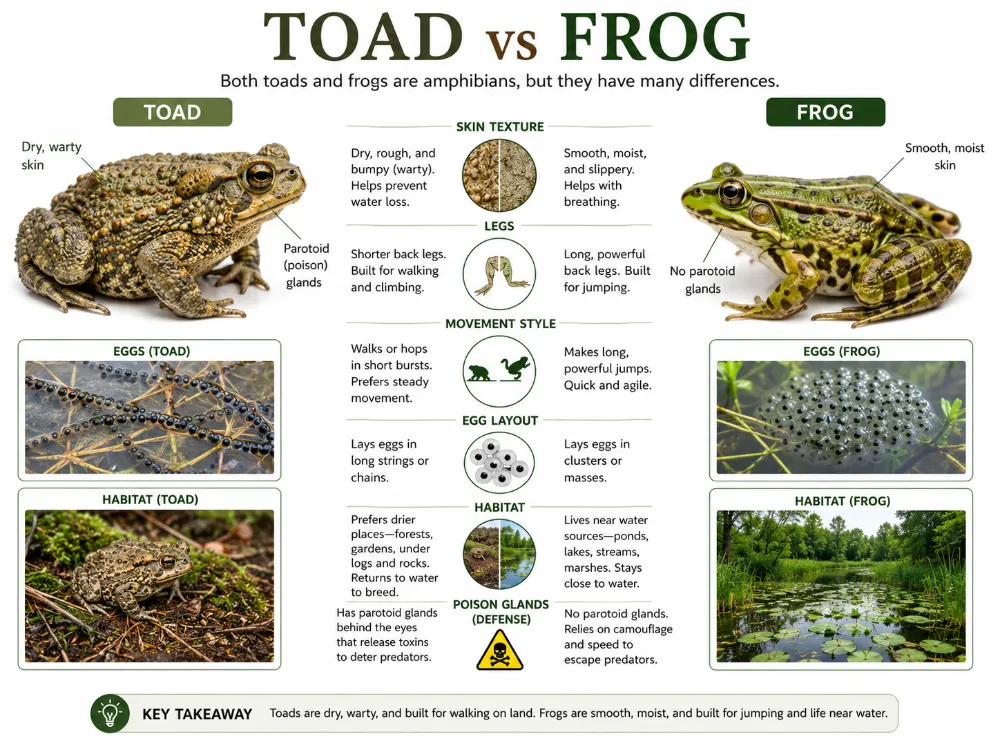
One of the most famous differences is the skin. Toads usually have thicker, drier-looking, bumpier skin. The bumps do not mean they are diseased or dangerous to touch, but they do give the animal a rougher appearance.
Frogs usually have smoother, moister skin. In many species, the skin looks almost shiny or soft, especially when the animal is fresh from water or damp vegetation.
This skin difference reflects lifestyle. A toad that spends more time on land needs skin that resists drying better, while many frogs stay more closely connected to water or humid habitats.
Toads are usually more squat and sturdy
Toads often look rounder, lower, and heavier for their size. Their body tends to appear compact, with a broad torso and a more grounded posture. When sitting still, they often look like little earth-colored lumps built for patience rather than speed.
Frogs are often slimmer and more streamlined. Many have a more elongated body shape that fits their stronger jumping style and closer tie to wet environments.
If the animal looks compact and chunky, toad becomes more likely. If it looks sleek and spring-loaded, frog becomes more likely.
Leg length is another strong clue
Frogs usually have longer hind legs, especially in relation to body size. These long legs give them strong leaping power and help them swim efficiently in water.
Toads usually have shorter hind legs. They can still hop, but their movement is often less dramatic. Many toads look like they are built more for short hops, steady crawling, or shuffling movement than for long leaps.
This is one reason frogs often seem more explosive in motion, while toads often seem more deliberate.
Frogs usually jump farther
Because frogs usually have longer hind legs, they often escape danger with quick, powerful leaps. A frog startled at the edge of a pond may spring away in a sudden burst and vanish into water or vegetation.
Toads more often make shorter hops or walk away in a slower, more grounded way. They are not clumsy, but they usually do not launch themselves with the same long-distance leap style seen in many frogs.
If the animal reacts with one or two big springing jumps, frog is often the stronger guess. If it hops in shorter bursts or simply moves off more steadily, toad becomes more likely.
Toads often spend more time on land
Many toads are more comfortable in terrestrial settings than many typical frogs are. They may live in gardens, woodland edges, fields, and other land habitats, returning to water mainly for breeding rather than for daily life.
Many frogs are more strongly tied to ponds, marshes, streams, wet grass, reeds, and damp vegetation. Even land-dwelling frogs often depend more obviously on moisture.
This does not mean every frog lives in water or every toad lives far from it. It means toads as a general type are usually better adapted for drier land conditions.
Eggs are often arranged differently
Another classic difference appears during breeding. Many toads lay eggs in long jelly-like strings, sometimes wrapped around plants or lying in shallow water.
Many frogs lay eggs in clumps, masses, or floating groups instead of long strings. Frog egg masses can look like jelly clusters with many black centers.
This is not a universal rule for every species on Earth, but it is a very helpful pattern in many familiar frogs and toads.
Tadpoles can differ too
Frog and toad tadpoles can also show differences, although these are often harder for beginners to use confidently. In general, toad tadpoles are often darker and smaller in many familiar species, while frog tadpoles may vary more in size and appearance depending on the species.
However, tadpole identification is much trickier than adult identification. Habitat, timing, and local species matter a lot. Most people will find skin, legs, and body shape easier clues than tadpole details.
So tadpoles can help, but they are rarely the fastest answer for non-specialists.
Toads often have noticeable poison glands
Many true toads have prominent glands behind the eyes called parotoid glands. These glands produce defensive chemicals that help discourage predators. In many toads, they show up as obvious swollen areas behind the head.
Frogs can also produce skin secretions, but the large parotoid gland look is especially associated with true toads. This is one reason toads often look a little more rugged and “armored” in the head and shoulder region.
If you see a squat amphibian with large gland-like bulges behind the eyes, it is very likely a toad.
Touching a toad does not give you warts
This is one of the most common myths. Touching a toad does not cause warts. Human warts are caused by viruses, not by contact with amphibian skin.
The myth probably grew because toads already have bumpy skin, and people connected those bumps with human skin growths. In reality, the bumps are normal body features of the toad.
That said, it is still best not to handle frogs or toads unnecessarily. Their skin is sensitive, and oils, lotions, or chemicals on human hands can harm them.
Frogs are often greener or brighter, but color can mislead
Many people associate frogs with green skin and toads with brown skin. That pattern is common enough to be useful sometimes, but it is not a perfect rule. Some frogs are brown, gray, red, yellow, or patterned, and some toads can be surprisingly colorful too.
Color depends heavily on species, environment, camouflage needs, and even moisture. This means color can support identification, but it should never be your only clue.
Body texture and leg shape are usually much more reliable than color alone.
Both frogs and toads need water to reproduce
Even though toads are often more land-adapted, both frogs and toads usually return to water to breed. Eggs and tadpoles typically require aquatic environments, at least in the early life stages.
This is one reason amphibians are so sensitive to environmental change. A species may spend much of the adult stage on land but still depend completely on ponds, wetlands, or seasonal pools for reproduction.
So while toads may seem like dry-land animals, they are still amphibians with a life cycle tied to water.
Why frogs and toads matter in the ecosystem
Both frogs and toads are important predators of insects and other small invertebrates. They help regulate populations of flies, mosquitoes, beetles, slugs, and many other small animals. In turn, they also serve as food for snakes, birds, mammals, fish, and larger predators.
Because their skin is sensitive and their life cycle depends on both water and land, frogs and toads are also useful indicators of environmental health. When amphibian populations decline, it can signal problems such as pollution, habitat loss, or disease pressure.
So the frog-versus-toad question is not just about appearance. It also connects to larger ecological ideas.
Why people confuse them so often
People confuse toads and frogs because they are so closely related and because many species fall somewhere between the extreme textbook images. A beginner imagines a green pond frog and a brown warty toad, but real nature includes many forms that are less obvious.
The confusion is also reinforced by language. Since toads are a kind of frog in the broad biological sense, people sometimes hear conflicting statements that seem contradictory until the broader relationship is explained.
Once you focus on skin texture, leg length, body shape, and lifestyle, the difference becomes much easier to understand.
How to tell them apart quickly
If you need a fast field guide, use these clues together:
Toad: drier bumpy skin, squat body, shorter legs, more walking or short hopping, often more land-based
Frog: smoother moister skin, slimmer body, longer legs, strong jumping, often more closely tied to water
No single clue is perfect for every species, but this combination works very well in many common situations.
Which one is “better” for a garden?
Both can be beneficial because both eat insects and other small invertebrates. Toads are especially appreciated in gardens because they often spend time on land hunting slugs, beetles, ants, and other small pests at ground level.
Frogs can also be very helpful, especially in wet gardens, pond edges, and damp habitats where they hunt insects and other prey. The better question is not which one is better, but whether the garden offers safe habitat for amphibians at all.
A healthy garden with shelter, moisture, and no heavy chemical use can support both.
Final takeaway
The main difference between a toad and a frog is that toads are usually more land-adapted frogs with drier, bumpier skin, shorter legs, and a squat body, while frogs usually have smoother skin, longer legs, and stronger jumping ability. Toads often spend more time on land, while many frogs stay more closely tied to wet habitats. The line is not perfectly strict in every species, but once you know the key clues, telling them apart becomes much easier.
FAQs
Is a toad a frog?
Yes. In the broad biological sense, a toad is a type of frog.
How can I tell a toad from a frog fast?
Look at the skin and legs. A toad usually has bumpy skin and shorter legs, while a frog usually has smoother skin and longer jumping legs.
Do toads cause warts?
No. Touching a toad does not cause warts.
Which lays eggs in strings, frogs or toads?
Toads often lay eggs in long strings, while many frogs lay eggs in clumps or masses.