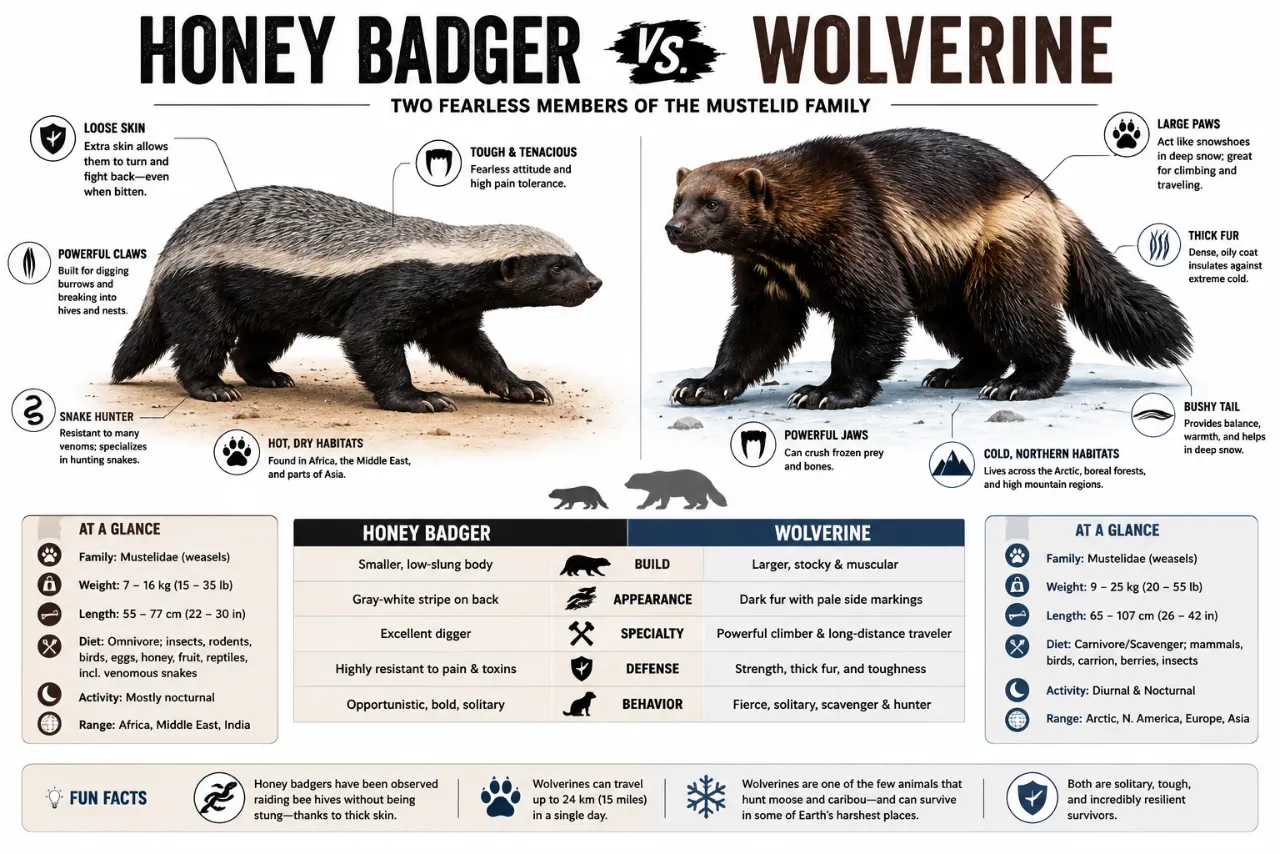
Honey badgers and wolverines are both tough, fearless mammals in the mustelid family, but they are not the same animal. The honey badger is a smaller, heat-adapted African and Asian predator famous for loose skin, snake-hunting, and defensive aggression. The wolverine is a larger, cold-adapted northern scavenger-predator with powerful jaws, large paws, and snow-country endurance. In a direct physical comparison, the wolverine usually has the size and strength advantage.
Honey Badger vs Wolverine Quick Answer
The main difference is environment and body design. Honey badgers are compact, low-bodied mustelids built for digging, raiding nests, resisting attacks, and surviving in hot dry landscapes. Wolverines are larger, heavier, and built for cold forests, mountains, tundra, snow travel, carcass scavenging, and taking advantage of large prey remains. Both are famously tough, but the wolverine is generally the more powerful animal, while the honey badger is more specialized for heat, digging, snake predation, and close-range defense.
Honey Badger vs Wolverine Summary Table
| Feature | Honey Badger | Wolverine |
|---|---|---|
| Scientific name | Mellivora capensis | Gulo gulo |
| Family | Mustelidae | Mustelidae |
| Other name | Ratel | Glutton, carcajou in some regions |
| Native range | Africa, Middle East, parts of South Asia | Northern North America, northern Europe, Russia, boreal and tundra regions |
| Typical habitat | Savannas, dry woodlands, scrublands, grasslands, deserts, rocky areas | Boreal forests, tundra, mountains, snowy wilderness, subarctic regions |
| Typical adult weight | Usually about 6–16 kg, males larger than females | Often about 9–25 kg, males usually larger and heavier |
| Body shape | Low, compact, broad-headed, thick-skinned | Stocky, powerful, bear-like mustelid with large paws |
| Main weapons | Strong jaws, sharp claws, loose skin, scent glands, bold defense | Powerful jaws, strong claws, large paws, stamina, heavy body |
| Diet | Omnivorous predator: insects, reptiles, snakes, birds, eggs, small mammals, honey, carrion | Omnivorous predator-scavenger: carrion, small mammals, birds, eggs, berries, roots, sometimes larger prey |
| Famous trait | Fearlessness, snake hunting, thick loose skin | Strength for size, snow travel, powerful scavenging ability |
| Social behavior | Mostly solitary | Mostly solitary |
| Best advantage | Defensive toughness, agility, digging, heat tolerance | Size, strength, cold endurance, jaw power, snow mobility |
| Quick identification clue | Black body with gray-white back stripe, low body, African or Asian habitat | Dark shaggy body with pale side markings, bushy tail, northern snowy habitat |
What Is a Honey Badger?
The honey badger, also called the ratel, is a tough mustelid found across much of Africa and parts of Southwest and South Asia. Despite the name “badger,” it is not the same as the European badger or American badger. It belongs to its own mustelid lineage and is famous for its bold behavior, strong bite, digging ability, and remarkable defensive confidence.
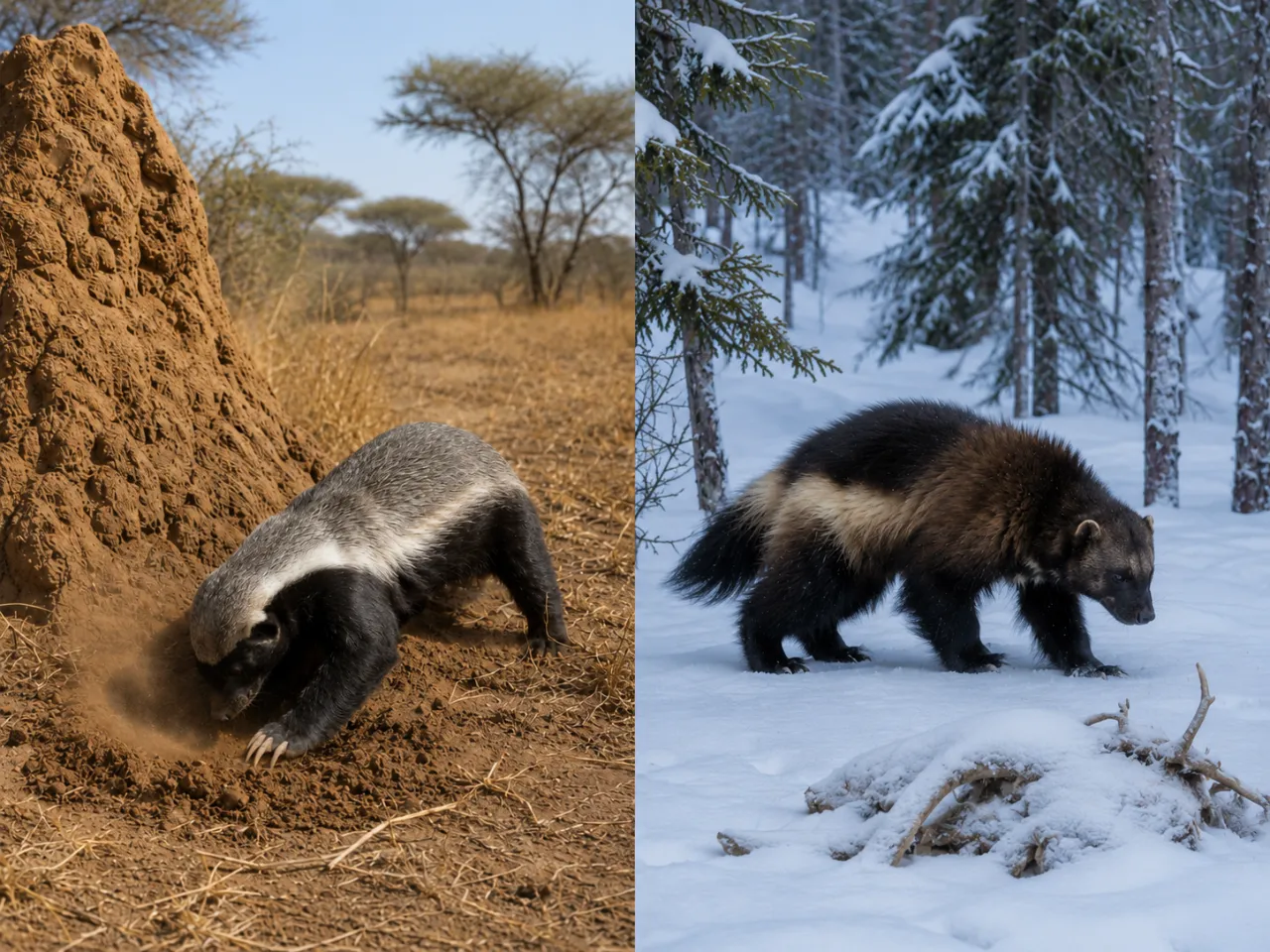
Honey badgers have a low, muscular body, short legs, strong claws, a broad head, and a distinctive coat pattern. Most have a black underside and a grayish-white mantle running across the head, back, and tail. This bold contrast may act as a warning signal to predators.
They are opportunistic feeders. Honey badgers eat insects, scorpions, snakes, lizards, birds, eggs, rodents, small mammals, roots, fruit, honey, bee larvae, and carrion. They are especially famous for raiding beehives and attacking venomous snakes, although they are not magically immune to all danger. Their toughness comes from behavior, anatomy, and some resistance to venom, not invincibility.
What Is a Wolverine?
The wolverine is the largest land-dwelling mustelid. It lives in cold northern regions, including boreal forests, tundra, mountains, and remote snowy landscapes. Although it looks somewhat like a small bear, it is more closely related to weasels, martens, badgers, otters, and honey badgers.
Wolverines have thick fur, powerful limbs, large paws, a strong neck, a broad head, and extremely strong jaws for their size. Their large feet help them move across snow, and their dense coat protects them from harsh winter conditions. They are built for endurance, scavenging, digging into frozen carcasses, and covering large territories.
Wolverines eat carrion, small mammals, birds, eggs, insects, berries, roots, and sometimes live prey. In winter, they may rely heavily on carcasses left by wolves, bears, avalanches, starvation, or hunting events. Their jaws can crush frozen meat and bone, making them highly successful in cold environments where food is locked in ice and snow.
Quick Visual Difference
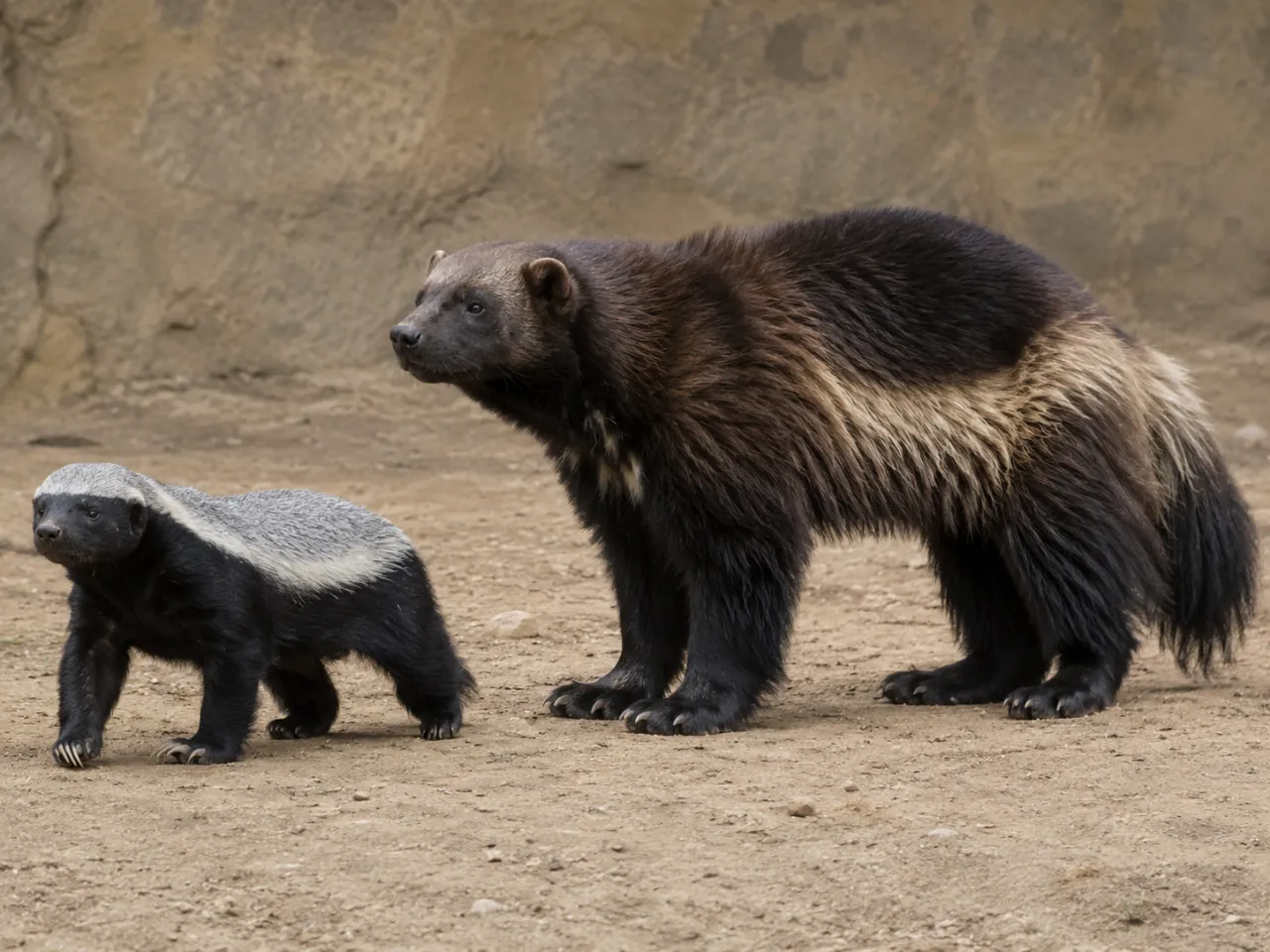
The easiest way to tell them apart is by body shape, coat pattern, and habitat. A honey badger is lower to the ground, shorter-legged, and has a clear black-and-gray body pattern. A wolverine is larger, shaggier, more bear-like, and usually has a dark coat with lighter side stripes or patches.
Honey badger: low body, gray-white back, black underside, short tail, hot-country habitat.
Wolverine: larger body, shaggy dark fur, pale side markings, bushy tail, cold northern habitat.
Honey badger: looks like a compact digging predator.
Wolverine: looks like a small bear-weasel built for snow and carcasses.
Size and Weight Comparison
Wolverines are usually larger and heavier than honey badgers. Adult honey badgers are powerful for their size, but they are still relatively compact animals. Males are larger than females, and body size varies by region and food supply.
Wolverines are generally heavier, especially adult males. A large male wolverine may be substantially more massive than a typical honey badger. This weight difference matters because body mass affects pushing power, bite leverage, grappling strength, and durability in physical conflict.
In simple terms, the honey badger is a compact lightweight fighter, while the wolverine is a heavier cold-country powerhouse.
Body Shape and Strength
The honey badger has a low, wide, muscular body designed for digging, squeezing into holes, raiding burrows, and resisting attacks. Its body is close to the ground, making it difficult for predators to flip or grab easily. Its loose skin allows it to twist and bite even when held.
The wolverine has a stockier, taller, more powerful frame. Its limbs are strong, its paws are large, and its neck and jaws are heavily built. Wolverines can travel long distances through snow, dig into dens or carcasses, and drag or defend food with impressive force.
Both animals are strong, but their strength is used differently. Honey badgers rely on compact defense, digging, and close-range toughness. Wolverines rely more on total body power, jaw strength, endurance, and cold-environment mobility.
Claws and Digging Ability
Honey badgers have strong front claws that are excellent for digging. They can dig into soil, break open termite mounds, raid burrows, and reach hidden prey. Digging is central to their survival strategy, especially in dry environments where food is often underground or protected.
Wolverines also dig well, but their digging is often linked to snow, dens, and frozen food. They may dig through snow to reach stored carcasses, locate prey, or create dens. Their claws are strong, and their paws are broad enough to help them move across snowy terrain.
The honey badger is more specialized for hard-ground digging and burrow raiding. The wolverine is more specialized for snow travel, frozen food access, and cold-country foraging.
Bite Force and Jaw Power
Both honey badgers and wolverines have powerful jaws for their size. Honey badgers can bite hard enough to kill small prey, break into tough food sources, and defend themselves against larger animals. Their bite is part of their fearless reputation.
Wolverines are especially famous for jaw strength. Their skull, teeth, and jaw muscles allow them to feed on frozen meat, crack bones, and tear through tough carcass material. This is a major advantage in northern winter environments.
Exact bite-force numbers found online are often unreliable, so they should be treated cautiously. Anatomically, however, the wolverine generally has the stronger crushing and carcass-processing bite, while the honey badger has a dangerous defensive bite combined with agility and loose skin.
Loose Skin vs Thick Fur
The honey badger’s loose skin is one of its most important defensive adaptations. If a predator grabs it, the honey badger can twist inside its skin and bite back. This makes it difficult to hold securely. Its skin is also thick, especially around the neck and back.
The wolverine does not have the same loose-skin defense, but it has thick fur and a rugged body adapted to cold. Its coat helps protect it from freezing temperatures and harsh weather. Its body is built for long-distance movement and durability rather than skin-twisting defense.
The honey badger is harder to hold. The wolverine is harder to overpower.
Habitat and Range
Honey badgers live in warm and often dry environments. They can be found in savannas, deserts, scrublands, rocky hills, grasslands, dry woodlands, and open landscapes. They avoid dense tropical forest in many areas but are otherwise highly adaptable.
Wolverines live in cold northern habitats. They are associated with boreal forests, alpine mountains, tundra, and snowy wilderness. They need large territories and are strongly linked to deep snow in many parts of their range, especially for denning.
These animals would almost never meet naturally. Honey badgers are heat-adapted Afro-Asian mustelids. Wolverines are cold-adapted northern mustelids.
Diet and Hunting Style
Honey badgers are opportunistic omnivores with strong predatory habits. They raid nests, dig out rodents, tear open logs, break into beehives, and attack reptiles. They are well known for killing snakes, including venomous species. They also eat fruit, roots, insects, carrion, and many small animals.
Wolverines are also opportunistic, but they are more strongly associated with scavenging large carcasses, especially in winter. They may hunt small mammals such as rodents, hares, and marmots, and they can sometimes take larger animals when conditions favor them. They also cache food, storing meat for later use.
The honey badger is a raider and close-range predator. The wolverine is a scavenger-predator and cold-season survival specialist.
Snake Hunting and Venom Resistance
Honey badgers are famous for attacking venomous snakes. They have thick skin, quick reflexes, and some resistance to certain venoms. However, they are not completely immune to snake venom. A serious bite can still affect them, and their survival depends on many factors, including the snake species, bite location, venom dose, and the badger’s condition.
Wolverines do not specialize in snake hunting. Their cold habitats have fewer reptiles, and their survival challenges are different. Wolverines are more likely to deal with snow, frozen carcasses, wolves, bears, and seasonal food scarcity than venomous snakes.
This is one of the clearest ecological differences: honey badgers are built for hot-country hazards, while wolverines are built for frozen wilderness.
Cold Adaptation vs Heat Adaptation
Wolverines are excellent cold-weather animals. Their dense fur, broad paws, stamina, and ability to find food in snow make them well suited to northern environments. They can travel across large home ranges in harsh conditions where many other predators struggle.
Honey badgers are better suited to heat, dry ground, and open landscapes. They can dig for food, use burrows for shelter, and forage at night or during cooler periods. Their survival depends on toughness, flexibility, and bold foraging rather than snow travel.
A wolverine would be out of place in a hot African savanna. A honey badger would be poorly adapted to deep subarctic snow.
Temperament and Behavior
Honey badgers are famously bold. They may stand their ground against animals much larger than themselves, including jackals, hyenas, leopards, and lions. Their reputation comes from a willingness to fight defensively when cornered, not from constantly seeking battles.
Wolverines are also bold, but their behavior is often more about food defense, territory, and survival in a harsh environment. Wolverines may challenge larger predators at carcasses or return to food caches with determination. They are solitary, wide-ranging, and persistent.
Both animals are fearless in the sense that they do not give up easily. The honey badger is more explosive and defensive. The wolverine is more relentless and endurance-based.
Social Behavior
Both honey badgers and wolverines are mostly solitary. They usually live and forage alone, except during mating or when a mother is raising young.
Honey badgers may have overlapping ranges, and males may roam widely in search of females. Mothers raise cubs alone and may move them between dens. Young honey badgers learn hunting and foraging skills over time.
Wolverines also maintain large home ranges. Males may have ranges that overlap with several females. Females give birth in dens, often associated with deep snow or secure shelter. Wolverines are slow-reproducing compared with many smaller mammals, so population recovery can be difficult when numbers decline.
Defense Against Predators
Honey badgers defend themselves with biting, clawing, twisting, scent release, and sheer aggression. Their loose skin helps them escape holds, while their strong jaws and claws make them dangerous to grab. Their bold coloration may warn predators that they are not worth attacking.
Wolverines defend themselves with strength, claws, teeth, and intimidation. Their larger size gives them an advantage over many mid-sized predators. They can also climb, travel through snow, and avoid danger across large territories.
A predator may attack either animal only to discover that the meal is not worth the risk.
Honey Badger vs Wolverine: Who Would Win?
A real fight between a honey badger and a wolverine would not happen naturally because they live on different continents and in very different habitats. Still, people often compare them because both have reputations for toughness.
In a hypothetical one-on-one fight between healthy adults, the wolverine would usually have the advantage. It is generally larger, heavier, stronger, and has extremely powerful jaws and claws. Its body mass would matter in a close struggle.
The honey badger should not be underestimated. It has loose skin, strong jaws, sharp claws, high pain tolerance, and a fierce defensive style. It could injure a wolverine, especially if the wolverine failed to control it quickly. But in most realistic size-based comparisons, the wolverine is the more powerful combatant.
The better scientific answer is not simply “who wins,” but why each animal is tough in its own world. The honey badger is a hot-country survival raider. The wolverine is a cold-country endurance scavenger and predator.
Which Animal Is More Aggressive?
Honey badgers appear more aggressive because their defensive behavior is loud, bold, and dramatic. When threatened, they may charge, bite, claw, release scent, and refuse to back down. This makes them seem almost reckless.
Wolverines are not usually reckless. They are cautious, solitary, and efficient, but they can be extremely determined when defending food or territory. Their aggression is often tied to survival resources such as carcasses or dens.
So the honey badger is usually more visibly aggressive, while the wolverine is more quietly formidable.
Which Animal Is Smarter?
Both are intelligent mustelids. Honey badgers show problem-solving ability, flexibility, and strong memory when searching for food. They can open simple barriers, investigate objects, and exploit unusual food sources.
Wolverines are also intelligent. They navigate large territories, remember food caches, avoid predators, use snow and terrain, and adjust foraging behavior seasonally. Their survival depends on memory, persistence, and the ability to locate scattered resources.
It is difficult to rank one as smarter overall. Honey badgers may show more visible puzzle-solving in captivity, while wolverines show remarkable spatial intelligence and survival planning in the wild.
Which Animal Is More Dangerous to Humans?
Neither animal normally hunts humans. Both usually avoid people when possible. However, both can be dangerous if cornered, trapped, handled, or threatened.
A honey badger can bite deeply, claw aggressively, and release a strong odor. People should never try to catch or handle one. Wolverines are also powerful and can injure a person if trapped or cornered, though wild encounters are rare because wolverines usually live in remote areas.
The main risk is not predation. The risk is treating a wild mustelid as harmless. Both deserve distance and respect.
Ecological Role
Honey badgers help control rodents, insects, reptiles, and other small animals. Their digging can influence soil and create shelter opportunities for other species. They also scavenge, helping recycle carrion.
Wolverines are important scavengers and predators in northern ecosystems. They help clean up carcasses, move nutrients, and influence smaller prey populations. Their food caching behavior also affects how energy moves through cold environments.
Both animals are small compared with lions, bears, or wolves, but they play important ecological roles as tough mid-sized carnivores.
Conservation Status
Honey badgers are widespread in many regions, but they may face local threats from poisoning, persecution, habitat change, road deaths, and conflict with beekeepers or poultry owners. Their boldness can bring them into conflict with people.
Wolverines are more vulnerable in some parts of their range because they require large territories, cold habitats, low human disturbance, and reliable snow conditions for denning in many areas. Habitat fragmentation, climate change, trapping history, and low reproductive rates can make population recovery difficult.
Both animals benefit from healthy landscapes and reduced human conflict. Wolverines especially need large connected wilderness areas.
Common Misconceptions
One common myth is that honey badgers are completely invincible. They are tough, but they can be killed by large predators, severe wounds, disease, starvation, vehicles, traps, and venom in some circumstances.
Another myth is that wolverines are tiny bears. Wolverines look bear-like, but they are mustelids, not bears. Their closest broad relatives include weasels, martens, badgers, otters, and honey badgers.
A third myth is that toughness means the animals constantly fight. In reality, both avoid unnecessary injury when possible. Fighting is risky for any wild animal. Their toughness is mainly a survival tool, not a lifestyle.
How to Identify One in a Photo
When looking at a photo, use several clues together:
Check the coat pattern: gray-white back and black underside suggest honey badger.
Check the tail: short tail suggests honey badger; bushier tail suggests wolverine.
Check the body: low, compact body suggests honey badger; larger shaggy body suggests wolverine.
Check the habitat: dry savanna or desert suggests honey badger; snow or boreal forest suggests wolverine.
Check the feet: large snow-adapted paws suggest wolverine.
Check the face: wolverines often have a broader, bear-like face; honey badgers have a flatter, low-slung mustelid face.
Final Comparison
The honey badger and wolverine are two of the toughest members of the mustelid family, but they represent different survival designs. The honey badger is a compact, heat-adapted raider with loose skin, strong claws, bold defense, and a remarkable ability to attack snakes, raid nests, and dig out hidden food. The wolverine is a larger, cold-adapted wilderness animal with powerful jaws, large paws, thick fur, and the endurance to survive in snow-covered northern landscapes.
If comparing raw size and power, the wolverine usually has the advantage. If comparing defensive boldness and hot-country adaptability, the honey badger is exceptional. Both animals prove that toughness in nature is not just about being big. It is about being perfectly adapted to survive in a difficult world.
Related Animal Comparisons
Honey Badger vs Badger
Wolverine vs Badger
Wolverine vs Tasmanian Devil
Honey Badger vs Mongoose
Wolverine vs Fisher
Honey Badger vs Cobra
FAQs About Honey Badger vs Wolverine
Is a honey badger the same as a wolverine?
No. They are both mustelids, but they are different species. The honey badger is Mellivora capensis, while the wolverine is Gulo gulo. They live in different regions and are adapted to different environments.
Which is bigger, a honey badger or a wolverine?
The wolverine is usually bigger and heavier. Honey badgers are compact and powerful, but wolverines generally have more body mass, larger paws, and greater overall strength.
Would a honey badger beat a wolverine?
In a hypothetical fight, a wolverine would usually have the advantage because it is larger, stronger, and has very powerful jaws and claws. A honey badger could still injure a wolverine because of its loose skin, strong bite, and fierce defensive behavior.
Are honey badgers more aggressive than wolverines?
Honey badgers often appear more aggressive because their defense is loud, bold, and direct. Wolverines are also formidable, but they are usually more cautious and are especially determined when defending food or territory.
Do honey badgers and wolverines live in the same place?
No. Honey badgers live in Africa, parts of the Middle East, and parts of South Asia. Wolverines live in cold northern regions of North America, Europe, and Asia. Their natural ranges do not normally overlap.
Are honey badgers immune to snake venom?
Honey badgers have some resistance to certain venoms and strong defensive adaptations, but they are not completely immune to all snake venom. A severe bite can still be dangerous.
Is a wolverine a type of bear?
No. Wolverines may look somewhat bear-like, but they are mustelids. They are related to weasels, martens, badgers, otters, and honey badgers, not bears.
Which animal has the stronger bite?
Both have strong bites for their size, but the wolverine is generally considered to have the stronger crushing bite because it can feed on frozen meat and bone. Exact bite-force numbers online should be treated cautiously.
Can a honey badger survive in snow?
Honey badgers are not adapted for deep snow or subarctic winters. They are better suited to warm, dry, and open habitats. Wolverines are the snow-adapted species.
Which animal is tougher?
Both are tough in different ways. The honey badger is famous for loose skin, snake hunting, and bold defense. The wolverine is famous for strength, cold endurance, powerful jaws, and survival in harsh northern wilderness.