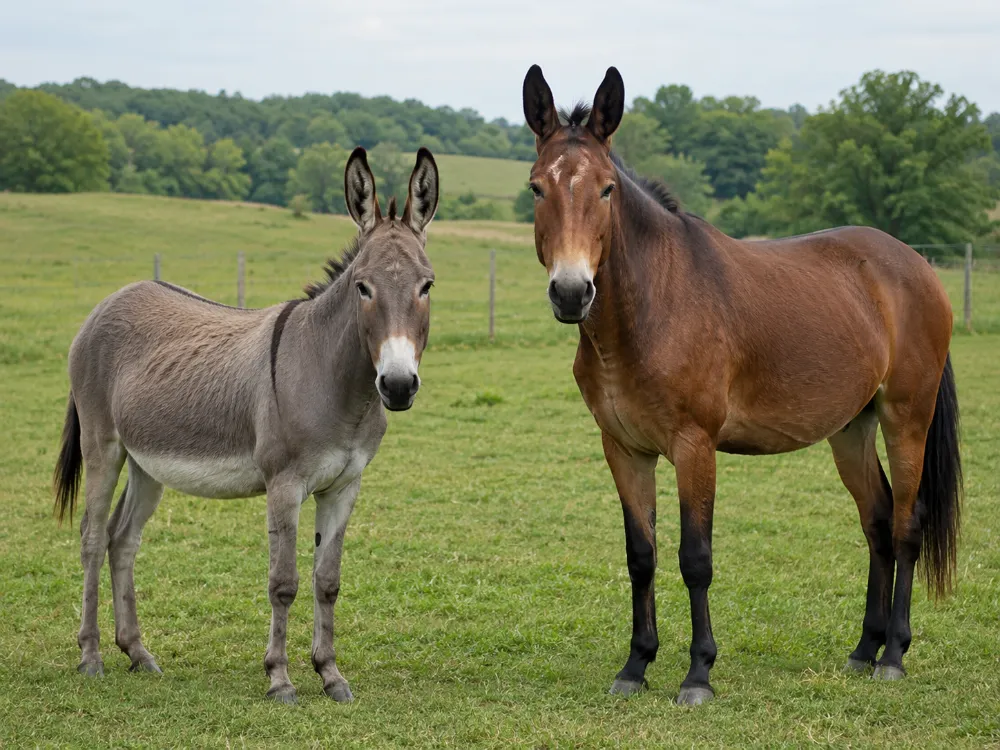
A donkey is a true equid species domesticated from wild asses, while a mule is a hybrid animal produced by breeding a male donkey with a female horse. Donkeys can reproduce with other donkeys; mules are usually sterile. Mules often look more horse-like, are usually larger, and are valued for strength and endurance. Donkeys are smaller, hardier, long-eared, and excellent guardians, pack animals, and companions.
| Feature | Donkey | Mule | Key Difference |
|---|---|---|---|
| Biological identity | A domesticated ass, commonly classified as Equus africanus asinus or Equus asinus | A hybrid between a male donkey and a female horse | A donkey is a real breeding animal; a mule is a hybrid. |
| Parents | Donkey father and donkey mother | Male donkey, called a jack, and female horse, called a mare | Mules have one donkey parent and one horse parent. |
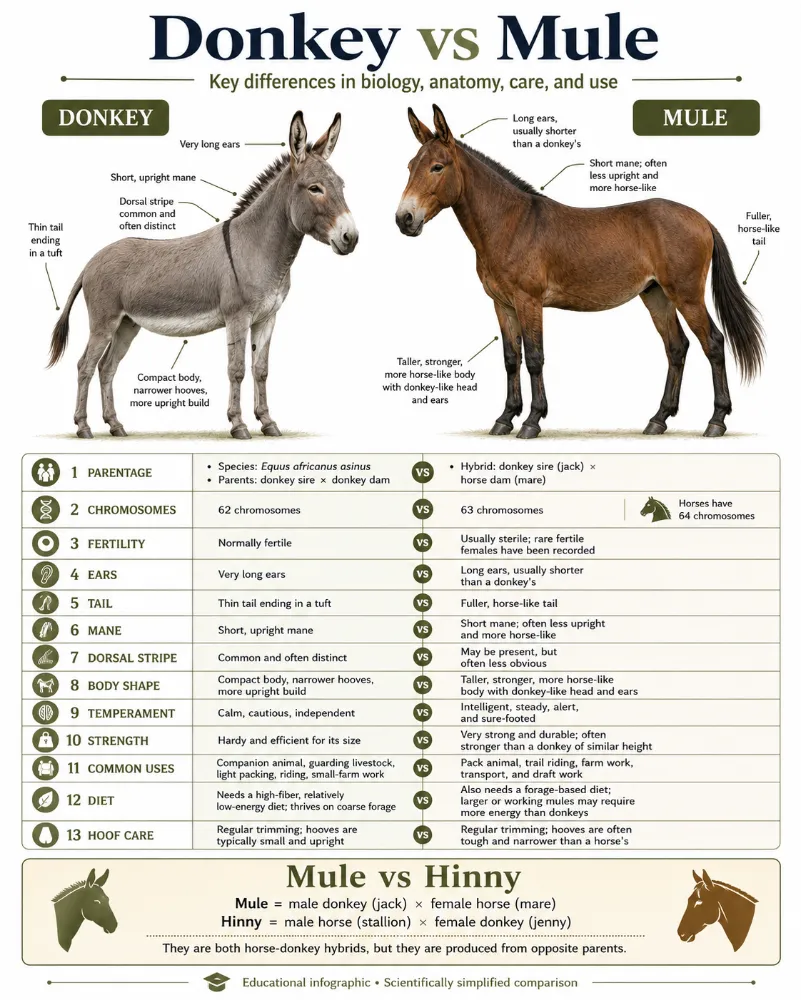
| Chromosomes | 62 chromosomes | 63 chromosomes | The odd chromosome number is why mules are usually sterile. |
| Fertility | Usually fertile | Almost always sterile | Donkeys can breed; mules usually cannot. |
| Average size | Ranges from miniature to large mammoth donkeys | Depends strongly on the horse mother and donkey father | Mules are often taller and more horse-like. |
| Ears | Very long ears | Long ears, but often shorter than a donkey’s and more horse-influenced | Donkeys usually have the longest ears. |
| Tail | Cow-like tail with a tuft at the end | More horse-like tail with longer hair along the tail | The tail is one of the easiest visual clues. |
| Back stripe | Many donkeys have a dorsal stripe and shoulder cross | Usually lacks the classic donkey cross, though markings vary | A clear cross often suggests donkey ancestry. |
| Voice | Distinct bray | Often a mixed sound between a bray and a whinny | Mules sound different because of mixed ancestry. |
| Temperament | Cautious, thoughtful, social, protective, sometimes called stubborn | Intelligent, strong, cautious, often steady and sure-footed | Both are smart; “stubborn” often means self-preserving. |
| Common uses | Pack work, guarding livestock, companionship, light riding, driving | Riding, packing, farm work, mountain trails, draft work, endurance work | Mules are often chosen for strength and work; donkeys for hardiness and guarding. |
What Is a Donkey?
A donkey is a domesticated member of the horse family, Equidae. Domestic donkeys descend from African wild asses and have been used by humans for thousands of years as pack animals, draft animals, riding animals, guardians, and companions.
Donkeys are not small horses. They have their own anatomy, behavior, social needs, metabolism, and survival strategy. They evolved in dry, harsh environments where careful movement, efficient digestion, and cautious decision-making helped them survive.
Common donkey traits include:
Long ears
Short upright mane
Small, tough hooves
Strong survival instinct
Efficient digestion
Calm but cautious temperament
Strong memory
Close social bonds
Distinctive braying voice
Donkeys come in many sizes, from miniature donkeys used mainly as companions to large mammoth donkeys historically used for breeding strong mules.
What Is a Mule?
A mule is the hybrid offspring of a male donkey and a female horse. The male donkey is called a jack, and the female horse is called a mare. The result is an animal that combines donkey and horse traits.
Mules are famous for their strength, endurance, sure-footedness, intelligence, and ability to work in difficult terrain. They have been used for mountain travel, farm labor, military transport, packing, riding, and hauling for centuries.
A mule may inherit:
The donkey’s caution and sure-footedness
The horse’s size and stride
The donkey’s hardiness
The horse’s athletic body shape
A strong working ability
A mixed voice between bray and whinny
Long ears, though often shorter than a donkey’s
Because a mule is a hybrid, its appearance can vary widely. A mule from a large draft mare may be huge and powerful, while a mule from a small pony mare may be much smaller.
The Main Difference Between a Donkey and a Mule
The main difference is biological. A donkey is an animal that can breed with other donkeys and produce donkey offspring. A mule is a hybrid produced by crossing a male donkey with a female horse.
This difference affects almost everything else: fertility, body shape, size, temperament, use, and care. Mules often look like a blend of horse and donkey. Donkeys look more consistently donkey-like, with long ears, a short mane, a tufted tail, and often a dorsal stripe.
In simple terms:
Donkey: A true equid with two donkey parents.
Mule: A hybrid with a donkey father and horse mother.
Hinny: A different hybrid with a horse father and donkey mother.
Donkey vs Mule Genetics
Donkeys and horses are closely related, but they have different chromosome numbers. A donkey has 62 chromosomes, while a horse has 64. When a male donkey and female horse produce a mule, the mule usually has 63 chromosomes.
This odd number makes normal reproduction extremely difficult. That is why mules are almost always sterile. They can live normal, healthy lives, but they usually cannot produce offspring.
| Animal | Parents | Typical Chromosome Number | Usually Fertile? |
|---|---|---|---|
| Donkey | Donkey × donkey | 62 | Yes |
| Horse | Horse × horse | 64 | Yes |
| Mule | Male donkey × female horse | 63 | Almost always no |
| Hinny | Male horse × female donkey | 63 | Almost always no |
What Is the Difference Between a Mule and a Hinny?
A mule and a hinny are both horse-donkey hybrids, but the parents are reversed. A mule has a donkey father and horse mother. A hinny has a horse father and donkey mother.
This parentage can influence size, appearance, and development. Mules are generally more common than hinnies because breeding a jack donkey to a mare has historically been more practical and produced larger, stronger working animals.
| Hybrid | Father | Mother | Common Notes |
|---|---|---|---|
| Mule | Donkey | Horse | More common, often larger, widely used for work and riding |
| Hinny | Horse | Donkey | Less common, often smaller, may look more donkey-like |
Many people call all donkey-horse hybrids “mules,” but technically a hinny is not the same as a mule.
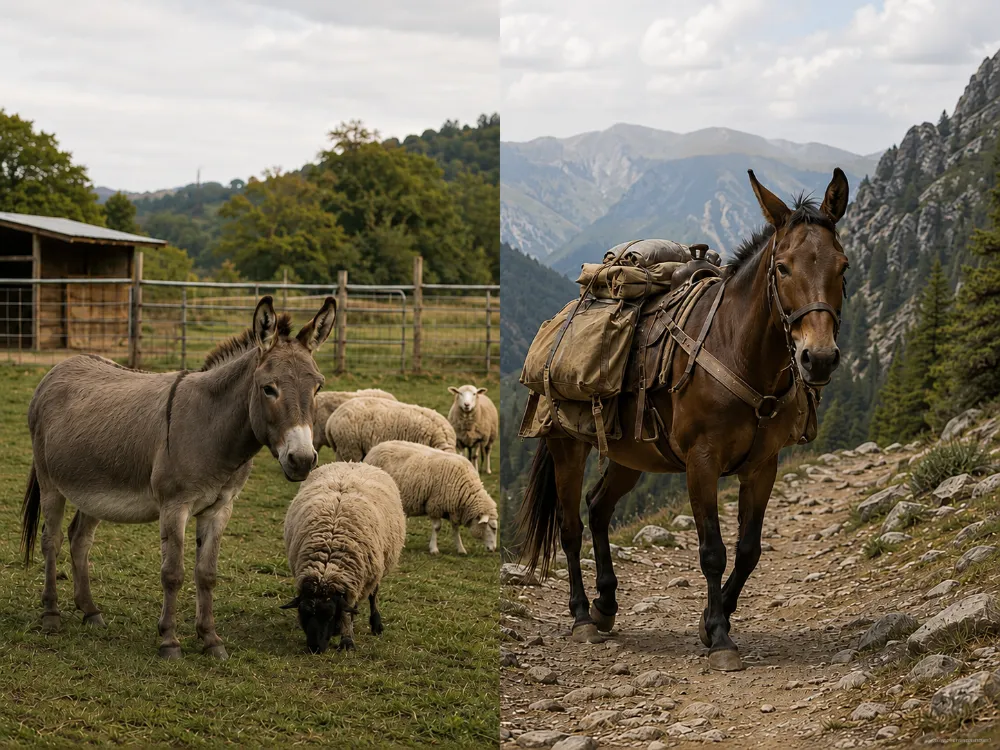
Appearance Differences
Donkeys and mules can look similar, especially from a distance, but several physical clues help separate them. Donkeys usually look more compact, long-eared, and straight-backed. Mules often look taller, more horse-like, and more athletic, although they keep some donkey features.
| Body Feature | Donkey | Mule |
|---|---|---|
| Ears | Very long and large | Long, but often shorter and more horse-influenced |
| Head | Often broader and more donkey-like | Often more horse-like, but with donkey influence |
| Mane | Short, upright, and coarse | May be short or more horse-like depending on ancestry |
| Tail | Thin tail with a tuft at the end | More horse-like tail with longer hair |
| Back | Often straighter | May be slightly more horse-like or curved |
| Legs | Shorter and sturdy | Often longer and more horse-like |
| Hooves | Small, tough, upright hooves | Often larger than donkey hooves but tougher than many horse hooves |
Ears, Tail, and Mane
The ears are the most obvious clue. Donkeys usually have very long ears that help with hearing and heat regulation. Mules also have long ears, but they are often not as long as a donkey’s ears and may look more proportional to a horse-like head.
The tail is another excellent clue. A donkey’s tail is more like a cow’s tail: relatively thin along most of its length with a tuft of long hair at the end. A mule often has a more horse-like tail with more hair growing down the tail.
The mane also differs. Donkeys usually have a short upright mane. Mules vary. Some have a short donkey-like mane, while others show more horse influence.
Dorsal Stripe and Shoulder Cross
Many donkeys have a dark stripe running along the back, called a dorsal stripe. Some also have a shoulder stripe that crosses it, forming a cross-like marking. This pattern is especially visible in many gray or brown donkeys.
Mules may show some primitive markings depending on genetics, but they usually do not show the classic donkey cross as clearly as many donkeys do. Coat color in mules often reflects the horse parent, so mules can appear bay, chestnut, black, gray, palomino, pinto, or other colors.
Useful marking clues include:
Clear dorsal stripe and shoulder cross: often suggests donkey.
Horse-like color and tail: often suggests mule.
Mixed features: may require looking at parentage or body structure.
Size Comparison
Donkeys vary greatly in size. Miniature donkeys may be very small, standard donkeys are medium-sized, and mammoth donkeys can be large. Mules also vary widely because their size depends heavily on the horse mother and donkey father.
A mule from a draft horse mare may be tall and powerful. A mule from a pony mare may be much smaller. This makes mule size less predictable than donkey size unless you know the parents.
| Size Type | Donkey | Mule |
|---|---|---|
| Smallest forms | Miniature donkeys can be very small | Pony mules can be small |
| Medium forms | Standard donkeys are common companion and work animals | Many riding and packing mules are medium to large |
| Largest forms | Mammoth donkeys can be tall and heavy | Draft mules can be very large and powerful |
| Predictability | Depends on donkey breed or type | Depends strongly on both parents |
Temperament Differences
Both donkeys and mules are intelligent, cautious, and often misunderstood. People sometimes call them stubborn, but this usually reflects a strong self-preservation instinct. Unlike some horses, donkeys and mules may stop and assess danger instead of blindly fleeing.
Donkeys are often calm, thoughtful, social, and protective. They may bond strongly with another donkey, horse, goat, sheep, or human caretaker. They dislike being rushed and often respond best to patient handling.
Mules are often intelligent, steady, and hard-working. A well-trained mule can be extremely reliable, especially in rough terrain. However, mules remember bad handling and may become defensive if treated harshly.
| Trait | Donkey | Mule |
|---|---|---|
| Caution | Very cautious and thoughtful | Cautious, often with strong self-preservation |
| Social bonds | Strong; often needs a companion | Strong, but may bond with horses, donkeys, or people |
| Training style | Needs patience and trust | Needs clear, fair, consistent handling |
| Reaction to pressure | May freeze or refuse if unsure | May resist unfair pressure and remember bad experiences |
| Best handler | Calm, patient, observant | Experienced, fair, consistent |
Are Donkeys and Mules Stubborn?
The idea that donkeys and mules are stubborn is only partly true. They are not unintelligent or lazy. They are cautious animals that often think before acting. If something seems unsafe, confusing, painful, or unfair, they may refuse to move.
This trait comes from survival. A horse may react by flight. A donkey may stop and evaluate. A mule often combines the donkey’s caution with the horse’s strength and movement.
Better words than stubborn include:
Cautious
Self-preserving
Intelligent
Observant
Strong-willed
Trust-based
Good training works with this intelligence rather than fighting against it.
Strength and Working Ability
Mules are famous for working ability. They are often strong for their size, sure-footed, durable, and capable of carrying or pulling loads in difficult conditions. Their hybrid ancestry can produce a useful blend of donkey hardiness and horse power.
Donkeys are also strong and useful, especially for carrying loads, guarding livestock, and working in dry environments. They may not be as large or fast as many mules, but they are efficient, tough, and careful.
Common work roles include:
Donkeys: pack animals, livestock guardians, companions, light driving, small-scale farm work.
Mules: riding, packing, mountain trails, hauling, farm work, draft work, endurance riding.
For heavy work, a mule is often preferred. For smaller farms, companionship, guarding, or low-maintenance land use, a donkey may be better.
Sure-Footedness and Trail Use
Both donkeys and mules are known for sure-footedness. Mules are especially valued in mountains, canyons, rocky trails, and remote terrain because they can combine careful foot placement with greater size and carrying ability.
Donkeys are also very sure-footed, especially in dry, rocky environments. Their small, tough hooves and careful movement help them navigate rough ground. However, smaller donkeys cannot carry the same loads as large mules.
For trail use:
Donkey: excellent for light packing, companionship, and small-scale work.
Mule: excellent for riding, packing, and carrying loads over rough terrain.
Diet and Digestion
Donkeys evolved in harsh environments where food was sparse and fibrous. They are very efficient at using low-quality forage. This means they can gain weight easily if fed rich pasture, grain, or high-calorie feeds.
Mules also tend to be efficient and hardy, but their needs vary with size, workload, and horse ancestry. A hardworking mule may need more calories than a companion donkey, but overfeeding can still cause obesity and metabolic problems.
Basic feeding principles include:
Provide clean water at all times
Base the diet on appropriate forage
Avoid excessive grain unless medically or work-demand justified
Monitor body condition carefully
Use low-sugar forage when needed
Provide minerals suited to local forage
Consult an equine veterinarian or nutritionist for special cases
Donkeys especially should not be fed like high-performance horses unless they are doing heavy work and have a nutrition plan.
Hoof Care Differences
Donkey hooves are often more upright, smaller, and tougher than horse hooves. They are adapted to dry ground. When kept in wet pastures or muddy environments, donkeys can develop hoof problems if not managed carefully.
Mule hooves are often strong and durable, sometimes tougher than horse hooves. However, they still need regular trimming and care. A working mule may need shoes or hoof protection depending on terrain and workload.
Hoof care needs include:
Regular trimming by someone experienced with donkeys or mules
Dry resting areas
Monitoring for thrush, cracks, and overgrowth
Proper hoof balance
Workload-appropriate hoof protection
A farrier who only understands horses may not always trim donkeys correctly. Donkey and mule hoof shape should be respected.
Health and Lifespan
Donkeys and mules can be long-lived animals when cared for well. Many live into their 30s, and some donkeys live even longer. Longevity depends on nutrition, hoof care, dental care, parasite control, workload, shelter, and veterinary attention.
Common health concerns include:
Obesity
Laminitis
Dental disease
Hoof overgrowth
Parasites
Skin problems
Respiratory issues from dusty hay or poor shelter
Joint problems in older animals
Donkeys often hide pain. A sick donkey may become quiet, stand apart, eat less, or show subtle behavior changes rather than dramatic signs. Mules can also be stoic. Caretakers should take small changes seriously.
Reproduction and Fertility
Donkeys are fertile animals. A male donkey is called a jack, a female donkey is called a jenny or jennet, and a young donkey is called a foal. Donkeys can produce donkey foals when bred to other donkeys.
Mules are almost always sterile because of their mixed chromosome number. Male mules are typically infertile. Female mules, sometimes called molly mules, are also usually sterile, although extremely rare exceptions have been reported historically.
This fertility difference is one of the clearest distinctions between donkeys and mules.
Can Mules Have Babies?
In almost all cases, no. Mules are usually sterile and cannot reproduce. Their 63 chromosomes do not pair normally during reproductive cell formation, making fertility extremely rare.
There have been rare reports of fertile female mules, but these cases are exceptional and should not be considered normal. For practical animal care and farming, mules are treated as non-breeding animals.
This is why mules must be produced by breeding donkeys and horses again; they do not form a self-sustaining breeding population.
Male and Female Terms
| Animal | Male | Female | Young |
|---|---|---|---|
| Donkey | Jack | Jenny or jennet | Foal |
| Horse | Stallion | Mare | Foal |
| Mule | John mule | Molly mule | Mule foal |
| Hinny | Male hinny | Female hinny | Hinny foal |
Donkeys as Livestock Guardians
Donkeys are often used as livestock guardians, especially with sheep, goats, or calves. Their natural alertness, dislike of canids, loud bray, and defensive behavior can help discourage some predators.
However, not every donkey is a good guardian. A good guardian donkey should be calm, healthy, properly introduced to livestock, and not aggressive toward the animals it is supposed to protect.
Important cautions include:
Some donkeys may chase or injure small livestock if not properly matched.
One donkey may bond better with livestock than a group of donkeys.
Donkeys cannot protect against every predator.
They still need shelter, hoof care, food, water, and veterinary care.
A donkey is not a living fence. It is an animal with its own needs and personality.
Mules as Riding and Pack Animals
Mules are widely valued as riding and pack animals. Their strength, endurance, sure-footedness, and caution make them especially useful in rugged terrain. In many mountain and canyon regions, mules have carried supplies and riders where wheeled vehicles cannot go.
A good mule can be calm, careful, and reliable, but it requires skilled training. Mules do not respond well to rough, impatient, or confusing handling. They are intelligent enough to remember both good and bad experiences.
Good mule training emphasizes:
Trust
Clear cues
Consistency
Patience
Good timing
Fair correction
Reward-based learning
Respect for the mule’s caution
Which Is Easier to Train?
Neither donkeys nor mules should be trained exactly like a reactive horse. Both think carefully and may resist pressure they do not understand. They need calm, consistent, intelligent handling.
Donkeys may be easier for some people because they are smaller and calmer, but their caution can frustrate impatient handlers. Mules may be more athletic and versatile, but their intelligence and strength require good horsemanship.
The easiest animal to train is not determined only by type. It depends on:
Individual temperament
Early handling
Trust in humans
Training method
Health and pain status
Experience of the handler
Clarity of the task
Which Is Better for Beginners?
A calm, well-handled donkey may be better for some beginners who want a companion, light work animal, or small property guardian. A well-trained mule can also be excellent, but an untrained or poorly handled mule may be too strong and clever for a novice.
Beginners should avoid choosing based only on cute appearance or reputation. They should ask:
Is the animal healthy?
Has it been handled regularly?
Is it safe with people?
Does it lead, tie, pick up feet, and load calmly?
Does it have a suitable companion?
Can I afford hoof care, dental care, feed, fencing, and shelter?
A trained, mature animal is usually easier than a young, unhandled one.
Housing and Fencing
Donkeys and mules need secure fencing, dry shelter, clean water, and safe footing. Donkeys are especially sensitive to wet, muddy conditions because their hooves evolved for drier environments. Mules also need dry resting areas and protection from extreme weather.
Good housing includes:
Dry shelter from rain, wind, heat, and snow
Safe fencing without sharp wire or dangerous gaps
Good drainage
Clean water
Low-stress herd or companion arrangements
Enough space to move comfortably
Separate feeding if animals have different diets
Donkeys and mules are social animals. A lone donkey can become stressed, lonely, or depressed. Companionship is an important welfare need.
Cost and Care Commitment
Donkeys and mules are sometimes marketed as low-maintenance animals, but this can be misleading. They may be hardy, but they still require daily care, regular hoof trimming, vaccinations, deworming plans, dental care, shelter, safe fencing, and emergency veterinary access.
Costs may include:
Hay or forage
Minerals
Hoof trimming
Dental floating
Vaccinations
Parasite testing and control
Shelter and fencing
Training
Emergency veterinary care
Tack or harness if used for work
Because they can live for decades, buying or adopting a donkey or mule is a long-term commitment.
Donkey vs Mule for a Small Farm
For a small farm, the better choice depends on the job. A donkey may be ideal for companionship, light packing, guarding livestock, or living on sparse forage with careful management. A mule may be better for riding, hauling, packing, or more demanding work.
| Farm Need | Better Choice | Reason |
|---|---|---|
| Livestock guardian | Donkey | Many donkeys bond with livestock and may discourage canids. |
| Trail riding | Mule | Mules often combine strength, caution, and sure-footedness. |
| Heavy packing | Mule | Larger mules can carry more than most donkeys. |
| Companion animal | Donkey | Donkeys are social, gentle, and often suitable companions when well cared for. |
| Draft or hauling work | Mule | Draft mules can be very strong and durable. |
| Low-calorie land management | Donkey | Donkeys can do well on appropriate sparse forage, but obesity must be prevented. |
Common Myths About Donkeys and Mules
Myth: Donkeys are just small horses.
Fact: Donkeys have different anatomy, behavior, metabolism, and care needs.Myth: Mules are a separate species.
Fact: Mules are hybrids between a male donkey and a female horse.Myth: Mules can breed normally.
Fact: Mules are almost always sterile.Myth: Donkeys and mules are stupid.
Fact: They are intelligent, cautious, and often self-preserving.Myth: Donkeys need the same rich feed as horses.
Fact: Many donkeys need lower-calorie, high-fiber diets to avoid obesity and laminitis.Myth: Any donkey will guard livestock.
Fact: Guardian ability depends on individual temperament, training, and proper introduction.
How to Tell a Donkey From a Mule Quickly
To identify a donkey or mule quickly, look at the tail, ears, body shape, and overall horse-like appearance.
Quick identification clues:
Very long ears plus tufted cow-like tail: likely donkey.
Long ears plus more horse-like tail and body: likely mule.
Clear dorsal stripe and shoulder cross: often donkey.
Taller, more athletic, horse-like frame: often mule.
Known parents are donkey and horse: mule or hinny, depending on which parent is which.
Some animals can be difficult to identify by appearance alone, especially small mules or large donkeys. Parentage gives the final answer.
Final Takeaway
The difference between a donkey and a mule is simple at the biological level: a donkey is a true equid with donkey parents, while a mule is a hybrid produced from a male donkey and a female horse. Donkeys are usually fertile; mules are almost always sterile.
Donkeys are typically long-eared, hardy, cautious, social, and useful as companions, pack animals, and livestock guardians. Mules usually combine donkey hardiness with horse size and athleticism, making them excellent riding, packing, and working animals.
Neither animal is “better” in every situation. A donkey is often better for companionship, guarding, and small-farm life. A mule is often better for heavy work, riding, and mountain travel. The right choice depends on your goals, experience, land, care resources, and the individual animal’s temperament.
FAQs About Donkey vs Mule
What is the main difference between a donkey and a mule?
A donkey is a domesticated equid with two donkey parents. A mule is a hybrid produced by breeding a male donkey with a female horse.
Is a mule a donkey?
No. A mule is not a donkey. It is a hybrid with one donkey parent and one horse parent. It may look partly donkey-like, but it is not the same as a donkey.
Can mules reproduce?
Mules are almost always sterile because they usually have 63 chromosomes, an odd number that prevents normal reproduction. Rare exceptions are extremely unusual.
Can donkeys reproduce?
Yes. Donkeys are usually fertile and can produce donkey foals when bred with other donkeys.
What are a mule’s parents?
A mule’s parents are a male donkey, called a jack, and a female horse, called a mare.
What is a hinny?
A hinny is the hybrid offspring of a male horse and a female donkey. It is similar to a mule but has the reverse parentage.
Which is bigger, a donkey or a mule?
Mules are often larger because they have a horse mother, but size varies widely. A mammoth donkey may be larger than a small pony mule.
Why do mules have long ears?
Mules inherit long ears from their donkey parent. Their ears are usually long, but often not as long as a donkey’s ears.
How can you tell a donkey from a mule?
Look at the tail, ears, body shape, and markings. Donkeys usually have very long ears, a tufted tail, and often a dorsal stripe. Mules usually look more horse-like, with a more horse-like tail and larger body.
Are donkeys smarter than horses?
Donkeys are highly intelligent and cautious. They are not simply smarter or less smart than horses; they think and react differently because they evolved under different survival pressures.
Are mules smarter than horses?
Mules are often considered very intelligent because they combine horse and donkey traits. They can learn quickly and remember experiences well, but they require fair and consistent handling.
Are donkeys and mules stubborn?
They are often called stubborn, but their behavior usually reflects caution and self-preservation. If they do not trust a situation, they may refuse to move until they feel safe.
Which is better for riding, a donkey or a mule?
For most adult riding and trail work, a mule is usually better because it is often larger, stronger, and more horse-like. Large donkeys can also be ridden by appropriately sized riders.
Which is better as a livestock guardian?
A donkey is more commonly used as a livestock guardian. However, not every donkey is suitable, and proper introduction to livestock is important.
Do donkeys and mules need different care from horses?
Yes. Donkeys and mules often need different feeding, hoof care, training methods, and management. Donkeys especially can become obese or develop laminitis if fed too richly.