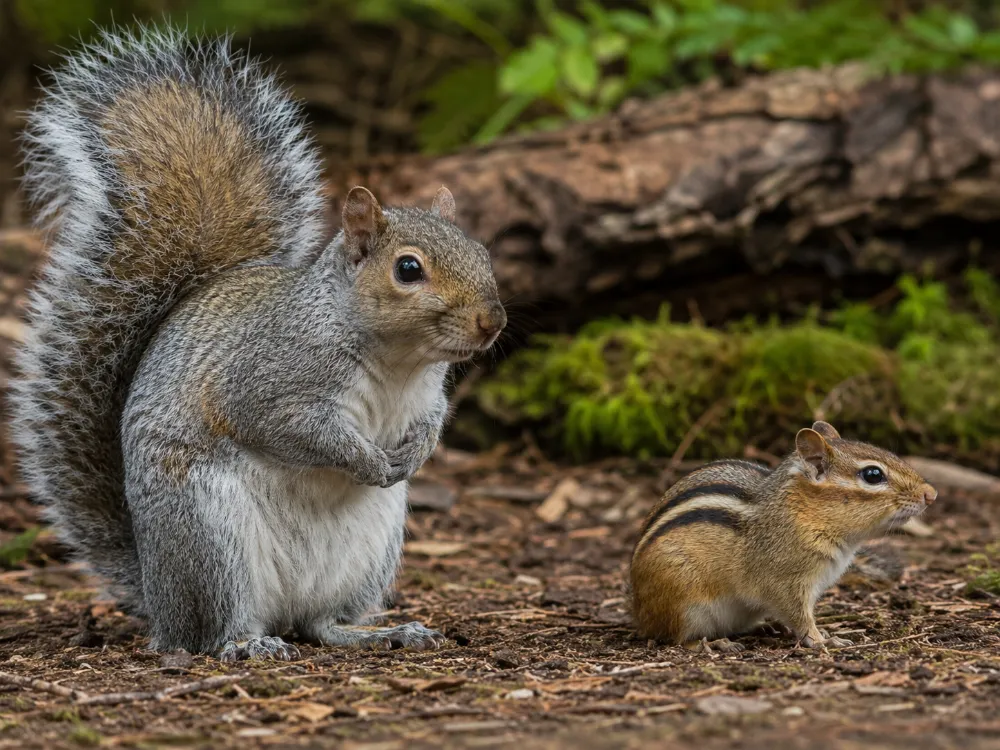
Squirrels and chipmunks are close relatives, but they are not the same animal in everyday use. Chipmunks are small, striped, mostly ground-dwelling members of the squirrel family. Common tree squirrels are larger, have bushier tails, spend more time climbing trees, and usually lack bold facial stripes. The easiest clue is this: chipmunks have stripes on the face and body; tree squirrels usually do not.
| Feature | Squirrel | Chipmunk | Quick Identification Tip |
|---|---|---|---|
| Animal family | Sciuridae | Sciuridae | Chipmunks are part of the squirrel family. |
| Common meaning | Usually refers to tree squirrels in everyday speech | Small striped ground squirrel relative | “Squirrel” is broader; “chipmunk” is more specific. |
| Size | Usually larger | Usually smaller | Chipmunks look compact and mouse-sized compared with many squirrels. |
| Tail | Long, full, and very bushy | Shorter, thinner, and less fluffy | A big plume-like tail usually means squirrel. |
| Stripes | Most tree squirrels do not have bold stripes | Clear stripes on face, back, and sides | Facial stripes strongly suggest chipmunk. |
| Habitat use | Often trees, branches, trunks, attics, and yards | Ground cover, logs, rocks, burrows, stone walls, garden edges | Squirrels climb more; chipmunks stay low more often. |
| Nesting | Tree cavities, leaf nests, sometimes buildings | Underground burrow systems | Chipmunks are famous for burrows. |
| Cheek pouches | Usually not obvious in common tree squirrels | Large cheek pouches for carrying food | A chipmunk may look like its cheeks are stuffed. |
| Movement | Climbs, leaps, and runs along branches | Darts quickly along the ground and into cover | Chipmunks often move in quick stop-and-go bursts. |
| Winter behavior | Many remain active through winter | Often spend long periods in burrows and wake to feed from stored food | Chipmunks store food underground. |
Are Squirrels and Chipmunks Related?
Yes. Squirrels and chipmunks are closely related. Both belong to the rodent family Sciuridae, which also includes tree squirrels, ground squirrels, flying squirrels, marmots, prairie dogs, and chipmunks.
The confusion comes from the word “squirrel.” Scientifically, chipmunks are part of the squirrel family. In everyday language, however, people usually say “squirrel” when they mean a tree squirrel, such as an eastern gray squirrel, fox squirrel, or red squirrel. When people compare “squirrel vs chipmunk,” they are usually comparing common tree squirrels with chipmunks.
So the most accurate answer is: a chipmunk is a kind of squirrel relative, but it is not what most people mean when they say “squirrel” in a backyard or park.
The Fastest Way to Tell a Squirrel From a Chipmunk
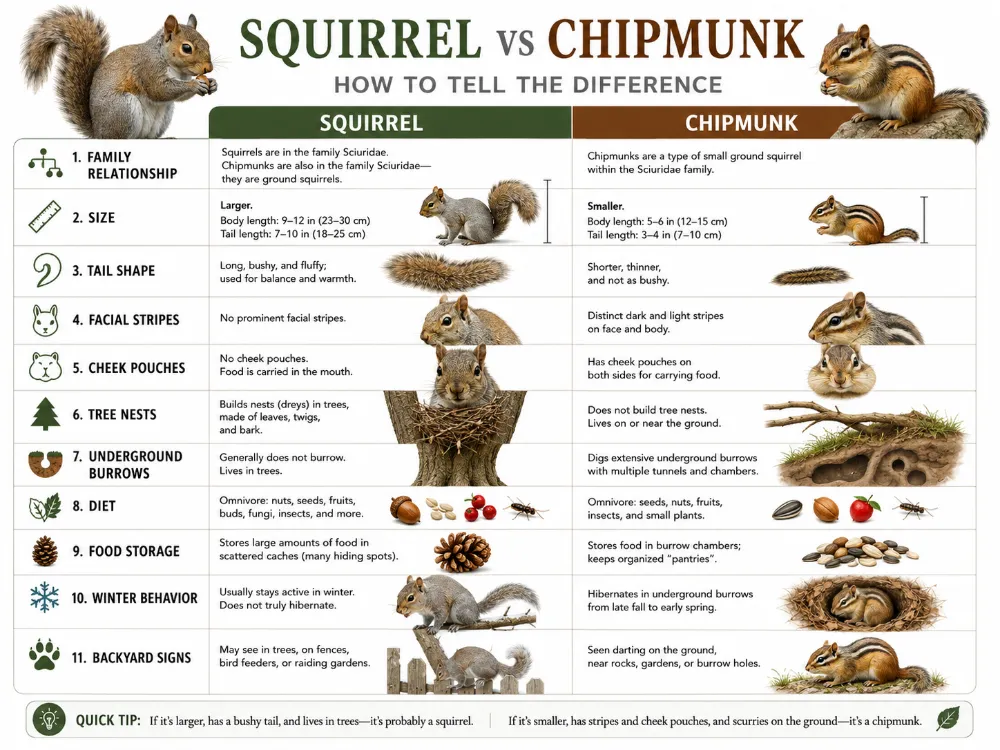
The easiest difference is the stripe pattern. Chipmunks usually have bold dark and light stripes running along the head, face, back, and sides. Tree squirrels usually lack these strong facial stripes. Some ground squirrels can have body stripes, but they usually do not have the same clear facial stripes that chipmunks do.
Use these quick clues:
Small animal with facial stripes: probably a chipmunk.
Larger animal with a big bushy tail: probably a tree squirrel.
Animal running up a tree trunk: more likely a squirrel.
Animal darting into a ground hole: more likely a chipmunk.
Animal with stuffed cheek pouches: almost certainly a chipmunk.
Scientific Classification
| Classification | Common Tree Squirrel | Chipmunk |
|---|---|---|
| Kingdom | Animalia | Animalia |
| Phylum | Chordata | Chordata |
| Class | Mammalia | Mammalia |
| Order | Rodentia | Rodentia |
| Family | Sciuridae | Sciuridae |
| Common group | Tree squirrels, ground squirrels, or flying squirrels depending on species | Small striped ground-dwelling squirrels |
Chipmunks are not mice, rats, or baby squirrels. They are adult rodents in the squirrel family, with their own body shape, behavior, burrowing lifestyle, and food-storing habits.
Size Differences
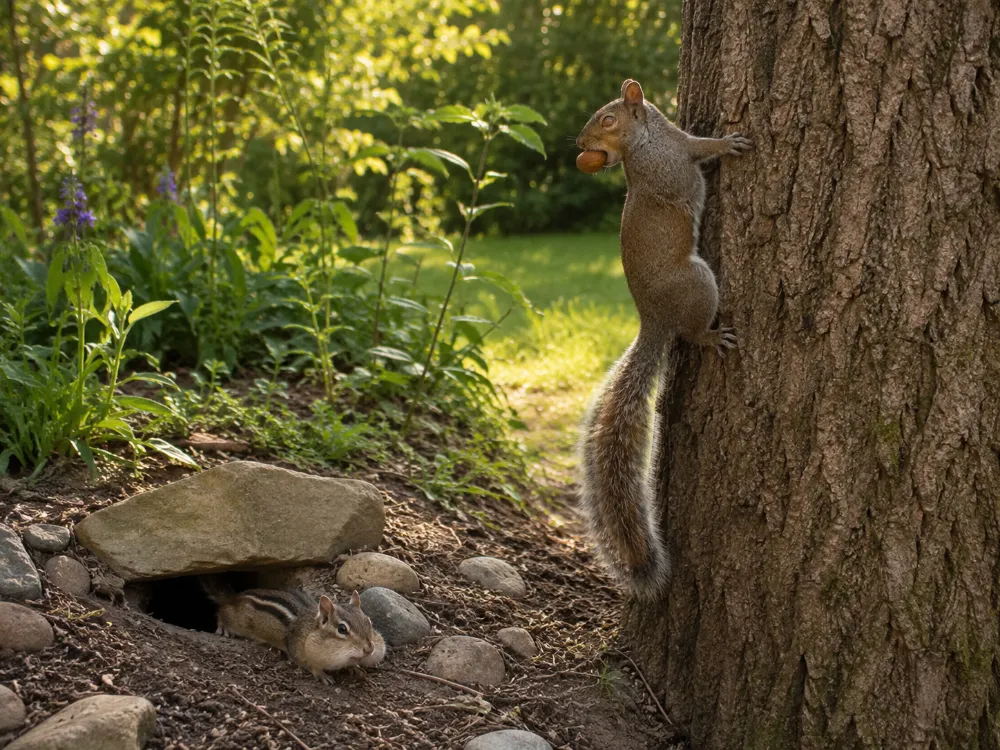
Most chipmunks are much smaller than common tree squirrels. A chipmunk has a compact body, short legs, small rounded ears, and a relatively thin tail. A tree squirrel is usually larger, longer-bodied, and more powerful, with a large bushy tail used for balance, warmth, and communication.
| Size Feature | Common Tree Squirrel | Chipmunk |
|---|---|---|
| Body size | Medium-sized backyard rodent | Small, compact rodent |
| Tail size | Long and bushy | Shorter and less fluffy |
| Body impression | Agile climber with strong limbs | Quick ground-darter with small body |
| Visual comparison | Often several times larger than a chipmunk | Looks more delicate and low to the ground |
Size alone is useful, but it should not be the only clue. A young squirrel can be small, and some ground squirrels are chipmunk-like. Stripe pattern, tail shape, and behavior give a more reliable identification.
Stripe Differences
Chipmunks are famous for their stripes. Most have dark stripes running along the back and sides, with lighter stripes between them. They also usually have clear facial stripes running from the nose area toward the eye and ear.
Most common tree squirrels do not have bold stripes. Eastern gray squirrels are gray or brownish-gray. Fox squirrels are often orange-brown or grayish. Red squirrels are reddish with a pale belly. None of these typical tree squirrels have chipmunk-style facial stripes.
Important stripe clues include:
Chipmunks: stripes on face, back, and sides.
Tree squirrels: usually plain gray, brown, red, black, or mixed, without facial stripes.
Ground squirrels: some have stripes, but many lack bold facial striping.
Tail Differences
The tail is one of the easiest visual differences. Tree squirrels have long, thick, bushy tails. Their tails help them balance on branches, leap between trees, communicate with other squirrels, shade their bodies, and stay warm in cold weather.
Chipmunks have a shorter and thinner tail. It may be somewhat bushy, but it is not the large plume-like tail of a tree squirrel. When a chipmunk runs, its tail may stick up or trail behind, but it does not dominate the animal’s silhouette the way a squirrel’s tail does.
Simple rule:
Huge fluffy tail: squirrel.
Small striped body with modest tail: chipmunk.
Face and Cheek Pouches
Chipmunks have cheek pouches, and they use them constantly. These expandable pockets inside the cheeks allow chipmunks to carry seeds, nuts, grains, and other food back to their burrows. A chipmunk with full cheek pouches can look comically round-faced.
Tree squirrels also carry food, but they usually carry one nut, acorn, or food item in the mouth. They do not usually show the same dramatic stuffed-cheek look as chipmunks.
Chipmunk cheek pouches are an adaptation for a food-storing lifestyle. Instead of eating everything where they find it, chipmunks often transport food quickly to underground storage chambers.
Habitat Differences
Common tree squirrels spend much of their lives in trees. They climb trunks, leap between branches, build leaf nests, use tree cavities, and escape predators by moving upward. They also come to the ground to bury nuts, feed, and travel.
Chipmunks are more strongly associated with the ground. They prefer areas with logs, rocks, shrubs, stone walls, garden edges, brush piles, forest floors, and burrow entrances. They can climb, but they are not as tree-focused as tree squirrels.
| Habitat Feature | Squirrel | Chipmunk |
|---|---|---|
| Main shelter | Tree cavities, leaf nests, sometimes buildings | Underground burrows |
| Best habitat | Woodlands, parks, yards with mature trees | Woodland edges, gardens, stone walls, logs, shrubs |
| Escape route | Up trees | Into burrows, rocks, logs, or dense cover |
| Typical activity zone | Ground and canopy | Mostly ground level |
Nesting and Burrowing
Tree squirrels usually nest above ground. They may use tree cavities or build leafy nests called dreys. These nests are often made of leaves, twigs, bark, moss, and other plant material. A squirrel drey may appear as a rounded leaf ball high in a tree.
Chipmunks usually live in underground burrow systems. A chipmunk burrow may have nesting chambers, food storage chambers, escape tunnels, and hidden entrances. The entrance hole may be surprisingly neat, often without a large mound of soil around it because chipmunks carry excavated soil away from the entrance.
Burrow signs may include:
Small round holes near rocks, logs, steps, patios, or foundations
Quick chipmunk movement in and out of one area
No obvious soil mound beside the entrance
Food storage activity in late summer and fall
Diet Differences
Squirrels and chipmunks are both opportunistic omnivores, but their feeding styles differ. Tree squirrels are famous for eating nuts, acorns, seeds, buds, fruits, fungi, and sometimes insects or eggs. They often bury nuts in scattered locations, a behavior called scatter-hoarding.
Chipmunks also eat seeds, nuts, fruits, fungi, insects, and small invertebrates. However, they are especially known for carrying food in cheek pouches and storing it in burrows. This is called larder-hoarding, because food is collected in a central storage area.
| Food Type | Squirrel | Chipmunk |
|---|---|---|
| Nuts and acorns | Very common food | Very common food |
| Seeds | Common | Common, often carried in cheek pouches |
| Fruit and berries | Often eaten seasonally | Often eaten seasonally |
| Fungi | Can be important | Can be important |
| Insects and small animals | Occasionally eaten | Occasionally eaten |
| Food storage | Often buries food in many separate places | Often stores food underground in burrows |
Food Storage Behavior
Food storage is one of the most interesting differences between squirrels and chipmunks. Many tree squirrels scatter-hoard. They bury individual nuts or seeds in many locations, then return later using memory and smell. Some forgotten nuts may sprout into new trees.
Chipmunks often use cheek pouches to carry many seeds at once back to their burrow. They may store large amounts of food underground for cold weather. This allows them to wake during winter and feed without leaving the safety of the burrow very often.
In simple terms:
Squirrels: hide food in many outdoor caches.
Chipmunks: carry food in cheek pouches and store much of it underground.
Behavior Differences
Squirrels are often bold, visible, and acrobatic. They run along fences, climb trees, leap from branch to branch, raid bird feeders, and chase each other around trunks. In urban parks, some squirrels become very comfortable around people.
Chipmunks are usually more secretive. They dart quickly between cover, pause upright to scan for danger, and disappear into burrows or under logs. They are often seen near stone walls, garden edges, shrubs, and woodland floors.
Common behavior clues include:
Squirrels: climbing, leaping, tail flicking, chasing, burying nuts.
Chipmunks: ground darting, cheek stuffing, burrow use, sharp alarm calls.
Climbing Ability
Tree squirrels are expert climbers. Their sharp claws, flexible ankles, powerful hind legs, and balancing tails allow them to move easily on vertical tree trunks and narrow branches. They can descend headfirst down a tree, leap long distances, and escape many predators by going upward.
Chipmunks can climb trees, shrubs, fences, and logs, but they are not as specialized for an arboreal lifestyle as tree squirrels. They usually prefer staying close to the ground, where burrows and dense cover provide escape routes.
If the animal spends most of its time high in trees, it is probably a squirrel. If it stays low and vanishes into a small ground hole, it is probably a chipmunk.
Sounds and Calls
Squirrels and chipmunks both use vocal signals. Tree squirrels may chatter, bark, squeal, or make alarm calls when they see predators. They also use tail flicks as visual signals.
Chipmunks are surprisingly vocal for their size. They may make sharp “chip” calls, trills, or repeated alarm notes. These calls can warn other animals of danger or announce a territory.
Many people hear chipmunks before they see them. A repeated high-pitched “chip-chip-chip” from a brushy edge or stone wall may come from a chipmunk watching from cover.
Winter Behavior
Squirrels and chipmunks handle winter differently. Many tree squirrels remain active through winter, although they may reduce activity during severe cold or storms. They rely on cached nuts, tree cavities, nests, and body fat.
Chipmunks often spend much of winter underground. They are not true deep hibernators in the same way some animals are. Instead, they may enter periods of torpor, wake periodically, eat stored food, and return to rest. This allows them to survive cold months without constantly foraging above ground.
Winter differences include:
Tree squirrels: often visible above ground in winter.
Chipmunks: often hidden in burrows for long periods.
Reproduction and Young
Squirrels and chipmunks both give birth to live young and care for them in nests or burrows. Baby squirrels are born helpless, hairless, and dependent on the mother. Young chipmunks are also born helpless and develop inside the safety of an underground nest chamber.
Tree squirrels often raise young in tree cavities or leaf nests. Chipmunks raise young in burrows. Litter size varies by species, food availability, climate, and season.
Young animals of both groups must learn quickly. They face predators, weather, competition, and the challenge of finding food before winter.
Predators and Defense
Squirrels and chipmunks are important prey animals. They feed many predators, including hawks, owls, foxes, coyotes, snakes, weasels, bobcats, domestic cats, and dogs.
Tree squirrels defend themselves by climbing, leaping, hiding in tree cavities, giving alarm calls, and using their tails for balance and communication. Chipmunks defend themselves by staying near cover, using burrows, freezing, darting quickly, and giving alarm calls.
Defense strategies include:
Squirrels: escape upward into trees.
Chipmunks: escape downward into burrows or cover.
Backyard Signs
If you see activity around your yard but cannot identify the animal, look at the clues it leaves behind.
| Backyard Sign | Likely Squirrel | Likely Chipmunk |
|---|---|---|
| Small holes near patio, stone wall, or foundation | Less likely | Very possible |
| Nuts buried in lawn or garden beds | Common | Possible, but chipmunks often store food in burrows |
| Leaf nest high in tree | Common | Unlikely |
| Animal raiding bird feeder from above | Common | Possible from below, but less acrobatic |
| Stuffed cheeks while running | Uncommon | Very common |
| Frequent running along fences and branches | Common | Less common |
Are Squirrels or Chipmunks More Likely to Enter Homes?
Tree squirrels are more likely than chipmunks to enter attics, roof spaces, chimneys, and wall voids. Their climbing ability allows them to reach rooflines, vents, loose fascia, and attic openings. Once inside, squirrels may chew, nest, and create noise.
Chipmunks are more likely to cause problems at ground level. They may burrow near patios, steps, foundations, gardens, and retaining walls. They usually do not live inside attics, but they may enter garages, basements, or low openings by accident.
Home risk pattern:
Squirrels: roofline, attic, chimney, tree-to-house access.
Chipmunks: ground holes, foundation edges, patios, steps, garden beds.
Do Squirrels and Chipmunks Damage Gardens?
Both can affect gardens, but in different ways. Squirrels may dig in pots, steal fruit, bury nuts in flower beds, chew bulbs, and raid bird feeders. Chipmunks may dig small burrows, eat seeds, take berries, and store food.
Most damage is minor unless animals are very abundant or burrows undermine sensitive structures. In a healthy yard, both animals are part of the local ecosystem. Problems usually happen when food sources are concentrated, such as bird feeders, vegetable gardens, fruit trees, or unsecured pet food.
Helpful prevention steps include:
Use wildlife-resistant bird feeders
Clean spilled seed
Protect young plants with mesh or cages
Harvest ripe fruit quickly
Seal gaps under sheds and steps
Keep pet food indoors
Avoid leaving piles of nuts or seeds outside
Are Squirrels or Chipmunks Dangerous?
For most people, squirrels and chipmunks are not dangerous. They are wild animals and should not be handled, but they are not aggressive toward humans under normal conditions.
Possible concerns include:
Bites if handled or cornered
Fleas, ticks, or mites
Damage to gardens or structures
Chewing by squirrels in attics
Burrowing by chipmunks near foundations or steps
Attracting predators if food is abundant
The safest rule is to observe them without touching them. If one enters a home, do not grab it with bare hands. Give it an exit or call wildlife control if needed.
Ecological Importance
Squirrels and chipmunks are small animals with big ecological roles. They move seeds, bury nuts, spread fungi, feed predators, and influence plant communities. Forgotten food caches can grow into new plants and trees.
Important ecological roles include:
Seed dispersal
Fungal spore dispersal
Soil disturbance through digging
Food for predators
Forest regeneration through buried nuts
Insect and small invertebrate consumption
Although they can be pests around homes, they are also important members of woodland, park, and backyard ecosystems.
Squirrel vs Chipmunk vs Ground Squirrel
Ground squirrels can confuse the comparison because chipmunks are closely related to ground-dwelling squirrels. Some ground squirrels have stripes and burrows, making them look chipmunk-like. The best clue is facial striping.
| Animal | Main Traits | Best Clue |
|---|---|---|
| Tree squirrel | Larger, bushy tail, climbs trees, usually no stripes | Big fluffy tail and tree climbing |
| Chipmunk | Small, striped face and body, cheek pouches, burrows | Stripes on the face |
| Ground squirrel | Ground-dwelling, may have body stripes, often larger than chipmunk | Usually lacks the chipmunk’s bold facial stripes |
If the animal has stripes only on the back but not on the face, it may be a ground squirrel rather than a chipmunk.
Squirrel vs Chipmunk as Backyard Visitors
Squirrels are often more visible because they move through trees, fences, rooflines, feeders, and open lawns. They may become bold in parks and neighborhoods where they are used to people.
Chipmunks are often more secretive. They move quickly between hiding places, stuff food in their cheeks, and vanish into holes near rocks, steps, roots, or logs.
If you enjoy wildlife watching, both animals can be fascinating. The key is to avoid feeding them by hand. Hand-feeding can make wild animals dependent, bold, or more likely to bite.
How to Identify Them From a Distance
You do not need to catch or approach the animal to identify it. Watch its body shape, tail, stripes, and escape route.
Ask these questions:
Does it have stripes on the face?
Is the tail large and bushy or shorter and thinner?
Is it climbing trees or staying near the ground?
Does it run into a burrow?
Does it carry food in stuffed cheek pouches?
Is it much larger than a chipmunk-sized rodent?
Facial stripes plus cheek pouches almost always point to a chipmunk. Large bushy tail plus tree climbing usually points to a squirrel.
Common Myths About Squirrels and Chipmunks
Myth: Chipmunks are baby squirrels.
Fact: Chipmunks are adult animals in their own group, not young tree squirrels.Myth: All squirrels live in trees.
Fact: The squirrel family includes tree squirrels, ground squirrels, flying squirrels, marmots, prairie dogs, and chipmunks.Myth: Chipmunks do not climb.
Fact: Chipmunks can climb, but they spend more time near the ground than tree squirrels.Myth: Squirrels and chipmunks only eat nuts.
Fact: Both eat varied diets, including seeds, fruits, fungi, insects, and other foods.Myth: Chipmunks hibernate like bears.
Fact: Many chipmunks enter torpor and wake periodically to eat stored food.Myth: Squirrels remember every nut they bury.
Fact: They recover many caches, but forgotten seeds can help grow new plants.
Final Takeaway
Squirrels and chipmunks are close relatives in the squirrel family, but they are easy to tell apart once you know the clues. In everyday comparison, “squirrel” usually means a larger tree squirrel with a big bushy tail, while a chipmunk is a smaller striped ground-dweller with cheek pouches and burrows.
Look for facial stripes, tail size, and escape behavior. A small animal with face stripes, stuffed cheeks, and a ground burrow is probably a chipmunk. A larger animal with a huge fluffy tail climbing trees and leaping across branches is probably a squirrel.
Both animals are intelligent, adaptable, and ecologically important. They may annoy gardeners or homeowners at times, but they also disperse seeds, feed predators, and add energy to woodland and backyard ecosystems.
FAQs About Squirrel vs Chipmunk
Are chipmunks squirrels?
Chipmunks belong to the squirrel family, so they are squirrel relatives. However, in everyday language, “squirrel” usually refers to larger tree squirrels, while “chipmunk” refers to small striped ground-dwelling squirrels.
What is the main difference between a squirrel and a chipmunk?
The main difference is appearance and lifestyle. Chipmunks are smaller, have stripes on the face and body, use cheek pouches, and live in burrows. Tree squirrels are larger, have bushy tails, and spend more time in trees.
How can you tell a chipmunk from a squirrel?
Look for facial stripes. Chipmunks usually have dark and light stripes on the face and back. Tree squirrels usually lack facial stripes and have a much larger bushy tail.
Are chipmunks baby squirrels?
No. Chipmunks are not baby squirrels. They are fully grown animals in their own group within the squirrel family.
Do squirrels have stripes?
Most common tree squirrels do not have bold stripes. Some ground squirrels have body stripes, but chipmunks are especially known for stripes on both the face and body.
Do chipmunks climb trees?
Yes, chipmunks can climb trees, shrubs, fences, and logs. However, they spend much more time near the ground than tree squirrels do.
Do squirrels live in burrows?
Some ground squirrels live in burrows, but common tree squirrels usually nest in tree cavities or leaf nests. Chipmunks are well known for underground burrows.
Do chipmunks live underground?
Yes. Chipmunks commonly live in underground burrow systems with nesting chambers, food storage areas, and escape tunnels.
What do squirrels eat?
Squirrels eat nuts, acorns, seeds, fruits, buds, fungi, and sometimes insects, eggs, or other small foods. They are opportunistic omnivores.
What do chipmunks eat?
Chipmunks eat seeds, nuts, fruits, berries, fungi, insects, worms, and other small foods. They often carry food in cheek pouches and store it underground.
Which is bigger, a squirrel or a chipmunk?
Common tree squirrels are usually much bigger than chipmunks. Chipmunks are small, compact animals with shorter tails and lighter bodies.
Do chipmunks hibernate?
Chipmunks often spend much of winter in burrows and enter periods of torpor. They may wake periodically to eat stored food rather than sleeping continuously all winter.
Are squirrels dangerous?
Squirrels are not usually dangerous, but they are wild animals and may bite if handled or cornered. They can also cause damage if they enter attics or chew structures.
Are chipmunks dangerous?
Chipmunks are not usually dangerous. They may bite if handled, and their burrows can be a nuisance near patios or foundations, but they generally avoid people.
Which animal is more likely to enter a house?
Tree squirrels are more likely to enter attics and roof spaces because they climb well. Chipmunks are more likely to use ground-level openings, garages, basements, or burrows near foundations.