Quick answer
Frogs and toads are both amphibians in the order Anura, the group of tailless amphibians. In everyday language, “frog” usually describes a smooth-skinned, long-legged amphibian that jumps well and often lives near water. “Toad” usually describes a drier, bumpier, shorter-legged amphibian that walks or makes short hops and often spends more time on land.
The important point is that “toad” is not completely separate from “frog.” True toads belong to the family Bufonidae, but many animals called toads in common language may not be true toads. In a broad sense, toads are a type of frog, but not all frogs are toads.
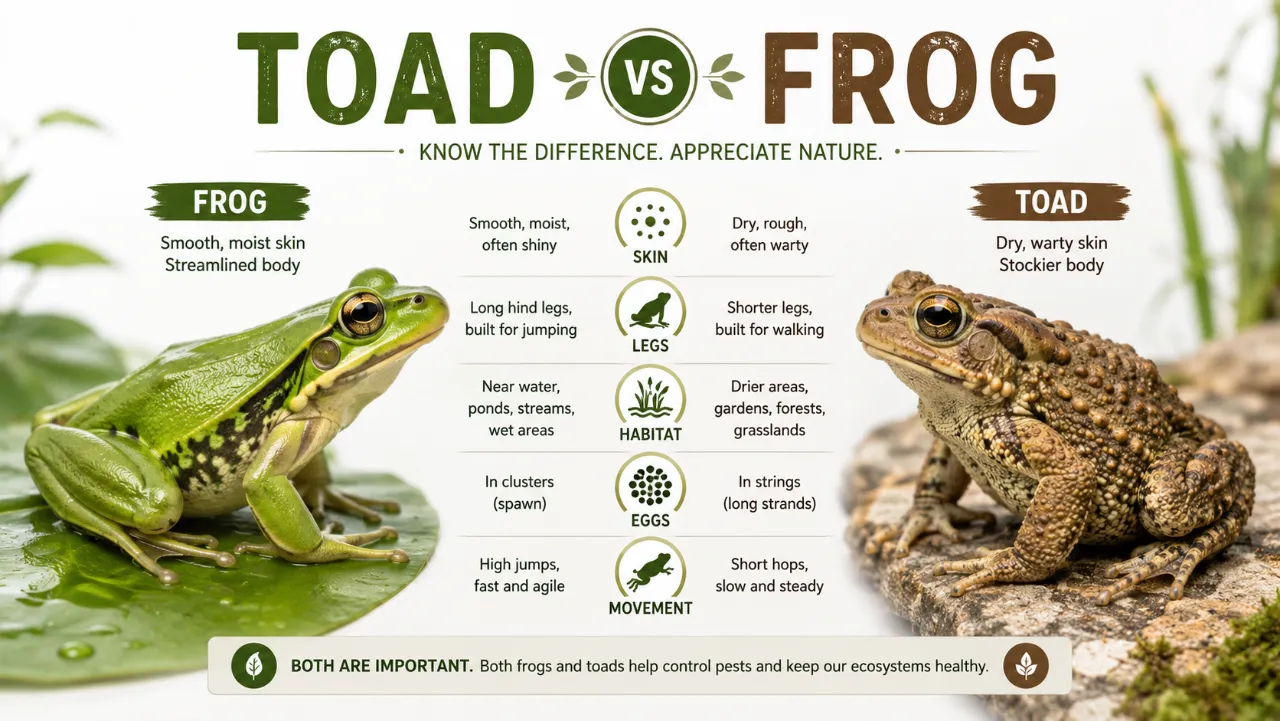
Summary table
| Feature | Frog | Toad |
|---|---|---|
| Scientific relationship | Broad term for many tailless amphibians in Anura | Generally a type of frog; true toads are in Bufonidae |
| Skin | Usually smooth, moist, and sometimes shiny | Usually drier, thicker, and bumpier-looking |
| Body shape | Often slimmer and more streamlined | Often broader, squat, and compact |
| Legs | Generally longer hind legs | Generally shorter hind legs |
| Movement | Often strong jumping and swimming | Often walking, crawling, or short hopping |
| Habitat | Often close to ponds, streams, wetlands, or moist places | Often more tolerant of drier land habitats |
| Eggs | Often laid in clusters or masses | Often laid in long strings, especially in true toads |
| Defense | May rely on jumping, camouflage, toxins, or water escape | Many have noticeable poison glands behind the eyes |
Why frogs and toads are closely related
Frogs and toads both belong to Anura, a large group of amphibians that lack tails as adults. This group includes thousands of species worldwide. They share many core traits: moist skin, external fertilization in many species, aquatic larvae in many species, and a life cycle that often includes transformation from tadpole to adult.
The word “frog” can be used broadly for the entire group, while “toad” is usually used for certain frog-like amphibians with drier skin and a more terrestrial lifestyle. True toads belong to the family Bufonidae, but common names are not always consistent. Some species called “toads” are not true toads, and some frogs look surprisingly toad-like.
For ordinary identification, the frog-toad difference is useful. For scientific classification, it is better to look at family, genus, and species rather than relying only on the common name.
How frog and toad bodies differ
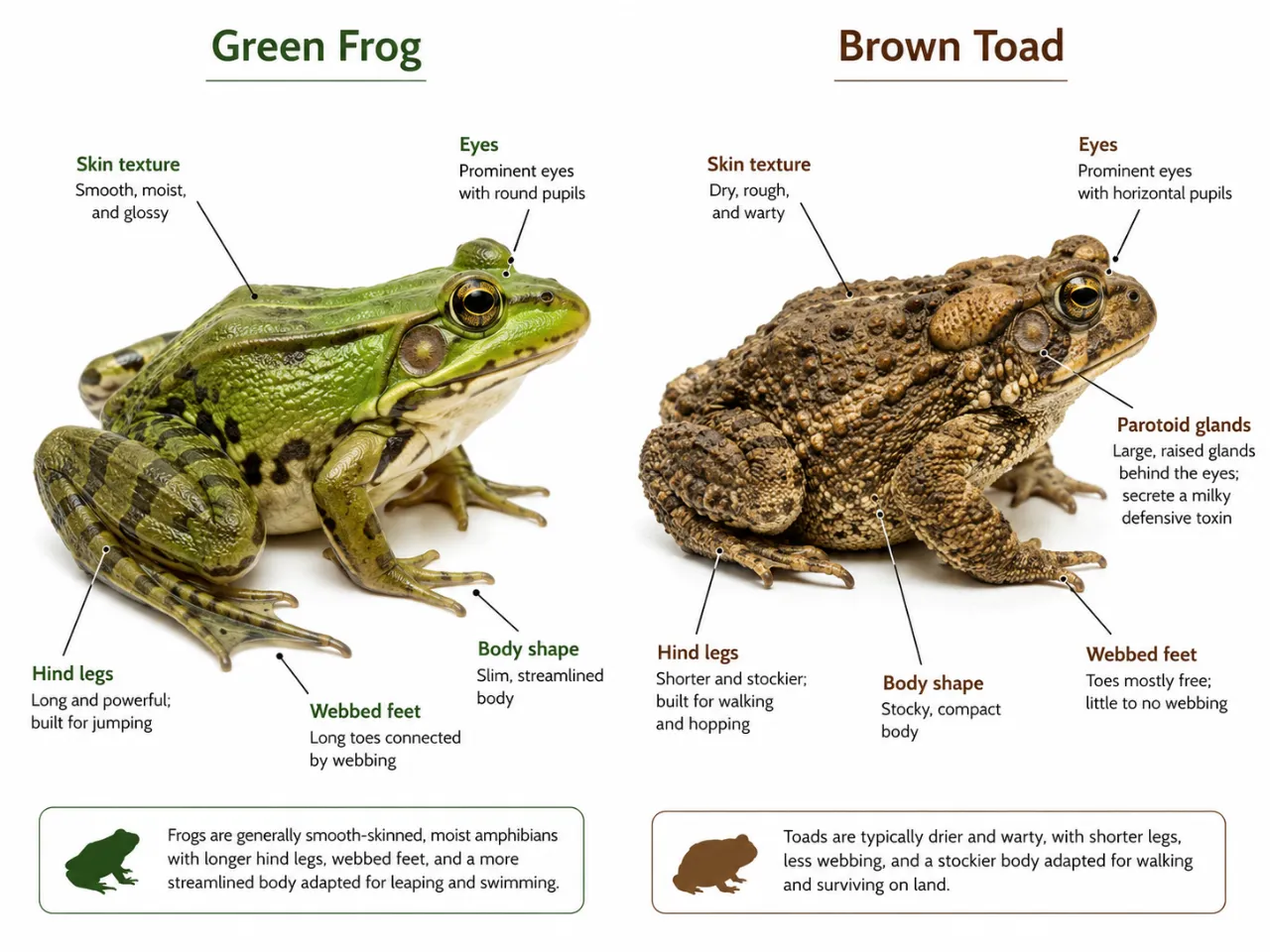
Frogs are generally built for jumping and swimming. Many have long hind legs, a narrower waist, and a smoother body shape. Their feet may be webbed, especially in species that spend much of their time in water.
Toads are generally more compact. Their bodies are often wider and heavier, with shorter legs and a squat posture. Instead of making long leaps, many toads move by walking, crawling, or making short hops. This body shape is useful for life on land, where long-distance jumping may be less important than hiding, burrowing, or moving steadily across the ground.
These differences are general patterns rather than absolute rules. Some frogs have short legs and rough skin, while some toads may jump better than expected. Habitat and species identity matter more than a single body feature.
How frog and toad skin differs
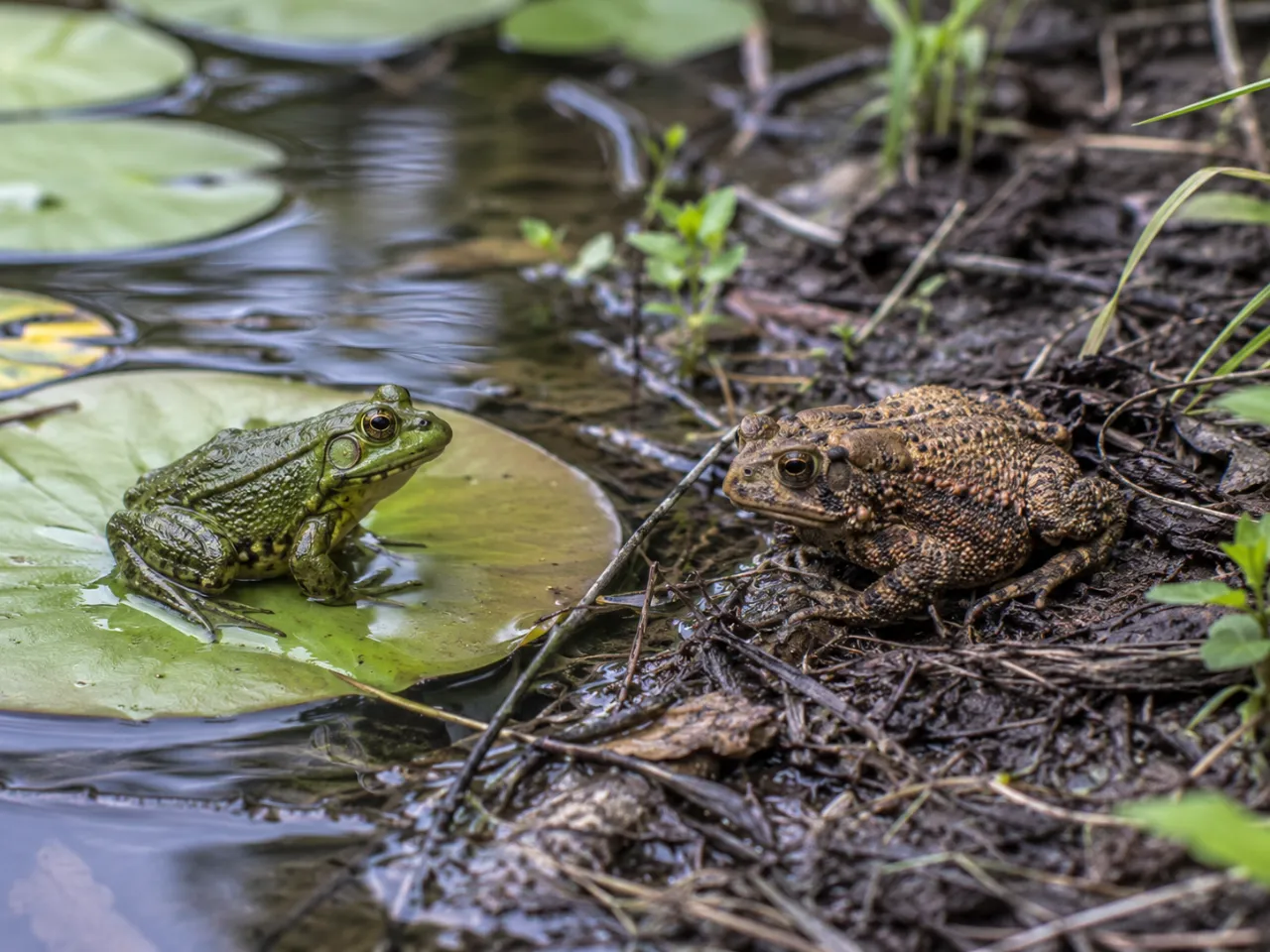
Skin is one of the easiest features to notice. Frogs often have smooth, moist skin that can look shiny. This skin helps with gas exchange and moisture balance, but it also means many frogs are strongly linked to wet habitats.
Toads usually have thicker, drier, bumpier-looking skin. The bumps are not warts, and touching a toad does not give a person warts. The rough texture is part of the animal’s normal skin structure and may help with camouflage, water conservation, and defense.
Many true toads have parotoid glands behind the eyes. These glands can produce defensive secretions that taste bad or may be toxic to predators. The strength of these secretions varies by species. People should avoid handling wild amphibians unnecessarily, and hands should always be washed after contact.
How frogs and toads move
Frogs are often strong jumpers. Their long hind legs act like springs, allowing them to leap away from predators or move quickly between land and water. Aquatic and semi-aquatic frogs may also be excellent swimmers, using webbed feet to push through water.
Toads usually move more slowly. Many make short hops rather than long jumps, and some walk or crawl with a deliberate motion. This does not mean toads are weak; their movement style matches their lifestyle. A toad that spends much of its time under leaves, in gardens, or near burrows does not always need the same leaping ability as a pond frog.
Movement can be a useful clue for identification. A smooth amphibian that launches into a pond with a long leap is likely to be called a frog. A squat amphibian that makes short hops across a path at night is likely to be called a toad.
Where frogs and toads live
Frogs are generally associated with moist environments. Many live near ponds, marshes, streams, lakes, rainforests, wet meadows, or damp woodlands. Some species spend much of their lives in water, while others live in trees, burrows, or leaf litter.
Toads are often more tolerant of drier conditions. Many can live in gardens, grasslands, open woodlands, scrublands, farms, and even semi-arid areas, as long as they have access to moisture and breeding sites. Their thicker skin helps reduce water loss compared with many smooth-skinned frogs.
Both frogs and toads still need moisture. Amphibians can dry out if conditions become too hot or dry, and most species need water or damp places for reproduction. Even land-loving toads usually return to ponds, pools, ditches, or temporary water bodies to breed.
Eggs, tadpoles, and life cycle
Most frogs and toads begin life as eggs laid in water or very moist places. These eggs hatch into tadpoles, which usually live in water and breathe through gills. As they develop, they grow legs, absorb the tail, and gradually transform into air-breathing juveniles.
Frog eggs are commonly laid in jelly-like clusters or floating masses, though this varies widely among species. Toad eggs, especially in many true toads, are often laid in long strings. These strings may be wrapped around aquatic plants or stretched through shallow water.
The tadpoles of frogs and toads can also differ, but identification is often difficult without knowing the species. In many cases, habitat, egg shape, adult calls, and local species lists are more reliable than tadpole appearance alone.
Which is more aquatic
Frogs are generally more aquatic than toads, but this is not always true. Many frogs live close to water and enter it frequently. Their long legs, smooth skin, and webbed feet often make them well suited for swimming and jumping into ponds or streams.
Toads are generally more terrestrial as adults. They may spend much of the year away from open water, hiding under logs, stones, leaves, soil, or garden debris. However, most still need water for breeding, and many migrate to ponds during the reproductive season.
There are many exceptions. Some frogs live high in trees, some live underground, and some toads stay close to water. The best description is that frogs are often more water-associated, while toads are often more land-tolerant.
Do all frog and toad species follow the same rules
No. The simple rules are helpful for beginners, but nature is more complicated. There are frogs with rough skin, frogs that live far from permanent water, and toads that can be surprisingly active near ponds. Common names can also be misleading.
For example, some species called “horned frogs” are squat, wide-mouthed predators that may look somewhat toad-like. Some “spadefoot toads” are not true toads in the family Bufonidae. This is why scientific classification is important when accuracy matters.
In general, the terms “frog” and “toad” are best understood as useful common-language categories. They describe typical appearance and lifestyle, but they do not create a perfect biological boundary.
Why frogs and toads are effective small predators
Both frogs and toads are important predators of insects and other small animals. Many species eat beetles, flies, mosquitoes, moths, ants, termites, worms, spiders, slugs, and other invertebrates. Larger species may eat small fish, small frogs, or even small vertebrates when available.
Their hunting style is often based on patience and speed. Many sit still, blend into the background, and wait for prey to come close. Then they strike with a fast, sticky tongue or a quick lunge of the mouth.
Frogs and toads also serve as prey for many animals, including snakes, birds, fish, mammals, and larger amphibians. Their role as both predator and prey makes them important links in many food webs.
Common myths about toads and frogs
One of the most common myths is that toads give people warts. They do not. Human warts are caused by viruses, not by touching toads. The bumps on a toad’s skin are natural structures, not contagious growths.
Another myth is that all toads are highly poisonous. Many toads have defensive skin secretions, but toxicity varies greatly among species. Some secretions mainly taste unpleasant, while others can be dangerous to pets or predators. It is safest to observe wild toads without handling them.
A third myth is that frogs always live in water and toads always live on land. This is too simple. Many frogs spend time on land, and many toads return to water for breeding. Their relationship with water depends on species, season, climate, and life stage.
Final takeaway
The difference between a toad and a frog is mostly a matter of common appearance, habitat, and movement. Frogs are generally smoother, wetter, longer-legged, and more closely tied to water. Toads are generally drier, bumpier, shorter-legged, and more land-tolerant.
Scientifically, the boundary is not perfect. Toads are part of the larger frog group, and common names can overlap. The best way to understand “toad vs frog” is to treat toads as a specialized, often more terrestrial kind of frog, while remembering that individual species may not follow every rule.
FAQs
Is a toad a type of frog?
Yes, in a broad biological sense, toads are a type of frog. True toads belong to the family Bufonidae, which is part of the larger frog order Anura. However, not every animal commonly called a toad is a true toad.
Can touching a toad give you warts?
No. Toads do not give people warts. The bumps on a toad’s skin are normal skin structures. Human warts are caused by viruses, not amphibians. However, it is still best to wash your hands after touching any wild amphibian.
Which is more poisonous, a frog or a toad?
It depends on the species. Many toads have defensive glands that produce irritating or toxic secretions. Some frogs also have powerful skin toxins, especially certain brightly colored species. Toxicity varies widely, so wild amphibians should be observed carefully and handled as little as possible.