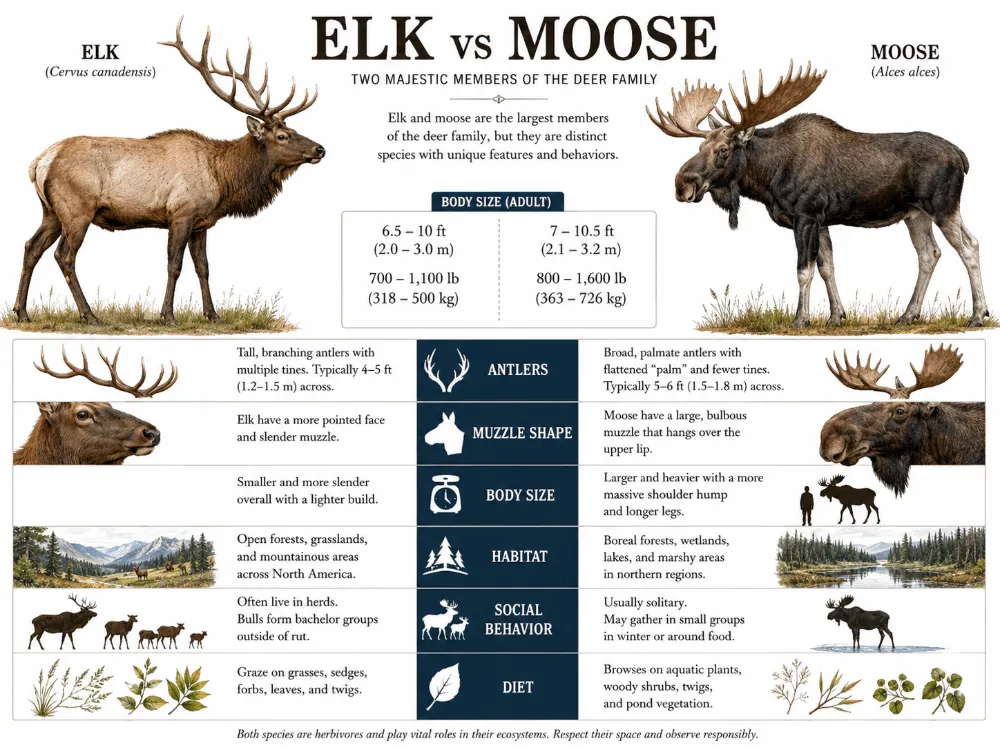
The easiest way to tell an elk from a moose is to look at body shape, antlers, and face. Moose are much larger, darker, longer-faced, and more hump-shouldered, with broad paddle-shaped antlers in males. Elk are smaller, lighter brown, more deer-like, and males usually carry long branching antlers rather than broad paddles. They are both large deer, but they are not the same animal and they live in somewhat different ways.
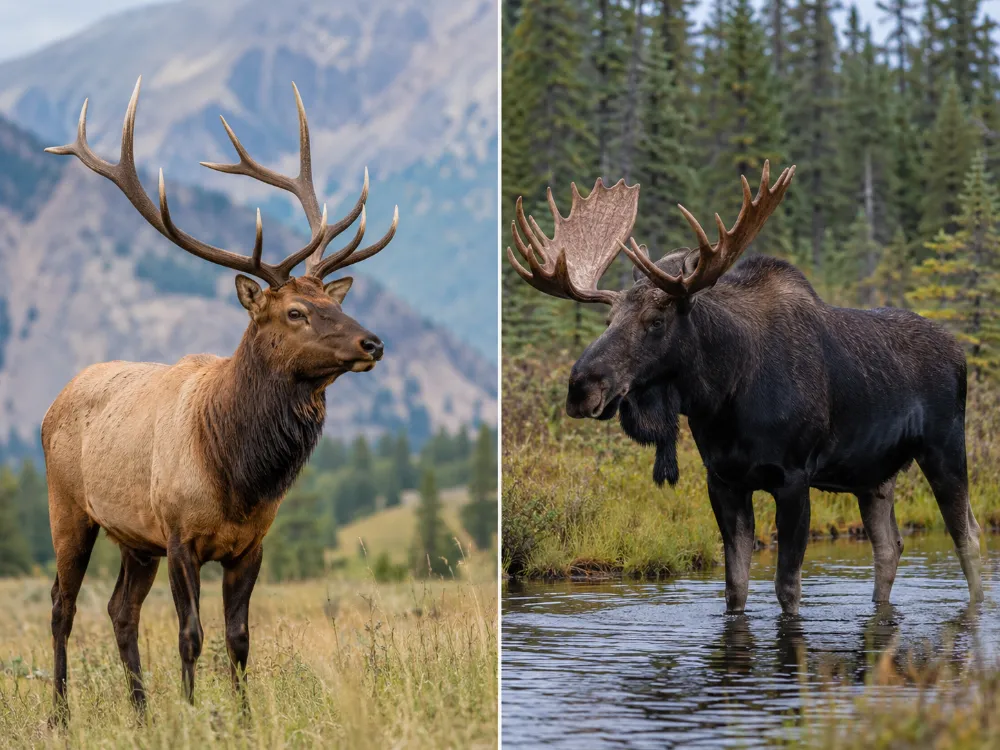
People often compare elk and moose because both are huge members of the deer family and both can look impressive, long-legged, and heavy-bodied from a distance. In North America, they are clearly different animals, but beginners may still confuse them when they see only a silhouette in the woods or a large antlered animal in a meadow.
In this guide, you will learn how elk and moose differ in appearance, antlers, habitat, behavior, diet, and range, plus the fastest ways to identify them correctly.
Quick comparison table
| Feature | Elk | Moose |
|---|---|---|
| Main scientific identity | Cervus canadensis | Alces alces |
| Overall size | Large, but smaller than a moose | The largest living deer species |
| Body shape | More deer-like, athletic, smoother-backed | Taller, heavier, long-legged, hump-shouldered |
| Face | Shorter, more deer-like face | Long, heavy muzzle with a drooping look |
| Antlers | Long branching antlers | Broad paddle-shaped antlers in mature males |
| Color | Usually tan to reddish-brown with darker neck and legs | Usually dark brown to nearly blackish |
| Social behavior | Often more social, especially in herds | Usually more solitary |
| Typical habitat | Forests, meadows, mountains, grassland edges | Boreal forest, wetlands, willow country, lake and marsh edges |
| Best quick clue | Smaller than a moose, tan body, branching antlers | Huge size, long nose, dark body, paddle antlers |
They are both deer, but they are not the same species
Elk and moose both belong to the deer family, Cervidae, which is why they share features such as long legs, antlers in males, cloven hooves, and plant-based diets. Even so, they are not just regional versions of one animal. They are different species with different body shapes, different ecological preferences, and different behavior.
Elk are closer in general appearance to a very large, powerful deer. Moose look much more specialized, with a towering body, long legs, a broad nose, and a distinctive shoulder hump. Once you know those differences, the two usually become much easier to separate.
So while both are giant deer, a moose is not simply a larger elk, and an elk is not a smaller moose.
Moose are much bigger
One of the biggest differences is body size. Moose are usually much larger and taller than elk. In fact, the moose is the largest living deer species in the world. A mature bull moose can look massive in a way that makes even a very large elk seem lighter and more balanced.
Elk are still extremely large animals and can be impressive at close range, but they usually look more athletic and less oversized. Their body appears more evenly proportioned and more classically deer-like.
If the animal seems enormous, towering, and unusually long-legged, moose becomes much more likely.
Moose have a very different face
The face is one of the easiest clues. Moose usually have a long, heavy muzzle with a drooping, almost horse-like or camel-like profile. The nose looks large and blunt, and the whole head often appears oversized.
Elk usually have a shorter, more refined face. Their head still looks powerful, but it is much more like a classic deer head and less like the long-nosed silhouette of a moose.
If the face looks long, bulbous, and heavy, think moose. If it looks cleaner and more deer-like, think elk.
Antler shape is one of the strongest field marks
Male elk usually have long, branching antlers with many pointed tines. These antlers rise upward and outward in a more classic deer pattern. They can be very large, but they do not usually form broad flat surfaces.
Male moose, especially mature bulls, are famous for broad paddle-shaped antlers. Instead of looking like a branching rack, the antlers often spread outward with wide flattened sections, though some moose can show more branching structure at certain ages or in certain populations.
If the antlers look like wide paddles, the animal is a moose. If they look like long branching spears, the animal is an elk.
Moose look darker overall
Color can help, although it should not be the only clue. Moose are usually darker, often deep brown and sometimes almost blackish from a distance. Their dark body helps give them a heavy, shadowy appearance in northern forest and wetland habitats.
Elk are often lighter in tone. Many have a tan or reddish-brown body with a darker neck, head, and legs. Their rump patch is often paler, which can make the contrast even more obvious.
If the animal looks light-bodied and golden-brown, elk becomes more likely. If it looks uniformly dark and heavy, moose becomes more likely.
Moose have a shoulder hump and longer legs
Moose often show a noticeable hump over the shoulders, especially in mature animals. Their legs also look exceptionally long, giving them a high, towering posture that suits movement through deep snow, brush, and wet ground.
Elk are also long-legged, but their body usually looks smoother-backed and less exaggerated. They seem more like strong runners of open ground and forest edges, while moose look like giant browsers built for swamps, willow thickets, and tangled northern cover.
If the animal seems high at the shoulders and unusually stilt-legged, moose is the better guess.
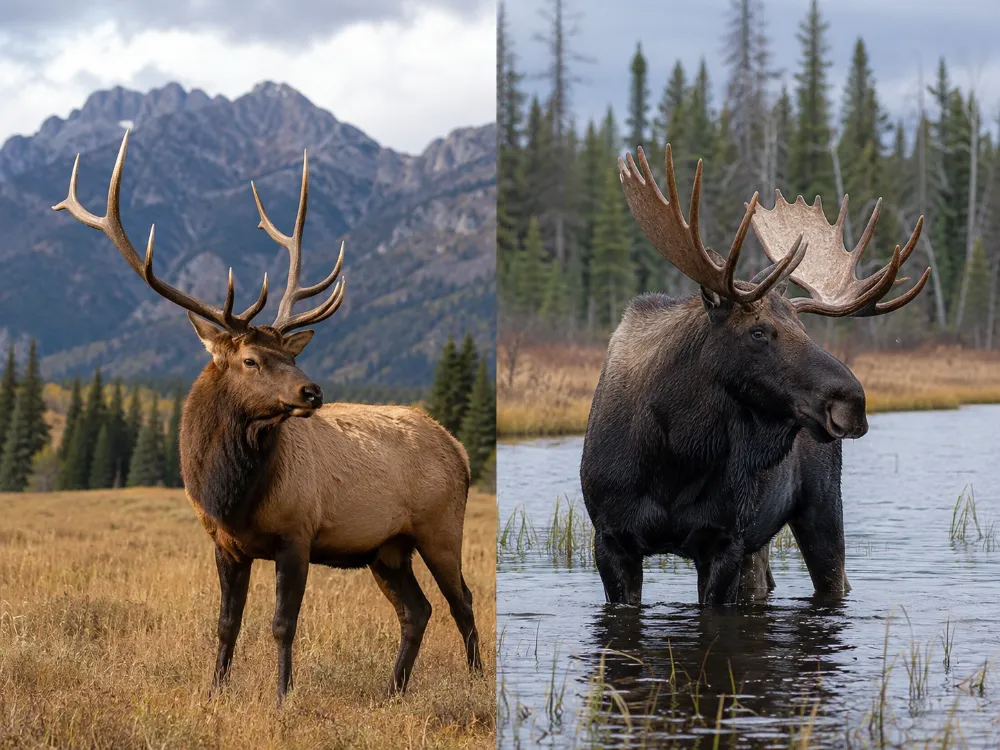
Elk are usually more social
Elk are often much more social than moose. Outside of certain seasons, elk may gather in herds, and in many places people regularly see groups feeding together in meadows, valleys, or open woodland. During the breeding season, this herd structure becomes especially obvious.
Moose are often more solitary. A moose may be seen alone, a cow with a calf, or a bull alone except during the breeding season. They do not usually create the same large, highly visible herd scenes associated with elk.
If you see many large deer-like animals together in an open area, elk is usually the stronger answer.
Elk and moose use different habitats
Elk often use a mix of forests, open meadows, mountain valleys, woodland edges, and grassland-like feeding areas. They are comfortable moving between cover and open ground, especially where grazing opportunities are good.
Moose are more strongly associated with northern forest, wetlands, lake edges, marshes, bogs, willow thickets, and shrubby browse-rich habitats. They often seem tied to places with dense young growth, aquatic plants, and lots of cover.
This habitat difference helps explain much of their body design. Elk are large grazers and mixed feeders of broader landscapes. Moose are towering browsers of northern brush and wet habitats.
They eat plants, but not exactly the same plants
Both elk and moose are herbivores, but they often feed differently. Elk commonly graze on grasses as well as leaves, forbs, and other vegetation depending on the season. They often use more open feeding areas than moose do.
Moose are famous as browsers. They often feed on twigs, shoots, willow, birch, aspen, aquatic plants, and other woody or wetland vegetation. Their long legs and big body help them reach and process browse in places where smaller deer might not feed as efficiently.
So if the animal is feeding in open grassland, elk becomes more likely. If it is stripping woody browse in swampy cover, moose becomes more likely.
Elk are famous for bugling
One of the most iconic elk traits is the bull’s bugling call during the rut, or breeding season. This high, haunting sound is one of the most famous wildlife calls in North America and is strongly linked with autumn elk behavior.
Moose vocalizations are much less dramatic to most people. Moose can make sounds, especially during breeding season or between cows and calves, but they are not famous for the same kind of ringing, far-carrying bugle that defines bull elk.
If you hear a wild autumn bugle in elk country, you are almost certainly hearing elk, not moose.
The breeding season looks different too
During the rut, bull elk often gather and defend groups of females, showing off, bugling, and sometimes fighting rivals. This creates some of the most dramatic herd-based breeding scenes among large deer.
Moose breeding behavior is usually less about big herd scenes and more about solitary or loosely paired animals coming together. Bulls may still compete, but the overall visual effect is different because moose are not usually gathering in the same large open-group structure seen in elk.
This makes elk rutting behavior more obvious and more famous to many wildlife watchers.
Elk move more like giant deer, moose move more like giant browsers
Elk often give an impression of coordinated, athletic movement. They can run fast, travel long distances, and move gracefully in groups. Even though they are heavy animals, they often look energetic and balanced.
Moose move with a different feel. They can be surprisingly fast, but they usually seem heavier, longer-legged, and more deliberate. Their gait often looks like that of a giant animal designed to stride through brush, swamp edges, and snow.
So even when both are walking, the elk often feels more herd-deer-like, while the moose feels more like a solitary giant of the northern forest.
Range can cause confusion in language
There is one extra layer of confusion: in Europe, the animal called an elk is actually what North Americans call a moose. In North America, however, elk means Cervus canadensis, while moose means Alces alces.
This language difference matters because some readers may see “elk” used differently in international sources. For a North American wildlife comparison, though, elk and moose are clearly separate animals.
So if you ever see conflicting use of the word elk in older or European material, that is a naming issue, not proof that the animals are the same.
Why people confuse them so often
People confuse elk and moose because both are giant deer with long legs, antlers in males, and a generally brown coat. If a person only sees a silhouette in poor light, the fine details may disappear and the animal may simply register as “very large deer.”
The confusion is also stronger among people who have never seen both species in person. A beginner may not realize just how much larger and stranger-looking a moose really is compared with an elk.
Once you focus on face shape, antlers, color, and body build, the difference becomes much easier to understand.
How to tell them apart quickly
If you need a fast field guide, use these clues together:
Elk: smaller than a moose, lighter brown, more deer-like face, branching antlers, often seen in groups
Moose: much larger, darker, long drooping face, paddle-shaped antlers, often seen alone in forest or wetland habitat
No single clue is perfect every time, but this combination is usually very reliable.
Which one is more dangerous?
Both elk and moose are powerful wild animals that deserve caution and distance. Moose are often considered especially dangerous in close encounters because of their huge size, long legs, and willingness to defend themselves strongly when threatened, especially cows with calves or animals stressed by dogs or winter conditions.
Elk can also be dangerous, especially during the rut or when people approach too closely. Large bulls are not harmless, and cows with calves can also defend themselves forcefully.
The safest rule is simple: treat both as large wild ungulates, never as oversized deer that will always run away quietly.
Final takeaway
The main difference between elk and moose is that elk are large, social, more deer-like animals with branching antlers and lighter brown coats, while moose are much larger, darker, more solitary animals with long drooping faces, shoulder humps, and broad paddle-shaped antlers. Elk often use meadows and open forest edges, while moose are more strongly tied to northern forest and wetland habitats. They may both be giant deer, but once you learn the face, antler, and body clues, they are much easier to tell apart.
FAQs
Is a moose bigger than an elk?
Yes. A moose is usually much larger than an elk and is the largest living deer species.
How can I tell an elk from a moose fast?
Look at the face and antlers. Moose have a long drooping face and broad paddle antlers, while elk have a more deer-like face and branching antlers.
Do elk and moose live in the same places?
They can overlap in some northern areas, but elk usually use more open meadows and forest edges, while moose are more strongly associated with wetlands, browse-rich cover, and northern forest.
Why is the word elk confusing in Europe?
Because in Europe the word elk usually refers to the animal that North Americans call a moose.