The easiest way to tell a falcon from a hawk is to look at the wings, face, and hunting style. Falcons usually have long, narrow, pointed wings built for speed, while hawks usually have broader wings and a sturdier build suited to soaring, gliding, or maneuvering through woods. Falcons also kill prey differently and belong to a different bird family from hawks. So although both are birds of prey, they are not the same kind of raptor.
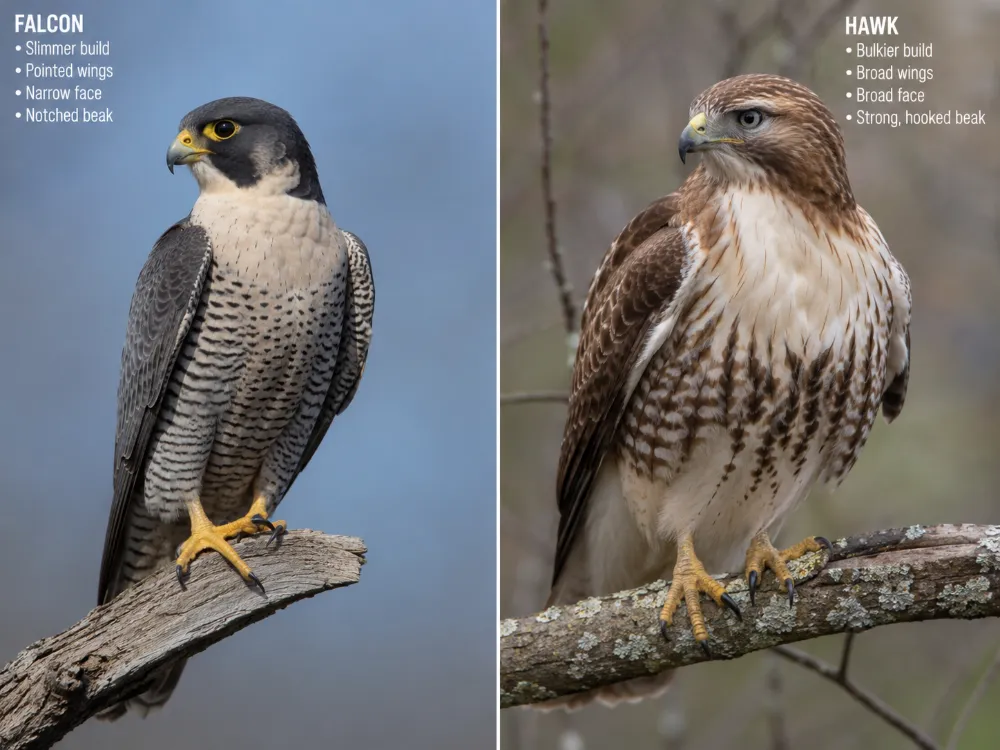
People often use the words falcon and hawk as if they mean almost any hunting bird with sharp talons. In everyday speech that is understandable, but biologically the difference is real. Falcons and hawks are separate groups with different anatomy, flight styles, and evolutionary history.
In this guide, you will learn how falcons and hawks differ in body shape, wings, beaks, hunting method, habitat use, and behavior, plus the fastest ways to identify them correctly in the field.
Quick comparison table
| Feature | Falcon | Hawk |
|---|---|---|
| Main family | Falconidae | Usually Accipitridae in everyday use |
| Wing shape | Long, narrow, pointed | Usually broader and more rounded or broader overall |
| Flight style | Fast, direct, powerful wingbeats | Often soaring, circling, gliding, or woodland maneuvering |
| Body build | Sleeker, more aerodynamic | Usually bulkier, broader-bodied |
| Beak | Usually with a distinct notch for killing prey | Strong hooked beak without the same falcon-style notch emphasis |
| Main hunting method | Speed and aerial interception | Ambush, soaring search, pounce, or short pursuit |
| Typical prey style | Often birds, insects, small mammals caught with speed | Small mammals, birds, reptiles, depending on species |
| Best quick clue | Pointed wings and fast, falcon-like flight | Broader wings and more classic soaring or woodland-hunting shape |
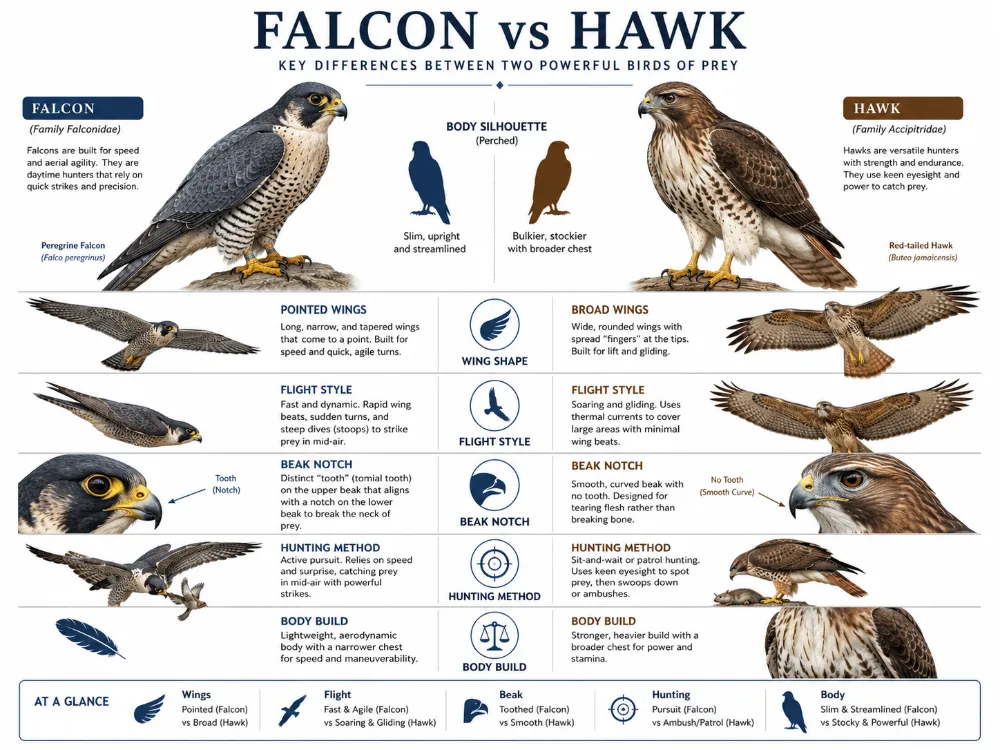
They are both raptors, but not the same group
Falcons and hawks are both birds of prey, also called raptors. That means they share certain features such as hooked beaks, sharp talons, strong vision, and a meat-based diet. These similarities are why people often lump them together.
However, they do not belong to the same main bird family. Falcons belong to the family Falconidae. Hawks, in ordinary English, usually refer to various birds in the family Accipitridae, especially broad-winged or forest-hunting species people commonly call hawks.
So the difference is not just about style or size. It is also a real taxonomic difference.
The word “hawk” is broader in everyday language
One reason the topic gets confusing is that falcon is usually a more precise label than hawk. Falcon refers to a well-recognized true falcon group. Hawk, by contrast, is a broader common name that people use for several kinds of raptors, especially medium-sized birds of prey that are not falcons, eagles, or vultures.
That means “hawk” is partly a practical field word. In common use, it often includes buteos, accipiters, and some other similar raptors. So when people compare falcon vs hawk, they are usually comparing falcons with the more typical broad-winged hawk image.
This is why the hawk category can feel a little less precise than the falcon category.
Falcons usually have longer, more pointed wings
One of the fastest ways to separate a falcon from a hawk is to look at the wings. Falcons usually have long, narrow, pointed wings that give them a sleek, aerodynamic shape. These wings are excellent for speed and rapid pursuit in open air.
Hawks usually have broader wings. In many species, the wings look wider and less sharply pointed. This broader shape suits soaring over fields, gliding on rising air, or maneuvering through woodland depending on the type of hawk.
If the bird looks sharply winged like a high-speed aerial hunter, falcon becomes more likely.
Falcons often look sleeker and more aerodynamic
Falcons usually have a leaner, more streamlined body. Their chest, head, and tail often seem shaped for speed and efficient aerial attack. Even when perched, many falcons look compact, tight, and fast.
Hawks often look sturdier and more broad-bodied. Some have a deep chest and wide wings suited to soaring, while woodland hawks may look compact but still broader-winged and less dart-shaped than a falcon.
If the bird gives the impression of a flying missile, falcon is a strong guess. If it looks more like a broad-winged soaring hunter, hawk becomes more likely.
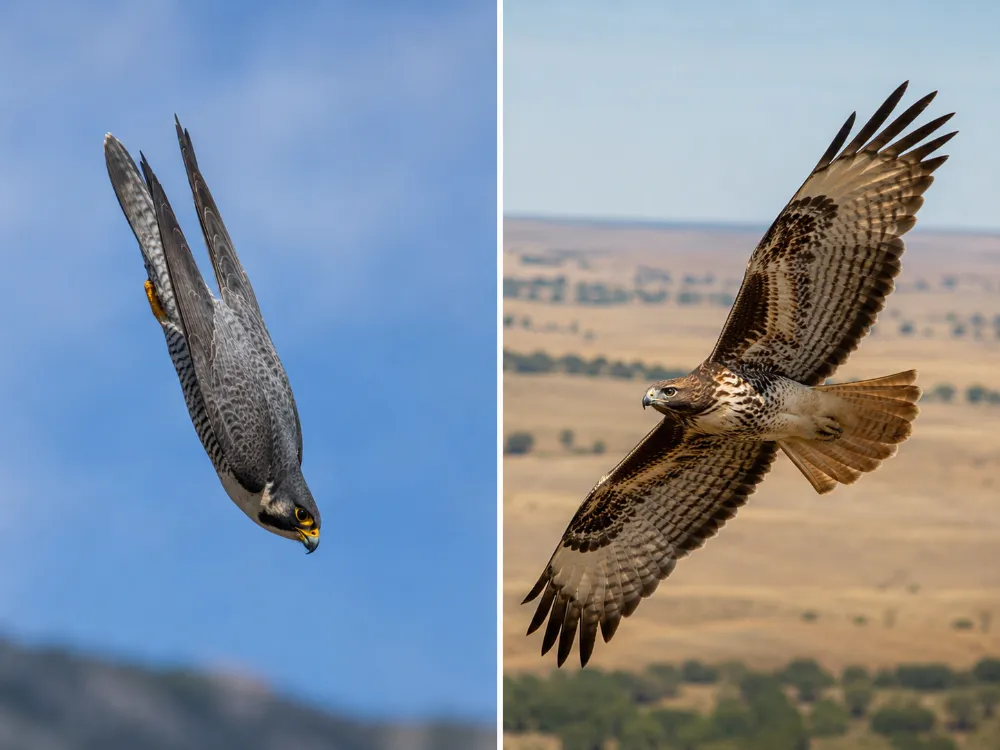
Flight style is one of the best clues
Falcons often fly with fast, purposeful wingbeats and strong direct motion. Many species look quick, energetic, and sharply controlled in the air. Some can reach astonishing speeds, especially during a hunting dive.
Hawks are more varied, but many show more soaring, circling, or gliding behavior. Broad-winged hawks often use rising air currents and may spend long periods riding the sky rather than driving forward with constant fast wingbeats. Woodland hawks can flap quickly too, but their flight still usually looks different from the sharper, more pointed falcon style.
If the bird cuts through the air with speed and precision, falcon is more likely. If it circles, soars, or glides more often, hawk becomes more likely.
Falcons usually have a distinctive beak notch
A classic falcon feature is the presence of a notch on the beak, sometimes called a tomial tooth. This helps the falcon dispatch prey efficiently after capture. It is one of the most important anatomical differences between falcons and hawks.
Hawks also have strong hooked beaks, but they do not show the same falcon-style emphasis on this notch as a defining killing tool. Hawks more often rely heavily on their talons to subdue prey before tearing it with the beak.
This difference is not always easy to see at a distance, but it is important biologically.
Falcons often kill prey differently
Falcons commonly strike prey at speed and then use the beak to finish the kill. Their hunting system combines aerial precision with the specialized beak structure mentioned above.
Hawks often depend more on the grip and crushing power of their talons. They may seize prey with the feet and then begin feeding with the hooked beak. In many hawks, the feet are especially central to the kill.
Both groups use talons and beaks, of course, but the balance of how they subdue prey is one of the real differences between them.
Hawks are often broader-winged hunters
Many hawks are built for a more versatile hunting style than falcons. Some soar over open country and scan the ground for movement. Others, especially woodland hawks, use bursts of speed through trees to surprise prey. Their wing shape and body style reflect these varied strategies.
Falcons, by contrast, are more strongly associated with speed and aerial interception. This gives them a different overall feel in both silhouette and behavior.
So even though both are predators, the hawk often feels more like a broad-shouldered hunter, while the falcon feels more like an air specialist.
Falcons are often famous for speed
If one trait defines falcons in the public imagination, it is speed. Falcons are among the most spectacular aerial hunters in the bird world. Their long pointed wings, compact body, and precision flight allow them to chase prey at high speed and, in some species, dive with extraordinary force.
Hawks can certainly fly fast, but they are usually not the classic symbol of extreme aerial speed. Their strengths more often involve soaring, scanning, ambush, or versatile hunting depending on the species.
So if the bird’s entire look suggests speed first, falcon is the better guess.
Hawks are often better known for soaring and scanning
Many hawks, especially buteos, are famous for circling over open country and watching the ground for rodents, reptiles, or other prey. Their broad wings make them efficient soarers, and their hunting style often looks patient and observant.
Other hawks, especially accipiters, are better at weaving through woodland after birds, but even these still tend to look less sharply pointed than falcons.
This is why a large soaring raptor over a field is often called a hawk first by many observers.
Face pattern can help, especially in falcons
Many falcons show strong facial markings, including dark moustache-like stripes in some species. These markings can make the face look bold and sharply patterned. The classic example is the peregrine falcon, whose face often looks strongly marked.
Hawks vary widely, but many do not show the same iconic falcon facial pattern. Their face often looks broader or more open, though plumage varies greatly across hawk species.
Facial pattern alone is not enough for identification, but it can support the other clues.
Tail and wing proportions often differ
Falcons often have a balanced look of pointed wings and a moderately long tail that helps with control during high-speed flight. Hawks vary more, but many broad-winged hawks look broader through the wings and less needle-shaped overall.
Woodland hawks can have relatively long tails that help with steering through trees, but even then the full silhouette usually does not match the classic falcon shape.
When experienced birdwatchers identify raptors at a distance, these proportion clues are often just as important as color.
Habitat use often reflects their hunting style
Falcons are often associated with open spaces, coastlines, cliffs, grasslands, or wide skies where speed and direct aerial pursuit are useful. Many species also adapt well to cities, where tall buildings can mimic cliffs and urban birds provide prey.
Hawks use a wide variety of habitats, from forests and woodland edges to grasslands, deserts, and farmland. Their diversity is one reason the hawk category feels broader and more flexible.
So habitat alone is not enough, but it often fits the body design. Fast open-air hunters tend to look like falcons. Broad-winged or ambush-oriented hunters often look like hawks.
Prey differences are real, but they overlap
Falcons often feed on birds, insects, and small mammals, especially prey that can be caught with speed or aerial skill. Some falcons are famous bird-hunters, while others also take large numbers of insects.
Hawks also eat birds and mammals, but many are especially known for hunting rodents, rabbits, reptiles, and other ground-based prey. Some woodland hawks specialize strongly in bird capture.
So prey choice does overlap. The more useful distinction is often not what they eat, but how they catch it.
Both have excellent eyesight, but they use it a little differently
Falcons and hawks both have superb vision, as expected for raptors. However, their visual hunting style often matches their flight style. Falcons often use vision in rapid high-speed pursuit and aerial timing.
Many hawks use vision in longer scanning behavior, watching from a perch or while soaring before dropping on prey. Woodland hawks also rely on timing and visual control, but often in more enclosed spaces.
So both are visual predators, but their eyes serve somewhat different hunting rhythms.
Why people confuse them so often
People confuse falcons and hawks because both are medium to large predatory birds with hooked beaks, sharp talons, and a familiar raptor outline. From a distance, any fast-flying brown or gray bird of prey can look similar if the silhouette is not clear.
The confusion also comes from language. Many people use “hawk” loosely for almost any raptor that is not huge, while “falcon” is sometimes used only when the bird is especially famous. Without knowing the wing shape and flight style, mistakes are easy.
Once you focus on wings, body build, and hunting style, the difference becomes much clearer.
How to tell them apart quickly
If you need a fast field guide, use these clues together:
Falcon: long pointed wings, sleek body, fast direct flight, often a distinct facial pattern, specialized beak notch, aerial hunter
Hawk: broader wings, sturdier body, more soaring or ambush-oriented flight, classic talon-focused hawk build, often broader overall silhouette
No single clue is perfect every time, but this combination usually works very well.
Which one is stronger?
If strength means brute grip and broad-bodied power, many hawks create that impression more strongly, especially the bigger broad-winged forms. If strength means speed, aerial precision, and high-impact flight performance, falcons often stand out more.
So the answer depends on what kind of strength you mean. Falcons are often the speed specialists. Hawks are often the broader-built generalist raptors.
Each group is impressive in a different way.
Final takeaway
The main difference between a falcon and a hawk is that falcons are sleeker, pointed-winged raptors built for speed and aerial precision, while hawks are usually broader-winged, sturdier raptors built for soaring, scanning, or ambush depending on the species. Falcons belong to a different family, often have a specialized beak notch, and are famous for fast pursuit. Hawks are a broader everyday group of raptors that often rely more heavily on talons and broader-winged hunting styles. They may both be birds of prey, but once you know the wing and flight clues, they are much easier to tell apart.
FAQs
Is a falcon a hawk?
No. Falcons and hawks are both raptors, but they belong to different bird groups.
How can I tell a falcon from a hawk fast?
Look at the wings. Falcons usually have long pointed wings, while hawks usually have broader wings.
Which is faster, a falcon or a hawk?
Falcons are generally more strongly associated with speed and high-speed aerial hunting.
Do falcons and hawks eat the same things?
They can overlap in diet, but the bigger difference is often how they hunt rather than what they eat.