The easiest way to tell an emu from an ostrich is to look at size, toes, and feathers. Ostriches are much larger, live in Africa, and have only two toes on each foot. Emus are smaller, live in Australia, and have three toes. Ostriches also have a more bare-looking neck and dramatic black-and-white plumage in males, while emus usually look shaggy, brown-gray, and more evenly feathered.
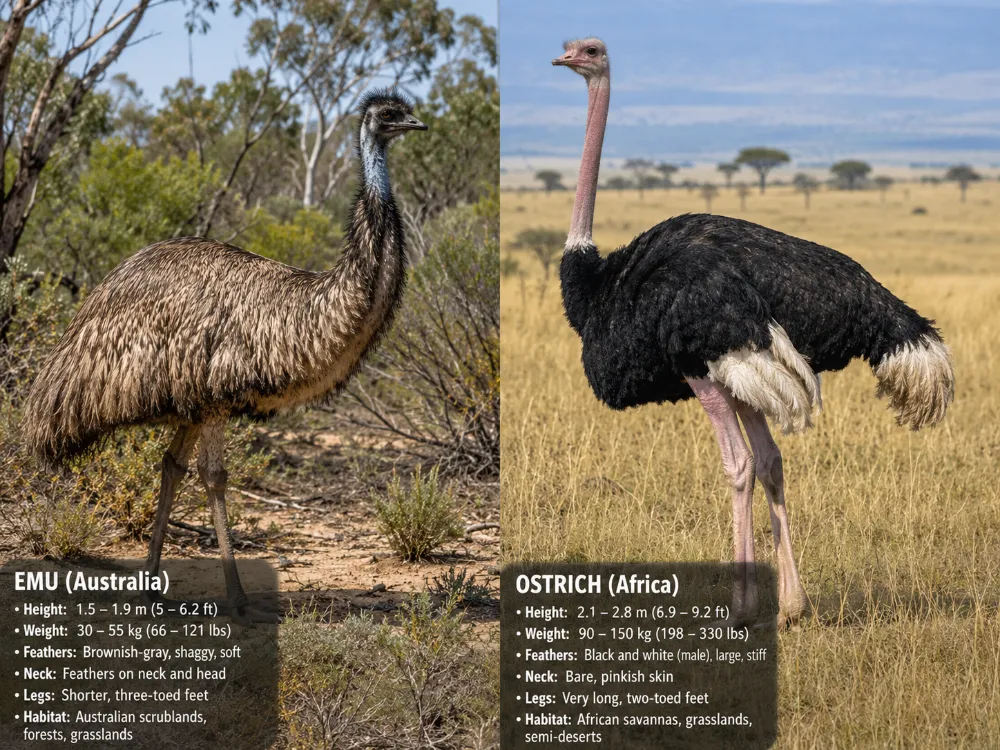
People often compare emus and ostriches because both are huge flightless birds with long legs, long necks, and powerful running ability. At a distance, they can look like oversized cousins built on the same basic plan. In reality, they belong to different bird lineages and differ in body structure, habitat, appearance, and behavior in ways that are easy to spot once you know what to check.
In this guide, you will learn how emus and ostriches differ in size, feet, feathers, range, eggs, movement, and lifestyle, plus the fastest ways to identify them correctly.
Quick comparison table
| Feature | Emu | Ostrich |
|---|---|---|
| Scientific name | Dromaius novaehollandiae | Struthio camelus |
| Native range | Australia | Africa |
| Overall size | Large, but smaller than an ostrich | The largest living bird |
| Toes | Three toes | Two toes |
| Feather appearance | Shaggy, brown-gray, softer-looking | More dramatic body plumage; males often black and white |
| Neck and legs | Feathered-looking and less sharply bare | Longer, more bare-looking neck and legs |
| Social pattern | Often solitary or in loose groups | Often more visibly social in open country |
| Best quick clue | Three toes and shaggy brown look | Huge size, two toes, and more bare, dramatic look |
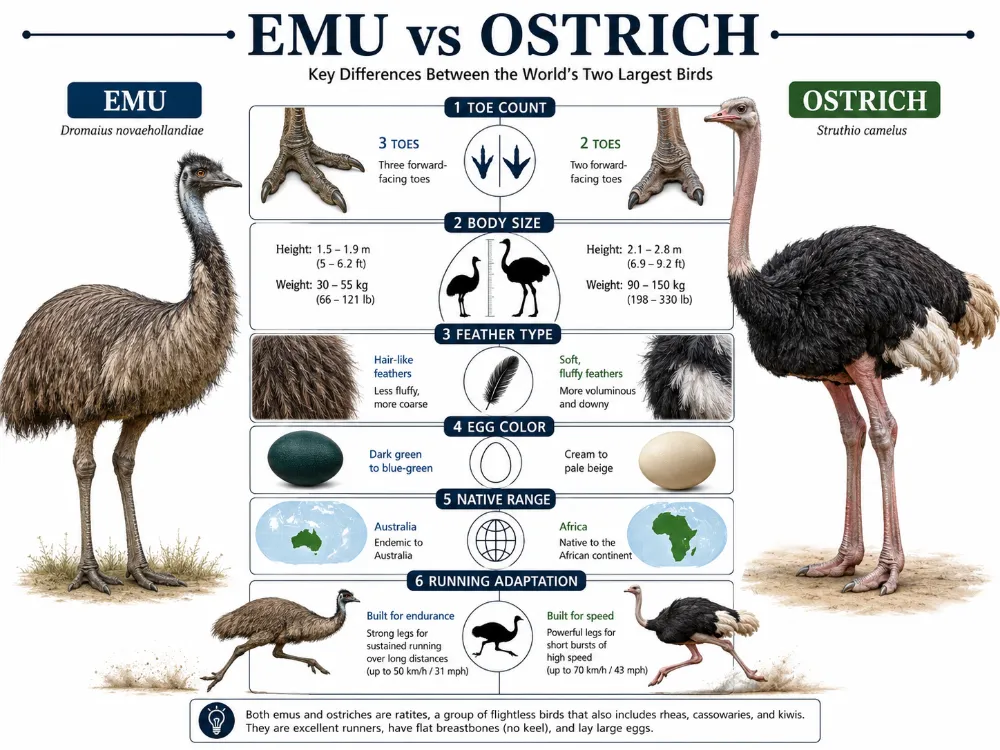
They are both flightless birds, but they are not the same kind of bird
Emus and ostriches are both large flightless birds, which is why they share a similar first impression: long neck, powerful legs, reduced wings, and a body built for running instead of flying. However, they are not simply regional versions of one species.
The ostrich belongs to a different lineage from the emu. Each bird evolved in a different continent under different ecological pressures. That separate history shaped their body size, foot structure, feather type, social life, and habitat use.
So while both are giant runners, the emu and ostrich represent two distinct evolutionary solutions to life as a large flightless bird.
Ostriches are much bigger
One of the clearest differences is size. Ostriches are much larger than emus and are the largest living birds in the world. A full-grown ostrich often looks towering, broad-bodied, and extremely long-legged.
Emus are still large and impressive birds, but they do not reach the same huge scale. They usually look narrower, somewhat shorter, and less massive overall than an ostrich.
If the bird seems enormous in a way that almost looks prehistoric, ostrich becomes the stronger guess. If it is very large but not overwhelmingly huge, emu becomes more likely.
The feet are one of the best identification clues
If you want one fast scientific field mark, look at the toes. Emus have three toes on each foot. Ostriches have only two.
This difference is extremely important because it reflects how the birds move. Ostriches are specialized for high-speed running on open ground, and the reduced toe number is part of that adaptation. Emus also run very well, but their foot structure follows a different path.
If you can clearly see only two large toes, the bird is an ostrich. If you see three, it is an emu.
Ostriches usually have a more bare-looking neck and legs
Ostriches often have a more exposed-looking neck and upper leg region. Their long neck can appear relatively bare and smooth compared with the shaggier impression created by an emu.
Emus usually look more evenly feathered overall, even though parts of the neck can still appear thinner. Their whole outline tends to feel softer and less sharply separated between feathered body and bare skin.
This difference helps create the classic visual contrast: the ostrich looks taller, cleaner-lined, and more open-skinned, while the emu looks rougher, shaggier, and more covered.
Emus usually look shaggier
Emus are famous for their shaggy, brown-gray plumage. Their feathers often hang in a rough, layered way that gives the bird a slightly fuzzy or tousled look. This texture makes the emu seem more earthy and less sharply patterned than an ostrich.
Ostriches usually look more dramatic and cleaner in color blocks, especially males. The overall feather impression is often more striking and high-contrast rather than softly shaggy.
If the bird looks like a large brown, slightly messy-feathered runner, emu is usually the better answer.
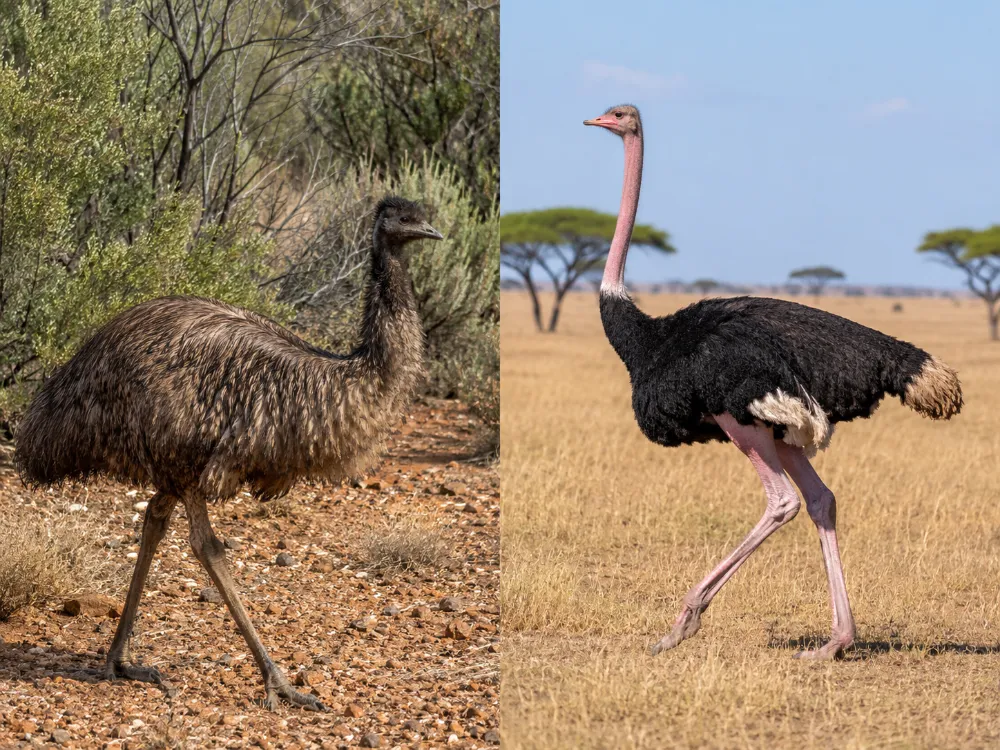
Male ostriches are more visually dramatic
Adult male ostriches are especially easy to recognize because they often have black body feathers with bold white wing and tail feathers. This contrast gives them a very striking appearance in open landscapes.
Emus do not show that same dramatic black-and-white male pattern. They usually appear in more muted brown-gray tones that help them blend into scrub, woodland edges, and open Australian landscapes.
If the bird shows strong black-and-white contrast, especially in a very large male, it is almost certainly an ostrich rather than an emu.
Emus are native to Australia, ostriches to Africa
Geography is one of the simplest clues of all. Emus are native to Australia. Ostriches are native to Africa.
This means a truly wild giant flightless bird seen in the Australian outback is an emu, not an ostrich. A giant wild flightless bird on African savanna or dry open land is an ostrich, not an emu.
Captive animals can appear anywhere in the world, of course, but in natural range the identification is much easier.
Ostriches are built for open-country speed
Ostriches are among the most specialized running birds on Earth. Their very long legs, large stride, and two-toed feet are all part of a body built for powerful movement across open ground.
Emus are also strong runners and can cover distance efficiently, but they do not look as extremely built for sprinting in open plains as ostriches do. Their build feels slightly more generalist and less exaggerated.
This is one reason ostriches often seem more like giant open-country racers, while emus feel more like tough, versatile long-distance walkers and runners.
Emus often look more compact and rough-textured
Compared with the ostrich, the emu often appears more compact in body outline. The neck is still long, but the overall impression is less towering and less cleanly segmented into bare and feathered areas.
The rough, layered feather texture also changes the whole visual feel of the bird. An emu looks more blended into dry grasses, scrub, and bushy landscapes, while an ostrich often stands out more clearly in open light.
So even before you count toes, the texture of the bird often hints at the answer.
They use different habitats in different ways
Ostriches are strongly associated with open African habitats such as savannas, semi-arid plains, and broad grassland country. Their body is well suited to visibility, distance running, and open-ground awareness.
Emus also use open habitats, but they are especially associated with Australian grasslands, shrublands, woodland edges, and semi-open country. Their ecology feels tied to broad, often dry landscapes with mixed cover rather than purely open plains alone.
So both are birds of open country, but the ostrich is usually the more obvious open-plain specialist.
Ostriches often live more visibly in open groups
Ostriches are often seen in open-country groups or in visible association with other large grazing animals in African landscapes. Their open habitat makes their social presence easier to observe, and they can appear strikingly conspicuous on the plain.
Emus may also occur in pairs or loose groups, especially depending on season and resources, but they often feel more scattered and less theatrically visible than ostriches in classic open-country scenes.
This is a general pattern rather than an absolute rule, but it matches the broader difference in how the two species use landscape.
Emu eggs and ostrich eggs are very different in color
Egg color is another memorable difference. Emu eggs are famous for being dark green to blue-green and glossy. They are among the most visually distinctive bird eggs in the world.
Ostrich eggs are much larger and usually pale cream to off-white. They look more like giant classic bird eggs, although on a much bigger scale than almost any other living species.
If you ever compare the eggs directly, the contrast is dramatic: dark green emu egg, pale giant ostrich egg.
Parental care differs too
Emus are especially interesting because males usually take on the main job of incubating the eggs and guarding the chicks after hatching. This makes the male emu a central figure in parental care.
Ostrich breeding and nesting systems are more complex in a different way, often involving shared nest use and dominant breeding structure, with strong differences between males and females in social and reproductive roles.
This means the two birds differ not only in appearance, but also in how their family system works.
The sounds they make are not the same
Emus can produce deep booming and drumming sounds, especially females. These sounds can be surprisingly low and resonant for such a shaggy-looking bird.
Ostriches also vocalize, but their sound profile is different and often less familiar to the average reader than their visual appearance. Males can produce booming or roaring-like calls, especially in display contexts.
So although both birds are not usually thought of first in terms of sound, their voices are another reminder that they are different species with different communication styles.
They defend themselves differently in detail, but both are powerful
Both emus and ostriches can be dangerous if cornered or mishandled. Their long legs are powerful, and both can kick hard. These are not birds that should be treated casually at close range.
Ostriches, because of their size and strength, often have the stronger public reputation for dangerous kicks. Emus are also powerful and should be respected, but they do not usually create the same towering physical impression as an ostrich.
So the safest rule is simple: both are large flightless birds with serious leg power.
Why people confuse them so often
People confuse emus and ostriches because both have the same broad visual formula: giant bird, long neck, long legs, flightless body, and open-country running style. If someone sees only a silhouette or a quick image online, the distinction may not seem important at first.
The confusion is even stronger in places where both are known mainly through zoos, farms, or popular culture rather than through direct wildlife experience. Many people know they are different, but not exactly how.
Once you focus on size, toes, feather texture, and geography, however, the difference becomes very easy to understand.
How to tell them apart quickly
If you need a fast identification guide, use these clues together:
Emu: smaller than an ostrich, shaggy brown-gray feathers, three toes, native to Australia
Ostrich: much larger, more bare-looking neck and legs, two toes, native to Africa, often dramatic black-and-white male plumage
No single clue is better than the toes, but body size and feather texture usually give the answer almost immediately.
Which one is faster?
Both birds are strong runners, but ostriches are generally considered the more specialized high-speed runners. Their leg structure and two-toed feet are especially adapted for powerful fast movement across open ground.
Emus are still fast and highly capable over long distances, but ostriches usually hold the stronger reputation for outright running performance.
So if the question is top-speed running specialization, the ostrich usually has the edge.
Final takeaway
The main difference between an emu and an ostrich is that the ostrich is much larger, African, and two-toed, with a more bare-looking neck and dramatic male plumage, while the emu is smaller, Australian, and three-toed, with shaggy brown-gray feathers and a rougher overall look. Both are large flightless runners, but once you check the feet, feather texture, and body size, they are very easy to tell apart.
FAQs
Is an ostrich bigger than an emu?
Yes. Ostriches are much larger than emus and are the largest living birds.
How can I tell an emu from an ostrich fast?
Look at the feet and feathers. Emus have three toes and shaggy brown feathers, while ostriches have two toes and a more bare, dramatic look.
Do emus and ostriches live in the same places in the wild?
No. Emus are native to Australia, while ostriches are native to Africa.
Which one is faster, an emu or an ostrich?
Both are fast runners, but ostriches are generally more specialized for top-speed running.