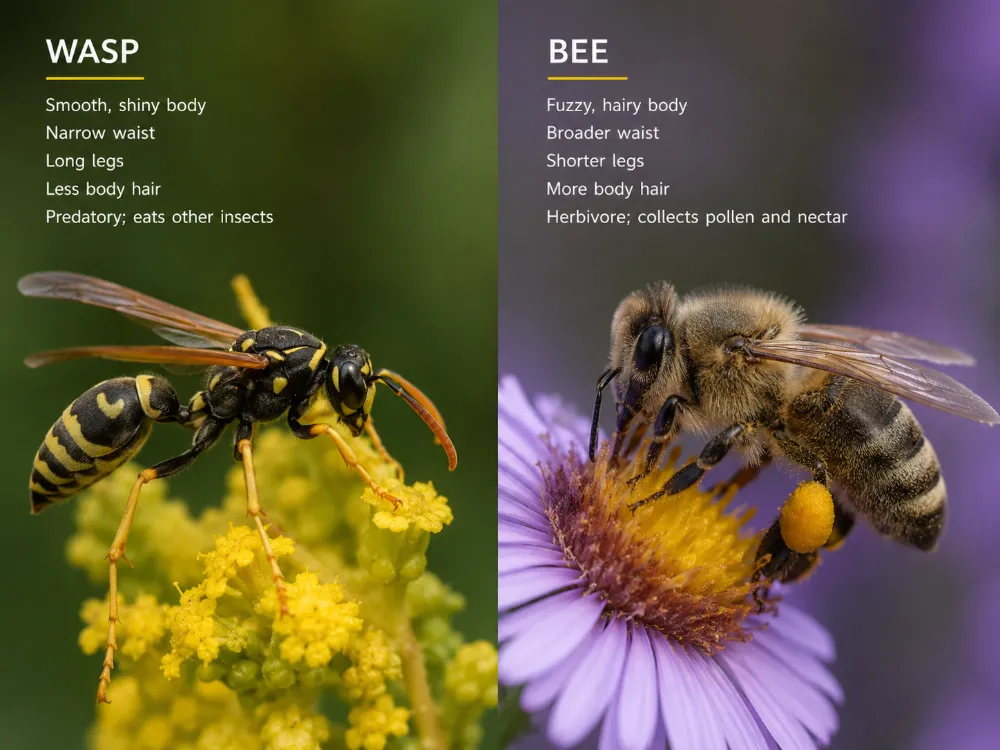
The easiest way to tell a wasp from a bee is to look at the body shape, hair, and behavior. Bees are usually rounder, fuzzier, and more pollen-focused, while wasps are usually slimmer, smoother, and more sharply waisted. Bees often visit flowers to gather pollen and nectar, while many wasps are hunters, scavengers, or both. They are related insects, but they live very different ecological lives.
People often confuse wasps and bees because both are flying insects that can sting, visit flowers, and build nests. From a distance, a striped yellow-and-black insect may simply look like “something that can sting.” Once you know what to check, however, the differences become much easier to see.
In this guide, you will learn how wasps and bees differ in body shape, hair, diet, nesting style, behavior, stinging, and ecological role, plus the fastest ways to identify them correctly.
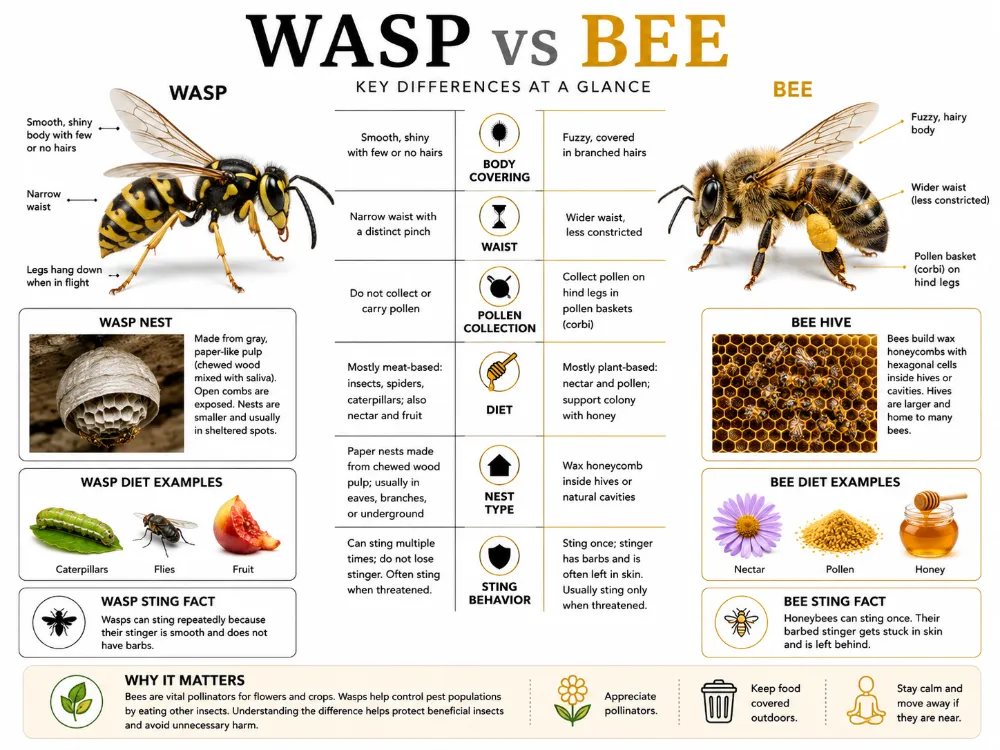
Quick comparison table
| Feature | Wasp | Bee |
|---|---|---|
| Body shape | Usually slimmer with a narrow waist | Usually rounder, thicker, and more compact |
| Body texture | Smoother, less hairy | Hairier or fuzzier, especially on the thorax |
| Main diet style | Often predatory, scavenging, or omnivorous | Mainly nectar and pollen focused |
| Pollen collection | Usually less specialized | Highly specialized for carrying pollen |
| Nest material | Often papery nests, mud nests, or hidden cavities depending on species | Wax combs, burrows, hollow stems, wood cavities, or soil nests depending on species |
| Temperament around food | More likely to visit meat, soda, or picnic food | More likely to focus on flowers |
| Sting pattern | Can often sting more than once | Varies by bee; honey bees often sting once and die, many others can sting repeatedly |
| Best quick clue | Shiny, narrow, smooth-bodied look | Fuzzy, pollen-carrying, flower-focused look |
They are related, but not the same kind of insect
Wasps and bees both belong to the order Hymenoptera, which also includes ants. That shared ancestry explains why they have some similarities, such as two pairs of wings, a narrow connection between body regions, and in many species a sting derived from the egg-laying structure of females.
However, bees and wasps are not the same thing. Bees form a specialized branch that is strongly adapted for collecting pollen and feeding on floral resources. Wasps are a broader and more varied group, including predators, parasitoids, scavengers, and social nest-builders.
So the bee is not just a fluffy wasp, and the wasp is not simply an angrier bee. Their biology is genuinely different.
Bees are usually fuzzier
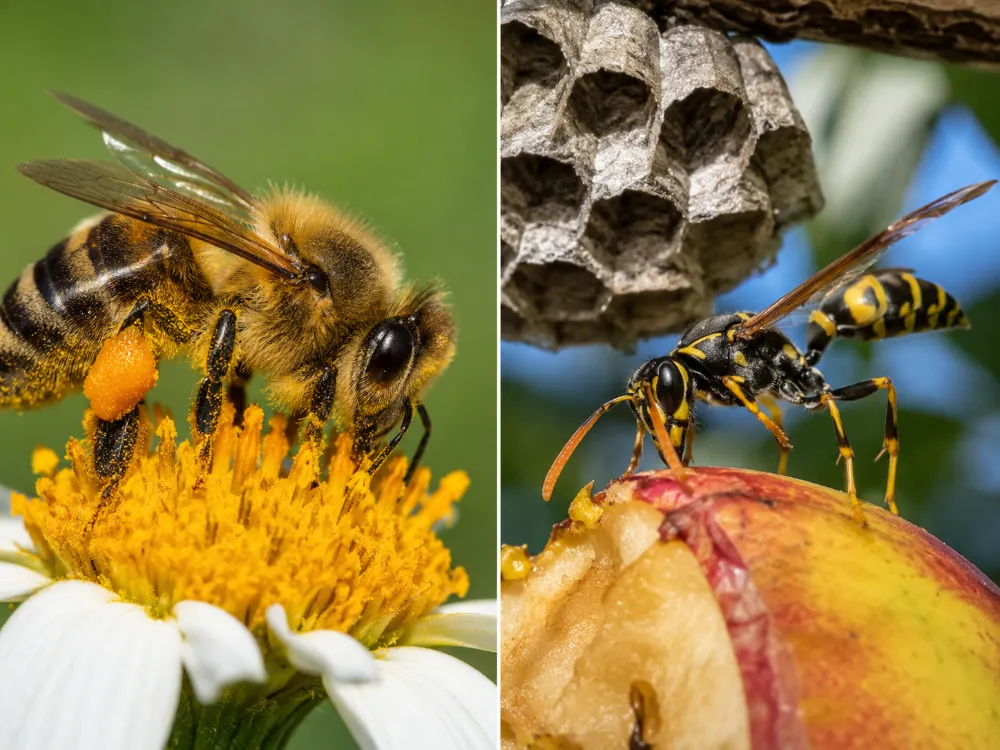
One of the easiest field clues is body hair. Bees are often noticeably fuzzy, especially around the thorax. That hair is not just for appearance. It helps trap pollen, which is essential for bee feeding and pollination.
Wasps are usually smoother and shinier. Their body often looks cleaner-lined, harder, and less fuzzy. This is because most wasps are not as specialized for pollen collection as bees are.
If the insect looks soft, hairy, and dusted with pollen, bee becomes much more likely. If it looks sleek and polished, wasp becomes more likely.
Wasps usually have a narrower waist
Many wasps have the classic pinched “wasp waist,” where the abdomen connects to the thorax through a very narrow section. This gives them a sharper, more angular appearance.
Bees also have a narrow connection between body sections, but they often look thicker and more compact overall. Their body does not usually give the same long, sharply pinched impression as a typical wasp.
If the insect looks thin, stretched, and sharply waisted, it is often a wasp. If it looks stockier and more rounded, it is often a bee.
Bees are built for pollen
Bees are highly specialized flower visitors. They feed mainly on nectar and pollen, and many species have structures that help them gather, carry, and transport pollen efficiently. In some bees, the legs or underside may visibly carry yellow or orange pollen loads.
This makes bees some of the most important pollinators in nature. Their bodies, hairs, and behavior all support that ecological role.
Wasps can visit flowers too, and some do contribute to pollination, but they are usually not as heavily specialized for pollen transport as bees are.
Wasps are often predators or scavengers
Many wasps live very different lives from bees. Instead of collecting pollen to feed young, many wasps hunt insects, spiders, caterpillars, or other small prey. Others scavenge sugary liquids, fruit, meat, or human food scraps.
This is why wasps are often noticed around picnics, trash bins, soda cans, fruit, and meat. They are much more willing than bees to investigate human food for sugar or protein.
So if the insect is hovering around a sandwich or piece of meat, it is much more likely to be a wasp than a bee.
Bees usually focus on flowers
Bees are often flower-centered insects. They move from bloom to bloom collecting nectar and pollen, and many species show strong loyalty to flower-rich environments. Their daily behavior is usually more tied to plants than to human food waste.
This is one reason people often view bees as calmer or more “garden-like.” Their lifestyle is strongly connected to pollination, nest provisioning, and plant reproduction.
If the insect is methodically working flowers and ignoring your food, bee becomes the stronger guess.
Body color can overlap, so it is not the best clue
People often think bees are always fuzzy yellow-and-black and wasps are always shiny yellow-and-black, but real nature is more complicated. Some bees are black, metallic green, blue, rusty, or banded. Some wasps are reddish, brown, black, or even metallic.
That means color alone is not reliable. Hair, body shape, movement, and behavior usually tell the story much better than color does.
So when identifying one, it is smarter to ask how it looks and what it is doing, not just what color it is.
Bees and wasps build different kinds of nests
Nest style is another important clue. Honey bees build wax combs and live in large colonies. Bumblebees may nest in cavities or underground spaces. Many solitary bees use soil, hollow stems, or wood holes.
Wasps vary greatly. Paper wasps build open comb nests. Yellowjackets make enclosed paper nests. Mud daubers build mud tubes. Many solitary wasps use burrows or hidden cavities. Some parasitic wasps do not build familiar nests at all.
So if you see papery layered nest material, wasp becomes more likely. If you see wax comb or heavy flower traffic to a cavity, bee becomes more likely.
Social life is more varied than many people expect
People often think bees are social and wasps are social, but the truth is broader. Some bees, such as honey bees and bumblebees, are social, while many others are solitary. The same is true for wasps. Some are social nest-builders, but many live alone.
This matters because “social behavior” does not cleanly separate bees from wasps. Instead, it shows that both groups include a wide range of lifestyles.
The more useful difference is what those lifestyles are organized around. Bees are usually organized around flowers and pollen. Wasps are often organized around prey, scavenging, or more generalized food use.
Stings are not exactly the same
Both bees and wasps can sting, but people often oversimplify how. A female wasp can usually sting more than once because the sting is not left behind in the same way a honey bee’s sting often is.
Honey bees are famous because workers often sting only once and then die. However, not all bees follow that exact pattern. Some bees can sting repeatedly, and many are much less likely to sting unless handled or trapped.
So the better general rule is not “bees sting once, wasps sting many times,” but rather “wasps often sting repeatedly, while honey bees are the classic one-time stingers.”
Wasps often feel more defensive around nests and food
Many people experience wasps as more aggressive, especially late in warm seasons when social wasps become more noticeable around food and nest defense becomes a bigger issue. A wasp circling fruit, soda, or meat often feels more confrontational than a bee on a flower.
Bees can defend themselves strongly too, especially when a colony is threatened. A disturbed beehive is not safe. But away from the nest, many bees are usually more interested in flowers than in bothering people.
This difference in everyday human experience is one reason wasps and bees have such different public reputations.
Bees are usually more important pollinators
Bees are among the most important pollinators on Earth. Many flowering plants depend heavily on them, and many agricultural crops benefit greatly from bee activity. Their body shape, behavior, and diet all make them highly effective pollen carriers.
Wasps can also pollinate, and some plants do receive real pollination help from wasps. Still, as a broad group, bees are much more strongly defined by pollination.
This is one reason bees are often seen as ecologically essential in a way that feels more obvious to the public.
Wasps are also useful in nature
Even though wasps are often disliked, they are not just pests. Many wasps control insect populations by hunting caterpillars, flies, beetles, and spiders. Some are major natural enemies of crop pests. Others clean up organic material or serve as pollinators in smaller but still meaningful ways.
From an ecological perspective, wasps are extremely important. They are both predators and prey, and they help shape insect communities in ways people do not always notice.
So bee and wasp are both useful, but in different ways: bee as pollinator, wasp often as predator and regulator.
Face and head shape can help
Wasps often have a more angular, sharp-faced look. Their head and jaws may appear more pronounced, especially in predatory or scavenging species. This can make them seem more severe in expression.
Bees often look softer-faced and more compact. Their fuzzy body and thicker shape change the whole impression of the insect.
This is a subtle clue, but when combined with hair and waist shape, it becomes very helpful.
Why people confuse them so often
People confuse wasps and bees because both fly, both can sting, and both may visit flowers. Quick sightings do not always show body hair or nest type clearly, so many people simply label any striped flying insect as a bee or any scary one as a wasp.
The confusion is strongest with species that blur the stereotype, such as hairy wasps, less-fuzzy bees, hover-like movement, or unusual colors. Popular language also tends to simplify both groups too much.
Once you focus on fuzziness, waist shape, and what the insect is doing, the difference becomes much easier to understand.
How to tell them apart quickly
If you need a fast identification guide, use these clues together:
Wasp: slimmer body, narrow waist, smoother surface, more likely around meat or sweet human food, often papery nests
Bee: thicker and fuzzier body, more pollen-focused, more likely on flowers, often carrying visible pollen, usually less shiny
No single clue is perfect for every species, but this combination usually works very well.
Which one is more dangerous?
That depends on the situation. Wasps are often more likely to sting repeatedly and more likely to create trouble around nests or food, which makes them feel more dangerous in everyday outdoor settings.
Bees can also be dangerous, especially when a hive is disturbed or when a person is allergic. The real medical risk in both cases often comes from allergy, multiple stings, or stings near sensitive areas.
So the better answer is that both deserve respect, but wasps more often create repeated sting situations in ordinary human encounters.
Final takeaway
The main difference between a wasp and a bee is that bees are usually fuzzier, rounder, and specialized for nectar and pollen, while wasps are usually smoother, slimmer, and more likely to hunt prey, scavenge, or investigate human food. Bees are especially important pollinators, while wasps are often important predators and ecological regulators. They are related insects, but once you check body hair, waist shape, and feeding behavior, they are much easier to tell apart.
FAQs
How can I tell a wasp from a bee fast?
Look at the body. Wasps are usually smoother and slimmer with a narrow waist, while bees are usually fuzzier and thicker-bodied.
Do wasps and bees both sting?
Yes. Both can sting, but wasps often sting more than once, while honey bees usually sting once and then die.
Which is better for flowers, a bee or a wasp?
Bees are generally more important and more specialized as pollinators.
Why do wasps come to food more than bees?
Many wasps are scavengers or predators and are attracted to sugar and protein, while bees are usually more focused on nectar and pollen.