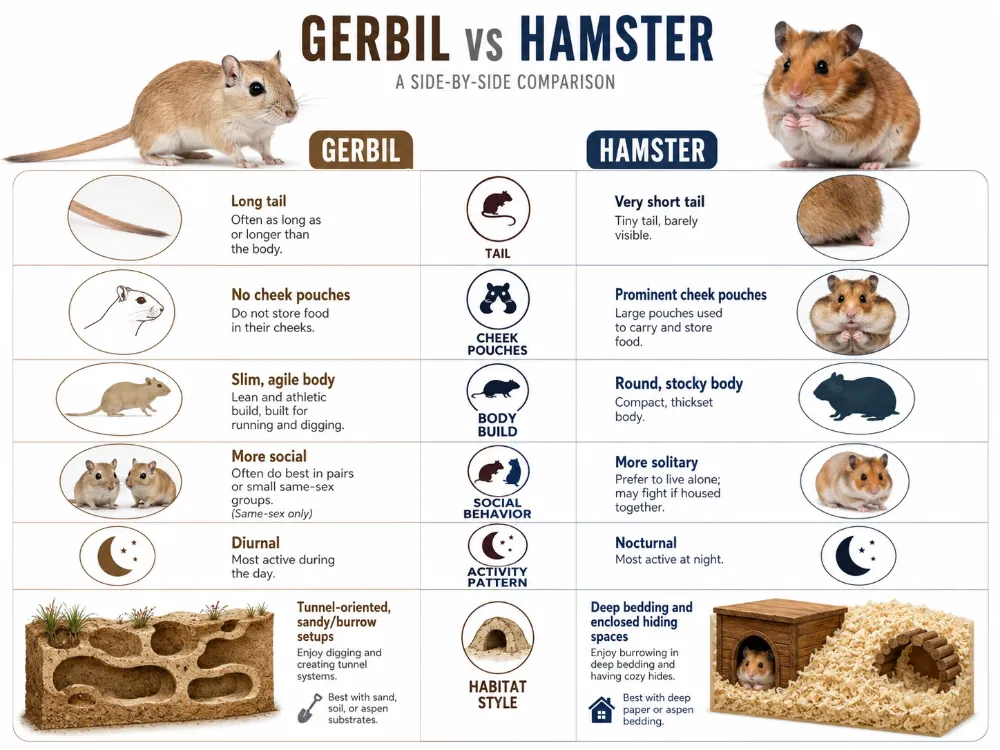
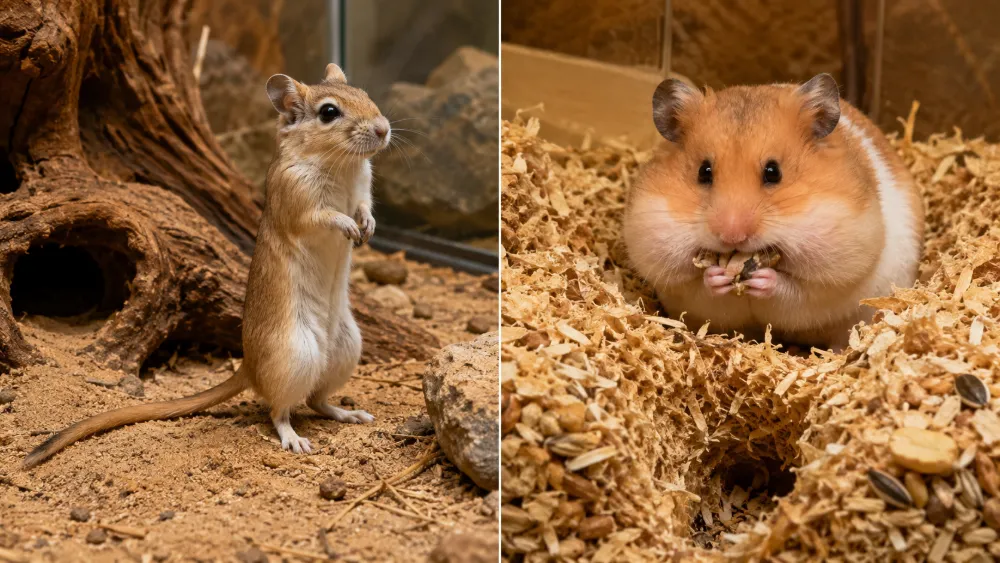
The short answer is that gerbils and hamsters are different rodents with different body shapes, behavior, and lifestyles. Gerbils usually have longer tails, slimmer bodies, and more social behavior, while hamsters usually have shorter tails, rounder bodies, and a more solitary nature. Hamsters also have very noticeable cheek pouches, while gerbils are better known for their long hind legs and alert, tail-balanced look.
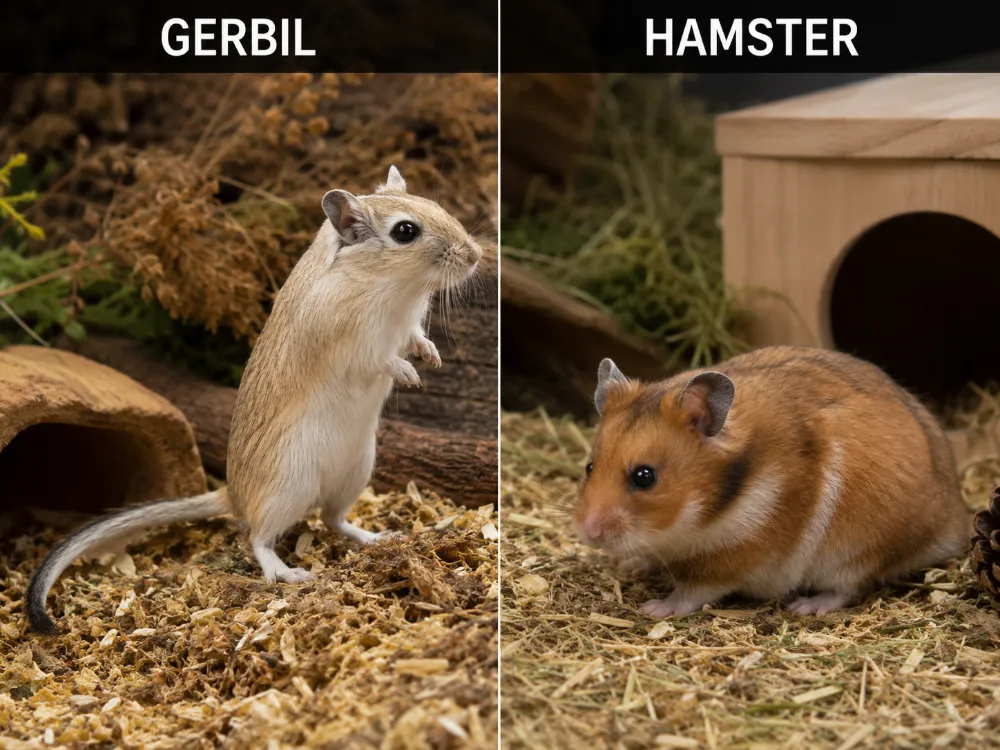
People often confuse gerbils and hamsters because both are small pet rodents with whiskers, rounded ears, soft fur, and a habit of digging or burrowing. At a quick glance, especially in pet stores or photos, they can seem like slightly different versions of the same kind of animal.
In reality, they are not the same. They belong to different rodent groups, evolved in different environments, and usually behave differently both in the wild and in captivity.
In this guide, you will learn how gerbils and hamsters differ in body shape, tail length, cheek pouches, social life, habitat, activity pattern, and pet suitability, plus the fastest ways to tell them apart.
Quick comparison table
| Feature | Gerbil | Hamster |
|---|---|---|
| Body shape | Slender, long-bodied, more upright | Rounder, chunkier, more compact |
| Tail | Long and clearly visible, often furred with a tuft | Very short and often barely visible |
| Cheek pouches | Not strongly visible in the classic hamster way | Very large cheek pouches for carrying food |
| Social pattern | Often more social, especially in stable pairs or groups | Often more solitary, especially many pet hamster species |
| Natural habitat style | Dry grassland, steppe, and semi-desert | Dry open habitats, fields, scrub, and burrows depending on species |
| Movement style | Quick, springy, active, often using hind legs strongly | Scurrying, digging, stuffing food, more low-bodied movement |
| Pet reputation | Curious, social, active, often enjoyable to watch in pairs | Cute, compact, often easy to house singly, but can be territorial |
| Best quick clue | Long tail and slimmer body | Round body, tiny tail, big cheek pouches |
They are different rodents, not two names for the same pet
Gerbils and hamsters are both rodents, but they are not the same kind of rodent. They belong to different branches of the rodent family tree, and that difference shows up clearly in the body, behavior, and survival strategy of each animal.
Gerbils are especially associated with dry open habitats and a more alert, long-tailed, hopping or springing body style. Hamsters are famous for their compact body, short tail, large cheek pouches, and strong food-storing behavior.
So although both are small mammals often kept as pets, a gerbil is not just a long-tailed hamster, and a hamster is not just a chunky gerbil.
The tail is one of the easiest clues
If you need the fastest visual difference, start with the tail. Gerbils have a long, obvious tail that usually looks important to the body design. In many species, the tail is furred and may end in a visible tuft. It helps with balance and contributes to the gerbil’s more agile, alert appearance.
Hamsters have very short tails. In many pet hamsters, the tail is so small that it is barely noticeable at first glance. This makes the body look rounder and more compact overall.
If the animal has a long visible tail, it is almost certainly a gerbil rather than a hamster.
Hamsters are usually rounder and stockier
Hamsters often look like small furry capsules with legs. Their body is usually compact, low, and thickset, especially in familiar pet species such as the Syrian hamster. This gives them the classic cuddly, round-pet look that people recognize immediately.
Gerbils usually look slimmer and longer in outline. Their body often seems lighter, more agile, and more built for quick bursts of movement. They usually look less bulky and less plush in overall shape than a hamster does.
If the animal looks like a little round food-storage machine, think hamster. If it looks leaner and more alert, think gerbil.
Hamsters have much more obvious cheek pouches
This is one of the most famous hamster features. Hamsters have large cheek pouches that extend far back along the sides of the head and neck. They use these pouches to carry food back to storage sites, and when full, the cheeks can become dramatically swollen.
Gerbils do not create the same classic puffed-cheek look that hamsters are famous for. They gather and handle food too, but they are not visually defined by giant expandable cheek pouches in everyday observation.
If you see a tiny rodent with comically stuffed cheeks, hamster becomes the stronger answer.
Gerbils usually have longer hind legs and a springier look
Gerbils often look built for quick, active movement. Their hind legs usually seem relatively long and strong, which helps create a lively, springing style. Even when standing still, many gerbils look ready to leap, pivot, or dash.
Hamsters usually look lower, heavier, and more centered toward the ground. Their motion often feels more like scurrying and digging than spring-loaded bounding.
This is one reason gerbils often look more like tiny desert runners, while hamsters look more like compact burrow specialists.
Gerbils are often more social
In general, gerbils are more social than many common pet hamsters. Mongolian gerbils, for example, often do well in stable same-sex pairs or compatible groups if housed correctly from an early age. They often groom, sleep, and interact with one another in ways that make their social life very visible.
Many hamsters, especially Syrian hamsters, are much more solitary and often do best housed alone once mature. If forced into shared space, they may become territorial or aggressive.
This is one of the biggest practical pet-care differences between the two.
Hamsters are more strongly associated with solitary living
When people think of a hamster as a single pet in a cage, that image reflects real biology for many species. Hamsters often keep separate burrows and food stores in the wild, and many pet hamsters are not naturally tolerant of close adult roommates.
Gerbils, by contrast, often give a much more group-oriented impression. They may rest together, communicate closely, and seem more socially busy within the enclosure when kept in a compatible pair.
So if the question is which pet is more likely to enjoy a same-species companion, the answer is usually gerbil rather than hamster.
Gerbils often come from drier, more open habitats
Gerbils are strongly associated with dry grasslands, steppes, and semi-desert environments. Their body style reflects this background. They are active, alert, and often highly responsive to their surroundings, with a design suited to open ground and quick movement between cover and burrow systems.
Hamsters also come from dry environments, but the everyday pet image is more strongly tied to underground living, nest chambers, food storage, and a compact burrowing lifestyle. Their body often reflects that more strongly than the long-tailed open-ground look of a gerbil.
This habitat difference helps explain why gerbils feel more like active desert rodents, while hamsters feel more like small hidden tunnel dwellers.
Hamsters are famous for food hoarding
Both animals store food, but hamsters are especially famous for it. Their cheek pouches allow them to gather large amounts of seeds and other food, carry them to the nest, and build impressive hidden stores. This hoarding behavior is one of the central features of hamster natural history.
Gerbils also cache food and use burrows, but the whole package of huge cheek pouches plus heavy food hoarding is more tightly linked to the hamster image.
That is why hamster enclosures often reveal little food stores hidden under bedding or inside shelters.
Gerbils often look more active during the day
Many pet owners notice that gerbils seem to be active in short bursts throughout both day and night. They may dig, chew, investigate, and interact repeatedly across the full daily cycle. This can make them feel more visible and entertaining during normal household hours.
Hamsters, especially many common pet hamsters, are often more strongly active in the evening, at night, or around twilight. During the day they may sleep deeply and become annoyed if disturbed too often.
This is a general pattern rather than a perfect rule, but it matters a lot for pet households.
Hamsters often sleep more solidly during the day
A hamster may spend much of the daytime hidden in bedding or in a nest chamber and then become much more active later. This is one reason children sometimes find hamsters disappointing at certain hours, even though the animal is simply following its normal rhythm.
Gerbils often seem easier to watch throughout the day because their activity is broken into shorter repeated periods. They may be awake, digging, grooming, or interacting several times rather than disappearing for one long inactive block.
So if the goal is a pet that is often visible, gerbils may sometimes fit that expectation better.
Gerbils are usually less strongly scented than some hamsters
Both animals have scent glands and communicate with smell, but many people find gerbils a little less strongly scented than some hamsters when kept in a clean, well-managed enclosure. Their dry-habitat background and lower urine volume can influence how the enclosure feels in daily care.
Hamsters can also be kept very clean with good husbandry, but their nest areas and stored food can sometimes create a stronger enclosed smell if bedding is not managed well.
This is not a universal rule for every individual, but it is a common experience among pet keepers.
Both like to burrow, but they do it differently
Hamsters are famous tunnelers and nest builders. Given deep bedding, many will create sleeping chambers, food stores, and underground pathways. Their whole body plan suits this secretive burrow-centered life.
Gerbils also love digging and can create impressive tunnel systems in deep substrate. However, because they are more social and often more visibly active, their enclosure life may feel more dynamic and outwardly busy than that of a hamster.
So both need enrichment for digging, but the experience of watching them use the space can feel different.
Gerbils often chew and shred constantly
Gerbils are enthusiastic chewers and often seem driven to shred cardboard, hay, paper, or wooden enrichment items. This behavior fits their natural activity level and their need to maintain an active environment.
Hamsters also chew, especially because rodent teeth must stay worn down, but gerbils often give a stronger impression of constant environmental editing. A pair of gerbils may turn a cardboard item into confetti surprisingly fast.
This is one reason gerbil setups usually benefit from lots of safe chew material and digging substrate.
Hamsters are often easier to keep singly
For a person who wants a single pet rodent, a hamster is often the easier species to house because many common pet hamsters naturally prefer solitary adult living. There is less pressure to maintain pair bonds or watch for group tension.
Gerbils can be wonderful pets, but they are often best kept with a compatible companion, and introductions or group changes can be difficult if done incorrectly. That makes their social success more rewarding, but also slightly more demanding.
So the easier animal for single-pet simplicity is often the hamster.
Body language feels different
Gerbils often look alert, upright, and ready to investigate. They may sit up on the hind legs, flick the tail, dart, dig, and reappear quickly. Their movement often has a bright, active quality.
Hamsters often look more like compact foragers. They may shuffle, sniff, dig, stuff food into the cheek pouches, and vanish into bedding or hideouts with a more grounded, low-bodied style.
If the animal feels energetic and springy, gerbil becomes more likely. If it feels round, secretive, and storage-focused, hamster becomes more likely.
Why people confuse them so often
People confuse gerbils and hamsters because both are small pet rodents with soft fur, rounded ears, whiskers, and digging habits. In quick photos, especially without a clear view of the tail or body shape, the differences can disappear.
The confusion is even stronger because both are sold as beginner-friendly small mammals. People may remember the general category of “small rodent pet” without learning the real biological and behavioral differences between them.
Once you focus on the tail, cheek pouches, and social behavior, the distinction becomes much easier.
How to tell them apart quickly
If you need a fast identification guide, use these clues together:
Gerbil: long visible tail, slim body, strong hind legs, more social, active in repeated bursts
Hamster: tiny tail, round body, large cheek pouches, more solitary, stronger nest-and-hoard lifestyle
No single clue is better than the tail. Long tail means gerbil. Nearly no tail plus stuffed cheeks means hamster.
Which one is better as a pet?
There is no universal winner. Gerbils are often great for people who enjoy watching active social behavior and keeping a pair in a well-designed enclosure. Hamsters are often great for people who want a single small pet with a strong burrowing and nest-building routine.
The better pet depends on the owner’s expectations. A person wanting daytime social activity may prefer gerbils. A person wanting one compact pet with deep bedding and quiet evening activity may prefer a hamster.
So the better animal is the one that fits the household, not the one with the cutest face in the store.
Final takeaway
The main difference between a gerbil and a hamster is that gerbils are usually slimmer, longer-tailed, and more social rodents, while hamsters are usually rounder, shorter-tailed, and more solitary rodents with large cheek pouches. Gerbils often feel more active and group-oriented. Hamsters often feel more compact, burrow-centered, and food-hoarding in style. They may both be small pet rodents, but once you compare tail, body shape, and behavior, they are very easy to tell apart.
FAQs
Is a gerbil the same as a hamster?
No. Gerbils and hamsters are different rodents with different body shape, tail length, and behavior.
How can I tell a gerbil from a hamster fast?
Look at the tail. A gerbil has a long visible tail, while a hamster has a very short tail.
Which is more social, a gerbil or a hamster?
Gerbils are usually more social, while many common pet hamsters are more solitary.
Do hamsters and gerbils both make good pets?
Yes, but they suit different homes. Gerbils are often better for people who want active pair behavior, while hamsters are often easier as single pets.