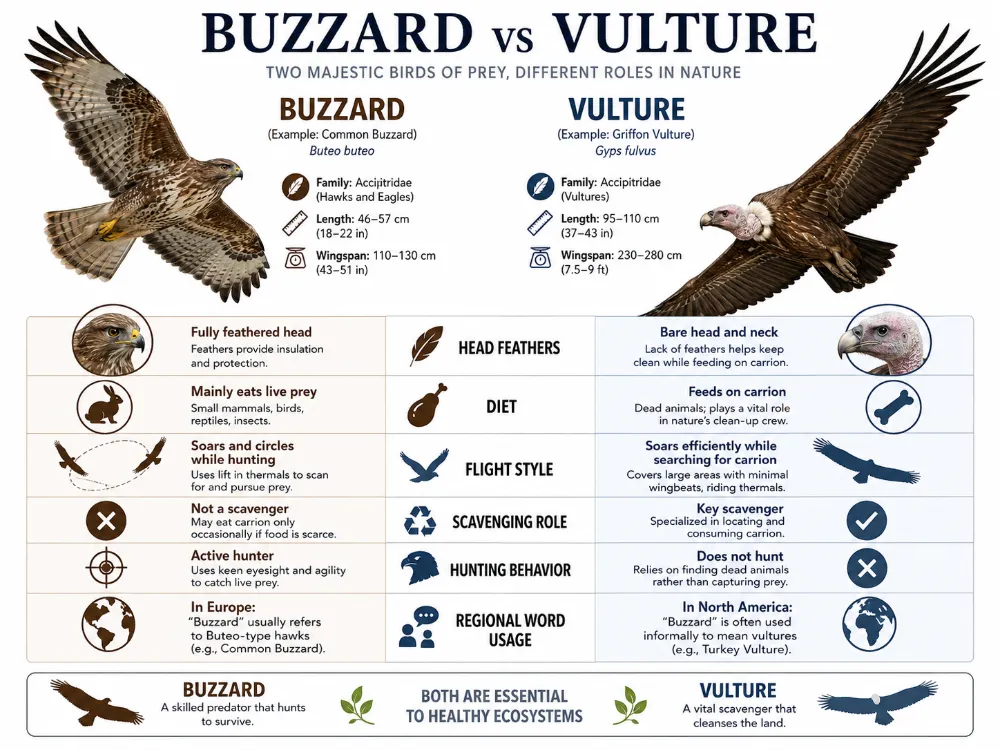
The short answer is that a vulture is a true scavenging bird, but a buzzard is usually a hawk-like bird in Europe and many other regions. In North America, however, people often call vultures “buzzards,” which creates a lot of confusion. So the biggest difference is that vulture is a more accurate biological term, while buzzard can mean very different birds depending on where you are.
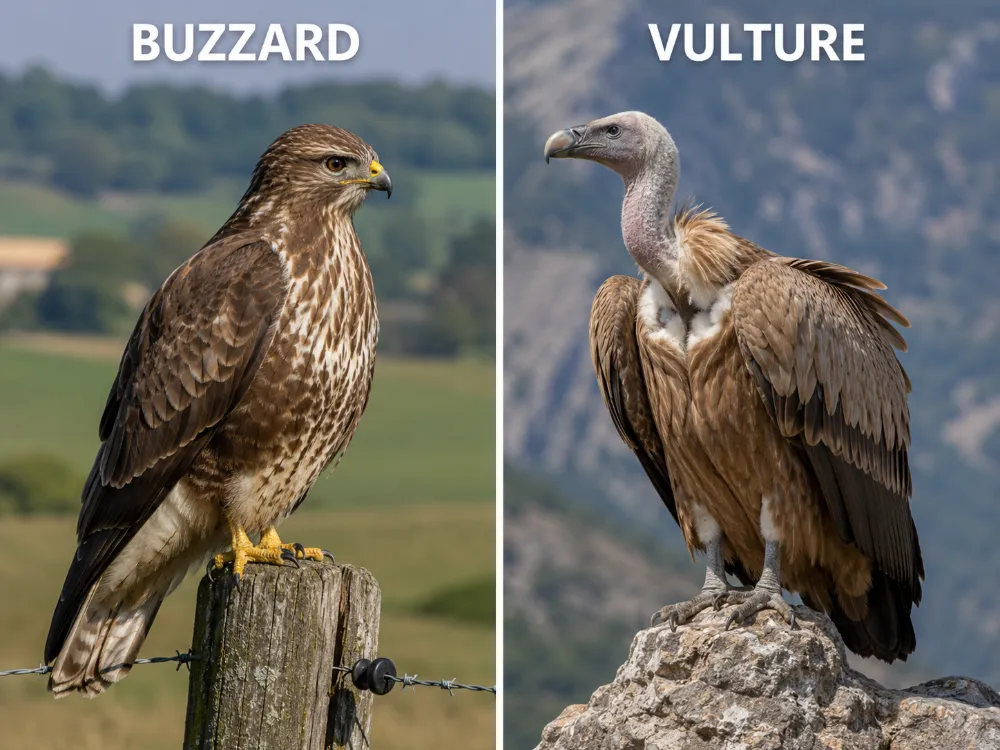
People often assume buzzards and vultures are the same thing because the words are used interchangeably in some places. That is partly true in everyday speech, especially in parts of the United States, but it is not correct in strict zoological usage. In much of the world, a buzzard is not a vulture at all.
In this guide, you will learn what buzzard and vulture really mean, how the terms differ by region, and how to tell a true buzzard from a true vulture by body shape, feeding style, flight, and behavior.
Quick comparison table
| Feature | Buzzard | Vulture |
|---|---|---|
| Main meaning | Usually a hawk-like raptor, especially a Buteo-type bird in Europe and many other regions | A scavenging bird specialized for feeding on carrion |
| Common North American use | Often used informally for vultures | The correct term for turkey vultures and black vultures |
| Diet | Usually hunts live prey such as rodents, reptiles, or small animals | Mainly feeds on carrion, though some take other food too |
| Head | Usually fully feathered | Often bare or sparsely feathered |
| Body type | Hawk-like, compact, broad-winged predator | Large soaring scavenger with broad wings and scavenging adaptations |
| Flight style | Often soaring and flapping like a typical broad-winged hawk | Often soaring for long periods, rocking or holding wings in distinctive ways depending on species |
| Main ecological role | Predator | Scavenger and carrion cleaner |
| Best quick clue | Feathered head and hawk-like hunting role | Bare-looking head and carrion-feeding lifestyle |
The word “buzzard” is the source of the confusion
The biggest reason this topic is confusing is that the word buzzard does not mean the same thing everywhere. In Britain, Europe, and many other regions, a buzzard usually means a hawk-like bird, especially the common buzzard or related birds in the Buteo group. These are real hunting raptors, not vultures.
In parts of North America, however, people often use buzzard as an informal name for vultures, especially turkey vultures. That local usage is very common in speech, but it is not the clearest biological wording.
So before comparing buzzard and vulture, the first question should always be: what region and what meaning are we talking about?
What is a buzzard in the strict zoological sense?
In the strict zoological sense, a buzzard is usually a medium strict zoological sense, a buzzard is usually a medium-to-large hawk-like bird of prey, especially one in the Buteo group. These birds have broad wings, strong talons, a feathered head, and a hunting lifestyle focused on live prey.
A typical buzzard may soar over fields, perch on posts or trees, and scan the ground for rodents, rabbits, reptiles, or other small animals. It behaves much more like a hawk than like a scavenging vulture.
So in the clearest animal-writing sense, a buzzard is best understood as a broad-winged predatory raptor, not a carrion specialist.
What is a vulture?
A vulture is a bird specialized for scavenging. Vultures are famous for feeding on dead animals and play a major ecological role by clearing carrion from landscapes. This makes them some of the most important sanitation birds in nature.
Vultures are not simply “lazy birds that do not hunt.” They are highly specialized scavengers with strong digestive systems, large soaring wings, and behavior adapted for locating carcasses over wide areas.
So while a buzzard usually hunts living prey, a vulture is usually built first and foremost for finding and processing dead animals.
Buzzards are usually predators, vultures are usually scavengers
This is the clearest biological difference. A buzzard is typically a predator. It watches, swoops, and captures live prey with strong feet and talons. Its daily life is organized around hunting.
A vulture is typically a scavenger. It searches for carrion, often soaring widely over large areas until it finds a carcass or notices other vultures gathering. Its daily life is organized around locating dead animals efficiently.
Both are raptors in a broad sense, but their main ecological jobs are very different.
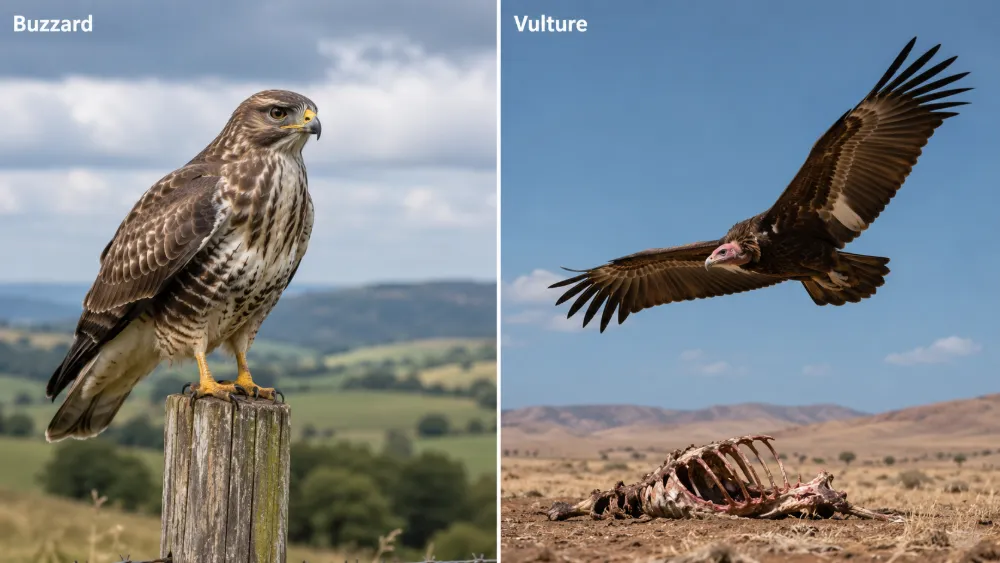
Vultures often have bare heads, buzzards usually do not
One of the easiest visual differences is the head. Many vultures have a bare or sparsely feathered head and neck. This is often understood as a useful adaptation for feeding inside carcasses, where a fully feathered face would get dirty more easily.
Buzzards usually have fully feathered heads, just like many hawks and eagles. Their face looks more like that of a classic bird of prey rather than a carrion specialist.
If the large soaring bird has a noticeably bare-looking head, vulture becomes much more likely than buzzard.
Buzzards look more like hawks
A true buzzard often looks like a broad-winged hawk. The body is usually compact, the head feathered, the bill hooked, and the feet strong enough to seize prey. Even when soaring, the overall shape usually feels predatory rather than scavenger-specialized.
Vultures often look different in posture and structure. They may appear long-winged, broad-winged, loose-bodied, and less “hawk-faced” than a buzzard. Their build reflects a soaring scavenger rather than a perching ambush hunter.
If the bird looks like a classic broad-winged hawk, buzzard is the stronger guess in the strict sense.
Vultures are more specialized for carrion life
Vultures are built around a very specific job. They travel efficiently over large distances, locate dead animals, and consume meat that many other animals avoid. Their digestive system is extremely powerful, allowing them to handle decaying food that would be dangerous for many species.
Buzzards are not built around that same role. They are general hunting raptors, even if they may occasionally scavenge when the opportunity is easy. The scavenging role does not define them in the way it defines vultures.
So even if both may eat meat, only the vulture is truly specialized as a carrion cleaner.
Flight style can help identify them
Both buzzards and vultures can soar, which is one reason people confuse them. However, vultures often spend especially long periods soaring with minimal effort as they search large areas. Some species show distinctive wing posture or rocking movement.
Buzzards also soar well, especially in rising air, but their flight often feels more like that of a broad-winged hawk. They may circle over hunting grounds and combine soaring with more typical raptor flapping and scanning behavior.
If the bird seems built almost entirely around effortless soaring and carcass-searching, vulture becomes more likely.
Vultures often gather at carcasses, buzzards usually do not
Behavior around food is another strong clue. Vultures are often seen descending toward carcasses, feeding in loose groups, or circling where dead animals are present. Their social feeding behavior can make them very noticeable.
Buzzards usually do not gather in the same way around large carrion sources. They may scavenge sometimes, but they are much more often seen hunting alone or perched while searching for prey.
If a large group of birds is feeding on a carcass, the birds are much more likely to be vultures than true buzzards.
Buzzards are often more tied to perches and hunting territory
A buzzard commonly uses fence posts, trees, poles, ridges, or other lookout points while scanning for prey. This perch-and-watch lifestyle is a classic hawk behavior.
Vultures are often less about watching from a hunting perch and more about wide aerial searching. They may perch socially at roost sites, but their feeding strategy is usually dominated by soaring and locating carrion rather than ambushing prey from a lookout.
So if the bird is repeatedly perched and hunting a field like a hawk, buzzard is the stronger biological answer.
Old World and New World vultures complicate the story
Vultures themselves are not all from one single lineage in the simplest sense. Old World vultures and New World vultures come from different evolutionary backgrounds, even though both groups evolved a scavenging vulture-like way of life. This is another example of similar ecological roles producing similar-looking birds.
That does not change the main comparison here. Both Old World and New World vultures are still scavengers in the way people usually mean when they say vulture.
So even though vulture biology is internally complex, it remains much clearer than the mixed regional meaning of buzzard.
In North America, “buzzard” often really means vulture
This point deserves its own section because it explains so many everyday misunderstandings. In parts of the United States, especially in casual rural speech, a turkey vulture may simply be called a buzzard. This usage is deeply rooted in local language and is very common.
That means a person saying “I saw buzzards over the roadkill” may actually be speaking perfectly naturally in local English, even though the birds are vultures in biological terminology.
So the word can be socially normal and scientifically imprecise at the same time.
In Europe, a buzzard is definitely not a vulture
In Britain and much of Europe, the common buzzard is a familiar broad-winged hawk. It is a predator, not a vulture, and no one using the word buzzard there would normally mean a carrion bird like a turkey vulture.
This is why international readers can get confused when they see the word buzzard online. One audience imagines a hawk. Another imagines a vulture.
So the region changes the mental picture immediately.
Buzzards usually have stronger prey-grabbing feet
Because buzzards are active predators, their feet and talons are central tools for catching and holding prey. They may seize rodents, reptiles, or other animals with clear hunting intent.
Vultures also have feet, but many species are not as specialized for gripping struggling prey as hawk-like raptors are. Their strength lies more in soaring, locating carcasses, and feeding efficiently once food is found.
So if you think like an ecologist, the buzzard’s body is organized around capture, while the vulture’s body is organized around search and cleanup.
Vultures are often misunderstood, but ecologically essential
Vultures sometimes have a negative public image because they feed on dead animals, yet this very behavior makes them incredibly valuable. They help remove carcasses quickly, limit disease spread, and clean landscapes in a way few other animals can match.
Buzzards are also ecologically useful because they control populations of small animals and help regulate prey species. But their role is more like that of a classic predator than a sanitation specialist.
So both birds matter, but they matter for very different reasons.
Why people confuse them so often
People confuse buzzards and vultures because both are large soaring birds often seen circling high in the sky. Distance hides details, and a dark bird riding warm air currents can look similar whether it is a broad-winged hawk or a scavenger.
The confusion becomes much worse because the word buzzard changes meaning by region. In one place it means hawk. In another place it means vulture. So even the language itself causes identification problems.
Once you separate the language issue from the bird biology, the difference becomes much easier to understand.
How to tell them apart quickly
If you need a fast identification guide, use these clues together:
Buzzard: usually a hawk-like predator, feathered head, hunts live prey, perches and scans, broad-winged raptor look
Vulture: true scavenger, often bare-headed, soaring carrion-finder, gathers at carcasses, built for cleanup
If you are in North America and someone says buzzard, remember that they may simply mean vulture in local speech.
Which one is more dangerous?
Neither true buzzards nor vultures are generally dangerous to people in normal situations. Buzzards are predatory birds, but they are not human hunters. Vultures are scavengers and are even less associated with attacking living humans.
The more important issue is not danger but ecological role and correct identification. A soaring bird over a field is more likely helping balance nature than threatening anyone.
So the main lesson here is accuracy, not fear.
Final takeaway
The main difference between a buzzard and a vulture is that a vulture is a true carrion-eating scavenger, while a buzzard is usually a hawk-like predator in much of the world. The confusion happens because in parts of North America people often call vultures “buzzards” in everyday speech. In strict animal terms, though, buzzard and vulture are not the same thing. A buzzard usually hunts. A vulture usually scavenges.
FAQs
Is a buzzard the same as a vulture?
Not in strict zoological usage. In much of the world, a buzzard is a hawk-like bird, while a vulture is a scavenger. In parts of North America, however, people often call vultures buzzards in everyday speech.
Why do Americans call vultures buzzards?
It is a long-standing regional common-name habit in informal English, especially for turkey vultures.
How can I tell a buzzard from a vulture fast?
Look at the head and behavior. A vulture often has a bare-looking head and scavenges carrion, while a buzzard usually has a feathered head and hunts live prey.
Are buzzards and vultures both birds of prey?
They are both large meat-eating raptorial birds in a broad sense, but they fill different ecological roles: buzzards as predators and vultures as scavengers.