Giant squid and colossal squid are both enormous deep-sea cephalopods, but they are not the same animal. The giant squid is usually longer because of its extremely long feeding tentacles, while the colossal squid is heavier, bulkier, and more powerful-bodied. The colossal squid also has rotating hooks on its arms and tentacles, while the giant squid mainly has suckers with toothed rings. Both are mysterious predators of the deep ocean.
Giant Squid vs Colossal Squid Quick Answer
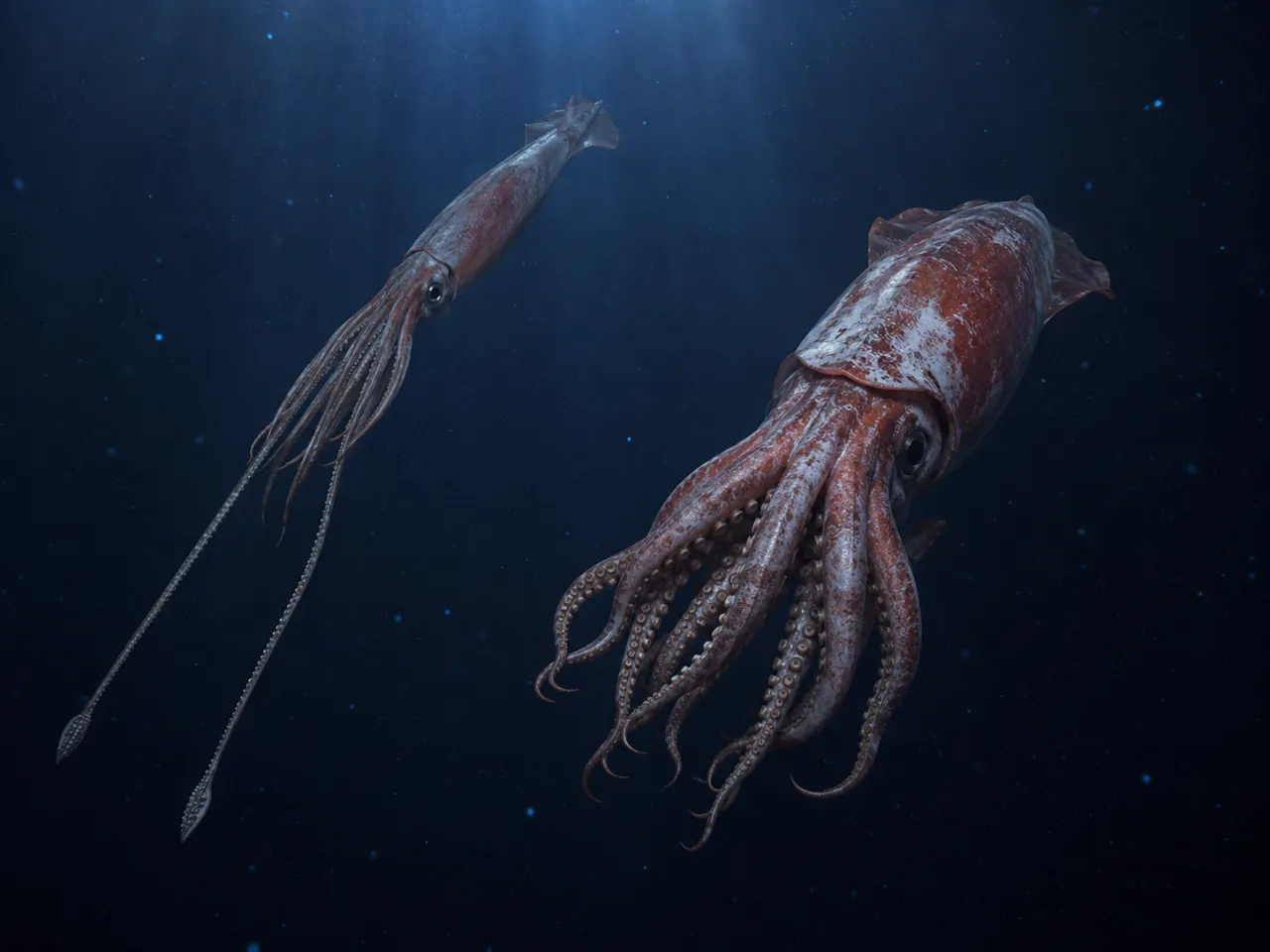
The giant squid is generally the longer animal, especially when its two long feeding tentacles are included. The colossal squid is generally the heavier and more massive animal, with a thicker mantle, larger body, heavier arms, and powerful hooks. Giant squid are found in deep oceans around the world, while colossal squid are mainly associated with the cold Southern Ocean around Antarctica.
Giant Squid vs Colossal Squid Summary Table
| Feature | Giant Squid | Colossal Squid |
|---|---|---|
| Scientific name | Architeuthis dux | Mesonychoteuthis hamiltoni |
| Family | Architeuthidae | Cranchiidae |
| Best known for | Extreme total length | Extreme body mass and hooks |
| Typical maximum length | Often estimated around 10–13 meters for large females, with older larger claims debated | Often estimated around 10–14 meters, but with a much bulkier body |
| Typical maximum weight | Much lighter than colossal squid at similar body length | Likely the heaviest known squid, with very large individuals estimated at several hundred kilograms |
| Body shape | Long, slender, with very long feeding tentacles | Thick, heavy, muscular, with a broad mantle |
| Arms and tentacles | Eight arms and two very long tentacles with suckers | Eight arms and two tentacles with suckers and powerful hooks |
| Main weapon | Long tentacles, toothed suckers, strong beak | Hooks, heavy arms, strong beak, massive body |
| Habitat | Deep oceans worldwide | Cold deep waters of the Southern Ocean, especially around Antarctica |
| Main predators | Sperm whales are major predators | Sperm whales are major predators; some large sharks may also prey on smaller individuals |
| Quick identification clue | Longer, thinner body with extremely long tentacles | Shorter-looking but heavier, with a thick body and hooks |
What Is a Giant Squid?
The giant squid is a deep-sea squid in the genus Architeuthis. It is one of the longest known squid and has inspired centuries of sea-monster stories. For a long time, scientists knew it mostly from dead specimens washed ashore, body parts found in sperm whale stomachs, and rare accidental captures by fishing vessels.
The giant squid has a long mantle, eight arms, two extremely long feeding tentacles, large eyes, a parrot-like beak, and rows of suckers armed with small toothed rings. Its total length can appear enormous because the feeding tentacles are so long. However, its body is much slimmer than that of a colossal squid.
Giant squid live in deep ocean habitats, usually far below the surface. They are rarely seen alive, which is why much of their behavior is still inferred from anatomy, stomach contents, scars on predators, and occasional deep-sea observations.
What Is a Colossal Squid?
The colossal squid is a massive deep-sea squid from the cold Southern Ocean. Its scientific name is Mesonychoteuthis hamiltoni. Despite its name, it is not simply a larger version of the giant squid. It belongs to a different family and has a different body design.
The colossal squid is famous for its huge mantle, heavy body, large beak, enormous eyes, and rotating hooks on its arms and tentacles. These hooks make it one of the most heavily armed squid known to science. While it may not always exceed the giant squid in total length, it is likely much heavier and more muscular.
Because adult colossal squid live in remote Antarctic deep waters, they are even less familiar to most people than giant squid. Many details of their life cycle, behavior, and maximum size remain uncertain.
Quick Visual Difference
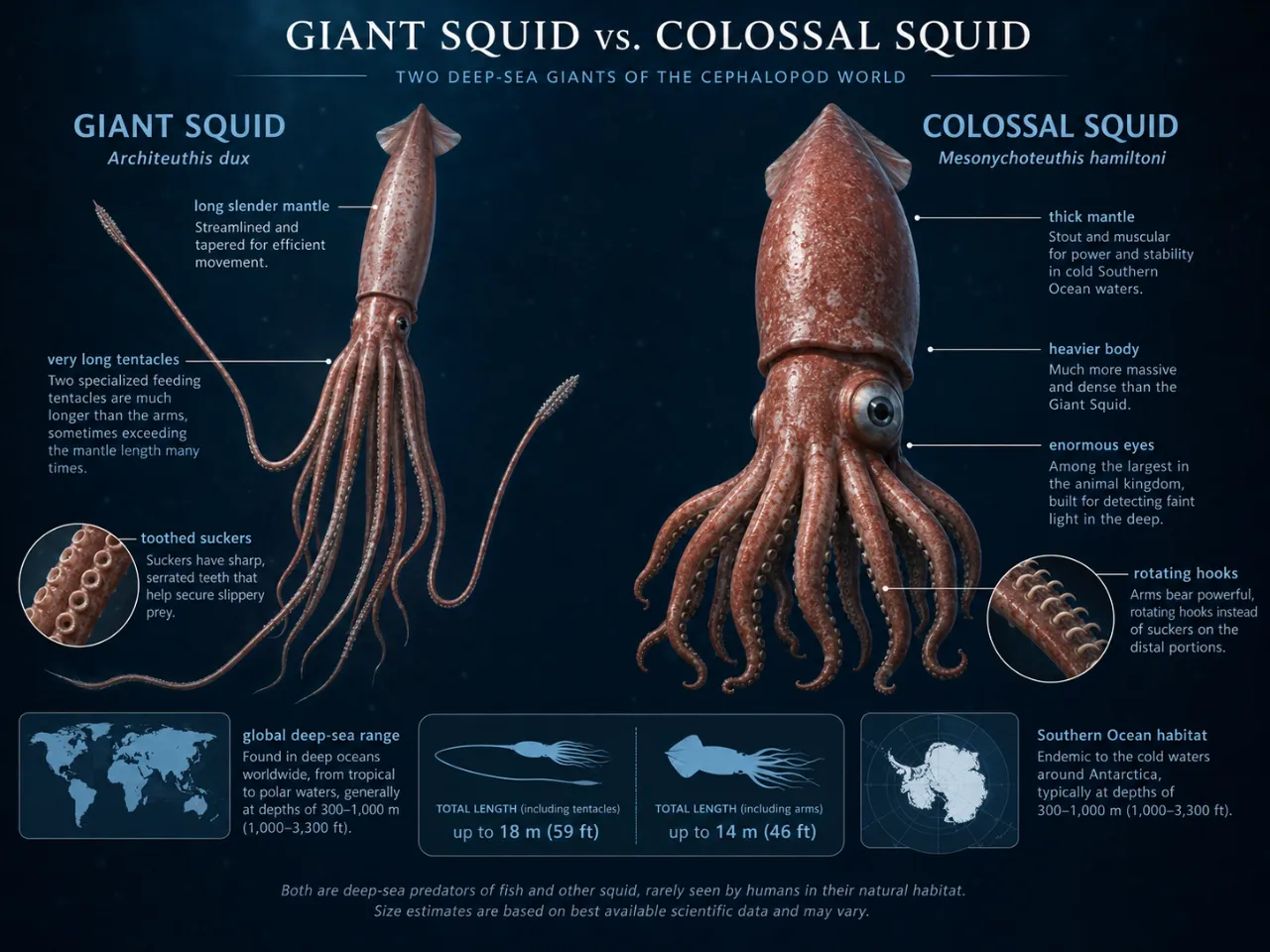
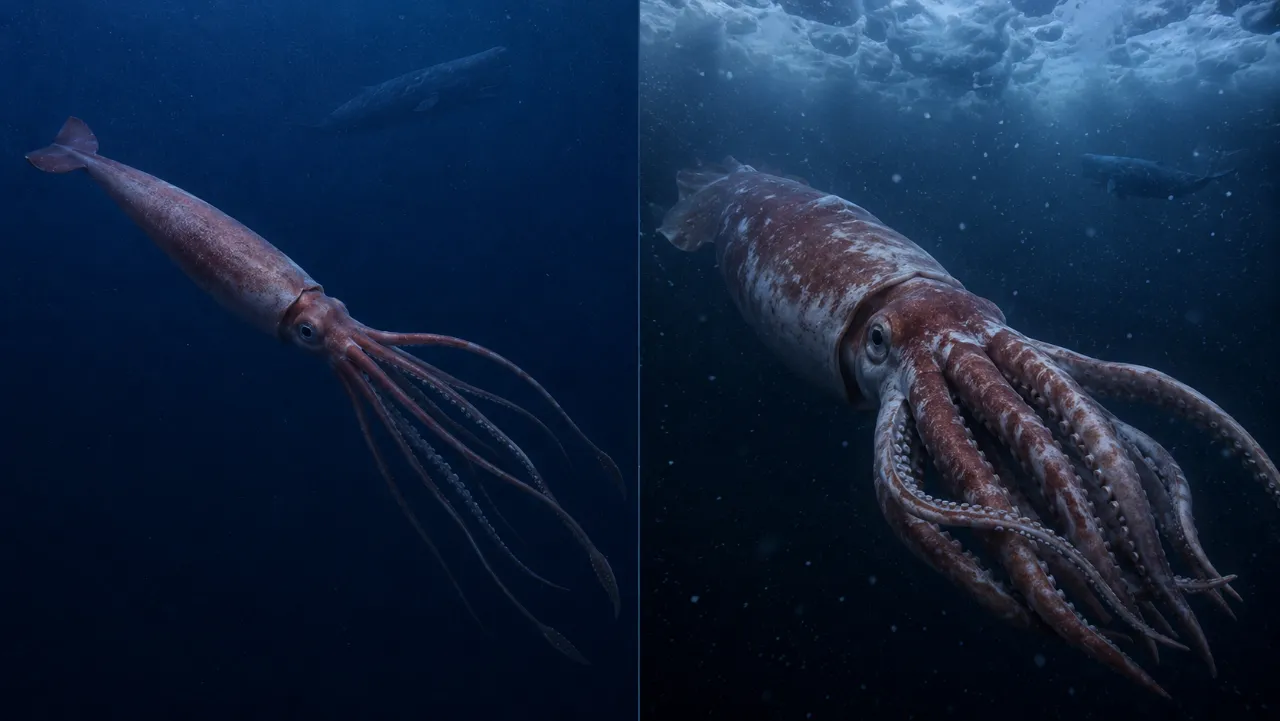
The easiest way to compare them is this: the giant squid looks longer and more slender, while the colossal squid looks heavier and more powerful. The giant squid’s extreme length comes mainly from its very long feeding tentacles. The colossal squid’s size comes from its thick mantle, heavy arms, and massive body.
Giant squid: long, slender, with extremely long tentacles and toothed suckers.
Colossal squid: bulkier, heavier, with a thick mantle and rotating hooks.
Giant squid: wider global deep-ocean distribution.
Colossal squid: mainly Southern Ocean and Antarctic deep-water habitats.
Size: Which Squid Is Longer?
The giant squid is usually considered longer in total body length because of its extremely long feeding tentacles. Large females may reach roughly 10–13 meters in total length, although exact maximum size is debated. Older reports of much larger giant squid exist, but many are difficult to verify and may involve stretched tentacles or inaccurate measurements.
The colossal squid may reach similar rough total lengths, but it is generally not as thin and ribbon-like. Its tentacles are not the only reason it is impressive. Its mantle and arms are much more massive. This means a colossal squid can look shorter than a giant squid while still being the more powerful and heavier animal.
If the question is “which squid is longer from tip to tentacle,” the answer is usually the giant squid.
Weight: Which Squid Is Heavier?
The colossal squid is generally considered the heavier animal. It has a broader, thicker body and a much more robust build. Very large individuals may weigh several hundred kilograms, making the colossal squid likely the heaviest known squid.
The giant squid may be longer, but much of that length comes from thin tentacles. Its mantle and arms are less massive than those of a colossal squid. This is similar to comparing a long, thin animal with a shorter but heavier animal: length does not always equal mass.
If the question is “which squid has more body mass,” the answer is the colossal squid.
Body Shape and Appearance
The giant squid has a long mantle, narrow body, large head, eight arms, and two very long feeding tentacles. Its body design is adapted for life in the deep sea, where it likely ambushes or captures prey using its long tentacles.
The colossal squid has a thicker mantle, larger body, heavier arms, and a more muscular appearance. It is built like a deep-sea heavyweight. Its body is less elegant and more powerful-looking than that of the giant squid.
A simple visual rule is: giant squid equals long and slender; colossal squid equals thick and heavy.
Arms, Tentacles, Suckers, and Hooks
Both animals have eight arms and two feeding tentacles, as squids typically do. But the details are very different.
The giant squid has suckers lined with small toothed rings. These suckers help grip prey and may leave circular scars on sperm whales. Its long tentacles can extend far beyond the body, giving it a dramatic total length.
The colossal squid has suckers too, but it is especially famous for hooks. Some hooks can rotate, giving the squid a powerful grip on prey. These hooks are found on the arms and tentacles and make the colossal squid look more heavily armed than the giant squid.
The giant squid grabs with long reach and toothed suckers. The colossal squid grabs with heavier arms and hooks.
Eyes: Which Has Bigger Eyes?
Both giant squid and colossal squid have enormous eyes. Large eyes are useful in the deep sea, where light is scarce and animals must detect faint movement, shadows, or bioluminescent signals.
The colossal squid is especially famous for having some of the largest eyes known in the animal kingdom. Large eyes may help it detect the silhouettes or bioluminescent disturbances of predators and prey in deep Antarctic waters.
Giant squid also have very large eyes, which likely help them detect sperm whales and other deep-sea threats. In both animals, huge eyes are not just impressive; they are survival tools.
Habitat and Range
Giant squid have a wide deep-ocean distribution. Specimens and evidence have been recorded from many parts of the world, including the North Atlantic, North Pacific, South Atlantic, and waters around New Zealand and other deep marine regions. They are generally associated with deep slopes, submarine canyons, and open deep-water habitats.
Colossal squid are much more strongly associated with the Southern Ocean, especially the cold waters around Antarctica. They are part of a deep, cold ecosystem where they may feed on large fish and other squid. Their range is more restricted than that of the giant squid.
So the giant squid is more globally distributed, while the colossal squid is more Antarctic and Southern Ocean-centered.
Depth: How Deep Do They Live?
Both species are deep-sea animals, but exact depth ranges are difficult to define because live observations are rare. Giant squid are often associated with deep waters several hundred meters below the surface and may occur deeper depending on age, prey, and region.
Colossal squid are also deep-water animals and are believed to live in cold Antarctic depths. Juveniles and adults may use different depth zones. Some evidence comes from captured specimens and from remains found in sperm whale stomachs.
Neither animal is a shallow-water creature. If a giant squid or colossal squid appears near the surface, it is often injured, dying, or accidentally brought up by fishing activity.
Diet and Hunting Behavior
Giant squid likely feed on deep-sea fish, smaller squid, and other marine animals. They probably use their long feeding tentacles to seize prey from a distance, bringing it toward the arms and beak. Their beak cuts food into pieces, and the radula helps process it further.
Colossal squid likely eat large deep-sea fish, including Antarctic toothfish, as well as other squid. Its hooks suggest a powerful grip, useful for holding slippery prey in cold deep water. Some scientists think the colossal squid may be more of an ambush predator than a high-speed pursuer, but many details remain uncertain.
Both are predators, but the giant squid seems more reach-based, while the colossal squid appears more heavily armed and power-based.
Predators: What Eats Them?
Sperm whales are the most famous predators of giant squid. Circular scars on sperm whales and giant squid beaks found in whale stomachs show that these animals are linked in deep-sea predator-prey relationships. The exact details of their encounters are rarely observed directly.
Sperm whales also prey on colossal squid. In fact, colossal squid beaks found in sperm whale stomachs are one of the major sources of information about the species. Some large sharks and other predators may eat smaller or younger colossal squid, but adult colossal squid likely have few natural enemies besides large deep-diving whales.
The deep ocean is not empty or peaceful. Both giant squid and colossal squid are powerful predators, but they are also prey for even larger hunters.
Giant Squid vs Colossal Squid: Who Would Win?
A real fight between a giant squid and a colossal squid would be unlikely. They do not have exactly the same distribution, and even if their ranges overlap in some deep-water regions, direct encounters would be rare and difficult to observe.
If a hypothetical encounter happened, the giant squid would have reach because of its longer feeding tentacles. It could potentially make contact from farther away. However, the colossal squid would likely have the advantage in body mass, arm strength, hooks, and durability.
The most scientific answer is that the giant squid is the longer deep-sea specialist, while the colossal squid is the heavier and more heavily armed animal. In a close physical struggle, the colossal squid would probably be the more powerful opponent.
Are Giant Squid and Colossal Squid Related?
They are both squids and both cephalopods, but they are not close enough to be considered the same type of squid. The giant squid belongs to the family Architeuthidae, while the colossal squid belongs to the family Cranchiidae.
Their similar giant size is partly a result of deep-sea gigantism and similar ecological pressures. However, their anatomy shows different evolutionary solutions. The giant squid became extremely long and tentacled; the colossal squid became heavy, hooked, and muscular.
Why Are They So Rarely Seen?
Both animals live in deep, dark, remote waters. This makes them difficult to observe alive. The deep sea is vast, three-dimensional, and hard for humans to study. Even large animals can remain hidden if they live hundreds or thousands of meters below the surface.
Many specimens are found because they wash ashore, are caught accidentally, or are discovered as remains in predator stomachs. Live footage of giant squid is rare, and live observations of colossal squid are even rarer.
Their mystery is not because they are mythical. It is because their habitat is one of the least accessible environments on Earth.
Common Misconceptions
One common misconception is that “giant squid” and “colossal squid” are two names for the same animal. They are different species from different families.
Another misconception is that the biggest animal is always the longest animal. The giant squid may be longer, but the colossal squid is heavier. Length and mass are different measurements.
A third misconception is that these squid regularly attack ships. Historical sea-monster stories may have been inspired by real giant squid, but there is no good scientific reason to imagine them as ship-attacking monsters. They are deep-sea predators adapted to catching fish and squid, not fighting boats.
How to Identify One in a Photo
Identifying these animals from photos can be difficult because many images show damaged specimens, partial bodies, or tentacles out of proportion. Still, several clues can help:
Check the body: a long, slender body with extremely long tentacles suggests giant squid.
Check the build: a thick, heavy mantle and bulky arms suggest colossal squid.
Check the weapons: visible hooks suggest colossal squid.
Check the location: Antarctic or Southern Ocean specimens may suggest colossal squid.
Check the tentacles: very long, thin feeding tentacles are more typical of giant squid.
Check the label carefully: many online images misidentify large squid, especially old or damaged specimens.
Giant Squid vs Colossal Squid vs Kraken
The kraken is a legendary sea monster from folklore, not a scientific species. Stories of enormous tentacled creatures may have been inspired by real giant squid or other large marine animals, but the kraken itself belongs to myth.
The giant squid is a real animal known for extreme length. The colossal squid is a real animal known for extreme mass. The kraken is a cultural legend built around human fear of the unknown ocean.
Real squid are impressive enough without exaggeration. Their true biology is more fascinating than most myths.
Conservation and Human Impact
Giant squid and colossal squid are not commonly targeted by fisheries in the way many commercial fish are, but they may still be affected by human activity. Deep-sea fishing, climate change, changes in prey distribution, pollution, and ecosystem shifts could influence their habitats and food webs.
Because both species are difficult to study, their population trends are not well understood. Scientists often learn about them indirectly, through strandings, bycatch, predator stomach contents, and rare observations.
Protecting deep-sea ecosystems is important not only for these famous squid, but also for the many lesser-known animals that share their environment.
Final Comparison
The giant squid and colossal squid are two of the most extraordinary animals in the ocean. The giant squid is the longer, slimmer animal, famous for its extremely long tentacles and global deep-sea range. The colossal squid is the heavier, bulkier animal, famous for its massive body, enormous eyes, and rotating hooks.
If you are comparing length, the giant squid usually wins. If you are comparing weight, power, and weaponry, the colossal squid is the stronger candidate. Both are real deep-sea predators, both remain partly mysterious, and both show how strange and spectacular life can become in the deep ocean.
Related Animal Comparisons
Squid vs Octopus
Octopus vs Cuttlefish
Giant Squid vs Sperm Whale
Colossal Squid vs Sperm Whale
Kraken vs Giant Squid
Octopus vs Squid Intelligence
FAQs About Giant Squid vs Colossal Squid
Is a colossal squid bigger than a giant squid?
It depends on how you measure size. The giant squid is usually longer because of its very long feeding tentacles. The colossal squid is generally heavier and bulkier, with a larger body mass.
Which is longer, giant squid or colossal squid?
The giant squid is usually considered longer in total length. However, exact maximum measurements are difficult because many specimens are incomplete, damaged, or stretched after death.
Which is heavier, giant squid or colossal squid?
The colossal squid is generally considered heavier. It has a thicker mantle, heavier arms, and a much more massive body than the giant squid.
Do giant squid and colossal squid fight?
There is no evidence that they commonly fight. They live in deep ocean habitats, and the colossal squid is mainly associated with Antarctic waters. Direct encounters would be rare and difficult to observe.
What eats giant squid?
Sperm whales are the most famous predators of giant squid. Giant squid beaks found in sperm whale stomachs and sucker scars on whales show that they are part of the sperm whale’s deep-sea diet.
What eats colossal squid?
Sperm whales are also major predators of colossal squid. Some large sharks or other predators may eat smaller individuals, but adult colossal squid are probably mainly threatened by very large deep-diving predators.
Does the colossal squid have hooks?
Yes. The colossal squid has hooks on its arms and tentacles, including rotating hooks. This is one of the clearest differences between it and the giant squid.
Are giant squid and colossal squid dangerous to humans?
They are not considered a normal danger to humans. They live in deep ocean habitats and rarely encounter people. Most human contact comes from dead specimens, accidental captures, or scientific study.