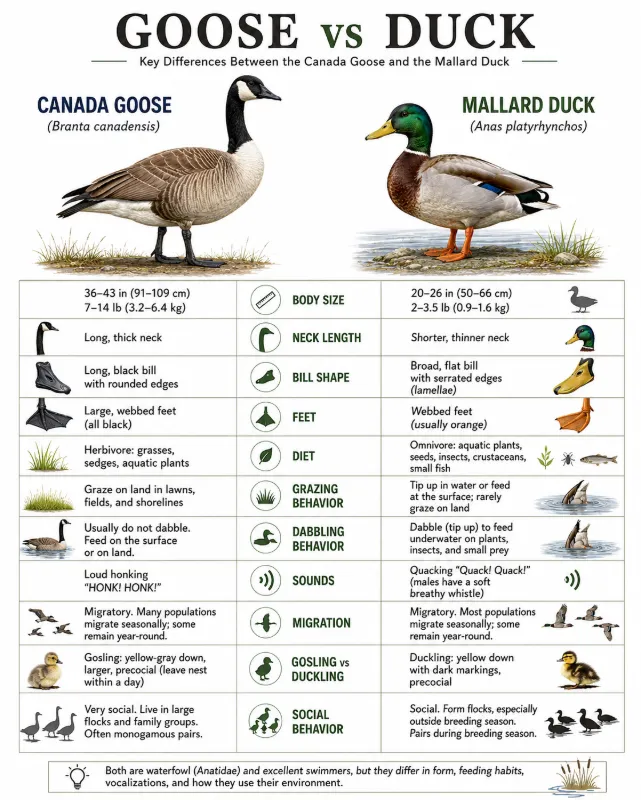
Geese and ducks are both waterfowl in the family Anatidae, but they are not the same. Geese are usually larger, longer-necked, more grass-eating, more strongly pair-bonded, and often louder and more territorial. Ducks are usually smaller, shorter-necked, more varied in diet, and more diverse in body shape and behavior. A goose often looks tall and heavy; a duck usually looks lower, rounder, and more compact.
Goose vs Duck Summary Table
| Feature | Goose | Duck |
|---|---|---|
| Animal group | Waterfowl in the family Anatidae | Waterfowl in the family Anatidae |
| Typical size | Usually larger and heavier | Usually smaller and more compact |
| Neck | Longer, more upright neck | Shorter neck, usually held lower |
| Body shape | Longer, heavier, more upright body | Rounder, lower, more compact body |
| Bill shape | Often shorter, stronger, and more triangular-looking | Often broader, flatter, and more shovel-like |
| Main diet | Mostly grasses, aquatic plants, grains, shoots, and roots | Plants, seeds, insects, snails, small fish, crustaceans, and aquatic invertebrates |
| Feeding style | Often grazes on land like a small livestock animal | Often dabbles, dives, filters, or forages in water and mud |
| Voice | Loud honks, calls, and alarm sounds | Quacks, whistles, grunts, squeaks, or soft calls depending on species |
| Social behavior | Often strong pair bonds and family groups | Varies widely; many form flocks but pair bonds may be seasonal |
| Temperament | Often more defensive, especially near nests or goslings | Often less territorial, though some species can be bold |
| Young bird name | Gosling | Duckling |
| Best quick clue | Large waterfowl with long neck, heavy body, and loud honk | Smaller waterfowl with shorter neck, broad bill, and compact body |
What Is a Goose?
A goose is a large waterfowl in the family Anatidae, the same family that includes ducks and swans. Geese are usually heavier than ducks, with longer necks, stronger bodies, and loud honking calls. Common examples include Canada geese, greylag geese, snow geese, barnacle geese, and domestic geese.
Geese are strongly associated with grazing. Many spend a lot of time on land eating grasses, tender shoots, grains, roots, and agricultural crops. They also feed in wetlands, lakes, ponds, marshes, and coastal areas, depending on species and season.
Geese are often highly social and may form strong pair bonds. During the breeding season, they can become territorial and defensive, especially around nests and goslings.
What Is a Duck?
A duck is a smaller waterfowl in the family Anatidae. Ducks are more diverse than geese in body shape, feeding style, color, and habitat. Common examples include mallards, wood ducks, teal, pintails, shovelers, mergansers, canvasbacks, eiders, and domestic ducks.
Ducks are often divided into several feeding groups. Dabbling ducks feed near the water surface by tipping forward. Diving ducks dive underwater for plants, mollusks, fish, or invertebrates. Sea ducks live in coastal waters and may dive deeply for shellfish or other marine foods.
Compared with geese, ducks usually have shorter necks, smaller bodies, broader bills, and more varied diets. Many ducks are less grass-specialized than geese.
Are Geese and Ducks Related?
Yes. Geese and ducks are related waterfowl. Both belong to the family Anatidae, along with swans. They share many traits, including webbed feet, waterproof feathers, bills adapted for feeding in water or wet ground, and young that can walk and swim soon after hatching.
However, geese and ducks are different groups within the waterfowl family. Geese are generally larger, more terrestrial grazers, while ducks are usually smaller and more varied in feeding behavior.
A simple way to understand the relationship is this: ducks, geese, and swans are close relatives, but they represent different waterfowl body types and lifestyles.
Size Differences
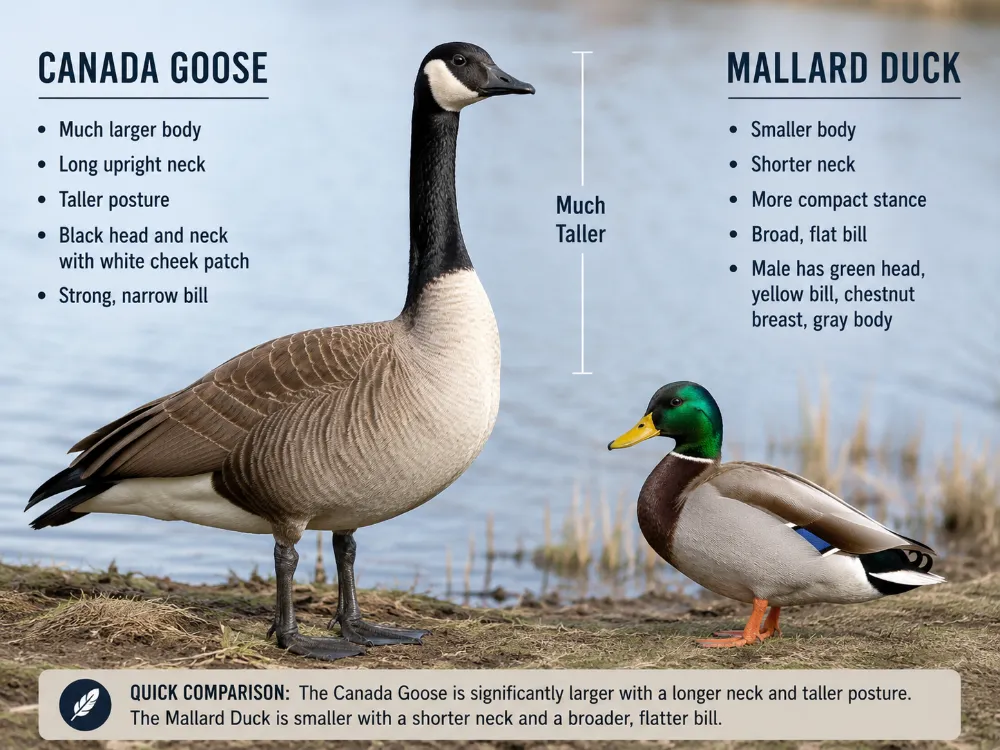
Geese are usually larger than ducks. A goose often has a heavier body, longer neck, longer legs, and a more upright posture. Many geese look closer to small swans than to small ducks in overall size and body presence.
Ducks are usually smaller and more compact. A mallard, for example, is much smaller than a Canada goose. Even large ducks often look rounder and lower to the ground than geese.
Size is one of the easiest clues. If the bird is big, long-necked, and heavy-looking, it is probably a goose. If it is smaller, rounder, and short-necked, it is probably a duck.
Neck Length Differences
Geese have longer necks than most ducks. Their necks help them graze on land, reach aquatic plants, watch for danger, and communicate with other geese. A goose often holds its neck upright when walking or alert.
Ducks usually have shorter necks. Their necks are still flexible, but they do not create the same tall, upright silhouette as a goose. Dabbling ducks may stretch their necks underwater while feeding, but their resting posture remains shorter and more compact.
Long neck plus large body usually suggests goose. Short neck plus rounded body usually suggests duck.
Bill Shape Differences
A goose bill is often shorter, stronger, and more triangular or wedge-like than a duck bill. It is well suited for clipping grass, pulling vegetation, and feeding on land. Some geese have serrated edges inside the bill that help grip plant material.
A duck bill is often broader and flatter. Many ducks use the bill to strain food from water, mud, or soft sediment. Dabbling ducks may filter tiny plants and invertebrates. Shovelers have especially wide bills adapted for filtering.
In simple terms, goose bills often look stronger for grazing, while duck bills often look flatter for dabbling and filtering.
Body Shape and Posture
Geese usually have a longer, more horizontal body when swimming and a more upright posture when standing. Their chest and neck give them a tall, alert appearance. On land, they often walk confidently while grazing.
Ducks usually look lower, rounder, and more compact. Their bodies sit closer to the water surface, and their short legs can give them a waddling walk on land. Some diving ducks have bodies set farther back toward the legs, making them excellent swimmers but less graceful walkers.
Posture helps identification: geese look tall and long-necked; ducks look compact and short-necked.
Feet and Swimming
Both geese and ducks have webbed feet. Webbing helps them push against water while swimming. Their legs are also useful for walking on mud, grass, ice, and wet ground.
Geese are strong walkers and grazers. They spend a lot of time on land and often move in family groups across lawns, fields, golf courses, wetlands, or agricultural land.
Ducks are usually more specialized for different types of aquatic feeding. Some ducks are surface dabblers, some are strong divers, and some are marine swimmers. Their feet and body position vary depending on feeding style.
Feather and Color Differences
Geese often have simpler color patterns than many ducks. They may be gray, brown, white, black, or patterned with strong head and neck markings. Canada geese, for example, have black heads and necks with a white cheek patch.
Ducks often show stronger differences between males and females. In many species, males are brightly colored during breeding season, while females are brown and camouflaged. Mallard drakes have green heads, while female mallards are mottled brown.
Color can help, but it is not always reliable. Some ducks are plain, and some geese have striking patterns. Body shape and size are usually better clues.
Male and Female Differences
In many goose species, males and females look similar. Males may be slightly larger, but the color pattern is often nearly the same. This makes sex identification difficult without behavior, size comparison, or close observation.
In many duck species, males and females look very different during the breeding season. Male ducks may have bright colors, glossy heads, bold wing patches, or decorative feathers. Female ducks are often brown and camouflaged to protect them while nesting.
This difference is common but not universal. Some duck species have more similar sexes, and some domestic forms have been bred into many colors.
Diet Differences
Geese are more strongly herbivorous than most ducks. They commonly eat grasses, sedges, clover, grains, aquatic plants, roots, leaves, and crop plants. Their digestive system is adapted to process large amounts of plant material.
Ducks have more varied diets. Some eat aquatic plants and seeds. Others eat insects, larvae, snails, worms, crustaceans, small fish, tadpoles, or mollusks. Diving ducks and sea ducks may feed on shellfish and underwater animals.
The simplest diet difference is this: geese are often grazers, while ducks are more varied foragers.
Feeding Behavior
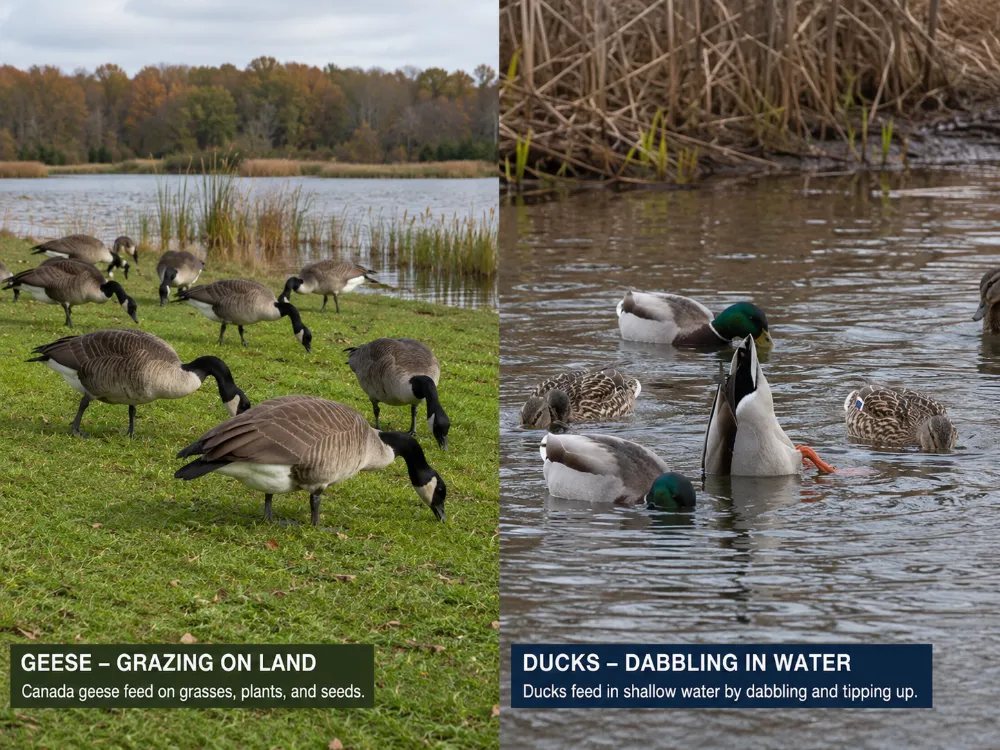
Geese often feed on land. They may graze in fields, lawns, marsh edges, parks, and agricultural areas. A flock of geese can look almost like small grazing livestock as they walk and clip vegetation.
Ducks often feed in water. Dabbling ducks tip forward with their tails in the air while reaching underwater plants and invertebrates. Diving ducks disappear below the surface to catch prey or pull up plants. Some ducks filter food through their broad bills.
If the bird is grazing like a goose on land, it is probably a goose. If it is dabbling, tipping, or diving like a compact water bird, it is probably a duck.
Sound Differences
Geese are famous for loud honking. Their calls can carry over long distances and are often heard during migration, alarm, flock movement, or territorial defense. A group of flying geese may honk repeatedly to coordinate movement.
Ducks make a wider range of sounds. Some quack, some whistle, some grunt, some squeal, and some make soft rasping calls. The familiar loud “quack” is especially associated with female mallards and domestic ducks, but not all ducks quack in the same way.
Deep honk usually suggests goose. Classic quack or varied soft calls usually suggest duck.
Migration Differences
Many geese are famous long-distance migrants. They often fly in V-shaped formations, using aerodynamic advantages and group coordination. Their honking calls are a classic sound of seasonal migration.
Many ducks also migrate, sometimes over very long distances. However, duck migration may be less visually dramatic to casual observers because ducks often fly in smaller groups or different formations depending on species.
Both geese and ducks can be migratory, resident, or partly migratory depending on species, region, climate, and food availability.
Social Behavior
Geese are often strongly social and family-oriented. Many form long-term pair bonds, and both parents may help guard and lead goslings. Family groups can remain together for months.
Ducks are also social, especially outside the breeding season, but pair bonds are often more seasonal in many species. Female ducks usually do most of the nesting and duckling care, while males may leave after mating or during incubation depending on species.
Geese often show stronger visible family defense. Ducks are more varied in their mating systems and parental behavior.
Temperament and Aggression
Geese are often more defensive than ducks. A goose may hiss, honk, spread its wings, lower its head, or charge if it feels threatened, especially near a nest or goslings. Domestic geese are sometimes used as “watch animals” because they are alert and noisy.
Ducks can also defend themselves, but they are usually less intimidating. Most ducks prefer to escape into water or fly away. Some male ducks can be aggressive during breeding season, but they rarely match the territorial presence of a large goose.
This is why people often describe geese as bold or bossy, while ducks are more often seen as shy or gentle.
Nesting Differences
Geese usually nest on the ground, often near water, islands, marsh edges, banks, or open areas with visibility. Many geese defend nest sites strongly. The female incubates the eggs while the male often guards nearby.
Ducks use a wider variety of nest sites. Some nest on the ground in grasses or reeds. Wood ducks nest in tree cavities. Some sea ducks nest near coastlines or tundra. Many female ducks rely on camouflage rather than aggressive defense.
Both lay eggs and have downy young that can move soon after hatching, but their nesting strategies differ by species.
Goslings vs Ducklings
A baby goose is called a gosling. Goslings are usually larger than ducklings, with longer necks and a more upright look even when young. They often follow both parents and graze on tender vegetation.
A baby duck is called a duckling. Ducklings are smaller, rounder, and often move in tight groups behind the mother. They may feed in shallow water, peck at small food items, and hide in vegetation.
Both goslings and ducklings are precocial, meaning they hatch with down, open eyes, and the ability to walk and swim soon after hatching.
Flight Differences
Geese are powerful fliers with long wings and strong migration ability. They often fly in lines or V-formations, especially during seasonal movements. Their larger bodies require strong wingbeats and coordinated takeoff.
Ducks are also strong fliers, and many species can take off quickly from water. Dabbling ducks can often spring almost straight up from the surface, while diving ducks may run across the water before becoming airborne.
Geese often look larger and more deliberate in flight, while ducks usually look smaller, faster, and more compact.
Habitat Differences
Geese often use open water, marshes, grasslands, agricultural fields, lawns, tundra, and wetlands. Because many geese graze, they frequently spend time in open grassy areas near water.
Ducks use nearly every kind of wet habitat. They can live in ponds, lakes, rivers, marshes, swamps, flooded fields, estuaries, mangroves, coastal bays, sea ice edges, and open ocean, depending on species.
Geese are more strongly tied to grazing areas near water. Ducks are more diverse in aquatic habitat use.
Domestic Geese vs Domestic Ducks
Domestic geese usually descend mainly from greylag geese or swan geese. They are often larger, louder, more territorial, and better at grazing than domestic ducks. They may be kept for meat, eggs, feathers, weed control, or guarding behavior.
Domestic ducks usually descend mostly from mallards, except Muscovy ducks, which come from a different wild species. Ducks are often kept for eggs, meat, pest control, and ornamental purposes. They are usually easier to manage in groups but still need water, shelter, and protection from predators.
For backyard keeping, geese need more space and stronger handling. Ducks are usually smaller and less confrontational, but they can be messy around water.
Goose Eggs vs Duck Eggs
Goose eggs are usually much larger than duck eggs. They have thick shells and rich yolks. Because geese lay fewer eggs than many ducks, goose eggs are less common in stores and kitchens.
Duck eggs are larger than chicken eggs in many breeds and often have rich yolks. Many domestic ducks are productive egg layers, especially breeds such as Khaki Campbell and Indian Runner.
If egg production is the goal, many duck breeds are more practical than geese. If large seasonal eggs are desired, geese may be valued.
Goose vs Duck vs Swan
Swans are the largest and longest-necked waterfowl in the same family. Compared with geese, swans are usually bigger, with longer necks and more graceful body lines. Compared with ducks, swans are much larger and more elegant-looking.
Geese sit between ducks and swans in many features. They are usually larger than ducks but smaller than swans. They have longer necks than ducks but shorter necks than most swans.
A simple size guide is: duck is usually smallest, goose is medium to large, and swan is usually largest.
Common Misunderstandings
One common misunderstanding is that all large waterfowl are geese. Some large water birds are swans, and some big-bodied ducks can look goose-like at first glance.
Another misunderstanding is that all ducks quack. Many ducks do not make the classic quack sound. Some whistle, grunt, squeak, or make soft calls.
A third misunderstanding is that geese are always aggressive. Geese are usually defensive, not randomly aggressive. Their bold behavior often protects mates, nests, goslings, or flock space.
How to Tell a Goose from a Duck Quickly
Look at size: geese are usually larger and heavier; ducks are usually smaller and rounder.
Look at the neck: geese have longer, more upright necks; ducks have shorter necks.
Look at the bill: goose bills are often stronger and more triangular; duck bills are often broader and flatter.
Watch feeding: geese often graze on land; ducks often dabble, dive, or filter in water.
Listen: geese honk; ducks quack, whistle, grunt, or make varied calls.
Watch behavior: geese are often more territorial and family-defensive.
Goose vs Duck: Final Comparison
Geese and ducks are closely related waterfowl, but they are easy to separate once you know the main clues. Geese are usually larger, longer-necked, louder, more grass-eating, and more defensive around families and nests. Ducks are usually smaller, shorter-necked, more compact, more diverse in diet, and more varied in feeding style.
The fastest field clues are size, neck length, bill shape, and feeding behavior. A large honking bird grazing on grass with a long neck is probably a goose. A smaller short-necked bird dabbling or diving in water is probably a duck.
FAQs About Geese vs Ducks
Are geese and ducks the same animal?
No. Geese and ducks are related waterfowl in the same family, but they are different groups. Geese are usually larger and longer-necked, while ducks are usually smaller and more compact.
Is a goose a type of duck?
No. A goose is not a duck. Geese and ducks are both waterfowl in the family Anatidae, but they are different types of birds within that family.
What is the easiest way to tell a goose from a duck?
Look at size and neck length. Geese are usually larger with longer upright necks. Ducks are usually smaller with shorter necks and broader, flatter bills.
Which is bigger, a goose or a duck?
A goose is usually bigger than a duck. Most geese are heavier, taller, and longer-necked than common ducks such as mallards.
Do geese quack?
Geese usually honk rather than quack. Their calls are often loud and carrying. Ducks make more varied sounds, including quacks, whistles, grunts, and soft calls.
Do all ducks quack?
No. Not all ducks make the familiar quack. Some ducks whistle, squeak, grunt, or make quiet rasping sounds. The classic loud quack is especially associated with female mallards and many domestic ducks.
Why are geese more aggressive than ducks?
Geese are often more defensive because they protect mates, nests, goslings, and flock space. They are not usually aggressive without reason, but they can be bold when they feel threatened.
What do geese eat?
Geese mainly eat grasses, aquatic plants, grains, shoots, roots, leaves, and crop plants. They are strong grazers and often feed on land.
What do ducks eat?
Ducks eat a wider variety of foods, including aquatic plants, seeds, insects, snails, worms, crustaceans, small fish, and other invertebrates, depending on species.
Can geese and ducks live together?
Domestic geese and ducks can sometimes live together if they have enough space, clean water, shelter, and careful management. Geese may dominate smaller ducks, especially during breeding season.
Can geese and ducks mate?
Geese and ducks are different enough that they do not normally produce viable offspring. Some unusual hybrid reports involve closely related waterfowl, but goose-duck breeding is not normal.
What is a baby goose called?
A baby goose is called a gosling. Goslings are usually larger and longer-necked than ducklings.
What is a baby duck called?
A baby duck is called a duckling. Ducklings are usually small, round, downy, and able to walk and swim soon after hatching.
Are geese better flyers than ducks?
Both can be excellent flyers. Geese are famous for long-distance migration in V-formations, while many ducks are fast and agile fliers with different takeoff styles.
Are geese or ducks better for backyard farms?
Ducks are often easier for beginners because they are smaller and usually less defensive. Geese are useful grazers and alert birds, but they need space, management, and respect because they can be loud and territorial.