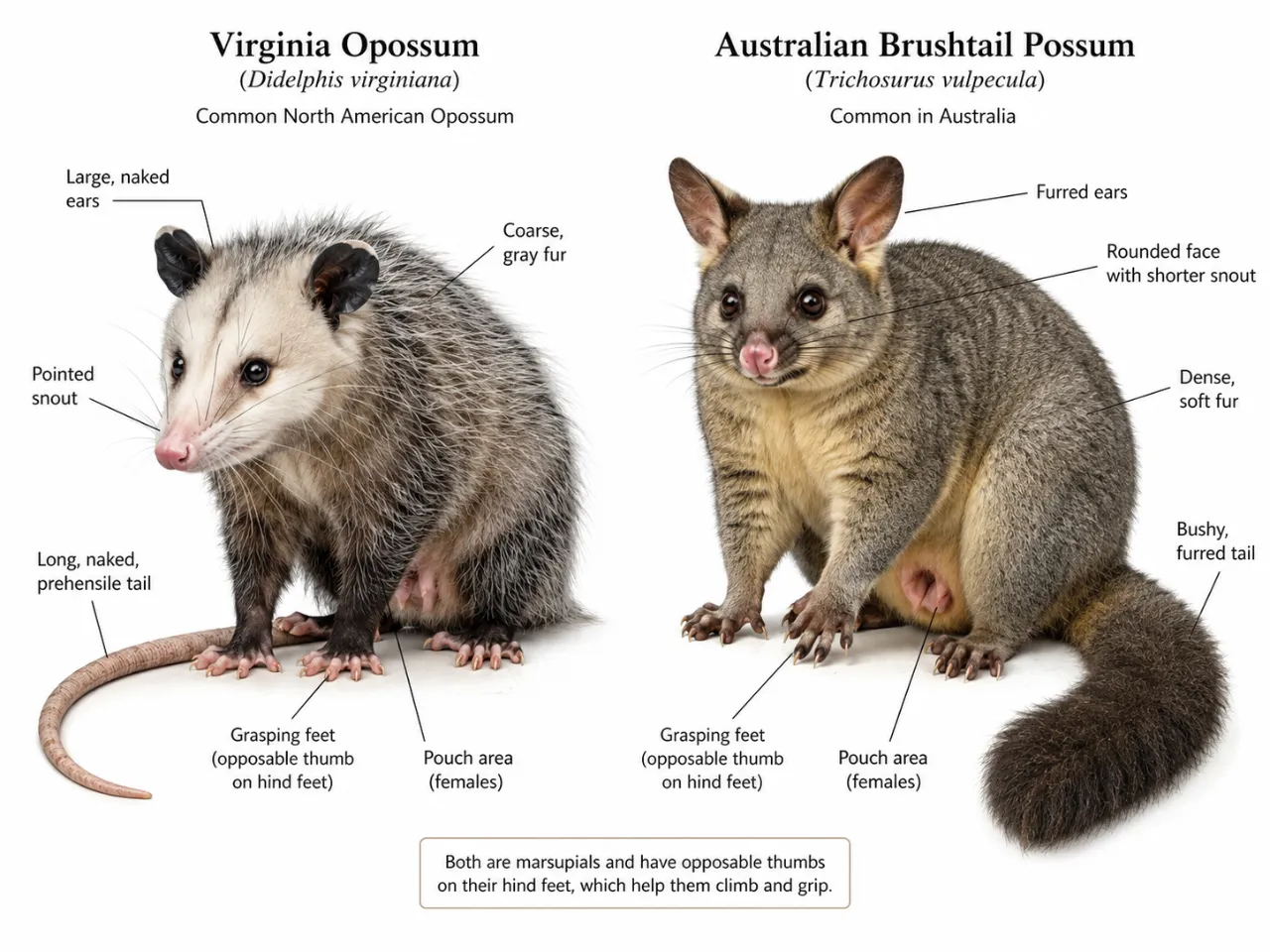
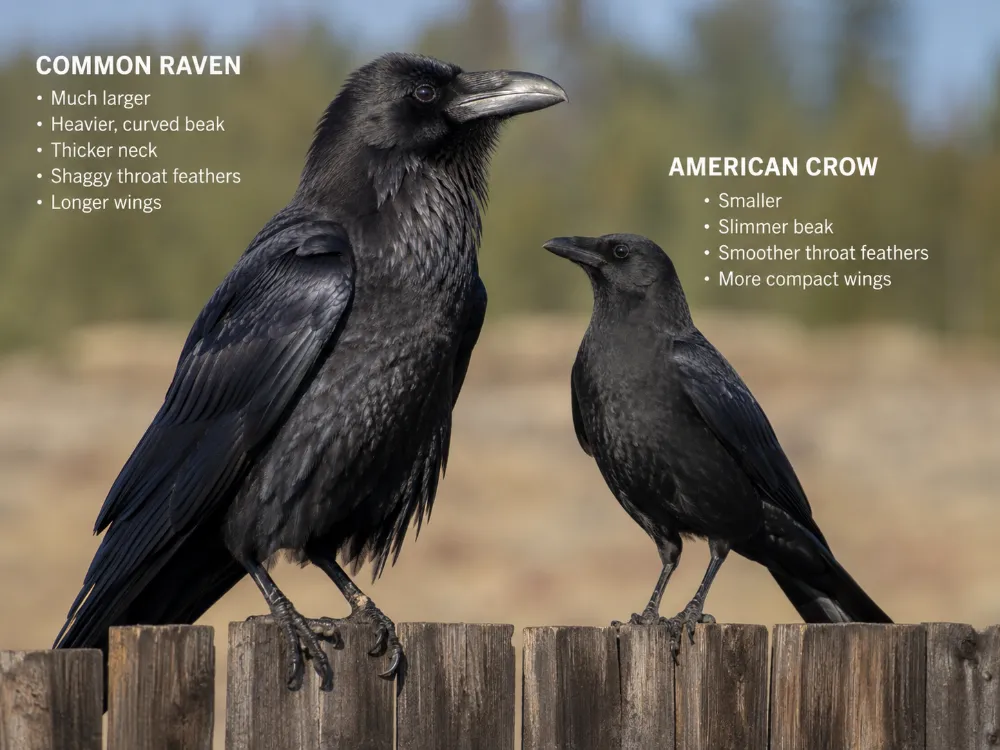
Ravens are usually much larger than crows. A common raven can be about 22–27 inches long with a wingspan of 45–51 inches, while an American crow is usually about 16–21 inches long with a wingspan of 33–39 inches. Ravens also look heavier, thicker-necked, longer-winged, and more powerful, with a larger beak and wedge-shaped tail.
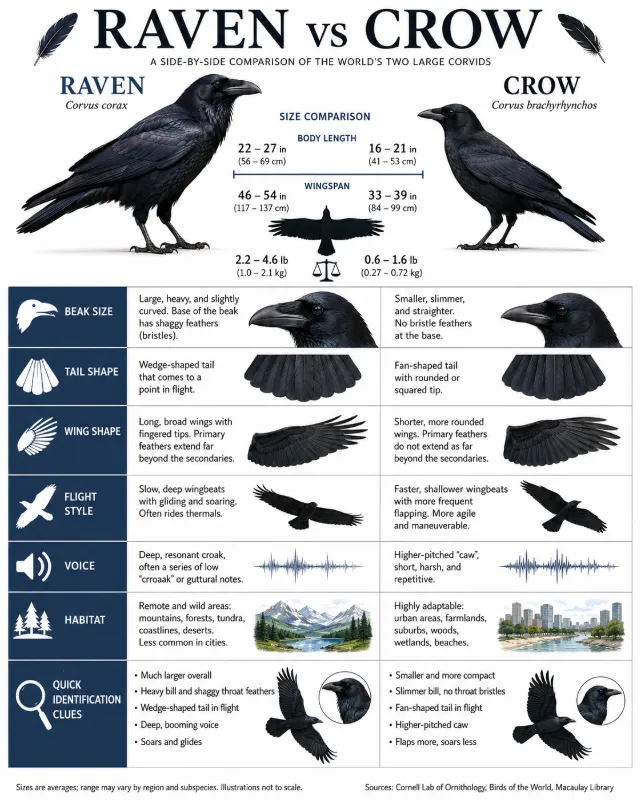
Raven vs Crow Size Summary Table
| Feature | Raven | Crow |
|---|---|---|
| Common example | Common raven, Corvus corax | American crow, Corvus brachyrhynchos |
| General size | Much larger and heavier | Smaller and lighter |
| Typical body length | About 22–27 inches | About 16–21 inches |
| Typical wingspan | About 45–51 inches | About 33–39 inches |
| Typical weight | Often about 1.5–4.4 lb, depending on sex and region | Often about 0.7–1.4 lb |
| Body impression | Large, powerful, thick-necked, eagle-like in flight | Medium-sized, slimmer, more compact, familiar city-bird shape |
| Beak size | Large, heavy, slightly curved, and powerful-looking | Smaller, straighter, and more moderate |
| Tail shape | Wedge-shaped or diamond-like in flight | Fan-shaped or rounded in flight |
| Wing shape | Longer, narrower-looking wings with strong fingered tips | Shorter, broader-looking wings |
| Flight style | Soars, glides, rolls, and uses strong wingbeats | More steady flapping; less soaring than ravens |
| Voice | Deep croak, low “gronk,” rough calls | Higher, sharper “caw” |
| Best quick clue | Looks almost hawk-sized, with a big beak and wedge tail | Smaller black bird with a fan tail and classic caw |
Raven vs Crow Size at a Glance
The common raven is usually the larger bird by a clear margin. A raven is not just a slightly bigger crow; it can look almost hawk-sized or even small-eagle-like when flying overhead. Its wings are longer, its body is heavier, and its beak looks much more powerful.
An American crow is still a fairly large songbird, but it is noticeably smaller than a raven. Crows look more compact, with shorter wings, a smaller bill, and a rounded or fan-shaped tail. In towns, farms, parks, and neighborhoods, most familiar black “cawing” birds are crows rather than ravens.
The size difference is easiest to see when the two birds are flying, perched near each other, or compared with familiar birds such as pigeons, hawks, or gulls.
How Big Is a Raven?
A common raven is one of the largest songbirds in the world. Adult common ravens are often about 22–27 inches long from bill to tail. Their wingspan is usually about 45–51 inches, making them appear very large in the air.
Ravens are also heavy for songbirds. Depending on sex, region, and individual condition, a raven may weigh roughly 1.5–4.4 pounds. This gives the bird a powerful, muscular appearance, especially around the neck, chest, and head.
When perched, a raven often looks bulky and thick-necked. When flying, it may look more like a raptor than a typical crow because of its long wings, strong body, and soaring ability.
How Big Is a Crow?
An American crow is smaller than a common raven but still larger than many backyard birds. Adult American crows are usually about 16–21 inches long, with a wingspan of about 33–39 inches.
Crows typically weigh much less than ravens, often around 0.7–1.4 pounds. Their bodies look slimmer, their beaks are smaller, and their wings are shorter compared with ravens.
A crow may look large when seen alone in a yard, parking lot, or tree. But beside a raven, the crow usually appears noticeably smaller, lighter, and less powerful.
Body Length Differences
Ravens are usually several inches longer than crows. This length difference comes from the raven’s larger body, longer wings, bigger head, and longer tail. A raven’s body looks stretched and heavy, while a crow looks more compact.
Body length alone can be hard to judge in the field because distance changes perception. A nearby crow can look bigger than a faraway raven. For this reason, size should be combined with tail shape, beak size, wing shape, voice, and flight style.
Still, if the black bird looks unusually large, long-bodied, and powerful, it may be a raven rather than a crow.
Wingspan Differences
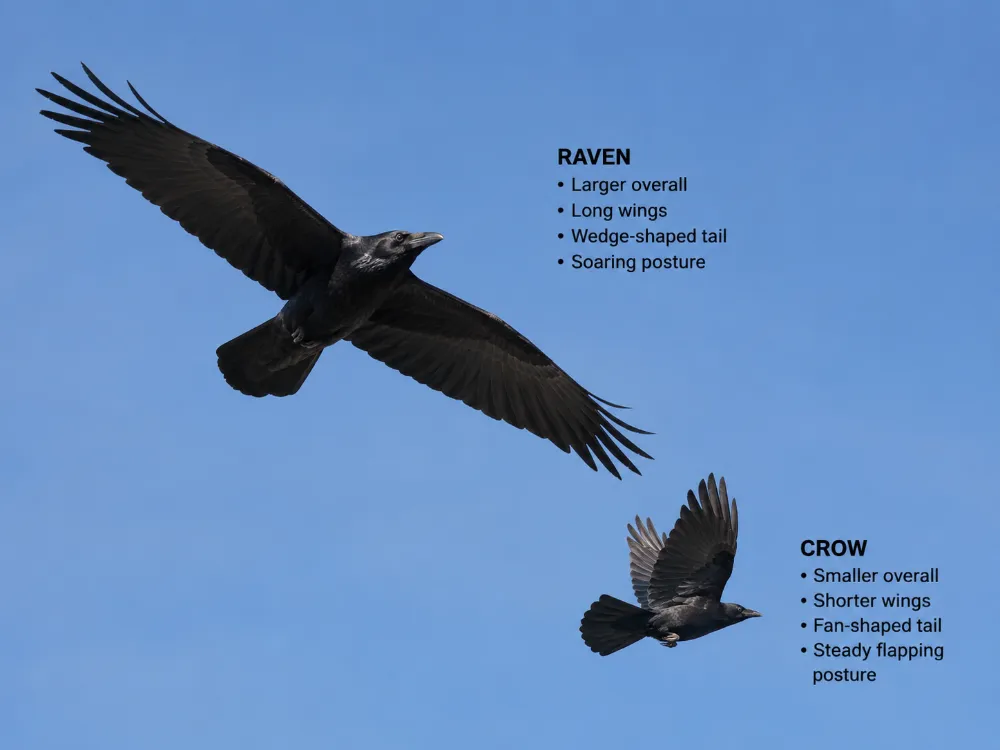
Wingspan is one of the clearest size differences. Ravens have much longer wings than crows. A flying raven may look broad, dramatic, and almost raptor-like, with long wings and visible “fingered” wing tips.
Crows have shorter wings and a more familiar flapping flight. Their wings can still look broad, but they usually do not create the same long, soaring silhouette as a raven.
If the bird is soaring high, gliding for long periods, or circling on broad wings, raven becomes more likely. If it is flapping steadily across a neighborhood or field, crow is more likely.
Weight Differences
Ravens are much heavier than crows. In some cases, a large raven may weigh two or three times as much as an American crow. This extra mass changes the bird’s whole appearance.
A raven’s body looks deeper and more muscular. The head and beak look larger. The neck feathers may appear shaggy, especially around the throat. A crow looks lighter, smoother, and more evenly proportioned.
Weight is not something most observers can measure in the field, but you can often see its effect in body shape and flight style.
Beak Size and Head Shape
Ravens have noticeably larger beaks than crows. The raven’s beak is thick, heavy, and slightly curved, giving the head a powerful profile. The beak may look almost oversized compared with the rest of the face.
Crows have smaller, straighter, more moderate beaks. Their head shape is smoother and less massive. From the side, a crow’s bill does not look as deep or as strongly curved as a raven’s bill.
If the bird has a huge bill and a heavy head, it is more likely a raven. If the beak looks medium-sized and neat, it is more likely a crow.
Tail Shape and Size
Tail shape is one of the best field marks. Ravens usually have a wedge-shaped or diamond-shaped tail in flight. The central tail feathers are longer, creating a pointed or triangular rear outline.
Crows usually have a fan-shaped or rounded tail. When a crow spreads its tail, the outer feathers are closer in length to the central feathers, making the tail look more even and rounded.
This clue is especially useful when the bird is flying overhead. A wedge tail suggests raven. A fan tail suggests crow.
Wing Shape and Flight Style
Ravens often fly with a slower, more powerful wingbeat. They also soar and glide more often than crows. Ravens may perform rolls, dives, and playful aerial movements, especially in windy areas, mountains, cliffs, or open country.
Crows usually fly with more direct, steady flapping. They can glide briefly, but they are not as strongly associated with long soaring flight. Their movement often looks more practical and less dramatic than a raven’s flight.
Flight style is not just about size. It also reflects wing shape, body mass, habitat, and behavior.
Perched Size and Posture
A perched raven often looks large, heavy, and thick-necked. Its throat feathers may look shaggy, and the beak appears strong. The bird may sit with a confident, bulky posture.
A perched crow looks smaller and smoother. Its body shape is more compact, the throat usually looks less shaggy, and the beak is not as massive. Crows often perch in groups on trees, poles, rooftops, wires, or fences.
If the bird is alone on a cliff, tall tree, or remote structure and looks extremely large for a crow-like bird, it may be a raven.
Voice Differences
Voice is often easier than size. Ravens usually make deep, rough croaks, gronks, knocks, and low rattling calls. Their voice sounds heavier and more resonant than a crow’s call.
Crows are famous for the classic “caw.” Their calls are usually sharper, higher, and more repeated. A group of crows may create a noisy series of caws, especially when mobbing a predator.
If the bird says a sharp “caw,” it is probably a crow. If it gives a deep hollow croak, it is more likely a raven.
Raven Size Compared With Common Birds
A raven is much larger than a pigeon and can look similar in wingspan to some hawks. It may even look eagle-like from a distance, especially when soaring. Its long wings and wedge tail make it stand out from most black birds.
A raven is also larger than a typical gull, though exact comparison depends on the gull species. In open country, mountains, deserts, and coastal cliffs, a raven’s large silhouette can be striking.
If a black bird looks surprisingly large compared with nearby birds, raven should be considered.
Crow Size Compared With Common Birds
A crow is larger than a blue jay, robin, blackbird, or pigeon in many cases, but it is smaller than a raven. In urban and suburban areas, crows often appear as medium-large black birds walking on lawns, feeding near roads, or perching in groups.
Crows are large enough to look bold and intelligent, but they do not usually look as massive, long-winged, or heavy-billed as ravens.
A crow may seem big when seen alone, but beside a raven it looks clearly smaller.
Raven vs Crow Size in North America
In North America, the most common comparison is between the common raven and the American crow. The common raven is larger, heavier, longer-winged, and more often found in wilder, more open, or rugged habitats, although it can also live near people in some regions.
The American crow is smaller and more common in many towns, farms, suburbs, fields, and wooded neighborhoods. It is highly adaptable and often lives close to human activity.
In western North America, both species may occur in the same broad region, making size, voice, tail shape, and habitat especially useful.
Raven vs Fish Crow Size
The fish crow is smaller than the American crow and much smaller than the common raven. Fish crows are found in parts of the eastern and southeastern United States, especially near water, coasts, rivers, and wetlands.
Fish crows can be difficult to separate from American crows by size alone, but they are clearly smaller than ravens. Their voice is also different, often sounding more nasal.
If the bird is crow-sized but has a nasal call near water, fish crow may be possible. If it is huge with a deep croak and wedge tail, it is a raven.
Raven vs Crow Size in the UK and Europe
In the UK and much of Europe, the common raven is still much larger than crows such as the carrion crow or hooded crow. Ravens are often associated with cliffs, mountains, moorlands, forests, coastal areas, and open landscapes, though they can appear in other habitats.
Carrion crows and hooded crows are smaller and more often seen in farmland, towns, woodlands, fields, and roadsides. Their size is closer to the American crow than to the common raven.
The same general rule applies: ravens are heavier, longer-winged, deeper-voiced, and wedge-tailed.
Why Ravens Are Bigger Than Crows
Ravens and crows belong to the same bird family, Corvidae, but they evolved different body sizes and ecological strategies. Ravens are often more associated with large territories, open landscapes, scavenging on larger carcasses, cliff nesting, and powerful flight over long distances.
Crows are usually more adaptable in human-dominated landscapes and often live in social groups. Their smaller size may make them more flexible in towns, farms, parks, and wooded edge habitats.
Both birds are intelligent and opportunistic, but ravens are built on a larger, more powerful frame.
Does Size Change by Age or Sex?
Yes. Young birds may look slightly different from adults, and males are often somewhat larger than females in many corvid species. However, these differences are usually smaller than the difference between a raven and a crow.
A large male crow is still usually smaller than a typical adult raven. A young raven may still look larger, heavier-billed, and longer-winged than a crow.
Age and sex can create overlap in appearance, but they rarely erase the overall raven-versus-crow size difference.
Can a Crow Look Like a Small Raven?
Yes, especially if the bird is seen alone, in poor light, or at an awkward angle. A large crow may seem raven-like to a casual observer, particularly when it fluffs its feathers or perches high above the viewer.
To avoid mistakes, do not rely on size alone. Look for the raven’s large curved beak, shaggy throat, wedge-shaped tail, deep croak, and soaring flight. A crow usually has a smaller bill, smoother throat, fan-shaped tail, sharper caw, and steadier flapping flight.
Identification is strongest when several clues point in the same direction.
Can a Raven Look Like a Giant Crow?
Yes. A raven can look like a giant crow at first glance because both are large black corvids with similar general body plans. Many people describe ravens as “huge crows,” but this is not scientifically precise.
Ravens are a separate kind of corvid with different proportions, behavior, voice, and flight style. The larger size is only one part of the difference.
If a “crow” looks unusually large, has a wedge tail, and gives a deep croaking call, it is probably a raven.
Habitat Clues That Support Size Identification
Habitat can help support identification. Ravens are often common in mountains, deserts, cliffs, forests, coastal headlands, open country, and remote areas. They may nest on cliffs, tall trees, power structures, or ledges.
Crows are often common in farms, towns, suburbs, city parks, fields, woodlots, roadsides, and neighborhoods. They are highly comfortable around people and may gather in flocks.
Habitat alone is not perfect because both birds can adapt, but it helps when combined with size and shape.
Social Group Size
Crows are often seen in groups. They may feed together, mob predators, roost communally, and call loudly to each other. Large winter crow roosts can contain many birds.
Ravens are often seen alone or in pairs, especially adult territorial pairs. Younger ravens may gather in groups around food sources, carcasses, landfills, or open feeding areas, but a lone large black corvid in wild country is often a raven.
If you see a noisy group of smaller black birds cawing together, they are likely crows. If you see one or two huge black birds croaking and soaring, they may be ravens.
Size Is Useful but Not Enough
Size is the first clue many people notice, but it should not be the only clue. Distance can fool the eye. A close crow may look bigger than a distant raven. A raven flying high overhead may seem smaller than it really is.
That is why bird identification uses multiple features. For raven vs crow, the best combination is size, beak shape, tail shape, voice, flight style, habitat, and behavior.
When all of those clues match, identification becomes much easier.
How to Tell Raven Size from Crow Size Quickly
Look at overall size: ravens are much larger and heavier than crows.
Look at wingspan: ravens have longer, broader-looking wings and often soar.
Look at the beak: ravens have a larger, heavier, more curved beak.
Look at the tail: ravens have wedge-shaped tails; crows have fan-shaped tails.
Listen to the voice: ravens croak deeply; crows caw sharply.
Watch the flight: ravens glide and soar more; crows flap more steadily.
Raven vs Crow Size: Final Comparison
Ravens are clearly larger than crows. A common raven may reach about 22–27 inches long with a wingspan of 45–51 inches, while an American crow is usually about 16–21 inches long with a wingspan of 33–39 inches. Ravens also weigh much more and look thicker, longer-winged, and more powerful.
The best quick size clue is overall impression: a raven looks like a huge black bird with a heavy beak and wedge-shaped tail, while a crow looks smaller, neater, and more compact. For the most accurate identification, combine size with voice, tail shape, beak shape, and flight style.
FAQs About Raven vs Crow Size
Is a raven bigger than a crow?
Yes. Ravens are usually much bigger than crows. A common raven is longer, heavier, and has a larger wingspan than an American crow.
How much bigger is a raven than a crow?
A raven can be several inches longer and may have a wingspan more than 10 inches wider than a crow. A large raven can also weigh two or more times as much as a crow.
What is the wingspan of a raven?
A common raven usually has a wingspan of about 45–51 inches. This gives it a large, powerful silhouette in flight.
What is the wingspan of a crow?
An American crow usually has a wingspan of about 33–39 inches. It is a large songbird, but still much smaller than a common raven.
How long is a raven?
A common raven is often about 22–27 inches long from bill to tail. Males may be slightly larger than females.
How long is a crow?
An American crow is usually about 16–21 inches long. It is smaller and more compact than a raven.
Can a crow be as big as a raven?
A very large crow may look impressive, but it is usually still smaller than a raven. Distance and viewing angle can make size hard to judge, so use tail shape, voice, and beak size too.
What bird looks like a giant crow?
A raven often looks like a giant crow to casual observers. It is larger, deeper-voiced, heavier-billed, longer-winged, and has a wedge-shaped tail.
What is the easiest way to tell a raven from a crow?
The easiest way is to combine voice and shape. Ravens give deep croaks and have wedge-shaped tails. Crows give sharper caws and have fan-shaped tails.
Do ravens and crows have different tails?
Yes. Ravens usually have wedge-shaped tails in flight. Crows usually have rounded or fan-shaped tails.
Do ravens have bigger beaks than crows?
Yes. Ravens have larger, heavier, more curved beaks. Crows have smaller, straighter, more moderate beaks.
Which is heavier, a raven or a crow?
A raven is much heavier. Common ravens may weigh several pounds, while American crows are usually much lighter.
Do ravens fly differently from crows?
Yes. Ravens often soar, glide, and use slow powerful wingbeats. Crows usually flap more steadily and are less likely to soar for long periods.
Are ravens just large crows?
No. Ravens and crows are related corvids, but they are different birds. Ravens are larger, heavier-billed, deeper-voiced, and more likely to have wedge-shaped tails.
Which is smarter, a raven or a crow?
Both ravens and crows are highly intelligent birds. They can solve problems, remember faces, use social learning, and adapt to many environments. Size does not make one automatically smarter than the other.