Quick answer
Gorillas and chimpanzees are both great apes, but they differ strongly in body size, diet, movement, social life, and behavior. Gorillas are the largest living primates. Adult males can be extremely powerful, with broad chests, long arms, and massive heads. Chimps are much smaller but highly agile, socially complex, and well known for tool use.
In simple terms, gorillas are generally larger, calmer, and more herbivorous, while chimps are generally smaller, more energetic, more omnivorous, and more behaviorally flexible. Neither animal is “better” or “more advanced”; each is adapted to a different way of life in African forests and woodland habitats.
Summary table
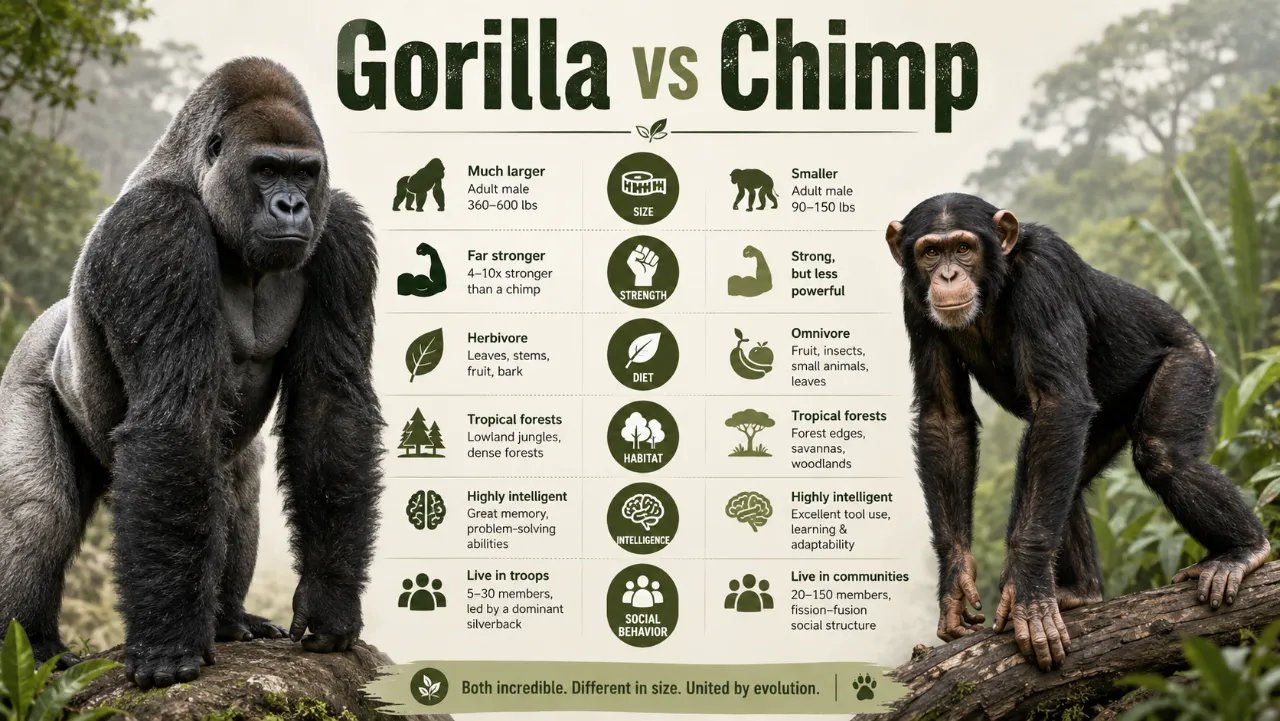
| Feature | Gorilla | Chimpanzee |
|---|---|---|
| Scientific group | Genus Gorilla | Genus Pan |
| General size | Much larger and heavier | Smaller and lighter |
| Adult male weight | Often around 135–200 kg, depending on species and individual | Often around 40–70 kg, depending on population and individual |
| Body build | Massive, broad-chested, heavily muscled | Lean, strong, agile, and flexible |
| Diet | Mostly leaves, stems, shoots, fruit, and other plant material | Fruit, leaves, seeds, insects, and sometimes meat |
| Social structure | Usually groups led by a dominant silverback male | Flexible communities with shifting subgroups |
| Tool use | Known but less frequent in the wild | Common and highly varied in many populations |
| Typical movement | Knuckle-walking, climbing when needed | Knuckle-walking, climbing, swinging, and quick movement through trees |
| Temperament | Generally calm unless threatened | Often more active, excitable, and socially intense |
| Wild range | Central and parts of eastern Africa | West, Central, and parts of East Africa |
How gorillas and chimps are related
Gorillas and chimpanzees are both great apes, meaning they belong to the same broad primate family as humans, orangutans, and bonobos. They do not have tails, have flexible shoulders, show complex social behavior, and display high intelligence compared with most mammals.
However, gorillas and chimps are not the same kind of ape. Gorillas belong to the genus Gorilla, while chimpanzees belong to the genus Pan. The word “chimp” usually refers to the common chimpanzee, although bonobos are also members of the genus Pan. In a “gorilla vs chimp” comparison, most people mean gorillas compared with common chimpanzees.
They share distant evolutionary ancestry, but each lineage followed a different path. Gorillas became large-bodied, mostly plant-eating forest apes. Chimps evolved as smaller, more agile apes with flexible feeding habits, strong social politics, and frequent tool use in many populations.
Size, strength, and body shape
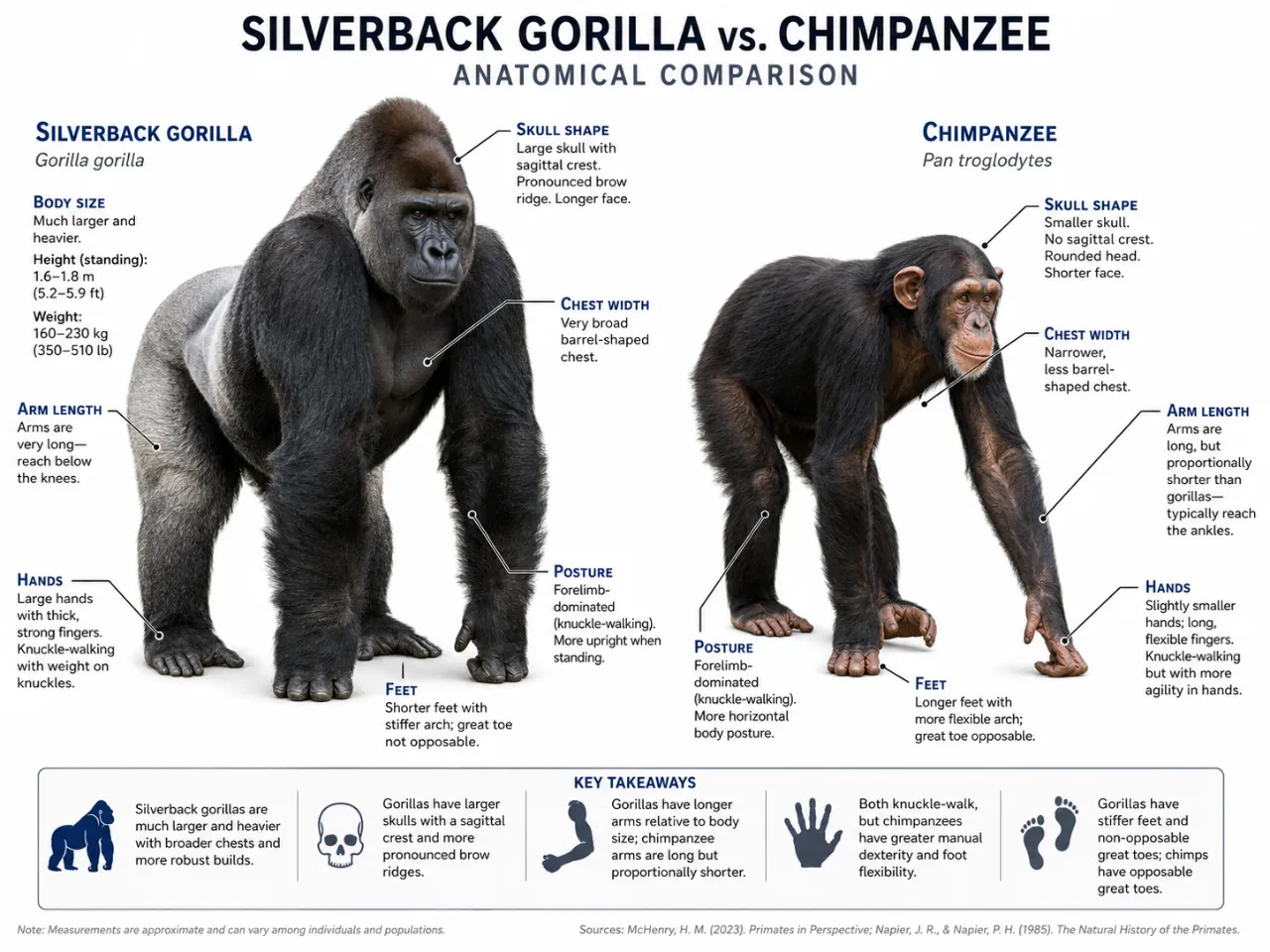
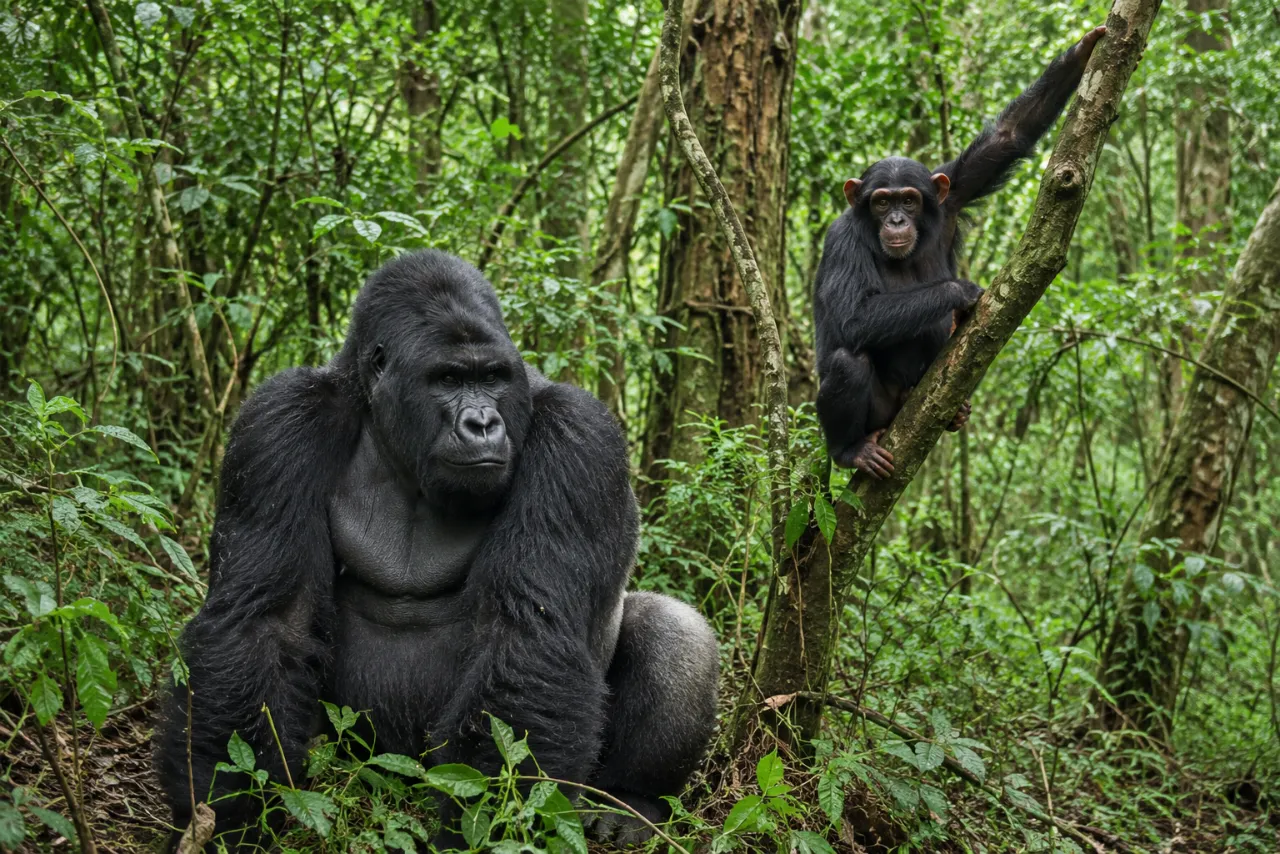
The most obvious difference is size. Gorillas are much larger than chimps. Adult male gorillas, especially silverbacks, can be several times heavier than adult male chimpanzees. Their bodies are built for strength, with huge arms, broad shoulders, thick necks, and powerful jaws.
Chimpanzees are smaller but still very strong for their size. Their bodies are lean, muscular, and adapted for climbing, pulling, gripping, and moving quickly through trees and on the ground. A chimp’s strength is impressive, but it should not be compared directly with a gorilla’s mass and power. A mature male gorilla is in a different size category.
Gorillas usually look more imposing because of their massive heads, sagittal crests in mature males, and broad upper bodies. Chimps have more slender frames, longer-looking limbs relative to body size, and more mobile facial expressions.
Habitat and range
Both gorillas and chimpanzees are native to Africa, but their ranges and preferred habitats are not identical. Gorillas are found mainly in forested regions of Central Africa and parts of eastern Africa. Different gorilla species and subspecies live in lowland forests, montane forests, swamp forests, and forest edges.
Chimpanzees have a wider range across parts of West, Central, and East Africa. They live in tropical forests, woodland-savanna mosaics, riverine forests, and other habitats where fruiting trees, nesting sites, and water are available.
Gorillas are generally more strongly associated with dense forest habitats, although some populations use varied landscapes. Chimps are often more flexible in habitat use, especially where forest patches connect with open woodland or savanna-like areas.
Diet and feeding behavior
Gorillas are mostly herbivorous. Their diet often includes leaves, stems, shoots, bark, roots, herbs, and fruit when available. Mountain gorillas, for example, rely heavily on leafy vegetation, while some lowland gorillas eat more fruit when it is seasonally abundant.
Chimpanzees are more omnivorous. Fruit is usually very important in their diet, but they also eat leaves, seeds, flowers, honey, insects, and occasionally meat. In some populations, chimps hunt monkeys or small mammals. This does not mean meat is their main food, but it can be an important occasional resource.
Their diets influence their behavior. Gorillas may spend long periods feeding on abundant vegetation, while chimps often travel farther to find fruit trees or valuable food patches. This helps explain why chimp communities can be more active and competitive around food.
Social behavior
Gorilla groups are often centered around one dominant adult male, known as a silverback. A typical group may include the silverback, several adult females, and their offspring. The silverback helps protect the group, makes many movement decisions, and plays an important role in social stability.
Chimpanzee societies are more fluid. Chimps live in larger communities that split into smaller temporary parties throughout the day. This is known as fission-fusion social behavior. Individuals may feed, travel, groom, or patrol in different subgroup combinations depending on food, relationships, mating, and social tension.
Chimp social life is often highly political. Alliances, dominance rank, grooming, reconciliation, coalition-building, and competition are all important. Gorillas also have social bonds and conflict, but their group structure is generally less fluid than that of chimps.
Intelligence, tools, and communication
Both gorillas and chimps are intelligent animals. They can learn, remember, solve problems, recognize individuals, communicate with gestures and sounds, and show emotional complexity. Their intelligence should be understood in relation to their natural lives rather than judged only by human-style tasks.
Chimpanzees are especially famous for tool use. In many populations, they use sticks to fish for termites, stones to crack nuts, leaves as sponges, and branches or stems for different feeding or display behaviors. Tool traditions can vary between chimp communities, which suggests a form of social learning.
Gorillas can also use tools, but wild tool use is generally less common and less varied than in chimpanzees. This may partly reflect differences in diet, habitat, social learning opportunities, and ecological need. A gorilla does not need to use a tool in the same way if its food is often abundant and reachable.
Temperament and conflict
Gorillas are often described as gentle giants, and this is partly fair, but it should not be misunderstood. A gorilla is a powerful wild animal. Most gorillas are generally calm when undisturbed, but a silverback may charge, display, beat his chest, or defend his group if he perceives danger.
Chimpanzees are usually more active and socially intense. They can be affectionate, playful, cooperative, curious, and intelligent, but they can also be aggressive. Conflicts between individuals, rival groups, or dominance competitors can be serious.
In a direct physical comparison, a gorilla is far stronger because of its much larger body size. However, real animals are not video-game fighters. Their behaviors evolved for survival, reproduction, feeding, defense, and social life, not for staged contests.
Do all gorillas and chimps behave the same way
No. There are important differences among species, subspecies, populations, sexes, ages, and individuals. A mountain gorilla does not live exactly like a western lowland gorilla. A chimp community in one forest may use tools differently from a chimp community in another region.
Age and sex also matter. Adult male gorillas are much larger than females and have different social roles. Male and female chimps can also differ in ranging patterns, social strategies, and dominance behavior. Young apes of both kinds are usually more playful and curious than adults.
Because behavior varies, careful wording matters. It is more accurate to say “generally,” “often,” or “in many populations” than to claim that all gorillas or all chimps behave in exactly the same way.
Why these differences make each ape successful
Gorillas are successful because their large bodies, strong digestive systems, and powerful jaws allow them to process large amounts of plant material. Their social groups provide protection, reproductive structure, and care for young. A silverback’s size and presence can reduce threats from rivals or predators.
Chimpanzees are successful in a different way. Their agility, flexible diet, tool use, memory, and social strategies allow them to exploit a wide range of foods and environments. Their fission-fusion society lets them adjust group size depending on food availability and social conditions.
Both survival strategies are effective, but both are vulnerable to human pressure. Habitat loss, hunting, disease, and human disturbance threaten many wild populations. Their slow reproduction makes recovery difficult when numbers decline.
Final takeaway
Gorillas and chimps are both intelligent African great apes, but they represent different evolutionary solutions. Gorillas are larger, stronger, more heavily built, and generally more plant-focused. Chimps are smaller, more agile, more omnivorous, and often more flexible in tool use and social behavior.
The best way to understand “gorilla vs chimp” is not to ask which animal is superior. Instead, compare how each ape is adapted to its world. Gorillas are powerful forest herbivores with stable social groups, while chimpanzees are energetic, highly social omnivores with complex relationships and remarkable behavioral flexibility.
FAQs
Is a gorilla stronger than a chimp?
Yes, generally. A mature male gorilla is much larger and more powerful than a chimpanzee. Chimps are very strong for their size, but gorillas have far greater body mass, muscle, and overall physical power.
Are chimps smarter than gorillas?
Chimpanzees are generally more famous for varied tool use and complex social strategies, but that does not mean gorillas are unintelligent. Gorillas also learn, communicate, remember individuals, solve problems, and show emotional complexity. Their intelligence appears in different ecological and social contexts.
Would a gorilla or chimp win in a fight?
A gorilla would almost certainly have the physical advantage because of its much larger size and strength. However, wild animals should not be reduced to fight scenarios. Gorillas and chimps evolved for survival in their natural habitats, not for direct contests with each other.