Quick answer
In scientific usage, an opossum is a marsupial from the Americas, while a possum is a marsupial from Australia, New Guinea, and nearby regions. They are related in the broad sense that both are marsupials, but they belong to different evolutionary groups and have different body shapes, behaviors, and habitats.
In casual North American speech, “possum” often means “opossum,” especially when people are talking about the Virginia opossum. This common shortcut is widely understood, but it can be confusing because true possums are different animals found on the other side of the world.
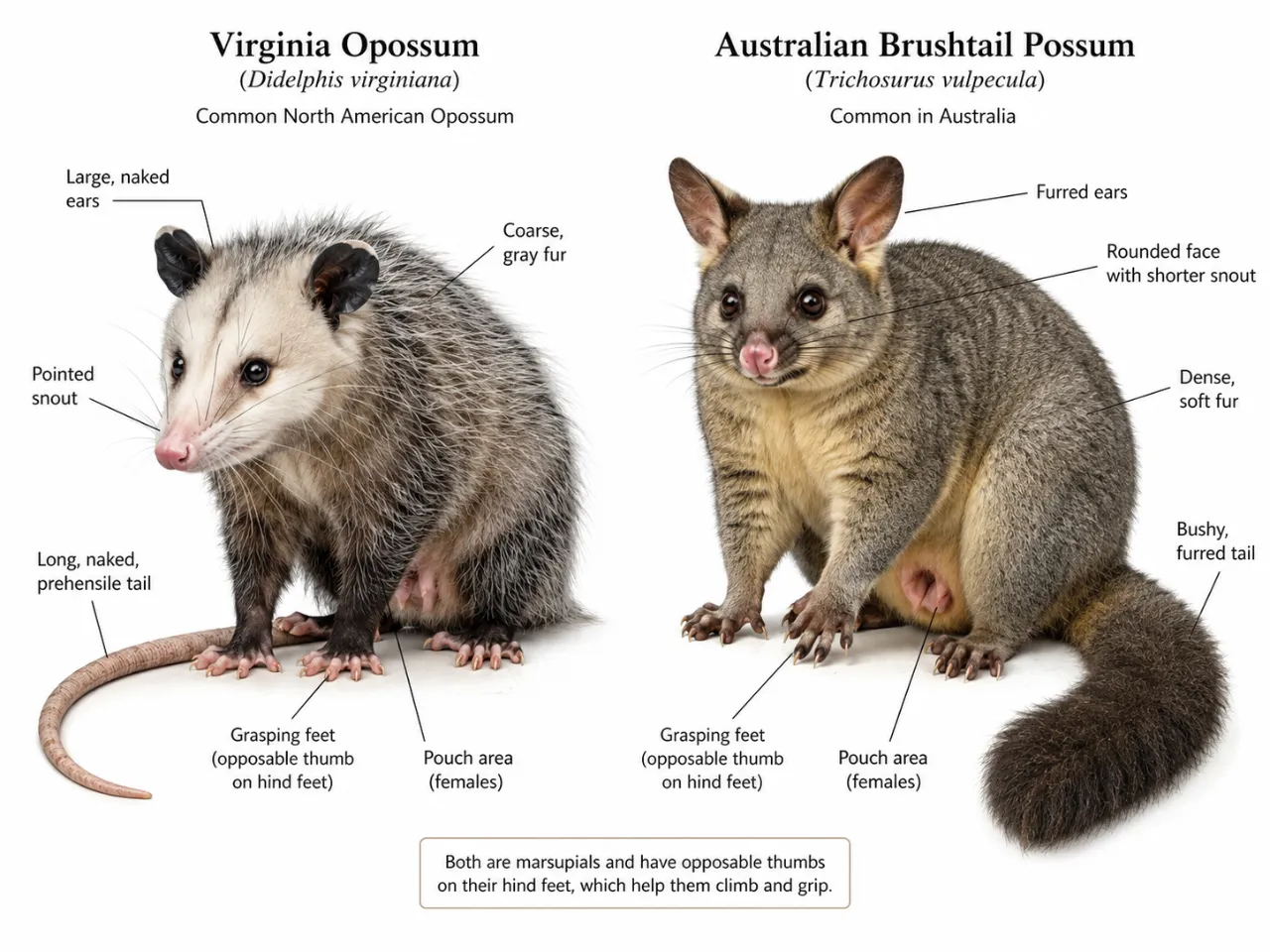
Summary table
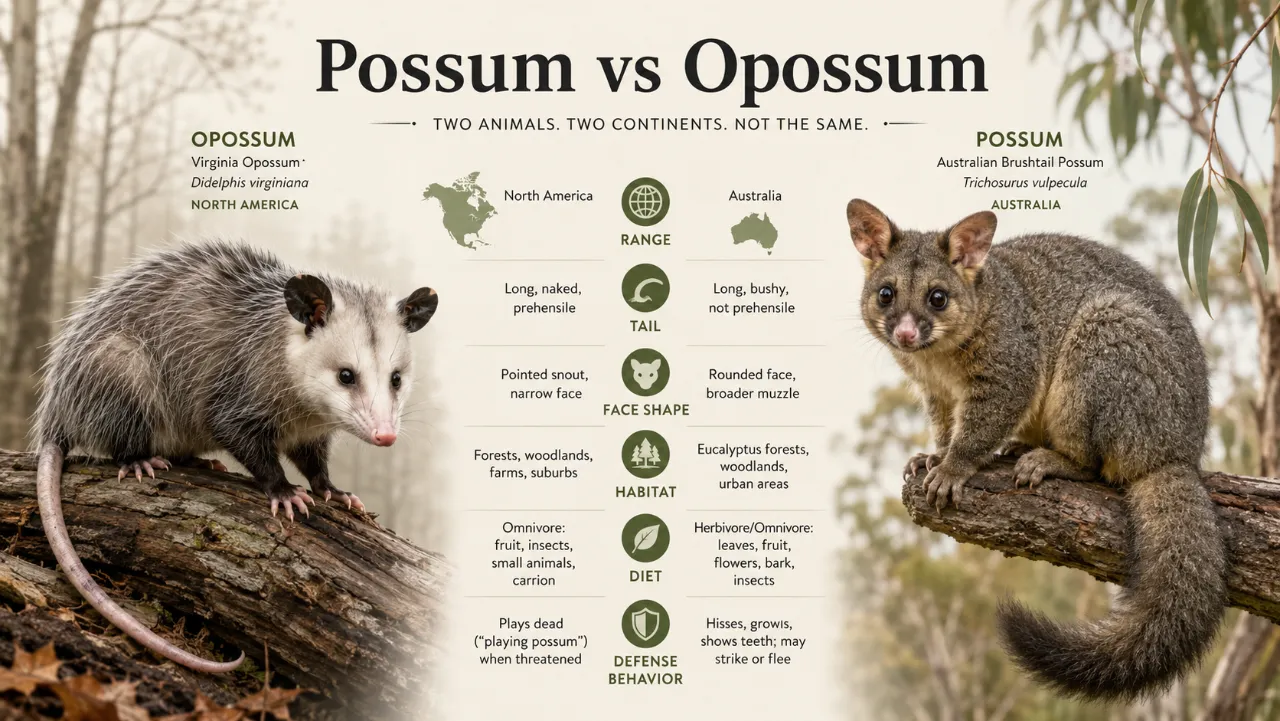
| Feature | Opossum | Possum |
|---|---|---|
| Common meaning | American marsupial, especially the Virginia opossum | Australasian marsupial, such as brushtail or ringtail possums |
| Native range | North, Central, and South America | Australia, New Guinea, Sulawesi, and nearby islands |
| Scientific grouping | Mostly order Didelphimorphia | Mostly Australasian possum groups within Diprotodontia |
| Typical face | Long, pointed snout | Shorter, rounder face in many species |
| Tail | Often mostly hairless and prehensile | Often furry or partly furry; may be prehensile in some species |
| Body covering | Coarse gray-white fur in many common species | Often softer, denser fur |
| Famous behavior | “Playing possum,” or defensive tonic immobility | Generally does not show the same famous death-feigning behavior |
| Diet | Highly omnivorous | Often leaves, flowers, fruit, nectar, and some animal matter, depending on species |
Why the names possum and opossum cause confusion
The confusion begins with common names. In North America, the word “possum” is often used as a casual short form of “opossum.” So if someone in the United States says they saw a possum in the yard, they probably mean a Virginia opossum.
In zoology, however, “opossum” usually refers to marsupials of the Americas, while “possum” usually refers to Australasian marsupials. These animals are related only broadly. They are both marsupials, but they are not simply regional versions of the same species.
The spelling also matters. “Opossum” begins with an “o,” but in ordinary speech the first sound is often dropped. This is why “opossum” and “possum” are sometimes treated as the same word in North America, even though they can mean different animals internationally.
How opossums live in the Americas
Opossums are native to the Americas. The best-known species is the Virginia opossum, which is found in much of the United States, parts of Canada, Mexico, and Central America. It is the only marsupial widely found north of Mexico.
Opossums are highly adaptable. They can live in forests, wetlands, farms, suburbs, parks, and city edges. They often shelter in hollow logs, brush piles, abandoned burrows, sheds, attics, or other protected spaces. They do not usually dig elaborate burrows themselves, but they may use shelter created by other animals or human structures.
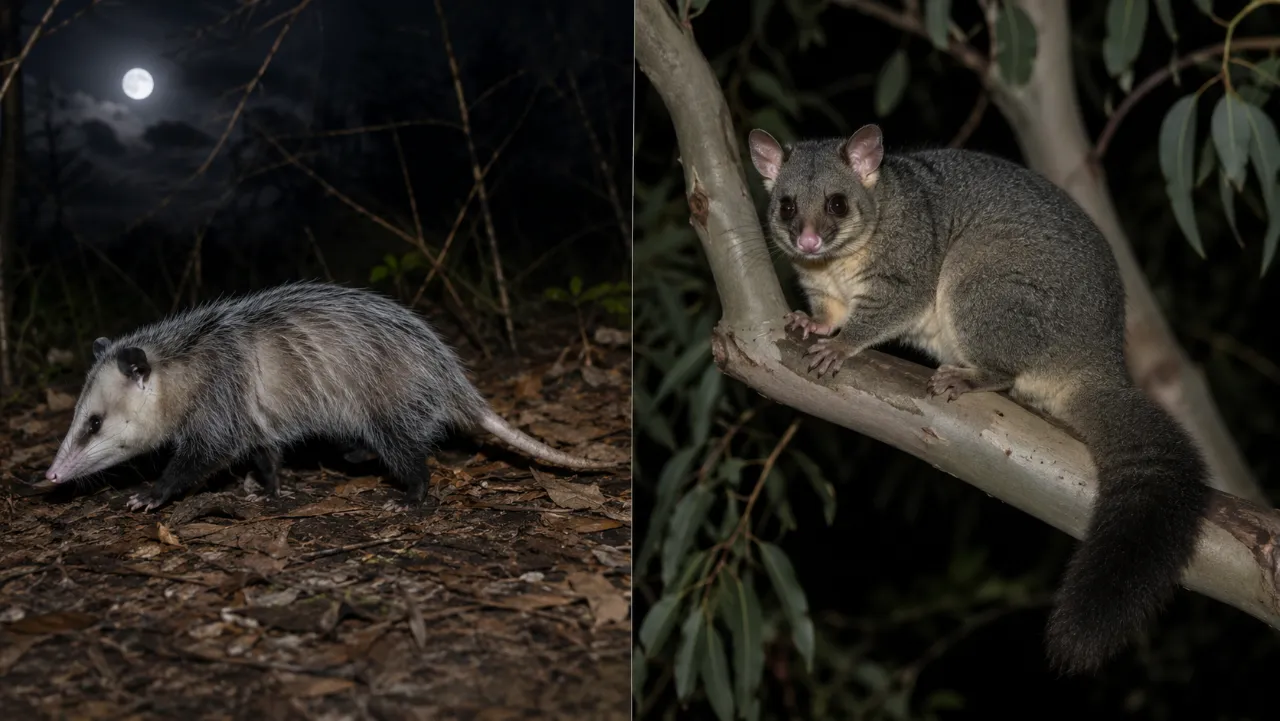
Many opossums are nocturnal or most active at night. Their flexible behavior helps them survive near people, especially where food and hiding places are available.
How possums live in Australia and nearby regions
True possums are native to Australia, New Guinea, and nearby islands. This group includes animals such as brushtail possums, ringtail possums, cuscuses, and several gliding species. They are diverse in size, shape, diet, and habitat.
Many possums are arboreal, meaning they spend much of their lives in trees. They may sleep in tree hollows, dense vegetation, roof spaces, or other elevated shelters. Brushtail possums are well known in Australian cities and suburbs, where they may live close to humans.
Possums often feed on leaves, flowers, fruit, nectar, bark, and sometimes insects or small animal matter. Diet varies widely by species. Some are mainly leaf-eaters, while others rely more heavily on fruit, nectar, or mixed foods.
How their bodies and tails differ
Opossums usually have a long, pointed face, dark ears, a pale or grayish body, and a mostly hairless tail. The Virginia opossum has a somewhat rat-like tail, although it is not a rodent. The tail can help with balance and grasping, but adults generally do not hang by their tails for long periods as cartoons sometimes suggest.
Possums often look rounder, softer, and more tree-adapted. Many have thick fur, large eyes, and a shorter face. Brushtail possums, for example, have a bushier tail than an American opossum. Ringtail possums have a more slender body and a prehensile tail that helps them move through branches.
These are general differences, not perfect rules. Possums are a diverse group, and some species look very different from others. Opossums are also diverse in Central and South America, where many species are smaller and less familiar to the general public.
Which animal plays possum
The famous behavior called “playing possum” is associated with opossums, especially the Virginia opossum. When extremely threatened, an opossum may enter a state of tonic immobility. It may collapse, become limp, open its mouth, drool, and release a foul-smelling fluid. This can make the animal seem dead or unappealing to predators.
This behavior is not a clever performance in the human sense. It is generally considered an involuntary defensive response triggered by intense stress. The opossum does not simply decide to act dead and then get up whenever it wants.
Australian possums are not generally known for the same classic “playing possum” defense. They more often rely on climbing, hiding, vocalizing, biting, scratching, or escaping into trees and shelters.
Diet and feeding behavior
Opossums are highly omnivorous. They may eat insects, worms, snails, fruit, grains, eggs, carrion, small animals, pet food, garbage, and many other available foods. This flexible diet helps them survive in both wild and human-altered environments.
Possums are often more plant-focused, but diet depends strongly on species. Brushtail possums commonly eat leaves, flowers, fruit, shoots, and sometimes human garden plants. Some possums may also eat insects, eggs, or other animal material when available.
Both animals can be important in ecosystems. Opossums help remove carrion and consume many invertebrates. Possums may help pollinate plants or disperse seeds when they feed on flowers and fruit, depending on the species and habitat.
Behavior and temperament
Opossums are generally solitary and secretive. They are not aggressive by nature, but they may hiss, show their teeth, drool, or defend themselves if cornered. Their open-mouth threat display can look frightening, but it is often a warning rather than an attempt to attack.
Possums vary widely in behavior. Some are shy forest animals, while others are bold urban visitors. Brushtail possums can be noisy, especially at night, and may produce hisses, growls, screeches, or coughing sounds. Ringtail possums are often quieter and more delicate in appearance.
Neither possums nor opossums should be treated as pets or handled casually in the wild. They are wild animals with specific needs and natural defenses. In many places, local laws also protect native marsupials.
Do all possums and opossums behave the same way
No. “Opossum” includes many species in the Americas, and “possum” includes many species in Australasia. Behavior can vary greatly by species, habitat, age, season, and contact with humans.
The Virginia opossum is familiar because it often lives near people, but it does not represent every opossum species. Many tropical American opossums are smaller, more arboreal, or less commonly seen.
Likewise, the common brushtail possum does not represent all Australian possums. Some possums glide between trees, some specialize in particular forest habitats, and others have more restricted ranges. It is best to compare specific species when accuracy is important.
Why these marsupials matter in ecosystems
Opossums and possums both play useful ecological roles. Opossums are scavengers, insect-eaters, fruit-eaters, and prey for larger predators. By feeding on carrion and invertebrates, they help recycle nutrients and influence small-animal populations.
Possums can be important browsers, seed dispersers, and sometimes pollinators. In Australian forests, some possums feed on flowers and nectar, moving pollen between plants. Fruit-eating species may help carry seeds through the landscape.
However, ecological role depends on location. A native possum can be beneficial in its natural ecosystem, but an introduced possum can become a serious problem elsewhere. For example, brushtail possums introduced to New Zealand have caused major ecological damage by browsing native vegetation and affecting wildlife.
Final takeaway
The difference between possum and opossum depends on where you are and how the words are being used. In North America, “possum” commonly means the same animal as “opossum,” especially the Virginia opossum. In scientific and international usage, however, opossums are American marsupials, while possums are Australasian marsupials.
Opossums usually have pointed faces, mostly hairless tails, and a famous death-feigning defense. Possums are often tree-dwelling, furry-tailed marsupials from Australia and nearby regions. Both are fascinating mammals, but they are not the same animal group in a strict zoological sense.
FAQs
Is a possum the same as an opossum?
In North American casual speech, “possum” often means “opossum.” Scientifically, however, opossums are marsupials from the Americas, while possums are marsupials from Australia, New Guinea, and nearby islands.
Which one plays dead, the possum or the opossum?
The famous “playing possum” behavior is associated with opossums, especially the Virginia opossum. It is generally an involuntary defensive response called tonic immobility, not a deliberate trick.
Are possums and opossums dangerous?
They are generally not aggressive toward people, but they are wild animals and may bite, scratch, or defend themselves if cornered. It is best to observe them from a distance and contact local wildlife professionals if one is injured or trapped.