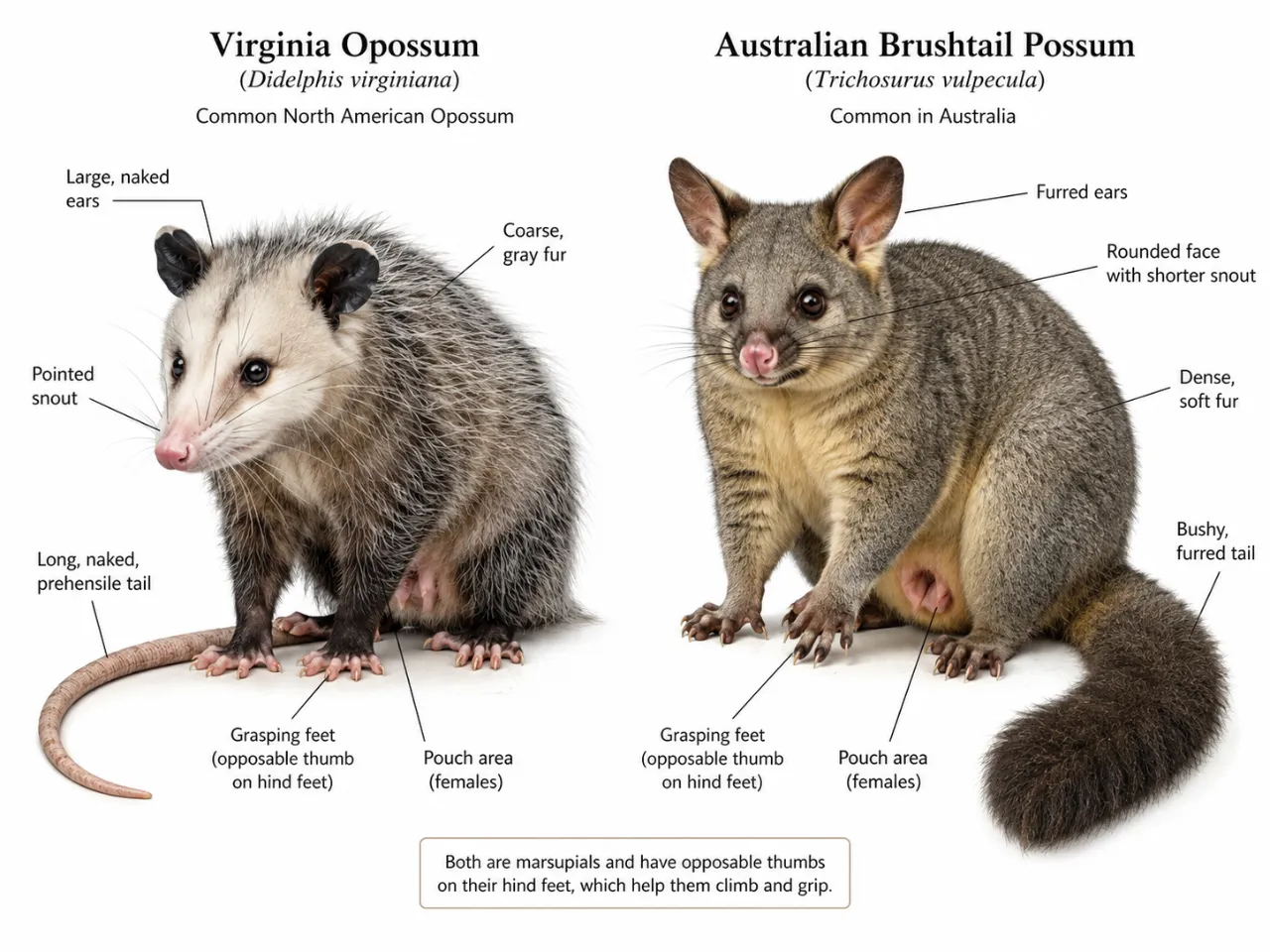
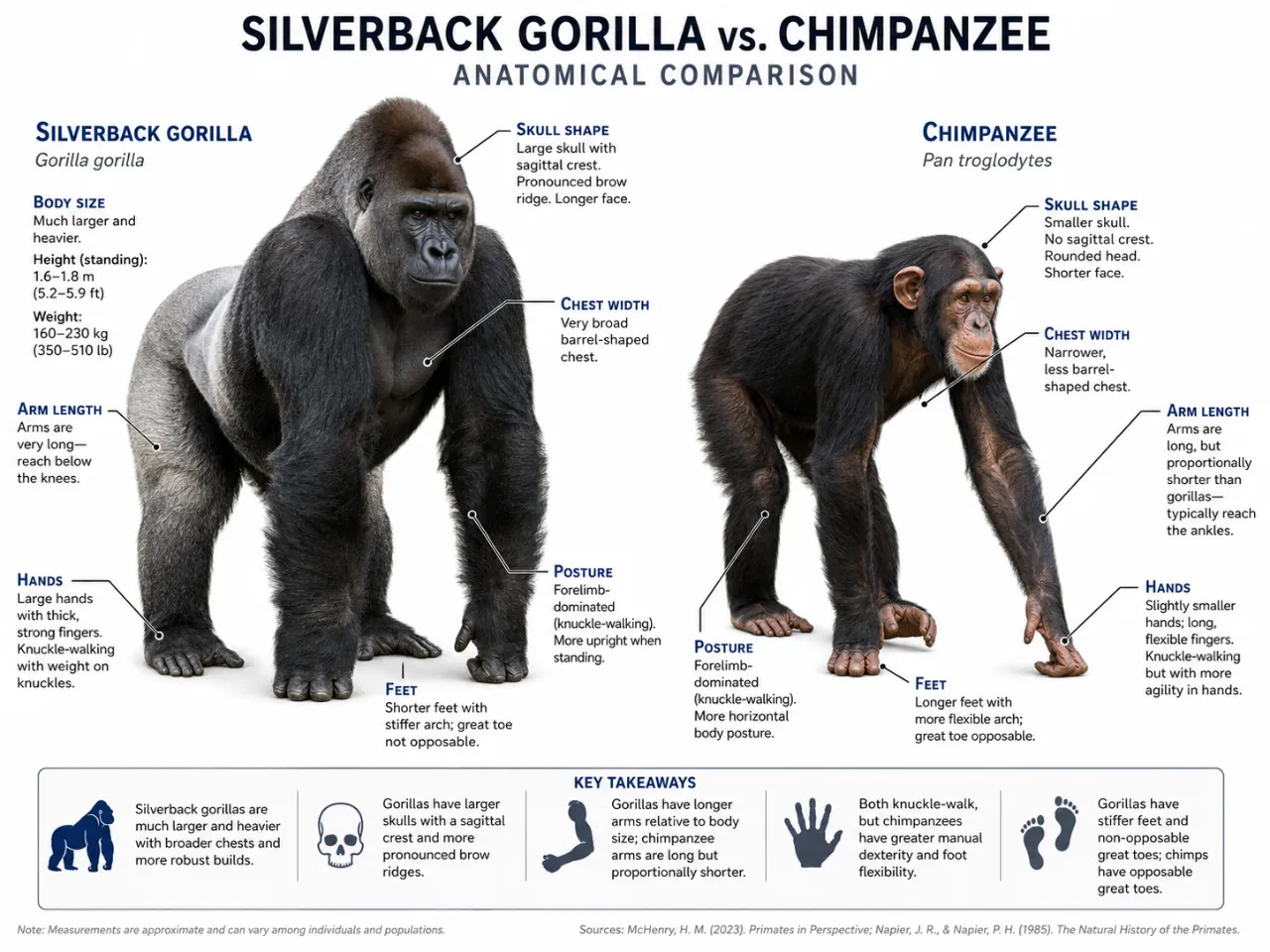
A grizzly bear and a gorilla are both incredibly strong mammals, but they are built for very different lives. A grizzly is a large North American bear with long claws, a powerful bite, heavy shoulders, and predatory defense skills. A gorilla is a highly intelligent African great ape with strong arms, social behavior, and impressive upper-body power. In a hypothetical fight, a large grizzly would usually have the physical advantage.
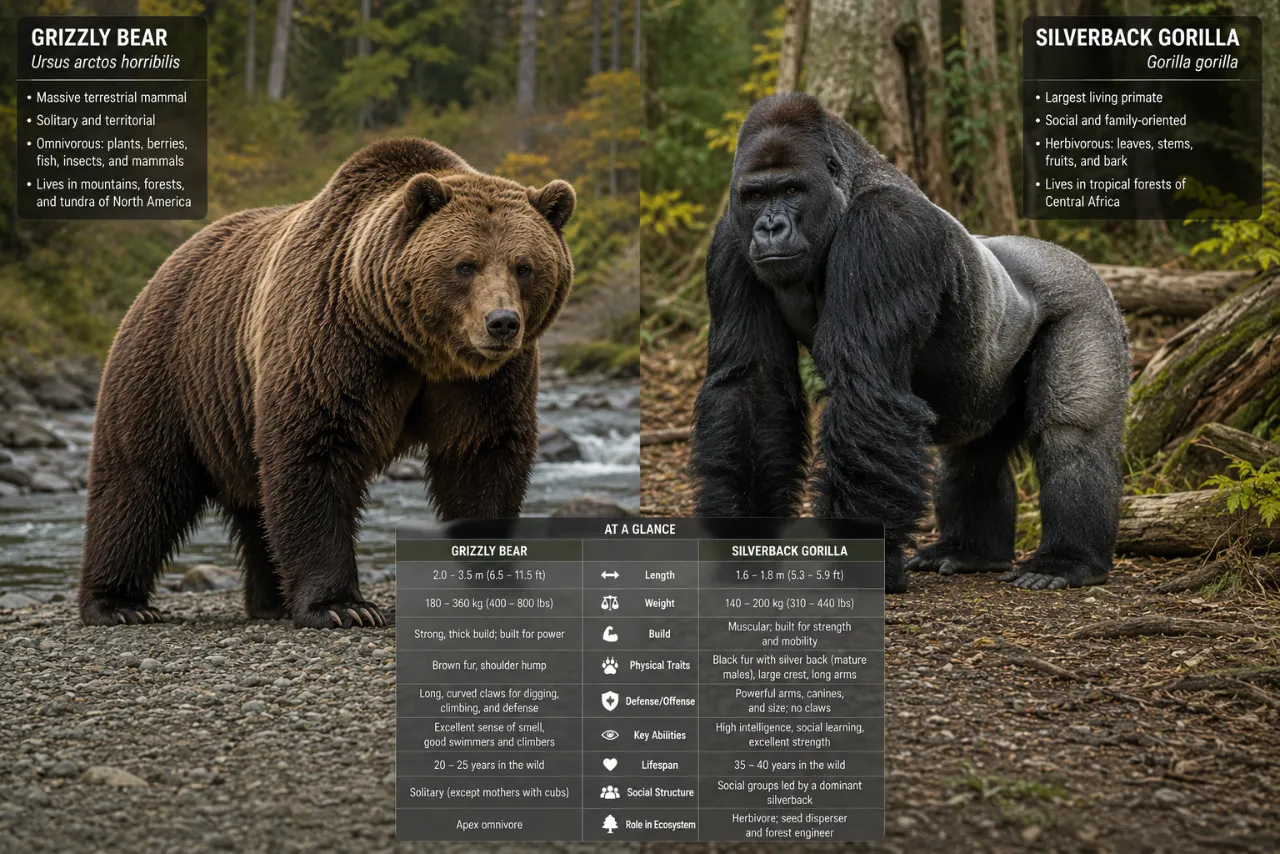
Grizzly Bear vs Gorilla Quick Answer
The main difference is that a grizzly bear is a heavily armed omnivorous predator-scavenger with claws, canine teeth, thick fur, and massive body weight, while a gorilla is a plant-eating great ape with powerful arms, high intelligence, and complex social behavior. Gorillas are extremely strong, but they are not built like bears for biting, clawing, and overpowering large dangerous animals.
Grizzly Bear vs Gorilla Summary Table
| Feature | Grizzly Bear | Gorilla |
|---|---|---|
| Scientific name | Ursus arctos horribilis | Gorilla species |
| Animal group | Bear, family Ursidae | Great ape, family Hominidae |
| Native range | North America | Central and eastern Africa |
| Typical adult male weight | Often about 180–360 kg, sometimes more | Often about 135–200 kg in the wild, sometimes more |
| Body design | Heavy, muscular, thick-furred, powerful shoulders | Large chest, long arms, strong hands, upright-capable posture |
| Main weapons | Long claws, strong bite, body mass, forelimb power | Powerful arms, canine teeth, grip strength, intimidation displays |
| Claws | Long, non-retractable digging and fighting claws | Flat nails, not claws |
| Diet | Omnivore: plants, roots, berries, insects, fish, carrion, mammals | Mostly herbivorous: leaves, stems, fruit, bark, and some insects |
| Social behavior | Mostly solitary | Social groups led by a silverback |
| Speed | Very fast in short bursts | Fast over short distances, but less built for pursuit |
| Biggest advantage | Size, claws, bite, durability, and fighting adaptations | Intelligence, arm strength, social awareness, and dexterity |
What Is a Grizzly Bear?
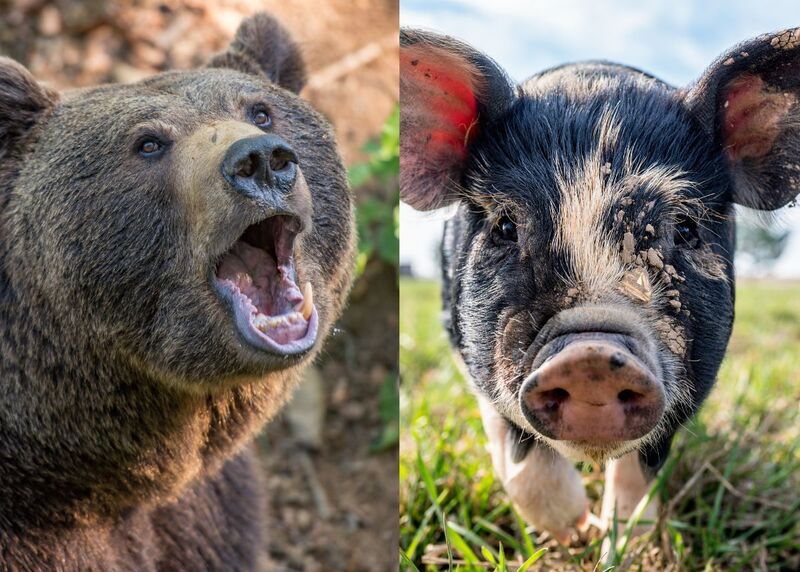
The grizzly bear is a North American subspecies of the brown bear. It is one of the most powerful land mammals in its range, known for its shoulder hump, long front claws, thick fur, broad head, and massive body. Grizzlies live in mountains, forests, tundra, meadows, river valleys, and coastal-influenced ecosystems depending on region and food availability.
Although grizzlies are not strict carnivores, they are highly capable predators and scavengers. They eat berries, roots, grasses, insects, fish, carrion, small mammals, and sometimes larger animals such as deer, elk calves, or moose calves. Their strength is not just for fighting; it is also used for digging, overturning logs, tearing into carcasses, catching fish, and defending food or cubs.
What Is a Gorilla?
Gorillas are the largest living primates. They are great apes, closely related to humans compared with most other animals. Gorillas live in African forests and include western gorillas and eastern gorillas, with several subspecies such as western lowland gorillas and mountain gorillas.
A mature male gorilla is called a silverback because of the gray or silver hair that develops across his back with age. Silverbacks lead family groups, protect females and young, make decisions about movement, and use impressive displays to warn rivals or threats. Gorillas are powerful, intelligent, and emotionally complex animals, but they are mostly plant-eaters rather than predators.
Size Comparison
A large grizzly bear is usually heavier than a wild male gorilla. Adult male grizzlies commonly weigh several hundred kilograms, and large individuals can be exceptionally massive. Their bodies are deep, broad, and heavily muscled, especially around the shoulders and neck.
Adult male gorillas are also very large, but their weight is usually lower than that of a large male grizzly. A silverback can be extremely muscular, especially through the arms, chest, shoulders, and neck. However, gorillas are not built with the same thick fur, heavy skull, large claws, and predator-like weaponry as a grizzly bear.
If comparing average adult males, the grizzly usually has the advantage in total body mass. If comparing an unusually large grizzly with an average gorilla, the size gap becomes even greater.
Body Shape and Physical Build
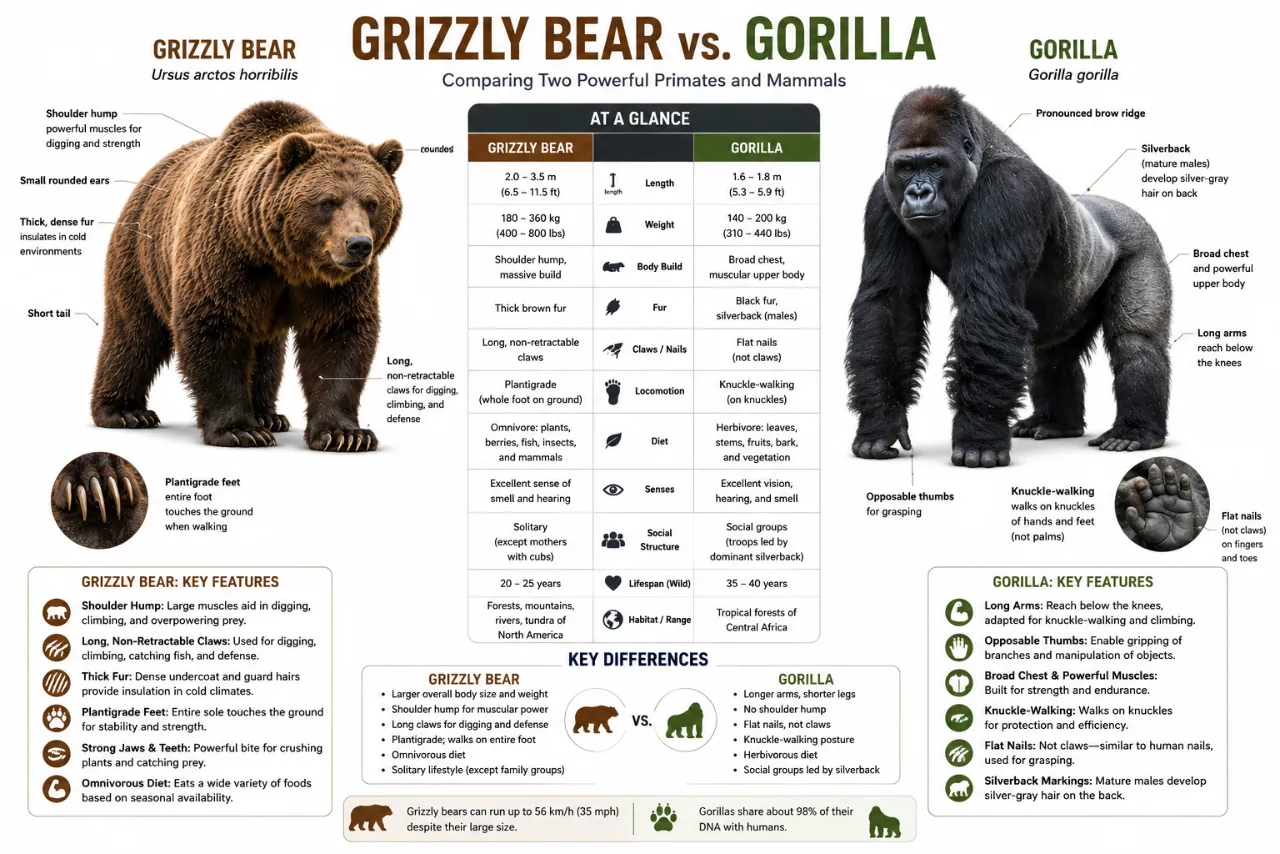
The grizzly bear has a compact, heavy body with a prominent shoulder hump. This hump is a mass of muscle that powers the front limbs, helping the bear dig, strike, pull, and grapple. Grizzlies walk on the full soles of their feet, giving them stability and power.
The gorilla has a very different body plan. It has long arms, a broad chest, strong hands, and shorter legs. Gorillas usually move by knuckle-walking, although they can stand or move upright for short moments. Their strength is concentrated in the upper body, especially the arms, shoulders, and back.
A grizzly is built like a heavy, clawed power animal. A gorilla is built like a large, intelligent, arm-dominant primate.
Claws vs Hands
This is one of the most important differences. A grizzly bear has long, strong, non-retractable claws. These claws are not only for defense; they are also used for digging roots, excavating dens, tearing logs apart, and catching food. In a physical confrontation, claws give the bear a serious advantage because they can cut, hook, and grip.
A gorilla does not have claws. It has hands with nails, fingers, and opposable thumbs. Gorilla hands are excellent for climbing, feeding, grasping branches, manipulating food, and social behavior. They are powerful and dexterous, but they are not slicing weapons like bear claws.
In tool-like control and grip, the gorilla has the more versatile hand. In combat weaponry, the grizzly’s claws are far more dangerous.
Bite Force and Teeth
Both animals have powerful jaws, but they use them differently. A grizzly bear has a strong bite suited for an omnivorous diet that includes tough vegetation, bones, meat, fish, and carrion. Its canine teeth can cause serious injury, and its skull and jaw muscles are built for heavy work.
A gorilla also has large canine teeth, especially adult males. These canines are used mostly in display, dominance, and defense rather than hunting. Gorillas are not meat-killing specialists. Their molars are better suited for grinding fibrous plant material.
Bite-force numbers are often repeated online with poor context, so exact comparisons should be treated cautiously. Still, from anatomy and body design, a large grizzly generally has the more dangerous bite in a fight, while a gorilla’s teeth are more important for display and social competition.
Strength Comparison
Gorillas are famous for their strength, and that reputation is deserved. A silverback has enormous upper-body power, strong arms, and a powerful grip. Gorillas can break vegetation, climb, wrestle, drag branches, and display with tremendous force.
Grizzlies, however, combine strength with greater body mass, long claws, thick fur, heavy bones, and a more rugged survival style. A grizzly’s strength is spread through its shoulders, neck, jaws, back, and limbs. It can dig through hard ground, move heavy objects, tear into logs, and fight other bears.
If measuring arm strength alone, a gorilla is extraordinary. If measuring total fighting power, body mass, durability, bite, claws, and forelimb force together, the grizzly bear has the advantage.
Speed and Movement
Grizzly bears may look bulky, but they can run surprisingly fast over short distances. Their speed is especially impressive because of their weight. They are not long-distance pursuit predators like wolves, but they can close a short gap very quickly.
Gorillas can also move quickly when they need to, especially during short charges or displays. However, they are not built for sustained speed or open-ground pursuit. Their movement is adapted to forest floors, climbing, knuckle-walking, and short bursts of power.
In open terrain, the grizzly would usually have the speed and momentum advantage. In dense forest, a gorilla’s climbing ability and maneuverability would be more useful for escape or avoidance, not necessarily for direct combat.
Intelligence and Behavior
The gorilla has a major advantage in intelligence, social awareness, and dexterity. Gorillas communicate through vocalizations, facial expressions, body postures, chest-beating, and subtle group behavior. They can solve problems, use environmental knowledge, and maintain complex social relationships.
Grizzlies are also intelligent animals. They remember food locations, learn seasonal patterns, solve foraging problems, and adapt to changing landscapes. However, their intelligence is different from that of apes. Bears are more solitary and food-driven, while gorillas are more socially complex.
If the comparison is brainpower, emotional complexity, and hand use, the gorilla is superior. If the comparison is survival toughness and physical weaponry, the grizzly is superior.
Diet and Feeding Strategy
Grizzly bears are flexible omnivores. Their diet changes with season and location. In spring they may eat roots, grasses, winter-killed animals, and emerging plants. In summer they may eat berries, insects, fish, and young animals. In autumn they focus on high-calorie foods to build fat for winter dormancy.
Gorillas are mostly herbivorous. They eat leaves, stems, shoots, fruit, bark, and pith. Some gorillas also eat ants, termites, or other small invertebrates, but animal food is a minor part of their diet. Their large digestive system helps them process fibrous vegetation.
A grizzly is a generalist that can exploit many food sources. A gorilla is a powerful plant-feeding specialist with strong social and forest-based adaptations.
Habitat and Natural Range
Grizzlies live in North America, especially in parts of Alaska, western Canada, and limited areas of the northwestern United States. They use open meadows, mountain slopes, river valleys, forests, tundra, and coastal regions depending on population and food supply.
Gorillas live in Africa, mainly in tropical and montane forests. Western lowland gorillas inhabit lowland rainforests and swamp forests. Mountain gorillas live in high-elevation forest habitats. Their survival depends on healthy forest ecosystems.
Grizzlies and gorillas do not naturally meet. They live on different continents, in different habitats, and belong to completely different evolutionary lineages.
Social Behavior: Solitary Bear vs Gorilla Family Group
Grizzlies are mostly solitary animals. Adult bears usually avoid each other except during mating, when mothers raise cubs, or when rich food sources bring many bears into the same area. Even then, they maintain dominance relationships and personal space.
Gorillas are social animals. A typical group may include one dominant silverback, adult females, younger males, juveniles, and infants. The silverback protects the group, mediates conflict, and guides daily movement. This social structure is one of the gorilla’s greatest strengths.
In nature, a gorilla’s power is not just physical. It also comes from group life, communication, and social organization.
Defense and Fighting Style
A grizzly bear’s defense is direct and physical. It can bite, claw, strike, grapple, and use its weight to overpower threats. Grizzlies may fight other bears over territory, mates, food, or cub defense. Their bodies are adapted to survive rough physical conflict.
A gorilla’s defense often begins with intimidation. A silverback may stand upright, beat his chest, roar, throw vegetation, charge, or display his size to scare off a threat. Actual fighting can happen, especially between males, but gorillas generally try to avoid unnecessary injury. Their canines and strength are dangerous, but their strategy is often warning before contact.
The grizzly is better equipped for violent physical contact. The gorilla is better equipped for social display, deterrence, and group protection.
Grizzly Bear vs Gorilla: Who Would Win?
A real fight between a grizzly bear and a gorilla would never happen naturally because they live on different continents. It is also not how wildlife should be understood. However, because people search this comparison, we can answer it from anatomy and behavior.
In a hypothetical one-on-one fight, a large adult grizzly bear would usually have the advantage. The bear is often heavier, has long claws, a stronger killing bite, thick fur, greater durability, and more experience using its mouth and forelimbs in dangerous physical conflict.
A silverback gorilla is extremely strong and intelligent, and it could injure many animals. But it lacks claws, has less body mass than a large grizzly, and is not specialized for killing large predators. Its strength is real, but it is not the same kind of weaponized strength seen in a bear.
The most scientific answer is: the gorilla is the more intelligent and socially complex animal, but the grizzly bear is the more physically dangerous combatant.
Which Animal Is More Dangerous to Humans?
Both animals deserve respect, but their risk to humans is different. Grizzly bears can be dangerous when surprised, defending cubs, guarding food, or habituated to human areas. Because they are large, fast, and armed with claws and teeth, close encounters can become life-threatening.
Gorillas are generally peaceful when left alone, but a silverback can be dangerous if he perceives a threat to his group. Most gorilla displays are warnings, not attempts to attack. Responsible wildlife tourism follows strict distance rules to reduce stress and disease risk.
Neither animal should ever be approached, fed, provoked, or treated as safe.
Conservation Status
Grizzly bear conservation depends on region. Some populations are relatively secure, especially in large wilderness areas, while others remain vulnerable because of habitat fragmentation, conflict with people, road expansion, and historical persecution.
Gorillas face severe conservation challenges. Habitat loss, poaching, disease, mining, agriculture, and human conflict have affected many populations. Mountain gorillas have benefited from intensive protection and ecotourism programs, but all gorilla populations still require careful conservation attention.
Both animals need large, connected habitats. The grizzly needs wild landscapes with secure food sources, while the gorilla needs protected forests and reduced human pressure.
How to Tell a Grizzly Bear from a Gorilla Quickly
If the animal has long claws, thick fur, a shoulder hump, and a bear-like snout, it is a grizzly bear.
If the animal has long arms, flat nails, a broad chest, and an ape-like face, it is a gorilla.
If it walks on the soles of its feet and has a short tail, it may be a bear.
If it knuckle-walks and uses hands to grasp vegetation, it is a gorilla.
If it lives in North America, it could be a grizzly.
If it lives in African forests, it could be a gorilla.
Final Comparison
The grizzly bear and the gorilla are both powerful, impressive mammals, but they represent very different evolutionary designs. The grizzly is a rugged omnivore with claws, bite strength, heavy body mass, and survival adaptations for harsh North American landscapes. The gorilla is a highly intelligent great ape with social bonds, powerful arms, dexterous hands, and a mostly plant-based forest lifestyle.
In raw combat terms, the grizzly bear would usually have the advantage. In intelligence, social behavior, and hand use, the gorilla is far more advanced. The better question is not simply which animal would win, but how each became so perfectly adapted to its own world.
Related Animal Comparisons
Bear vs Lion
Gorilla vs Lion
Grizzly Bear vs Polar Bear
Gorilla vs Chimpanzee
Bear vs Tiger
Silverback Gorilla vs Grizzly Bear
FAQs About Grizzly Bear vs Gorilla
Would a grizzly bear beat a gorilla?
In a hypothetical one-on-one fight, a large adult grizzly would usually have the advantage because of its greater body mass, long claws, powerful bite, thick fur, and fighting adaptations. A gorilla is extremely strong, but it is not built like a bear for clawing and biting large opponents.
Is a gorilla stronger than a grizzly bear?
A gorilla has incredible upper-body strength, especially in its arms and hands. However, a grizzly bear is generally stronger overall when body mass, shoulders, bite, claws, and durability are considered together.
Which is bigger, a grizzly bear or a gorilla?
A large male grizzly bear is usually heavier than a wild male gorilla. Gorillas are very muscular, but grizzlies often have more total mass and a more heavily built body.
Does a gorilla have a stronger bite than a grizzly bear?
Exact bite-force numbers vary and are often unreliable online. Anatomically, both have strong bites, but a grizzly’s bite is generally more dangerous in combat because it is combined with a larger skull, predatory teeth, claws, and greater body mass.
Can gorillas use tools against bears?
Gorillas can manipulate objects and show intelligence, but they do not normally use weapons in the way humans do. In a natural defensive situation, a gorilla would be more likely to display, charge, grab, bite, or retreat than to use a tool strategically against a bear.
Do grizzly bears and gorillas ever meet in the wild?
No. Grizzly bears live in North America, while gorillas live in African forests. They do not share a natural habitat.
Which animal is smarter, a grizzly bear or a gorilla?
The gorilla is generally smarter in terms of social intelligence, communication, dexterity, and problem-solving linked to great ape behavior. Grizzlies are also intelligent, but their intelligence is adapted to solitary survival, memory, and food-finding.
Which animal is faster?
A grizzly bear is usually faster in a short burst on open ground. Gorillas can move quickly for short distances, but they are not built for the same kind of fast open-ground charge as a grizzly.