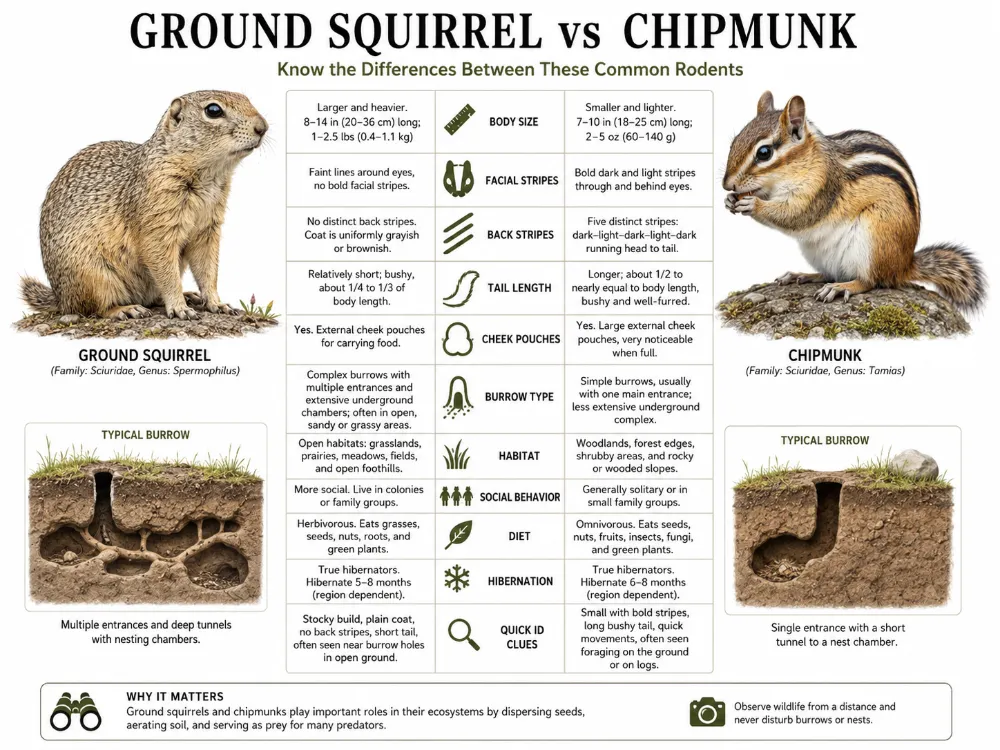
Ground squirrels and chipmunks are small squirrel-family rodents, but they are not the same. Chipmunks are usually smaller, have bold stripes on the face and body, carry food in cheek pouches, and often live near forests or rocky cover. Ground squirrels are usually larger, have shorter less-bushy tails, often lack facial stripes, and commonly live in open grasslands, fields, deserts, or burrow colonies.
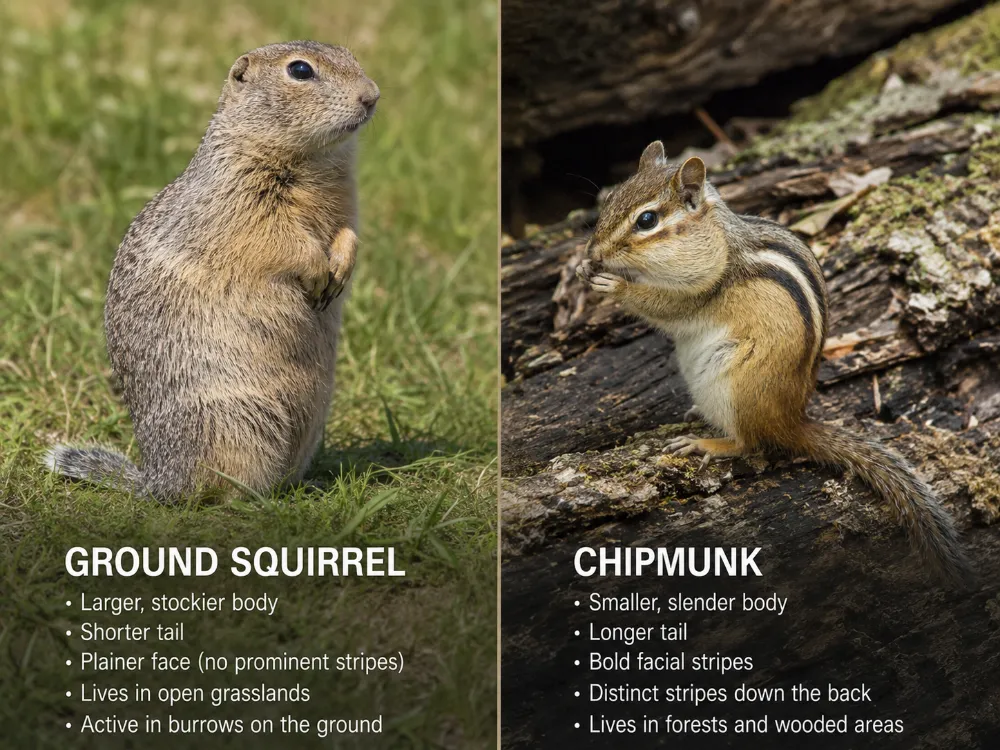
Ground Squirrel vs Chipmunk Summary Table
| Feature | Ground Squirrel | Chipmunk |
|---|---|---|
| Animal group | Ground-dwelling squirrels in the family Sciuridae | Small striped squirrels in the genera Tamias, Eutamias, and Neotamias |
| Common meaning | A broad term for many ground-living squirrel species | A more specific common name for small striped squirrel relatives |
| Typical size | Usually larger and heavier than chipmunks | Usually smaller, slimmer, and lighter |
| Body stripes | Some species have stripes or spots, but many do not | Usually has clear stripes along the back and sides |
| Facial stripes | Usually absent or less distinct | Usually has bold dark and light stripes on the face |
| Tail | Often shorter and less bushy than a tree squirrel’s tail | Usually longer and more upright-looking relative to body size |
| Cheek pouches | Present in some species, but not the main visual clue | Well-known for large cheek pouches used to carry food |
| Habitat | Grasslands, fields, deserts, meadows, farms, open slopes, and rocky areas | Woodlands, forest edges, gardens, rocky areas, logs, brush piles, and stone walls |
| Burrows | Often builds extensive burrow systems; some species live in colonies | Builds burrows too, but often more solitary and hidden |
| Social behavior | Varies; many species are social or colonial | Often more solitary, though they may live near each other |
| Diet | Seeds, grasses, leaves, roots, insects, fruits, crops, and sometimes small animals | Seeds, nuts, berries, fungi, insects, grains, and stored foods |
| Best quick clue | Larger ground rodent, open habitat, often no facial stripes | Small striped squirrel with facial stripes and cheek pouches |
What Is a Ground Squirrel?
A ground squirrel is not one single species. It is a common name for many squirrel-family rodents that spend much of their lives on or under the ground. Ground squirrels belong to the family Sciuridae, the same family that includes tree squirrels, flying squirrels, marmots, prairie dogs, and chipmunks.
Ground squirrels usually live in burrows. These burrows provide protection from predators, weather, heat, cold, and nesting dangers. Some ground squirrels are solitary, while others live in colonies with many burrow entrances spread across grasslands, fields, deserts, or open meadows.
Common examples include thirteen-lined ground squirrels, California ground squirrels, Richardson’s ground squirrels, Arctic ground squirrels, and many others. Because the term is broad, ground squirrel appearance can vary greatly by species.
What Is a Chipmunk?
A chipmunk is a small striped squirrel relative. Chipmunks are famous for their bold body stripes, facial stripes, quick movements, cheek pouches, and habit of carrying seeds and nuts to underground storage chambers.
Most chipmunks live in North America, while the Siberian chipmunk lives in parts of northern Asia. In North America, many chipmunks belong to the genus Neotamias, while the eastern chipmunk is commonly placed in Tamias.
Chipmunks are ground-dwelling, but they are also agile climbers. They often live around forest edges, logs, rocks, stone walls, shrubs, gardens, and woodland floors. They may climb trees or bushes to escape danger or reach food, but they usually nest and store food underground.
Are Chipmunks Ground Squirrels?
In a broad biological sense, chipmunks are close relatives of ground squirrels and belong to the same squirrel family. Some people may casually describe chipmunks as small ground squirrels because they live on the ground and dig burrows.
However, in everyday wildlife identification, “ground squirrel” and “chipmunk” usually refer to different-looking animals. Chipmunks are smaller and more distinctly striped, especially on the face. Many ground squirrels are larger, plainer, and more associated with open country.
So the practical answer is: chipmunks are squirrel-family rodents closely related to ground squirrels, but they are usually treated as a distinct group in common identification.
Size Differences
Ground squirrels are usually larger than chipmunks. Many ground squirrels have heavier bodies, thicker necks, and a more robust appearance. Some species, such as California ground squirrels, can look much larger than a typical chipmunk.
Chipmunks are usually small and lightweight. Their bodies are slim, quick, and compact. They often look more delicate than ground squirrels, with a narrow face and a lively, darting movement pattern.
If the animal is tiny, striped, and quick, it is likely a chipmunk. If it is larger, stockier, and living in open burrow systems, it may be a ground squirrel.
Stripe Differences
Stripes are one of the best clues. Chipmunks usually have clear dark and light stripes running along the back and sides. They also usually have strong facial stripes above and below the eyes.
Ground squirrels vary. Some species, such as the thirteen-lined ground squirrel, have stripes and spots on the body. However, many ground squirrels do not have the bold facial striping that chipmunks show. Others may be plain brown, gray, tan, speckled, or mottled.
The easiest rule is: body stripes plus facial stripes usually suggest a chipmunk. Body stripes without strong facial stripes may suggest a striped ground squirrel.
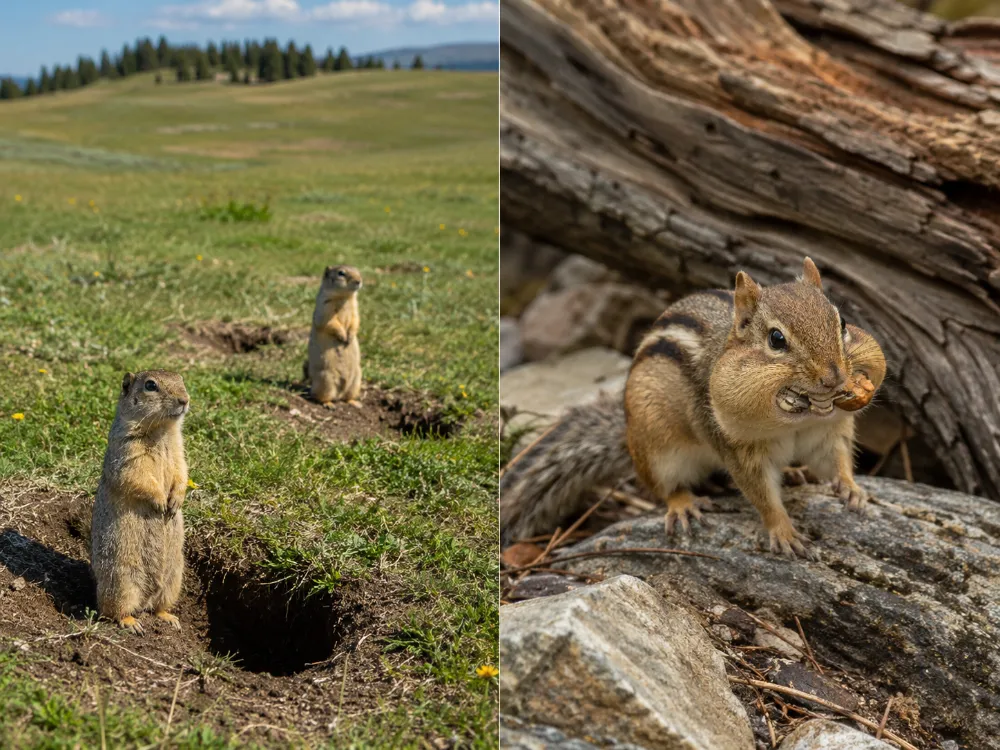
Facial Stripes
Facial stripes are especially useful because they separate chipmunks from many striped ground squirrels. Chipmunks usually have dark and pale stripes running across the face, often passing near the eyes.
Ground squirrels may have eye rings, pale markings, or subtle head patterns, but most do not have the classic chipmunk face stripes. This is why a small striped animal with a striped face is usually identified as a chipmunk.
If you can see the head clearly, the face often gives the answer faster than the body.
Tail Differences
Ground squirrel tails are usually shorter and less bushy than tree squirrel tails. They may be held low, flicked as signals, or used for balance while running across the ground. Some species have moderately bushy tails, but they usually do not look as delicate and upright as a chipmunk’s tail.
Chipmunks have relatively long tails for their small bodies. The tail is often carried upward or slightly curved as the animal runs. It is not as huge and fluffy as a tree squirrel’s tail, but it is often more noticeable than the tail of many ground squirrels.
Tail posture can help: chipmunks often run with a light, raised tail, while many ground squirrels look more low-bodied and ground-hugging.
Body Shape and Movement
Ground squirrels often look sturdier and more ground-oriented. They may stand upright near burrow entrances, run in short bursts, freeze to watch for predators, and dive quickly underground.
Chipmunks look smaller and more delicate. They often dart between cover, logs, rocks, shrubs, and burrow entrances. Their movement is quick, nervous, and stop-start, with frequent pauses to scan the area.
Both animals can stand on their hind legs to watch for danger, but ground squirrels often look more like small prairie animals, while chipmunks look more like striped woodland foragers.
Habitat Differences
Ground squirrels are commonly associated with open habitats. They may live in grasslands, meadows, deserts, roadsides, farms, pastures, alpine slopes, open woodlands, and dry fields. Many species prefer places where they can see predators from a distance and dig burrows in suitable soil.
Chipmunks often prefer habitats with cover. They are common in forests, woodland edges, brushy areas, rocky slopes, stone walls, logs, gardens, and parks. They usually stay close to objects they can hide under or climb over.
Open field with many burrow holes often suggests ground squirrels. Forest edge with logs, rocks, and striped tiny squirrels often suggests chipmunks.
Burrows and Tunnels
Both ground squirrels and chipmunks dig burrows. Ground squirrel burrows may be more obvious, especially in colony-forming species. You may see many entrances across a field, pasture, or open slope. Some burrow systems include nesting chambers, food storage areas, escape tunnels, and lookout spots.
Chipmunk burrows are often more hidden. The entrance may be tucked under logs, rocks, shrubs, roots, porches, or stone walls. Chipmunks often carry excavated soil away from the entrance, making the hole less obvious.
If there are many open holes in a grassy area, ground squirrels are more likely. If small holes are hidden near cover and a tiny striped animal appears, chipmunks are more likely.
Social Behavior
Many ground squirrels are social or semi-social. Some species live in colonies where individuals maintain nearby burrows, use alarm calls, and watch for predators. Prairie dogs, which are close ground squirrel relatives, are especially social, but many smaller ground squirrels also show group warning behavior.
Chipmunks are often more solitary. They may live near other chipmunks where food and shelter are good, but they typically defend burrow areas and food stores. They are not usually seen in large organized colonies like some ground squirrels.
For behavior, a group of burrow-dwelling rodents in an open field suggests ground squirrels, while a single striped animal near a log or stone wall often suggests a chipmunk.
Diet and Feeding Habits
Ground squirrels eat seeds, grasses, leaves, stems, roots, flowers, fruits, insects, fungi, and sometimes small animals or eggs. Some species may feed on crops, garden plants, or stored grains, which can bring them into conflict with people.
Chipmunks eat seeds, nuts, berries, fruits, fungi, insects, grains, and small plant parts. They are famous for stuffing food into cheek pouches and carrying it back to storage chambers. In autumn, they may collect large amounts of seeds and nuts for winter use.
Both animals are omnivorous to some degree, but chipmunks are especially associated with food storage and cheek-pouch carrying.
Cheek Pouches
Chipmunks are famous for their cheek pouches. These expandable pockets allow them to carry many seeds or nuts at once. A chipmunk with full cheek pouches can look almost comically swollen on both sides of the face.
Some ground squirrels also have cheek pouches, but they are not as strongly associated with the public image of the animal. In many ground squirrel comparisons, cheek pouches are less obvious than size, habitat, and striping.
If you see a tiny striped animal with bulging cheeks full of seeds, it is almost certainly a chipmunk.
Hibernation and Winter Behavior
Many ground squirrels hibernate or enter deep seasonal dormancy, especially in cold climates. Some species are famous for long hibernation periods and major changes in body temperature, heart rate, and metabolism.
Chipmunks also reduce winter activity, but many do not sleep continuously for the entire winter. Instead, they may wake periodically inside their burrows to eat stored food. In mild weather, they may briefly emerge above ground.
Both groups use burrows for winter survival, but ground squirrels are often more strongly associated with deep hibernation.
Alarm Calls and Communication
Ground squirrels often use alarm calls to warn others of predators. These calls may signal danger from hawks, foxes, coyotes, snakes, badgers, or domestic animals. Some species have complex alarm systems that vary by threat.
Chipmunks also vocalize. They may make chips, chucking sounds, trills, or sharp calls when alarmed. Their calls can be surprisingly loud for such small animals.
Both animals communicate with sound, scent, posture, and tail movement. In open habitats, ground squirrel alarm calls may be especially important for group survival.
Predators and Defense
Ground squirrels are prey for hawks, owls, foxes, coyotes, snakes, badgers, weasels, bobcats, and many other predators. Their defenses include burrows, alarm calls, vigilance, speed, and staying close to escape holes.
Chipmunks are eaten by hawks, owls, snakes, foxes, weasels, cats, raccoons, and other predators. They rely on quick movements, cover, burrows, rocks, logs, and dense vegetation.
Ground squirrels often survive by seeing danger early in open spaces. Chipmunks often survive by staying close to cover and disappearing quickly into hidden spaces.
Ground Squirrel vs Chipmunk vs Tree Squirrel
Tree squirrels are another common source of confusion. Tree squirrels usually have larger, bushier tails and spend more time in trees. They may come to the ground to feed, but they often nest in tree cavities or leaf nests.
Ground squirrels are more burrow-oriented and usually have shorter tails than tree squirrels. Chipmunks are also ground-oriented, but they are smaller and strongly striped.
A large squirrel with a huge bushy tail in a tree is likely a tree squirrel. A stockier burrow-dwelling squirrel in an open field may be a ground squirrel. A tiny striped squirrel with facial stripes is likely a chipmunk.
Ground Squirrel vs Thirteen-Lined Ground Squirrel
The thirteen-lined ground squirrel is often confused with a chipmunk because it has stripes. However, it usually lacks the bold facial stripes that chipmunks have. Its body stripes are often broken into lines and spots, giving it a patterned back.
Thirteen-lined ground squirrels also tend to live in open grasslands, lawns, golf courses, fields, and prairie-like habitats rather than dense woodland cover.
If the animal is striped but has no strong face stripes and lives in open grass, it may be a thirteen-lined ground squirrel rather than a chipmunk.
Ground Squirrel vs Golden-Mantled Ground Squirrel
The golden-mantled ground squirrel can look very similar to a chipmunk because it has stripes along the body. The key difference is the face. Golden-mantled ground squirrels usually have body stripes but lack the strong head and face stripes of chipmunks.
They are also often larger and more robust than chipmunks. They live in western North America, often in mountain forests, rocky areas, campsites, and open woodland habitats.
Remember: chipmunks usually have stripes on the face; golden-mantled ground squirrels have stripes on the body but a plainer head.
Do Ground Squirrels and Chipmunks Damage Gardens?
Both can cause garden problems. Ground squirrels may dig burrows in lawns, fields, banks, and gardens. They may eat seedlings, fruits, vegetables, grains, flowers, or roots. In agricultural areas, some species can be significant pests.
Chipmunks may dig small burrows near patios, stone walls, gardens, or foundations. They may eat seeds, bulbs, fruits, berries, and garden produce. However, they also eat insects and help move seeds and fungi.
Whether they are a problem depends on population size, location, and the amount of damage. A few individuals may be harmless or even enjoyable to watch, while many burrows near structures can become a concern.
Are Ground Squirrels or Chipmunks Dangerous?
Ground squirrels and chipmunks are not aggressive toward people, but they are wild animals. They can bite if trapped or handled. Like many wild rodents, they may carry fleas, ticks, parasites, or diseases in some regions.
The main risk usually comes from close contact, feeding, handling, or allowing them to nest near homes in large numbers. People should not pick them up or try to keep wild individuals as pets.
Observe them from a distance, secure food sources, and avoid encouraging them to enter buildings or depend on human food.
Can Ground Squirrels and Chipmunks Be Pets?
Wild ground squirrels and chipmunks are not suitable household pets. They have strong digging instincts, sharp teeth, high activity levels, specialized needs, and natural fear responses. In many places, keeping them is also illegal or restricted.
Capturing wild individuals can harm the animal and may expose people to bites or parasites. It also removes the animal from its ecological role.
If someone wants a small pet rodent, domesticated species such as hamsters, gerbils, guinea pigs, or rats are more appropriate than wild squirrels or chipmunks.
Ecological Importance
Ground squirrels are important ecosystem engineers. Their burrows loosen soil, provide shelter for other animals, and influence plant communities. They are also important prey for many predators.
Chipmunks help move seeds and fungi. By carrying and storing food, they may forget some caches, allowing seeds to germinate. They also eat insects and serve as prey for many animals.
Although they can be pests in some human settings, both animals play valuable roles in natural ecosystems.
Common Misunderstandings
One common misunderstanding is that all striped small rodents are chipmunks. Some ground squirrels are also striped, but they may lack facial stripes and live in more open habitats.
Another misunderstanding is that chipmunks are baby squirrels. They are not. Chipmunks are their own group of small squirrel relatives, not young tree squirrels or young ground squirrels.
A third misunderstanding is that ground squirrels are just squirrels that happen to be on the ground. In wildlife identification, ground squirrels are burrow-dwelling species adapted to life on and under the ground.
How to Tell a Ground Squirrel from a Chipmunk Quickly
Look at the face: chipmunks usually have bold facial stripes; most ground squirrels do not.
Look at size: chipmunks are usually smaller; ground squirrels are usually larger and stockier.
Look at habitat: chipmunks often stay near forests, rocks, logs, and cover; ground squirrels often live in open fields or grasslands.
Look at the tail: chipmunks often carry a more noticeable raised tail; ground squirrels often have shorter, lower tails.
Look at social behavior: many ground squirrels live in colonies; chipmunks are often more solitary.
Look at the burrows: many open burrow holes in a field suggest ground squirrels; hidden holes near cover suggest chipmunks.
Ground Squirrel vs Chipmunk: Final Comparison
Ground squirrels and chipmunks are both small members of the squirrel family, but they are usually easy to tell apart once you know the clues. Ground squirrels are generally larger, stockier, more open-country animals, often living in burrow colonies. Chipmunks are smaller, more strongly striped, and usually have clear facial stripes and cheek pouches.
The fastest identification clue is the face. A small striped animal with bold facial stripes is probably a chipmunk. A larger burrow-dwelling squirrel in an open field, especially without facial stripes, is more likely a ground squirrel.
FAQs About Ground Squirrels vs Chipmunks
Are ground squirrels and chipmunks the same animal?
No. They are related squirrel-family rodents, but they are not the same in common wildlife identification. Chipmunks are smaller and usually have facial stripes, while ground squirrels are often larger and more open-country animals.
Is a chipmunk a type of ground squirrel?
Chipmunks are close relatives of ground squirrels and live on the ground, so they may be considered ground-squirrel-like in a broad sense. However, chipmunks are usually treated as a distinct group with their own common name.
What is the easiest way to tell a chipmunk from a ground squirrel?
Look at the face. Chipmunks usually have bold dark and light stripes on the face. Many ground squirrels lack facial stripes, even if they have stripes on the body.
Are chipmunks smaller than ground squirrels?
Yes, chipmunks are usually smaller and lighter than most ground squirrels. Ground squirrels often look stockier and more robust.
Do ground squirrels have stripes?
Some ground squirrels have stripes, such as thirteen-lined ground squirrels and golden-mantled ground squirrels. However, they often lack the strong facial stripes typical of chipmunks.
Do chipmunks have cheek pouches?
Yes. Chipmunks have cheek pouches that allow them to carry seeds, nuts, and other food back to their burrows. Full cheek pouches can make their faces look swollen.
Do ground squirrels have cheek pouches?
Some ground squirrels have cheek pouches, but they are not as famous for them as chipmunks. In identification, size, habitat, and facial stripes are usually more useful.
Where do ground squirrels live?
Ground squirrels often live in grasslands, fields, deserts, meadows, open slopes, farms, and rocky areas. Many species dig burrows in open ground.
Where do chipmunks live?
Chipmunks often live in forests, woodland edges, gardens, rocky areas, brush piles, stone walls, logs, and places with cover. They dig burrows but usually stay near hiding places.
Do ground squirrels and chipmunks hibernate?
Many ground squirrels hibernate deeply. Chipmunks also reduce winter activity, but many wake periodically to eat stored food inside their burrows.
Are ground squirrels dangerous?
Ground squirrels are not usually aggressive, but they are wild rodents and may bite if handled. They can also carry fleas, ticks, or parasites in some areas.
Are chipmunks dangerous?
Chipmunks are usually harmless when left alone, but they should not be handled or fed by hand. Like other wild rodents, they can bite if frightened and may carry parasites.
Do ground squirrels damage lawns?
They can. Ground squirrels may dig burrows in lawns, fields, banks, or gardens. Large colonies can create holes, soil mounds, and plant damage.
Do chipmunks damage gardens?
Chipmunks may dig small burrows and eat seeds, bulbs, fruits, or garden produce. Minor activity is often harmless, but repeated digging near structures or gardens can become a nuisance.
Are chipmunks baby squirrels?
No. Chipmunks are not baby squirrels. They are adult animals from a distinct group of small striped squirrel relatives.