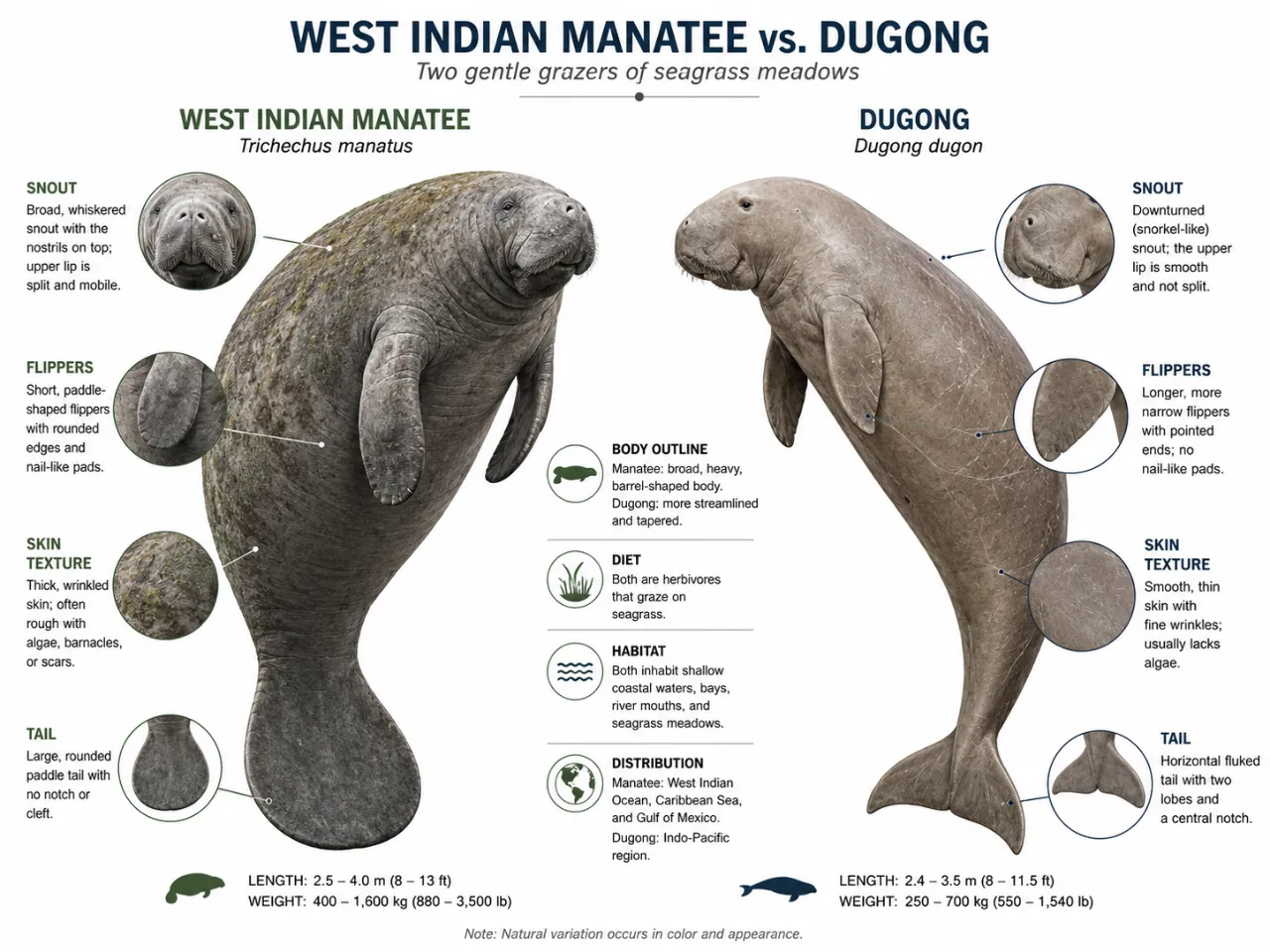
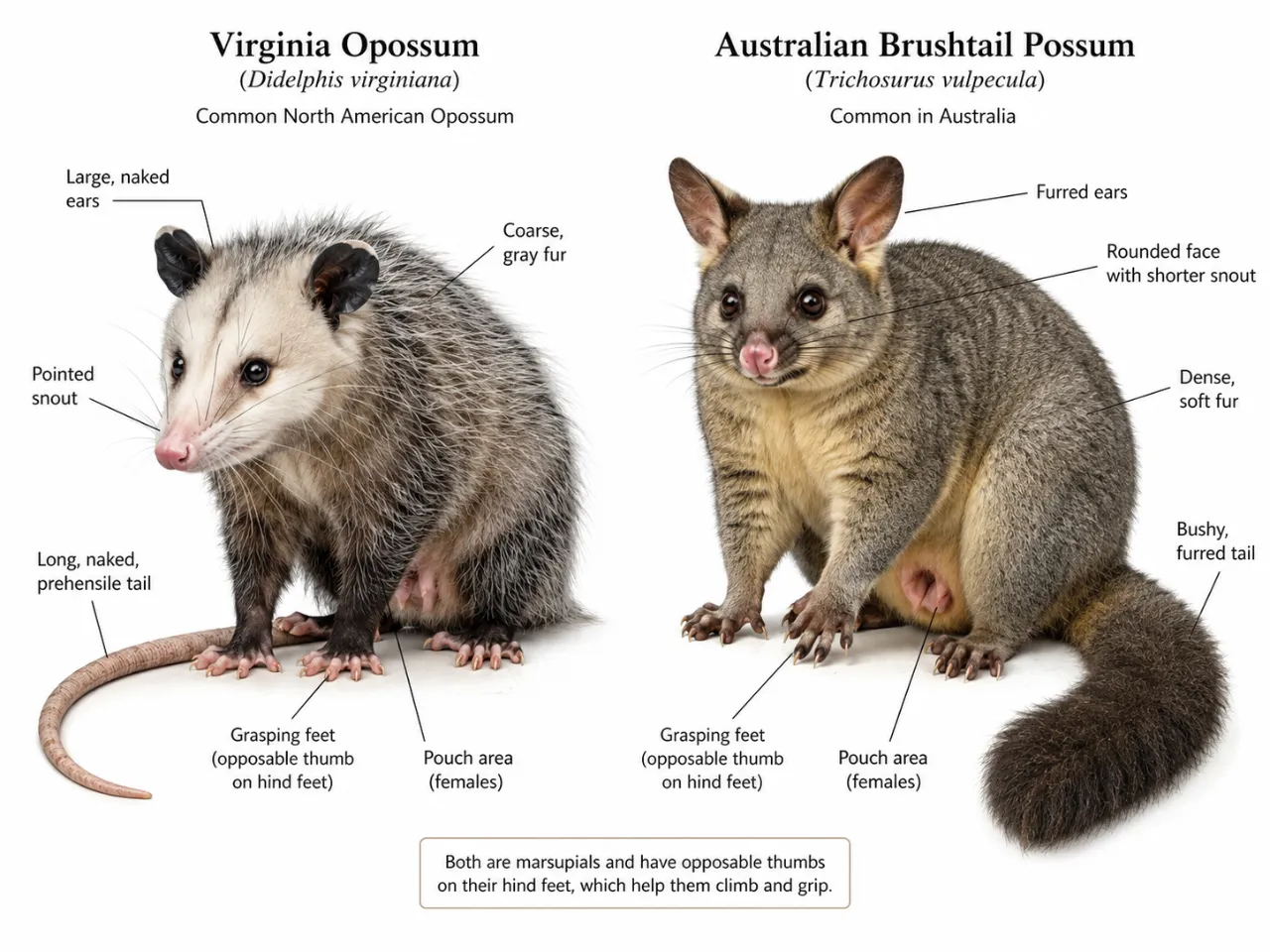
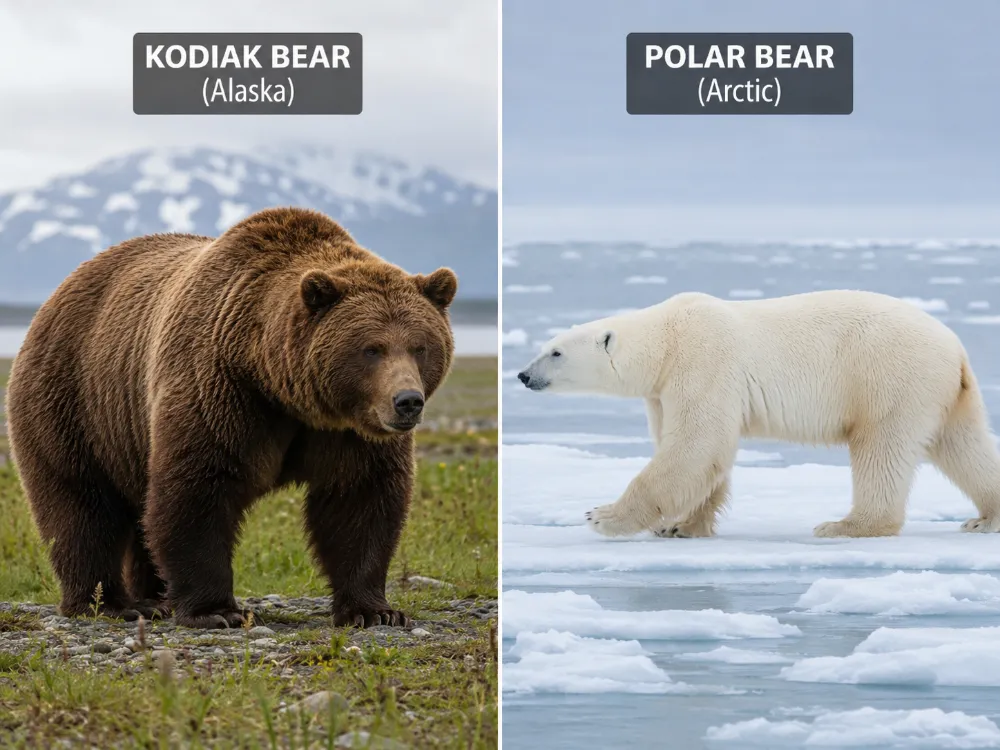
Kodiak bears and polar bears are two of the largest bears on Earth. Polar bears are usually longer and more specialized for Arctic sea ice and seal hunting, while Kodiak bears are massive island brown bears adapted to rich coastal food sources. In maximum size, both can be enormous, but polar bears are often considered the largest bear species overall, while Kodiak bears are among the largest brown bears.
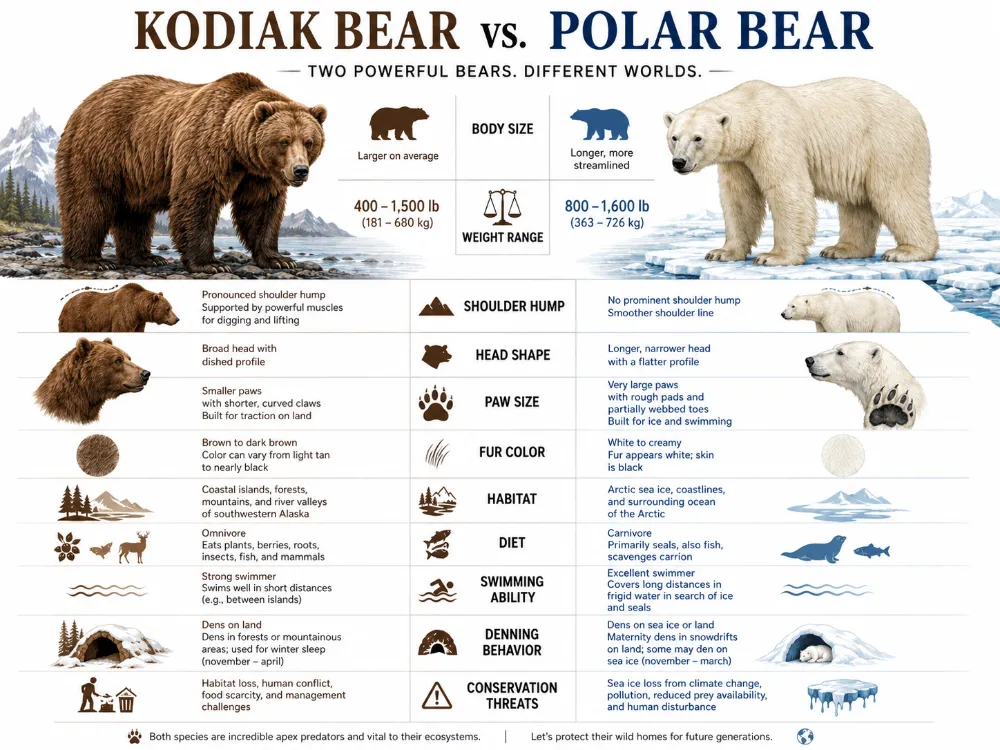
Kodiak Bear vs Polar Bear Summary Table
| Feature | Kodiak Bear | Polar Bear |
|---|---|---|
| Scientific name | Ursus arctos middendorffi | Ursus maritimus |
| Bear type | A subspecies of brown bear | A distinct Arctic bear species |
| Main range | Kodiak Archipelago, Alaska | Arctic regions around sea ice and northern coasts |
| Typical male weight | Often about 300–600 kg, with some larger individuals | Often about 350–700 kg, with some larger individuals |
| Typical female weight | Usually smaller, often about 180–320 kg | Usually smaller, often about 150–250 kg |
| Body shape | Stocky, muscular, powerful shoulders, brown bear build | Longer body, longer neck, narrower head, large paws |
| Shoulder hump | Prominent shoulder hump for digging and strength | No large brown-bear-style shoulder hump |
| Fur color | Brown, blond, dark brown, or grizzled | White to yellowish-white |
| Main diet | Omnivorous: salmon, berries, grasses, roots, carrion, mammals, and coastal foods | Mostly carnivorous: seals, especially ringed and bearded seals |
| Best habitat | Coastal forests, salmon streams, meadows, mountains, and island landscapes | Sea ice, Arctic coasts, tundra, and cold marine environments |
| Swimming ability | Can swim well, but not as marine-specialized | Excellent long-distance swimmer |
| Best adapted for | Rich coastal feeding, digging, fishing, and seasonal foraging | Sea ice hunting, swimming, extreme cold, and seal predation |
What Is a Kodiak Bear?
The Kodiak bear is a large subspecies of brown bear found only on the Kodiak Archipelago in Alaska. Its scientific name is Ursus arctos middendorffi. Because Kodiak bears have been isolated from mainland brown bears for thousands of years, they are recognized as a distinct brown bear subspecies.
Kodiak bears are among the largest brown bears in the world. Their huge size is linked to genetics, island isolation, and access to rich seasonal foods, especially salmon, berries, grasses, roots, sedges, and coastal resources. Like other brown bears, they have a strong shoulder hump, long claws, and powerful digging muscles.
Despite their size, Kodiak bears are not pure carnivores. They are flexible omnivores that change their diet with the seasons. This adaptability is one reason they can grow so large in productive island habitats.
What Is a Polar Bear?
The polar bear is a large Arctic bear with the scientific name Ursus maritimus, meaning “sea bear.” This name fits its lifestyle because polar bears are closely tied to sea ice, coastal waters, and marine prey.
Polar bears are usually considered the largest living bear species by average size. They have long bodies, long necks, narrow heads, small ears, huge paws, dense fur, black skin, and thick fat. These traits help them survive in freezing Arctic environments and hunt seals from sea ice.
Unlike Kodiak bears, polar bears are highly carnivorous. Their most important food is seal fat, which provides the energy they need to survive cold conditions, long travel, swimming, and fasting periods.
Are Kodiak Bears and Polar Bears Related?
Yes. Kodiak bears and polar bears are close relatives within the bear family. Kodiak bears are a form of brown bear, while polar bears evolved from brown bear ancestors and became specialized for Arctic marine life.
This close relationship explains why brown bears and polar bears can sometimes produce hybrids where their ranges overlap. However, Kodiak bears and polar bears do not naturally share the same habitat in normal circumstances. Kodiak bears live on islands in Alaska, while polar bears live far to the north in Arctic regions.
They are related, but they represent two very different survival strategies: one is a giant coastal omnivore, and the other is an Arctic marine predator.
Which Bear Is Bigger?
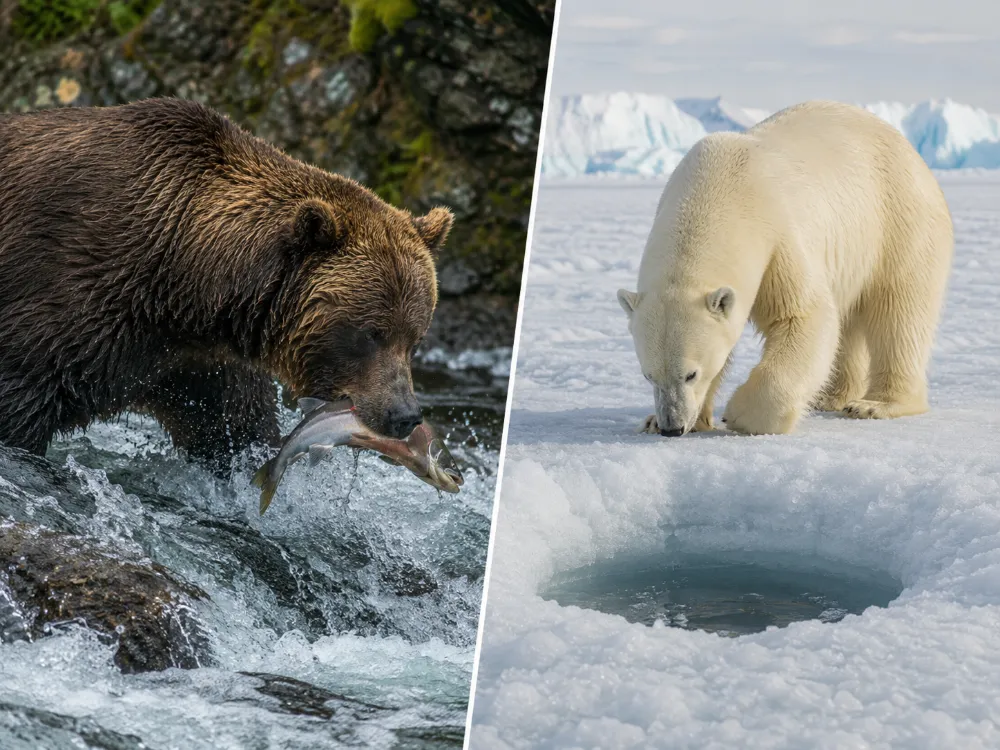
Polar bears are generally considered the largest bear species overall, especially when comparing average adult males. A large male polar bear can be longer and heavier than most brown bears.
Kodiak bears, however, are extremely close in size. Large male Kodiak bears can rival polar bears and may exceed many individual polar bears in weight, especially before winter when they have built up fat reserves.
The fairest answer is this: polar bears are usually the largest bear species by average size, but Kodiak bears are among the largest bears on Earth and can overlap with polar bears in maximum size.
Weight and Length Differences
Adult male polar bears often weigh about 350–700 kg, and very large individuals may exceed that range. Their bodies are long, and they may appear especially stretched from nose to tail compared with brown bears.
Adult male Kodiak bears often weigh about 300–600 kg, with some individuals becoming larger when food is abundant. Kodiak bears may look bulkier and more compact because they have the classic brown bear build: massive shoulders, thick limbs, and a powerful torso.
Female bears of both types are much smaller than the largest males. A large male from either species can be more than twice the weight of a female.
Body Shape and Build
Kodiak bears have the powerful build of a brown bear. They are stocky, muscular, and heavy through the shoulders. Their shoulder hump is made of strong muscles used for digging, turning over soil, ripping into logs, and excavating food.
Polar bears have a different outline. They are longer-bodied, longer-necked, and more streamlined. Their heads are narrower, their ears are smaller, and their paws are very large. These traits help them move across snow and ice and swim through cold water.
In simple terms, Kodiak bears look like massive land-based powerhouses, while polar bears look like long Arctic hunters built for ice, water, and distance.
Fur and Color Differences
Kodiak bears can be dark brown, medium brown, blond, cinnamon, or grizzled. Their coat color may vary by individual, age, season, and lighting. Like other brown bears, their fur helps them blend into forests, meadows, river valleys, and coastal landscapes.
Polar bears appear white or yellowish-white. This pale color helps them blend with snow, ice, and Arctic light. Their skin underneath is black, and their thick fur and fat layer provide insulation in freezing conditions.
Color is one of the easiest visual differences: Kodiak bears are brown bears, while polar bears are pale Arctic bears.
Head, Ears, and Face Shape
Kodiak bears have broad heads, strong jaws, rounded ears, and a more typical brown bear face. Their forehead and muzzle often create a dished or concave profile, especially when viewed from the side.
Polar bears have longer, narrower heads and smaller ears. Small ears help reduce heat loss in Arctic conditions. Their long necks also help when reaching into seal breathing holes or moving through water.
If the bear has a broad brown head and rounded ears, it is likely a brown bear type. If it has a long pale head, small ears, and a long neck, it is likely a polar bear.
Claws and Paws
Kodiak bears have long claws suited for digging, catching salmon, opening logs, and moving through rugged terrain. Their claws are typical of brown bears: strong, fairly long, and useful for land-based foraging.
Polar bear claws are strong and curved for gripping ice and holding slippery prey. Their paws are very large, helping distribute weight over snow and ice. The paw pads also provide traction on frozen surfaces.
Kodiak bear paws are built for digging and land power. Polar bear paws are built for ice traction, swimming, and walking across snow.
Habitat Differences
Kodiak bears live only on the Kodiak Archipelago in Alaska. Their habitat includes coastal forests, salmon streams, alpine meadows, grasslands, beaches, shrublands, and mountain slopes. They rely on seasonal food pulses, especially salmon runs and summer vegetation.
Polar bears live in Arctic regions where sea ice gives them access to seals. They may use sea ice, coastal tundra, islands, snow dens, and marine waters. For polar bears, sea ice is not just habitat; it is a hunting platform.
Kodiak bears are island brown bears. Polar bears are Arctic marine bears.
Diet Differences
Kodiak bears are omnivores. They eat salmon, grasses, sedges, berries, roots, bulbs, carrion, marine debris, clams, and occasionally mammals. Their diet changes with season and food availability. During salmon runs, fish can be a major food source.
Polar bears are much more carnivorous. Their main prey is seals, especially ringed seals and bearded seals. They depend heavily on seal fat, which gives them the energy needed for Arctic survival.
This is one of the biggest differences: Kodiak bears survive by eating many kinds of foods, while polar bears specialize in hunting marine mammals.
Hunting and Feeding Strategy
Kodiak bears often feed by foraging, fishing, grazing, digging, and scavenging. They may stand in streams to catch salmon, graze on sedges in meadows, dig roots, or search beaches for edible material. Their strength and intelligence allow them to exploit many food sources.
Polar bears are patient hunters. They often wait near seal breathing holes, stalk seals resting on ice, or break into snow lairs where seal pups are hidden. Their hunting style depends heavily on sea ice access.
Kodiak bears are flexible food generalists. Polar bears are specialized seal hunters.
Swimming Ability
Kodiak bears can swim, especially when moving between shorelines, crossing rivers, or navigating island environments. Like other brown bears, they are capable in water, but swimming is not the center of their lifestyle.
Polar bears are excellent swimmers. Their large front paws act like paddles, and their thick fat layer helps with buoyancy and insulation. They may swim long distances between ice, land, and hunting areas.
If the comparison is swimming specialization, the polar bear wins clearly. It is one of the most marine-adapted bears alive.
Strength and Fighting Ability
Both Kodiak bears and polar bears are incredibly strong. A large Kodiak bear has massive shoulders, long claws, powerful jaws, and the digging strength of a giant brown bear. A large polar bear has great body mass, long reach, strong forelimbs, and predatory power adapted for killing seals.
In a hypothetical fight, size, age, sex, health, hunger, terrain, and motivation would matter more than species name alone. A large male polar bear may have a size and reach advantage. A large male Kodiak bear may have more compact shoulder power and stronger land-based leverage.
Nature does not rank animals like fighting characters. Both are apex-level bears in their own environments, and both should be treated with extreme respect.
Which Bear Would Win in a Fight?
This is a popular search question, but it has no simple scientific answer. A very large male polar bear would likely be longer and possibly heavier than many Kodiak bears. A very large male Kodiak bear would be extremely powerful, heavily muscled, and dangerous on land.
On ice or in cold marine conditions, the polar bear would be in its element. In forested island terrain or salmon-rich coastal habitat, the Kodiak bear would be better adapted. Individual condition would be critical.
The most accurate answer is that either could win depending on the individuals and setting, but such encounters are not a normal part of their natural lives.
Behavior Around Humans
Kodiak bears usually avoid people when not surprised, threatened, or food-conditioned. However, they are huge wild animals and can be dangerous, especially if a person gets too close, surprises a bear, approaches cubs, or interferes with food.
Polar bears can be especially dangerous because they are highly carnivorous predators. In Arctic environments, a hungry polar bear may view humans as possible prey more readily than most brown bears would.
Both bears require serious safety precautions. The safest approach is distance, respect, food storage, local guidance, and never approaching a wild bear.
Social Behavior
Kodiak bears are generally solitary, but they may gather where food is abundant, such as salmon streams or rich feeding areas. In those settings, bears use body language, spacing, and dominance behavior to reduce conflict.
Polar bears are also mostly solitary. They may gather around whale carcasses, rich food sources, or certain coastal areas, but their normal hunting life is largely independent. Males and females come together mainly for mating.
Both species are solitary by nature, but food abundance can temporarily bring multiple bears into the same area.
Reproduction and Cubs
Kodiak bear females give birth in winter dens. Cubs are born tiny, blind, and helpless. The mother nurses and protects them in the den until they are ready to emerge in spring. Cubs stay with their mother while learning where to feed and how to avoid danger.
Polar bear females also give birth in maternity dens, usually in snow or frozen ground. The mother fasts while nursing her cubs, then leads them onto the sea ice when they are strong enough. Polar bear mothers face the challenge of feeding themselves while also raising cubs in a harsh Arctic environment.
Both species show strong maternal care, and cub survival depends heavily on the mother’s condition and habitat quality.
Denning and Winter Survival
Kodiak bears, like other brown bears, enter winter dens and live off stored body fat during the cold season. Pregnant females give birth in dens. Successful winter survival depends on gaining enough fat during the feeding season.
Polar bear denning is different. Pregnant females use maternity dens, but adult males and non-pregnant females may remain active through winter if hunting conditions allow. Polar bears are adapted to winter hunting on sea ice rather than simply sleeping through the coldest months.
Kodiak bears use winter dormancy as part of a seasonal brown bear cycle. Polar bears remain more tied to seal hunting and sea ice conditions.
Adaptations to Cold
Kodiak bears can handle cold Alaskan conditions, but they are not as specialized for extreme Arctic marine life as polar bears. Their winter strategy includes building fat reserves and denning.
Polar bears are built for severe cold. Their dense fur, thick fat layer, small ears, large paws, and heat-conserving body design help them survive on ice and in freezing water.
If the question is which bear is more cold-adapted, the answer is clearly the polar bear.
Ecological Role
Kodiak bears are major omnivores in island ecosystems. They move nutrients from salmon streams into forests, disturb soil while digging, scavenge carcasses, disperse seeds through droppings, and influence prey and plant communities.
Polar bears are top predators in Arctic marine ecosystems. Their seal hunting links them directly to the sea ice food web. They may also scavenge whale carcasses, bird eggs, and other foods when available, but seals remain central to their ecological role.
Kodiak bears help shape coastal island ecosystems. Polar bears help shape Arctic marine predator-prey dynamics.
Conservation Differences
Kodiak bears have a limited range because they live only on the Kodiak Archipelago. Their conservation depends on habitat protection, careful hunting management, reducing human-bear conflict, and maintaining healthy salmon systems.
Polar bears face a different and larger-scale challenge: loss of sea ice. Since sea ice is their main hunting platform, reduced ice can mean less access to seals, longer fasting periods, and lower body condition in some populations.
Both bears need large, healthy habitats, but their main conservation pressures are different. Kodiak bears are tied to island ecosystem management, while polar bears are tied to Arctic sea ice and climate conditions.
Could Kodiak Bears and Polar Bears Meet?
In normal natural conditions, Kodiak bears and polar bears do not meet. Kodiak bears are restricted to islands in southern Alaska, while polar bears live in Arctic regions much farther north.
Polar bears can overlap with some brown bear populations in the Arctic, but Kodiak bears are geographically separate from that overlap. Hybridization is known between polar bears and some brown bears, but Kodiak bears are not normally part of those encounters.
So, while they are close relatives, a wild Kodiak bear and a wild polar bear are extremely unlikely to encounter each other naturally.
Kodiak Bear vs Grizzly Bear vs Polar Bear
Kodiak bears and grizzly bears are both brown bears, but they are different forms. Kodiak bears live on the Kodiak Archipelago, while grizzlies are usually inland North American brown bears. Kodiak bears are often larger than inland grizzlies because of rich coastal food sources.
Polar bears are not brown bears, although they are close relatives. They are a distinct species specialized for Arctic sea ice, swimming, and hunting seals.
A simple comparison is: grizzly bear equals inland brown bear, Kodiak bear equals giant island brown bear, and polar bear equals Arctic marine bear.
How to Tell a Kodiak Bear from a Polar Bear Quickly
Look at color: Kodiak bears are brown, blond, or grizzled; polar bears are white or yellowish-white.
Look at habitat: Kodiak bears live on the Kodiak Archipelago; polar bears live in Arctic sea ice regions.
Look at body shape: Kodiak bears are stocky with shoulder humps; polar bears are longer with longer necks.
Look at the head: Kodiak bears have broader brown bear heads; polar bears have longer, narrower heads.
Look at diet: Kodiak bears are omnivores; polar bears are seal-hunting carnivores.
Look at paws: polar bears have especially large paws for snow, ice, and swimming.
Kodiak Bear vs Polar Bear: Final Comparison
Kodiak bears and polar bears are both giants, but they are giants of different worlds. The Kodiak bear is a huge island brown bear built for coastal foraging, salmon fishing, digging, and seasonal feeding. The polar bear is a long-bodied Arctic marine predator built for sea ice, swimming, cold, and seal hunting.
Polar bears are usually considered the largest bear species overall, but Kodiak bears can rival them in maximum size. If you are comparing lifestyle, the difference is clearer than size: Kodiak bears are powerful omnivores of Alaska’s island ecosystems, while polar bears are specialized predators of the Arctic sea ice.
FAQs About Kodiak Bears vs Polar Bears
Which is bigger, a Kodiak bear or a polar bear?
Polar bears are generally considered the largest bear species overall, especially by average male size. However, Kodiak bears are among the largest brown bears and can overlap with polar bears in maximum size.
Is a Kodiak bear a grizzly bear?
A Kodiak bear is a subspecies of brown bear, like a grizzly, but it is not usually called a grizzly. Kodiak bears live on the Kodiak Archipelago, while grizzlies are usually inland North American brown bears.
Is a polar bear a brown bear?
No. A polar bear is a distinct species, Ursus maritimus. It evolved from brown bear ancestors and remains closely related to brown bears, but it is not classified as a brown bear.
Which bear is stronger?
Both are extremely strong. Kodiak bears have massive shoulder power and digging strength. Polar bears have great body mass, long reach, and predatory strength for hunting seals. Strength depends on the individual, not just the species.
Would a Kodiak bear beat a polar bear?
There is no guaranteed answer. A large male polar bear may have a size and reach advantage, while a large Kodiak bear has powerful brown bear shoulders and land-based strength. Terrain, age, health, sex, and motivation would all matter.
Do Kodiak bears and polar bears live together?
No. Kodiak bears live on the Kodiak Archipelago in Alaska. Polar bears live in Arctic regions associated with sea ice. They do not normally meet in the wild.
What do Kodiak bears eat?
Kodiak bears eat salmon, berries, grasses, sedges, roots, carrion, clams, and other seasonal foods. They are flexible omnivores.
What do polar bears eat?
Polar bears mainly eat seals, especially ringed and bearded seals. Seal fat is their most important energy source.
Which bear is more dangerous to humans?
Both can be dangerous. Polar bears may be more likely to view humans as potential prey because they are highly carnivorous. Kodiak bears are also dangerous if surprised, food-conditioned, threatened, or defending cubs.
Can Kodiak bears swim?
Yes. Kodiak bears can swim, especially around island and coastal habitats. However, they are not as specialized for long-distance marine swimming as polar bears.
Can polar bears live without sea ice?
Polar bears can spend time on land, but sea ice is critical for hunting seals. Without reliable sea ice, many polar bears have less access to their main food source.
Do Kodiak bears hibernate?
Kodiak bears enter winter dens and live off stored fat during the colder season, especially pregnant females. Their denning pattern is similar to other brown bears.
Do polar bears hibernate?
Pregnant female polar bears use maternity dens, but adult males and non-pregnant females do not hibernate in the same way brown bears do. Many remain active if hunting conditions are available.
Are Kodiak bears endangered?
Kodiak bears are limited to a small island range, so careful management is important. Their status depends on habitat protection, salmon availability, and reducing human-bear conflict.
Are polar bears endangered?
Polar bears face serious conservation concerns because of sea ice loss and climate-related habitat change. Their status can vary by population, but sea ice decline is a major long-term threat.