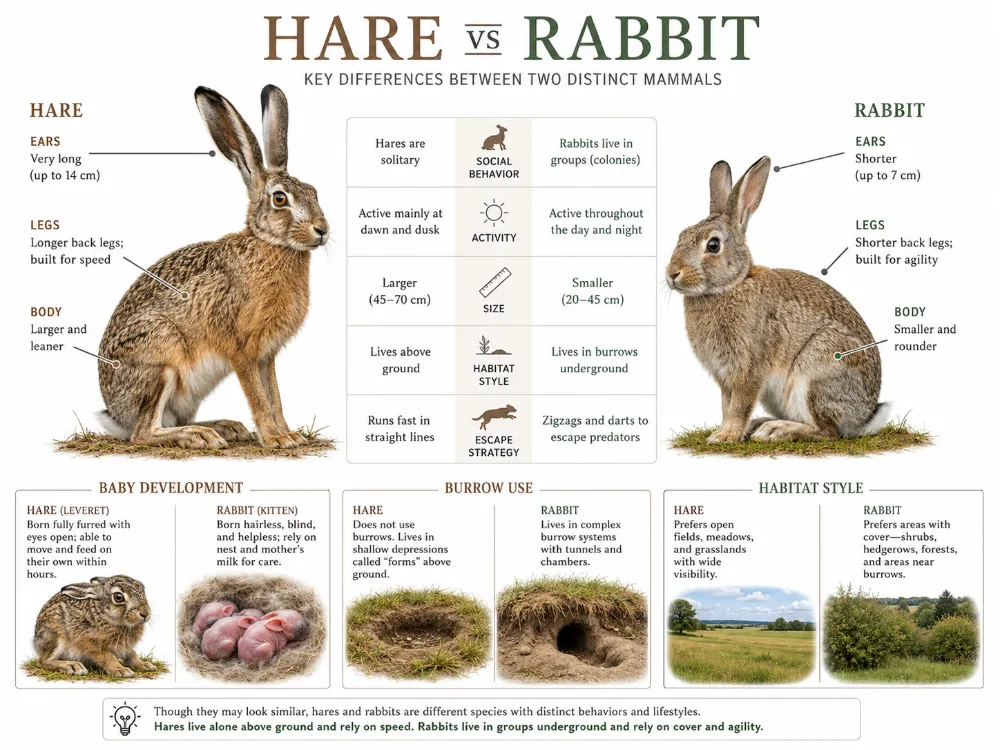
The short answer is that hares and rabbits are related but not the same animal. Hares are usually larger, longer-legged, and longer-eared, and their young are born furred, open-eyed, and ready to move. Rabbits are usually smaller, more social, and more strongly associated with burrows, and their babies are born blind, nearly hairless, and much more helpless. They belong to the same broader family group, but they live and reproduce in different ways.
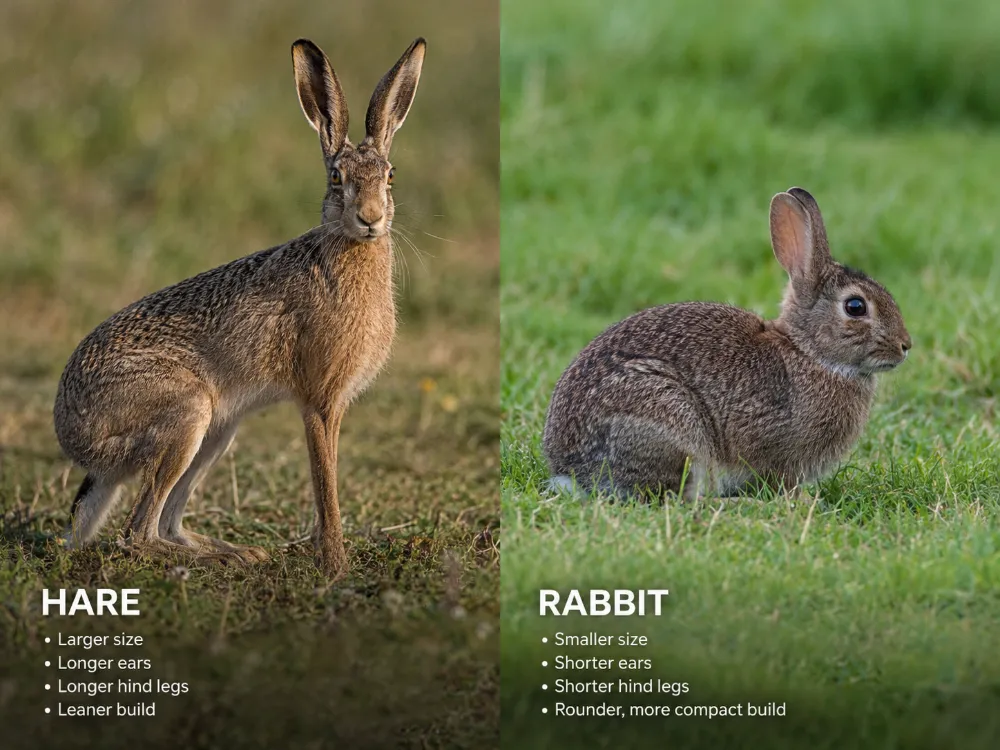
People often mix up hares and rabbits because both have long ears, strong hind legs, and a familiar “small hopping mammal” look. At a glance, they can seem almost identical, especially in pictures without clear scale or habitat clues.
In this guide, you will learn the clearest differences between hares and rabbits, how to identify them quickly, and why these two closely related animals have such different lifestyles.
Quick comparison table
| Feature | Hare | Rabbit |
|---|---|---|
| Overall size | Usually larger and longer-legged | Usually smaller and more compact |
| Ears | Often longer, with black tips in some species | Usually shorter relative to body size |
| Hind legs | Longer and more powerful for speed | Strong, but usually less exaggerated |
| Young at birth | Born furred, open-eyed, and more developed | Born blind, nearly hairless, and helpless |
| Nest style | Usually above ground in shallow forms or cover | Often in burrows or underground nests |
| Typical habitat style | More often open country and grassland | Often linked with burrows, cover, and colony areas |
| Social pattern | Often more solitary | Often more social, depending on species |
| Best quick clue | Taller, longer ears, longer legs | Rounder, smaller, burrow-linked |
They are related, but they are not the same animal
Hares and rabbits both belong to the family Leporidae, which means they are close relatives. That shared ancestry explains why they look similar at first glance. Both have large hind legs, long ears, fast reflexes, and bodies adapted for escaping predators.
However, they are not simply different names for the same creature. Hares and rabbits belong to different branches within that family and show consistent differences in body form, reproduction, habitat use, and behavior.
So while both are leporids, a hare is not just a bigger rabbit, and a rabbit is not just a smaller hare.
Hares are usually larger and leggier
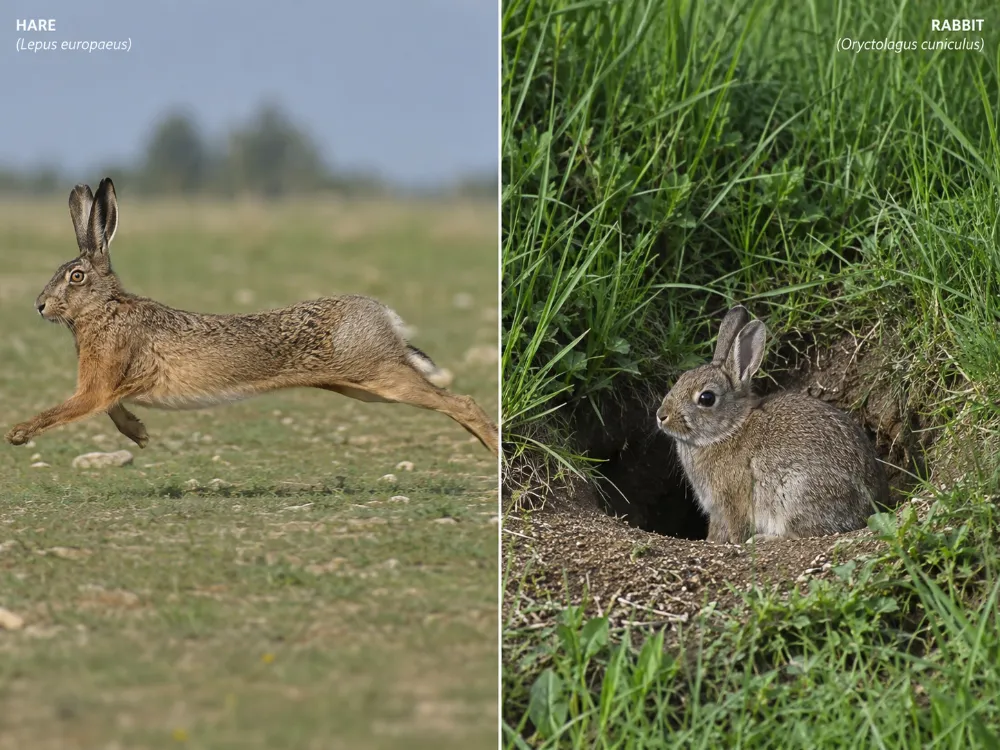
One of the easiest differences to notice is body shape. Hares are usually larger, taller, and more long-legged than rabbits. Their body often looks stretched and athletic, especially in the hindquarters.
Rabbits are usually more compact and rounder in overall outline. Even wild rabbits often look shorter-bodied and lower to the ground compared with the more upright, long-limbed look of a hare.
If the animal seems especially tall, rangy, and built for running, it is more likely to be a hare.
Hares often have longer ears
Hares usually have longer ears than rabbits, often noticeably so. In some hare species, the ear tips may also show black coloration, which can be a useful field mark.
Rabbits also have long ears compared with many mammals, but their ears are usually shorter relative to the body than those of hares. Their overall look is often softer and less exaggerated.
If the ears seem unusually long and striking, especially on a long-legged animal in open country, hare becomes more likely.
Hares have longer, stronger hind legs
Hares are especially well built for speed. Their hind legs are often longer and more powerful than those of rabbits, giving them a strong advantage in rapid escape across open ground.
Rabbits can run fast too, but they often depend more on quick dashes into cover or burrows rather than extended high-speed escape across open land. Their body design reflects this difference.
This is why hares often look like runners, while rabbits often look more like crouching, cover-dependent escape artists.
The babies are very different at birth
This is one of the most important biological differences. Baby hares are born in a much more developed state. They are usually born with fur, open eyes, and the ability to move around relatively soon after birth.
Baby rabbits are born in a much more helpless condition. They are usually blind, nearly hairless, and dependent on the nest for warmth and protection.
This difference reflects the environments in which they are born. Hares often give birth above ground, while rabbits are more strongly associated with protected underground nests or burrows.
Hares give birth above ground more often
Hares usually do not depend on deep burrow systems in the same way many rabbits do. Instead, they often give birth in shallow depressions or sheltered spots above ground, sometimes called forms, where the young remain hidden in vegetation.
Because these young are more exposed, they are born much more developed. Fur, open eyes, and early mobility all help them survive without the protection of a burrow.
This is a major reason hare young look and behave so differently from baby rabbits.
Rabbits are more strongly associated with burrows
Many rabbits are famous for their burrowing lifestyle. Wild rabbits often use underground tunnels and nest chambers, which provide protection from weather and predators. This more sheltered environment allows the young to be born in a less developed state.
Not every rabbit species digs the same way, but burrow life is one of the strongest classic rabbit traits, especially in familiar species such as the European rabbit and its domestic descendants.
When people imagine rabbits living in warrens, that image is based on real biology.
Hares are often more solitary
Hares are often less social than rabbits. Many species live more independently and are commonly seen alone, especially outside the breeding season. Their lifestyle often fits open landscapes where speed and alertness matter more than group burrow living.
Rabbits, depending on the species, are often more social and may live in colonies or loose groups. Social structure is especially visible in burrow-forming species that share space and use connected tunnel systems.
So if the animal is part of an obvious colony near burrow entrances, rabbit is often the better guess.
Habitat use is not exactly the same
Hares are often associated with open landscapes such as grasslands, meadows, farmland, tundra, or scrubby country where they can rely on vision, speed, and camouflage. Their long-legged build suits this more open way of living.
Rabbits are often more tightly linked to cover, edges, shrubland, hedgerows, and places where burrowing or quick retreat into dense shelter is possible. Even when they feed in open areas, they often stay closer to protective cover.
This does not mean the two groups never overlap in habitat, but they often use the same landscape differently.
Hares are built more for running, rabbits more for dodging
Hares often escape danger by making long, fast runs across open ground. Their large body, long ears, and powerful legs suit this strategy well. A hare may cover significant distance in an attempt to outrun a predator.
Rabbits often rely more on short bursts, sharp turns, and fast retreats into cover or underground safety. Their strategy is often less about pure endurance in the open and more about disappearing quickly.
So if you think of a hare as a runner and a rabbit as a dodger, you are close to the real difference.
Rabbits are more often domesticated
When most people think of pet rabbits, they are thinking of domestic rabbits descended mainly from the European rabbit. Rabbits have a long history of domestication and are common as pets, farm animals, and companion animals.
Hares are not domesticated in the same way. They remain much more strongly wild in human experience and are rarely thought of as pet-type animals.
This is one reason the word rabbit feels more familiar in everyday domestic life than the word hare.
Appearance can vary, but the overall pattern holds
There are many species of both hares and rabbits, so not every individual fits one perfect visual template. Some rabbits are larger than people expect, and some hares may seem less dramatic than the textbook image.
Even so, the overall pattern is still very useful: hares are usually taller, longer-legged, longer-eared, and more open-country in style, while rabbits are usually smaller, rounder, burrow-linked, and born much less developed.
This is why body form plus behavior usually gives the best identification.
Why people confuse them so often
People confuse hares and rabbits because both have the classic leporid look: long ears, quick movement, soft fur, and strong hind legs. In children’s books, cartoons, and casual conversation, the two are often treated as if they were interchangeable.
The confusion gets stronger because many people do not often see a true hare closely, while rabbits are more familiar through pets, gardens, and farm edges. So any long-eared hopping mammal may be casually called a rabbit.
Once you learn about baby development, leg length, and burrow use, the difference becomes much clearer.
How to tell them apart quickly
If you need a fast field guide, use these clues together:
Hare: larger, taller, longer ears, longer hind legs, more open-country look, young born furred and open-eyed
Rabbit: smaller, rounder, shorter ears, more burrow-linked, often more social, young born blind and helpless
No single clue is perfect every time, but this combination usually works very well.
Which one is faster?
Hares are usually regarded as the faster, more open-ground runners. Their build is better suited to high-speed escape over distance, and many hare species rely heavily on that ability.
Rabbits are also fast, but they usually depend more on short-range bursts and access to cover. Their speed matters, but it is part of a different escape strategy.
So if the question is long-legged speed across open ground, the hare usually has the edge.
Final takeaway
The main difference between a hare and a rabbit is that hares are usually larger, longer-legged, longer-eared, and more open-country animals whose young are born furred and ready to move, while rabbits are usually smaller, more compact, more strongly associated with burrows, and give birth to blind, helpless young. They are close relatives in the same family, but they live and reproduce in very different ways. Once you know the clues, they are much easier to tell apart.
FAQs
Is a hare the same as a rabbit?
No. Hares and rabbits are close relatives, but they are different animals with different body shape, habitat use, and reproductive strategies.
How can I tell a hare from a rabbit fast?
Look at size, ears, and legs. Hares are usually larger, longer-eared, and longer-legged than rabbits.
Are baby hares and baby rabbits born the same way?
No. Baby hares are born furred and open-eyed, while baby rabbits are born blind, nearly hairless, and much more helpless.
Which one lives in burrows, the hare or the rabbit?
Rabbits are much more strongly associated with burrows and underground nests than hares are.