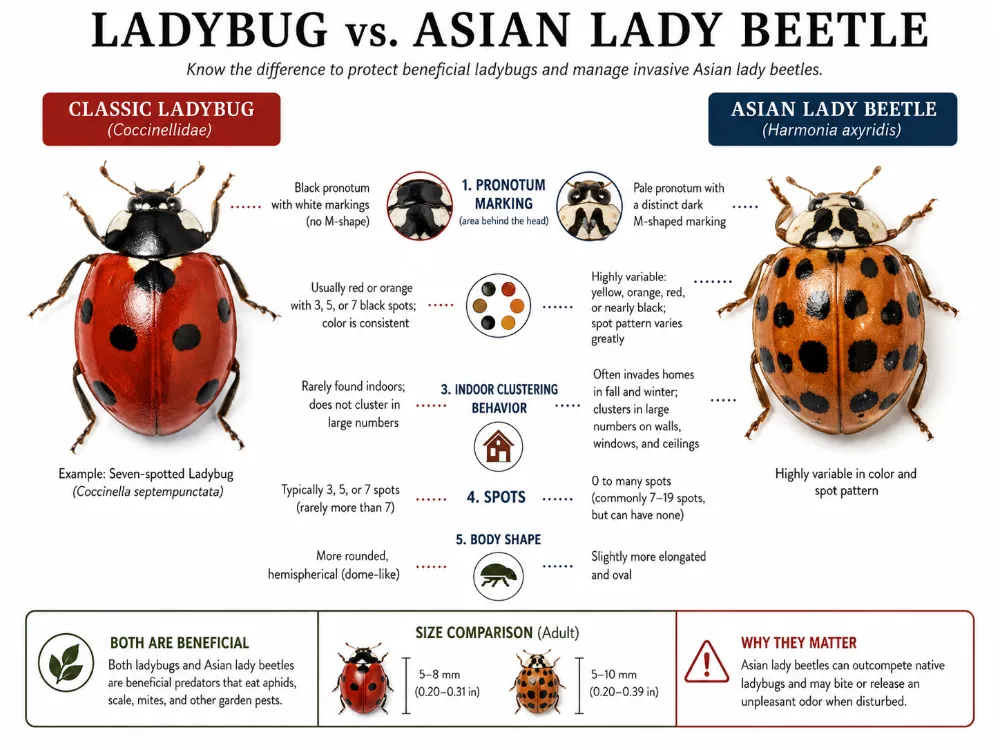
The short answer is that an Asian beetle is a type of ladybug, but in everyday language people often use “ladybug” for the more familiar native lady beetles and “Asian beetle” for the invasive Asian lady beetle that often enters houses. Asian lady beetles usually vary more in color, often have a pale area behind the head with a dark M- or W-shaped marking, and are more likely to gather indoors. So the difference is usually about species, behavior, and appearance, not two unrelated insect groups.
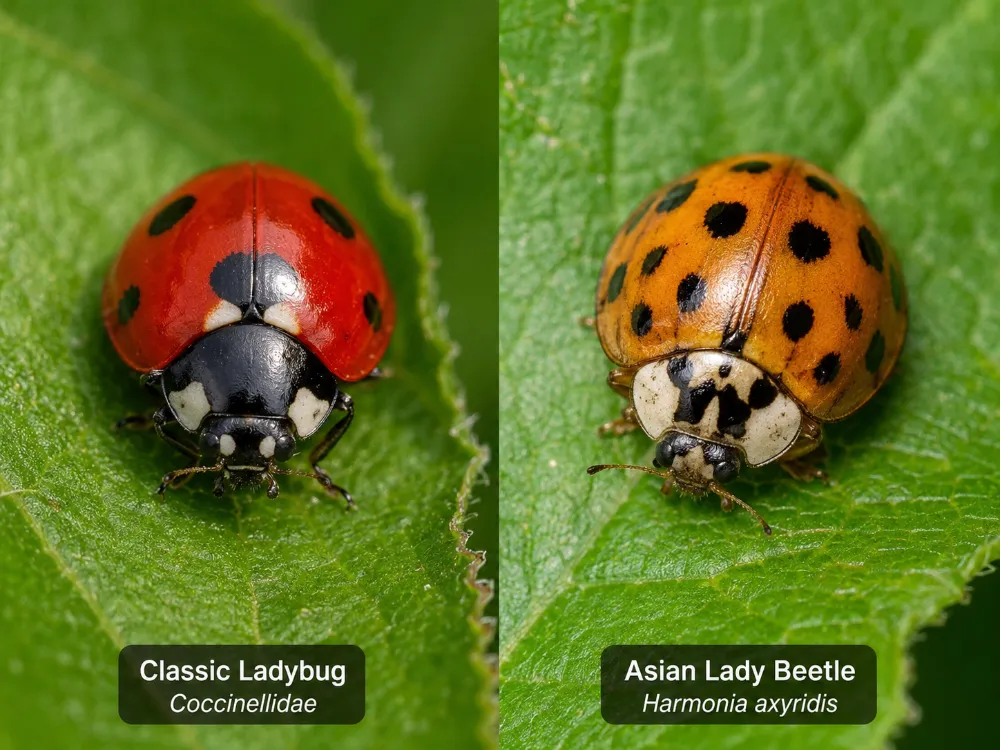
People often use the words ladybug and Asian beetle as if they mean completely different insects. In reality, the Asian lady beetle belongs to the same broader lady beetle family as the classic red-and-black ladybugs people recognize from gardens and children’s books.
In this guide, you will learn what makes an Asian lady beetle different from other ladybugs, how to identify them, why they behave differently around homes, and whether they are helpful or harmful.
Quick comparison table
| Feature | Typical Ladybug | Asian Lady Beetle |
|---|---|---|
| Basic meaning | Common name for many lady beetles | A specific lady beetle species or species group, often called the Asian lady beetle |
| Color | Often bright red with black spots | Very variable, from orange to red to yellowish, sometimes with many spots or almost none |
| Marking behind head | Usually less striking in many common species | Often a pale area with a dark M- or W-shaped marking |
| Indoor behavior | Less likely to gather indoors in large numbers | More likely to invade houses for overwintering |
| Odor | Can release defensive fluid, but usually less noticed by homeowners | Often more noticeable when disturbed |
| Biting behavior | Usually not noticed by people | Can sometimes nip human skin lightly |
| Garden role | Often beneficial predator of aphids and other pests | Also beneficial as a predator, but more likely to become a household nuisance |
| Best quick clue | Classic round red beetle image | Pale pronotum with dark M-shaped marking and strong tendency to cluster indoors |
What is a ladybug?
The word ladybug is a common everyday name for lady beetles, which are small beetles in the family Coccinellidae. In many places, people also call them ladybirds or ladybird beetles. These insects are famous for their rounded shape and bright warning colors.
Many ladybugs are beneficial predators that eat aphids, scale insects, and other soft-bodied pests. That is why gardeners often see them as helpful insects rather than harmful ones.
So when people say “ladybug,” they usually mean the general group, not one single exact species.
What is an Asian beetle?
In everyday home and garden talk, “Asian beetle” usually means the Asian lady beetle, especially the species most commonly noticed around houses. It is still a lady beetle, but it has earned a separate everyday label because of its behavior and its tendency to become a nuisance indoors.
This is why the comparison can be confusing. Scientifically, the Asian lady beetle is a kind of ladybug. In casual speech, however, people often separate it from the “regular ladybug” because it looks a little different and behaves differently around humans.
So the most accurate explanation is that the Asian lady beetle is not outside the ladybug group. It is one member of it.
All Asian lady beetles are ladybugs, but not all ladybugs are Asian lady beetles
This is the key idea. The term ladybug is broad, while Asian lady beetle is narrow. That means every Asian lady beetle is a ladybug in the broad sense, but many other ladybugs are not Asian lady beetles.
People often compare them as if they are opposites, but biologically it is more like comparing “dog” with “German shepherd.” One term is the larger group, and the other is a specific kind within that group.
Once you understand this, the whole topic becomes much clearer.
Color is one of the first visible differences
Many people picture a classic ladybug as a bright red beetle with neat black spots. Many native or familiar ladybugs do fit that image fairly well. Asian lady beetles, however, are often much more variable in color.
They may appear orange, red-orange, red, yellow-orange, or even paler in some cases. The number of spots can also vary a great deal. Some individuals have many spots, while others have few or almost none.
This variability is one reason people sometimes fail to realize they are looking at the same broader insect family.
The head and pronotum marking is often the best clue
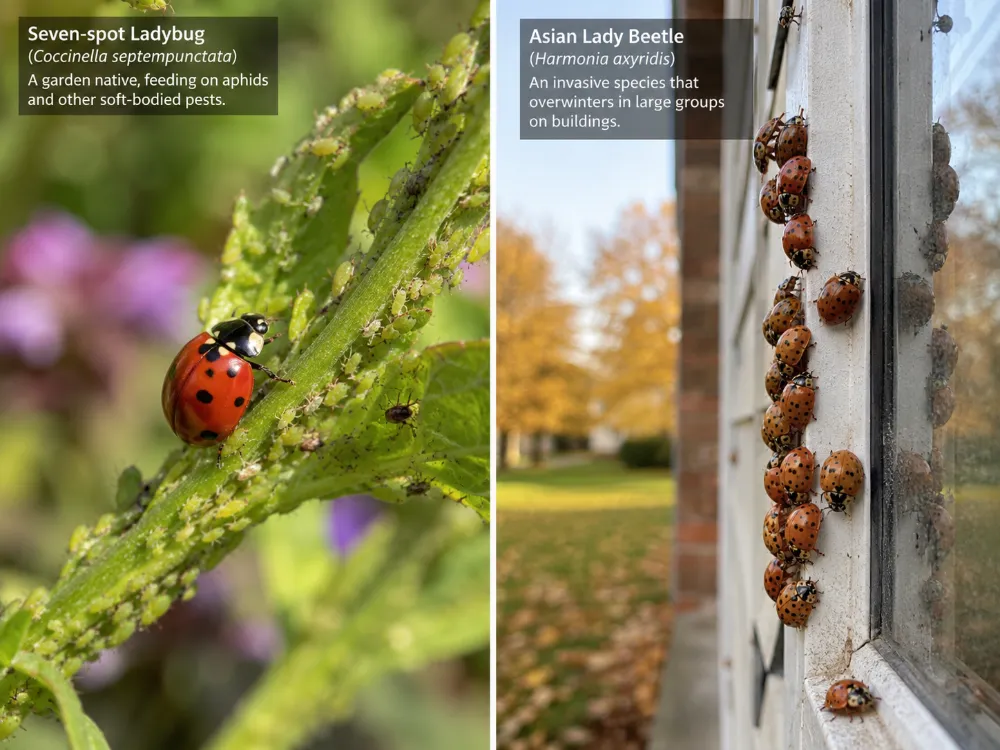
One of the most useful identification features is the area just behind the head, called the pronotum. Asian lady beetles often have a pale or whitish pronotum with a dark marking that looks like an M or W, depending on the viewing angle.
This marking is famous because it helps distinguish them from many of the more familiar garden ladybugs people expect to see. Not every individual looks identical, but the pattern is often strong enough to be a practical field clue.
If you see a beetle with a pale neck area and a dark M-shaped marking, Asian lady beetle becomes much more likely.
Asian lady beetles are more likely to come indoors
This is one of the biggest practical differences for homeowners. Many typical ladybugs stay mostly in outdoor environments where they feed and shelter in vegetation. Asian lady beetles are much more likely to gather on buildings and enter houses, especially as the weather cools.
They often seek warm, protected places to overwinter. As a result, people may find large numbers around windows, attics, wall spaces, ceilings, and sunny exterior walls.
This indoor clustering behavior is one reason the Asian lady beetle is talked about so differently from the more beloved “garden ladybug” image.
Ladybugs are often seen as welcome, Asian beetles as nuisance insects
In gardens, both ladybugs and Asian lady beetles can be beneficial because they eat pest insects. But indoors, public opinion changes quickly. A few ladybugs on plants may feel charming. Dozens or hundreds of Asian lady beetles in a window frame feel like an invasion.
This difference in human reaction is based more on behavior than on biology. The insects themselves are closely related, but their interaction with homes and buildings creates very different impressions.
So the distinction is partly scientific and partly cultural.
Asian lady beetles can have a stronger defensive odor
Like many lady beetles, Asian lady beetles can release a yellowish defensive fluid when stressed or crushed. This fluid can have an unpleasant odor and may leave stains on light-colored surfaces.
Other ladybugs can also use chemical defense, but people often notice it more with Asian lady beetles because these insects gather indoors in greater numbers and are handled or disturbed more often by homeowners.
This is another reason the Asian lady beetle has a stronger nuisance reputation.
Can Asian beetles bite?
Asian lady beetles can sometimes give a small nip to human skin, especially if they land on exposed skin and are searching for moisture or salt. These bites are usually not medically serious, but they can be surprising and unpleasant.
Most people do not think of ladybugs as biting insects, so this behavior adds to the sense that Asian lady beetles are somehow harsher or more aggressive. In reality, the bite is usually minor and not the same kind of biting behavior seen in blood-feeding insects.
Even so, this is one more reason people often separate Asian beetles from the kinder image of the “regular ladybug.”
Both can be helpful in gardens
It is important not to lose sight of the ecological role. Both many native ladybugs and Asian lady beetles are predators of soft-bodied insects such as aphids. In that sense, they can both help reduce pest populations on plants.
This is why lady beetles in general are often released or encouraged in agricultural and garden settings. They are part of the natural balance that keeps some pest insects under control.
So even though Asian lady beetles can be annoying indoors, they are not useless insects. They are still predators that can have value in the right place.
Why people confuse them so often
People confuse ladybugs and Asian lady beetles because the Asian lady beetle looks enough like a typical ladybug to fit the same mental picture. It is round, colorful, spotted, and small. Unless someone knows what features to check, the differences can be easy to miss.
The confusion also comes from language. Since Asian lady beetles really are lady beetles, calling them ladybugs is not strictly wrong in a broad sense. The problem is that in everyday speech, “ladybug” often suggests the more familiar, less troublesome garden species.
So the confusion is built into both appearance and common naming.
Why Asian lady beetles became so noticeable
Asian lady beetles became especially noticeable because of their tendency to gather in large numbers around buildings and enter homes. A single beetle is easy to ignore. A wall covered in clustered beetles is not.
They also became well known because homeowners notice them in seasons when many other insects are declining. That makes them stand out even more. Once people start seeing them on windows and ceilings, they begin asking whether they are “ladybugs” or something else.
This is why the comparison remains so common in home and garden questions.
How to tell them apart quickly
If you need a fast identification guide, use these clues together:
Typical ladybug: often classic red-and-black appearance, less likely to form large indoor clusters, usually seen as a garden helper
Asian lady beetle: more variable orange-to-red color, pale pronotum with dark M-shaped marking, more likely to invade homes in groups, stronger nuisance reputation
No single clue is perfect every time, but the pronotum marking and indoor clustering behavior are among the most useful.
Are they harmful?
Most ladybugs and Asian lady beetles are not dangerous in the way that stinging or disease-spreading insects are dangerous. They do not damage houses the way termites do, and they are not blood-feeding pests like mosquitoes or bed bugs.
However, Asian lady beetles can still be a nuisance. They may gather in large numbers, leave stains, release odor, or occasionally nip. For people with allergies or strong insect sensitivity, a large indoor presence can be especially frustrating.
So the best answer is that they are usually more annoying than dangerous.
Final takeaway
The main difference between a ladybug and an Asian beetle is that the Asian lady beetle is one specific type of ladybug that people often notice because it varies more in color, often shows a dark M-shaped marking behind the head, and commonly gathers inside houses. Regular “ladybug” in everyday speech usually means the broader group or the more familiar native-looking forms. Both belong to the same family, both can help by eating pests, but the Asian lady beetle is much more likely to become an indoor nuisance.
FAQs
Is an Asian beetle a ladybug?
Yes. An Asian lady beetle is a type of ladybug, or more precisely, a type of lady beetle.
How can I tell a ladybug from an Asian beetle fast?
Look for the pale area behind the head with a dark M-shaped marking and notice whether the beetles are gathering indoors in large numbers.
Do Asian lady beetles bite?
They can sometimes give a light nip, but it is usually minor and not medically serious.
Are Asian lady beetles harmful to gardens?
Not usually. They often eat aphids and other pests, though they can still be annoying when they enter homes.