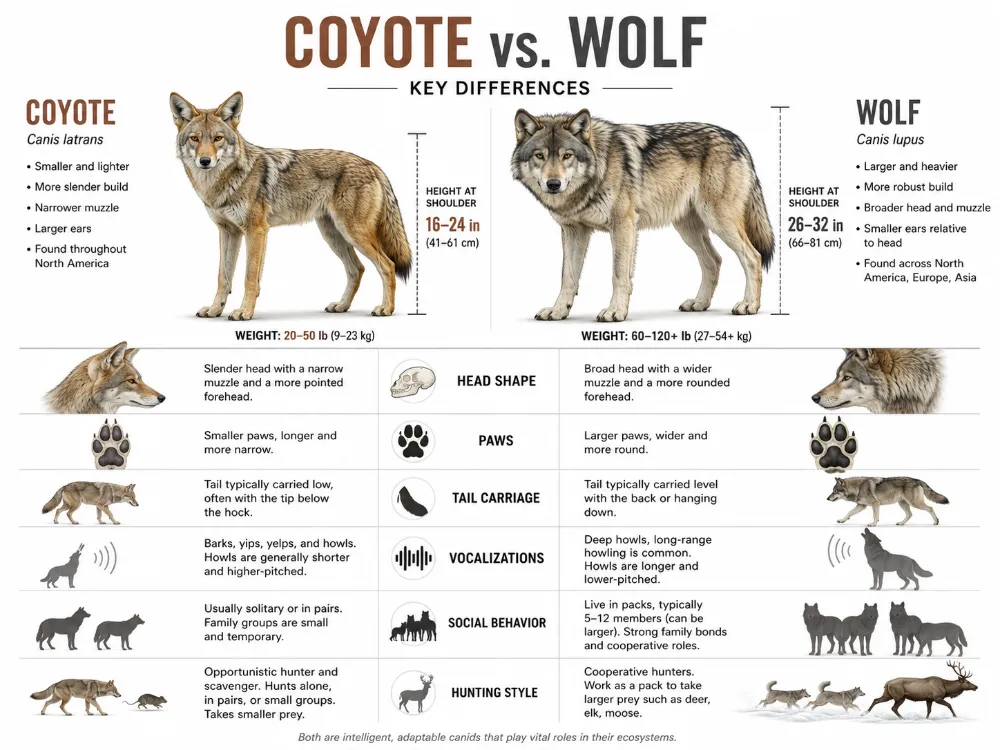
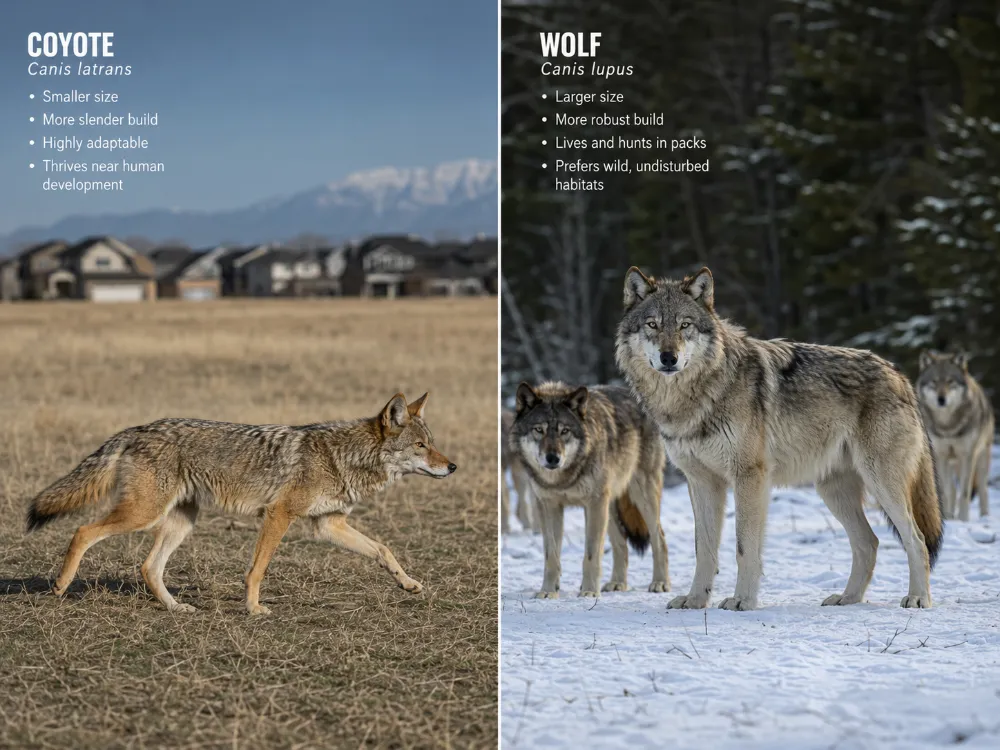
The easiest way to tell a coyote from a wolf is to look at size, build, face shape, and behavior. Wolves are usually much larger, heavier, and broader-headed, with bigger paws and a more powerful overall build. Coyotes are usually smaller, slimmer, narrower-faced, and more lightly built, with a sharper, more fox-like look. They also differ in social structure, hunting style, vocalizations, and how comfortably they live near people.
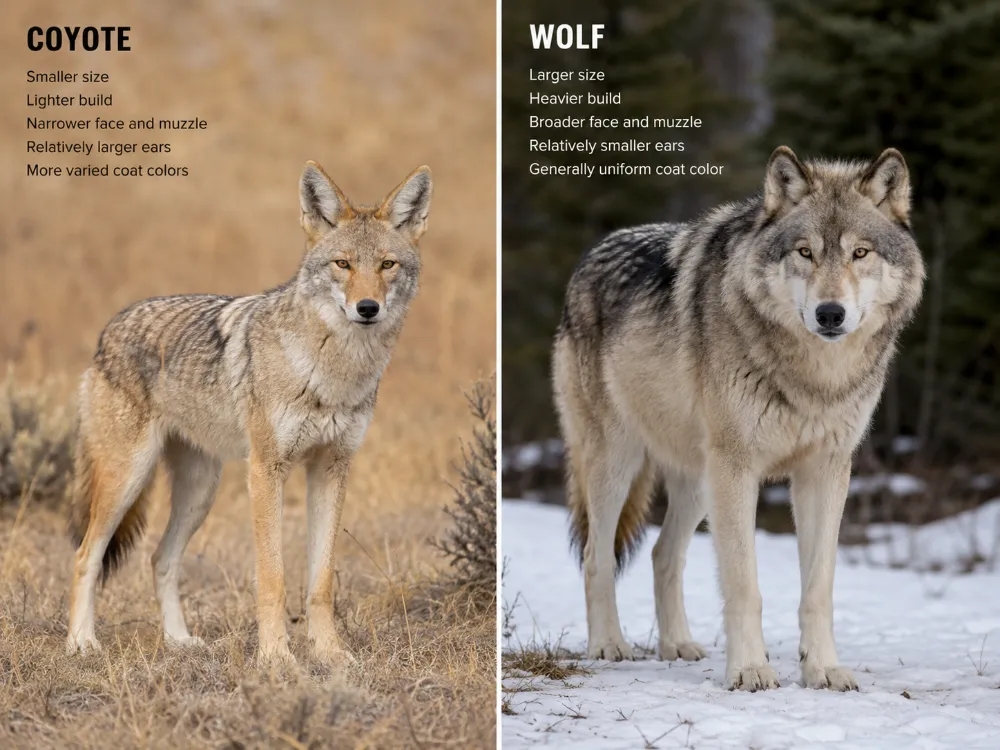
People often confuse coyotes and wolves because both are wild canids with pointed ears, bushy tails, and similar gray, tan, or brown coats. From a distance, especially in poor light, they can look surprisingly alike. Once you know what to check, however, the differences become much easier to see.
In this guide, you will learn how coyotes and wolves differ in appearance, size, behavior, voice, habitat, and lifestyle, plus the fastest ways to identify them correctly.
Quick comparison table
| Feature | Coyote | Wolf |
|---|---|---|
| Size | Smaller and lighter | Much larger and heavier |
| Build | Slim, narrow, lightly built | Broad-chested, powerful, heavily built |
| Head and muzzle | Narrower, sharper, more fox-like | Broader head, wider muzzle |
| Ears | Often appear larger relative to the head | Usually smaller relative to the larger head |
| Paws | Smaller and more delicate | Larger and heavier |
| Social structure | Often alone, in pairs, or small family groups | Usually more pack-oriented |
| Main hunting style | Small prey hunting and opportunistic feeding | Larger prey hunting and cooperative pack hunting |
| Relationship with people | Often adaptable near towns and suburbs | Usually more associated with wilder landscapes |
They are related, but they are not the same animal
Coyotes and wolves are close relatives in the dog family, Canidae. They share many traits because both are wild canids: long legs, pointed ears, strong noses, bushy tails, and a body designed for endurance movement across land.
However, they are not just big and small versions of the same creature. Wolves are generally more specialized for taking down larger prey and living in more structured packs, while coyotes are more flexible, opportunistic, and adaptable in mixed landscapes.
This family relationship explains why they resemble each other, but their ecology and body design clearly separate them.
Wolves are much larger
One of the clearest differences is size. Wolves are usually much larger and heavier than coyotes. A wolf often looks substantial, deep-chested, and powerful, with long legs supporting a broad body.
Coyotes are noticeably smaller and lighter. They usually look leaner, finer-boned, and more lightly framed. Even a healthy adult coyote often appears narrow compared with a wolf.
If the animal looks large enough to seem dog-like in a heavy, almost oversized way, wolf is more likely. If it looks smaller, rangier, and slimmer, coyote becomes more likely.
The body build is different
Wolves usually have a more powerful overall body shape. Their chest, shoulders, and neck often look thick and strong, reflecting an animal built for endurance travel and, in many cases, cooperative hunting of large prey.
Coyotes usually have a more delicate-looking build. They are still athletic and capable predators, but their frame is narrower and less massive. They often look quicker and lighter rather than strongly muscular.
This is one of the best visual clues when the animal is standing broadside.
The face is usually narrower in coyotes
Coyotes often have a narrower face with a more pointed muzzle. Their expression can seem sharper, more fox-like, and more delicate than that of a wolf. The nose area usually looks slimmer, and the whole head appears smaller relative to the body.
Wolves usually have a broader head and a wider, heavier muzzle. The face looks stronger and more blocky overall. This broader skull matches the wolf’s larger size and stronger jaw structure.
If the animal has a lean pointed face and a more delicate profile, coyote is the better guess. If the head looks broad and heavy, wolf is more likely.
Coyote ears often look bigger
Coyotes often seem to have relatively large ears because their head is smaller and narrower. The ears can stand out sharply and give the animal an alert, high-strung appearance.
Wolves have pointed ears too, but because the head is larger and broader, the ears often appear proportionally smaller. This can make the wolf’s head look more balanced and less “big-eared” than a coyote’s.
This is a subtle clue, but it helps when combined with body size and muzzle shape.
Wolves have bigger paws and legs
Wolves usually have larger paws and a heavier leg structure than coyotes. Their feet are built to support a bigger body and to travel long distances over snow, dirt, and rough terrain.
Coyotes have smaller, more delicate-looking paws and a lighter lower body. Their legs are still long and efficient, but they usually do not give the same heavy-duty impression as a wolf’s.
Tracks reflect this too. Wolf tracks are usually larger and more substantial, while coyote tracks are smaller and narrower.
Coat color can overlap
Color is not the most reliable way to tell them apart because both coyotes and wolves can appear gray, tan, brown, reddish, or mixed in tone depending on region, season, and individual variation.
Coyotes often show a somewhat grayer-tan or buffy look with rusty or pale tones mixed in. Wolves can also vary widely, from gray to black to white depending on population. Because of this overlap, color alone should never be your main clue.
It is better to focus on size, build, and face shape first.
Tail carriage can help
Coyotes often carry the tail lower, especially when trotting through open ground. Their tail may look narrow and somewhat drooped, helping create the classic image of a lean, cautious canid moving through a field.
Wolves also carry the tail low in many situations, but because the whole body is larger and more powerful, the tail often looks heavier and fuller. The difference is subtle, so this clue works best along with the others.
Neither species normally carries the tail tightly curled over the back like many domestic dogs do.
Wolves are more strongly pack-oriented
Wolves are famous for pack living. Many wolf populations rely on structured family groups, especially when hunting larger prey such as deer, elk, or other ungulates. Pack life helps them defend territory, raise young, and take down animals too large for one wolf to handle easily.
Coyotes can also live in family groups, pairs, or small loose groups, but they are often seen alone or in pairs more frequently than wolves. Their smaller prey base means they do not always need the same level of cooperative hunting.
So if you see several large wild canids moving together with obvious group coordination, wolf is often the stronger guess.
Coyotes are usually more adaptable around people
One of the most important behavioral differences is adaptability to human-modified environments. Coyotes are famous for living near farms, suburbs, and even large cities. They can exploit small prey, pet food, fruit, rodents, garbage, and many other food sources when necessary.
Wolves are usually more strongly associated with larger, less developed landscapes. Although some wolf populations live near human areas, wolves as a rule are less comfortable in dense suburban environments than coyotes are.
This adaptability is one reason coyotes have expanded so successfully across many regions.
They hunt differently
Coyotes usually hunt smaller prey such as rabbits, rodents, birds, reptiles, and other animals they can handle alone or with a mate. They are also opportunistic and may scavenge or switch foods easily depending on what is available.
Wolves are more strongly associated with larger prey and cooperative hunting. They can take down large hoofed mammals in some regions, especially when working as a pack. This does not mean wolves never eat small prey, but their body size and social hunting ability allow them to target much bigger animals.
So coyotes often hunt like flexible small-to-medium predators, while wolves often function as larger pack hunters.
Their voices sound different
Coyotes are famous for high, wavering yips, barks, yelps, and rising howls. Their calls often sound busy, sharp, and layered, especially when several animals vocalize together. To many listeners, coyote calls sound more chaotic and excited.
Wolves are famous for deeper, longer, more resonant howls. Their voices often sound lower, fuller, and more sustained. Wolf vocalizations can still vary, but they usually feel more powerful and less shrill than coyote sounds.
If the sound is high and yipping, think coyote. If it is deep and rolling, think wolf.
Coyotes often seem more nervous and quick
Coyotes often give an impression of alertness, caution, and quick decision-making. They may pause, glance, trot lightly, and react fast to disturbance. This suits an animal that often survives in mixed landscapes full of risk.
Wolves often appear steadier, more confident, and more physically commanding. Their movement can feel more deliberate and grounded, especially in a pack.
This is not a perfect rule, but many observers notice this difference in overall presence.
Range can overlap in some regions
In parts of North America, coyotes and wolves may occur in the same broad region. This can make identification harder, especially where hybridization has complicated local populations. Even so, the classic appearance differences still help in many cases.
Coyotes are much more widespread across North America and have expanded into many landscapes. Wolves are more restricted to certain regions and protected populations, depending on the species and the country.
So range helps, but physical identification still matters where both may be present.
Why people confuse them so often
People confuse coyotes and wolves because both are grayish wild canids with pointed ears and bushy tails, and because many people do not often see either one clearly at close range. Distance, low light, winter coats, and poor scale in photos all increase the confusion.
Large coyotes can look more wolf-like than people expect, while smaller wolves can look less dramatic than the giant wolf image many people carry in their heads. Domestic dog ancestry in some regions can also blur impressions further.
Once you focus on size, muzzle, ears, and overall body mass, the distinction usually becomes much clearer.
How to tell them apart quickly
If you need a fast identification guide, use these clues together:
Coyote: smaller body, narrower muzzle, relatively larger ears, lighter build, high yipping calls, often alone or in pairs
Wolf: much larger body, broader head, heavier chest, bigger paws, deeper howls, often more pack-oriented
No single clue is perfect every time, but this combination is usually very reliable.
Which one is more dangerous?
Wolves are generally more physically powerful because of their size and strength. A wolf is a larger predator with far greater body mass than a coyote. In that simple sense, wolves are more formidable animals.
Coyotes are usually less dangerous in direct physical terms, though they can still bite, defend themselves, and cause problems around pets or food-conditioned situations. Neither should be treated casually as a tame animal.
The right approach to both is distance, respect, and avoiding any behavior that encourages contact.
Final takeaway
The main difference between a coyote and a wolf is that coyotes are smaller, narrower-faced, lighter-built, and more adaptable around people, while wolves are much larger, broader-headed, heavier-bodied, and more strongly associated with pack hunting and wilder landscapes. Coyotes usually sound sharper and yippier, while wolves usually sound deeper and more resonant. They may look similar at first glance, but once you check size, face shape, and overall build, the difference becomes much easier to see.
FAQs
How can I tell a coyote from a wolf fast?
Look at size and face shape. Coyotes are smaller and narrower-faced, while wolves are much larger and broader-headed.
Is a wolf bigger than a coyote?
Yes. Wolves are usually much larger and heavier than coyotes.
Do coyotes and wolves sound the same?
No. Coyotes usually make higher yips and sharp calls, while wolves are known for deeper, longer howls.
Can coyotes and wolves live in the same places?
Yes, in some regions they can overlap, but coyotes are generally more adaptable to human-modified environments.