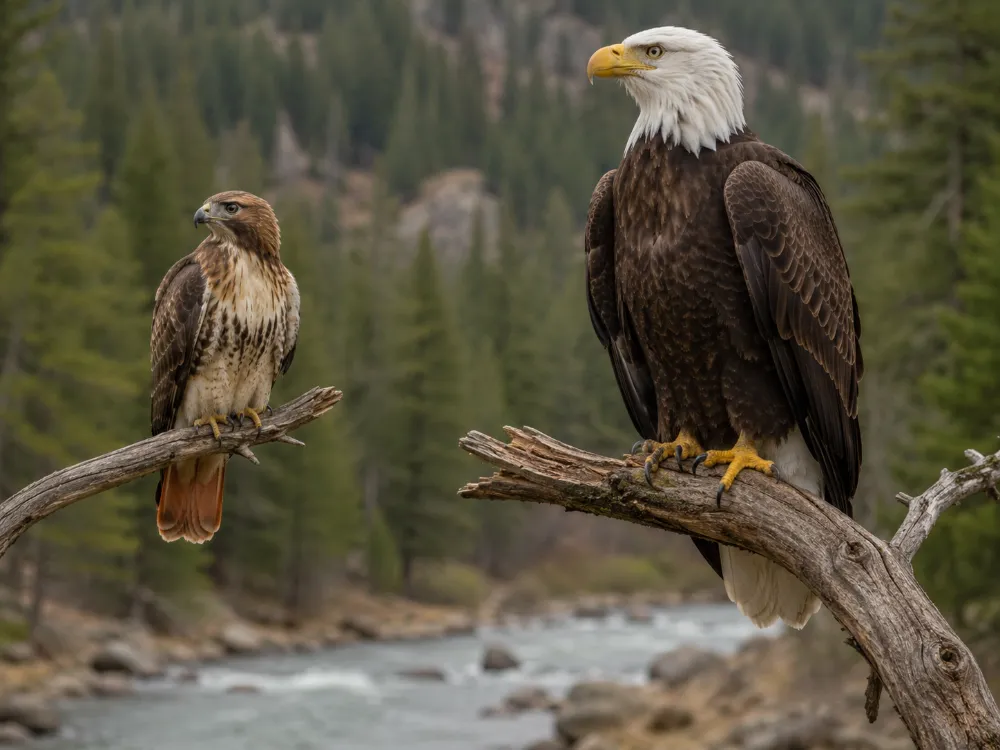
Hawks and eagles are both birds of prey, but eagles are usually larger, heavier, broader-winged, and more powerful. Hawks are generally smaller, faster, and more agile, often hunting birds, rodents, reptiles, or insects. Eagles can take larger prey, soar for long distances, and have massive beaks and talons. The easiest clue is size: a very large raptor with long broad wings is more likely an eagle.
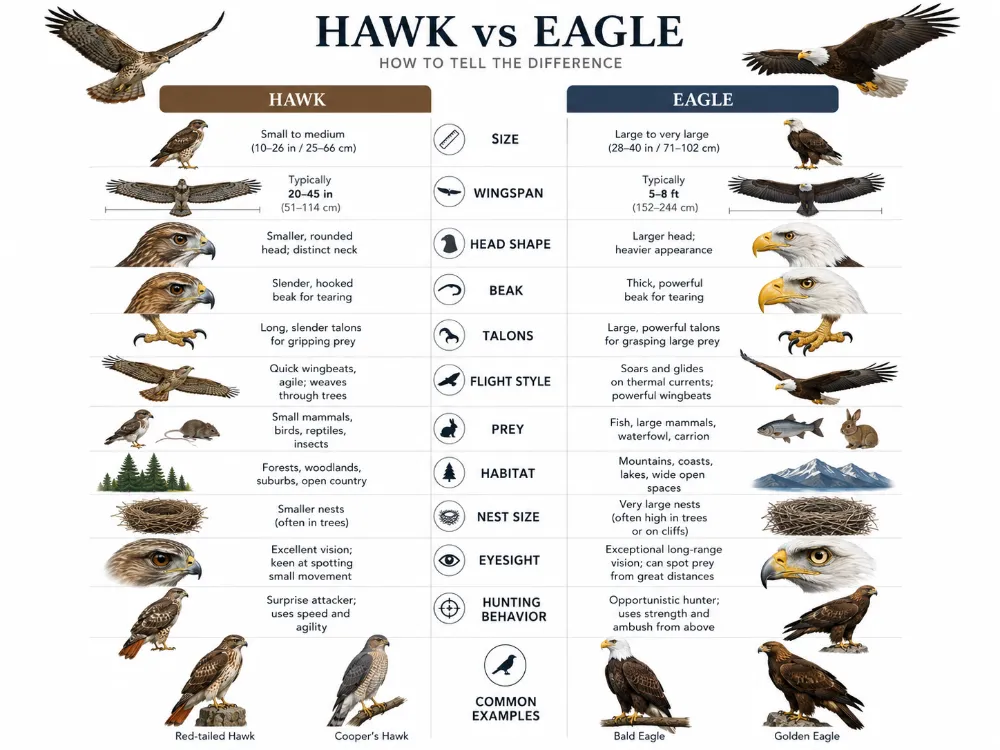
| Feature | Hawk | Eagle | Quick Identification Tip |
|---|---|---|---|
| Animal group | Bird of prey; many belong to the family Accipitridae | Bird of prey; many also belong to the family Accipitridae | Hawks and eagles are close raptor relatives. |
| Typical size | Small to medium-large | Large to very large | Eagles are usually much bigger. |
| Wings | Often shorter or more rounded in forest hawks; broad in soaring hawks | Usually long, broad, and powerful | Huge broad wings often suggest eagle. |
| Body build | Lighter, more agile | Heavier, stronger, more massive | Eagles look more powerful and deep-bodied. |
| Beak | Hooked but usually smaller | Large, deep, strongly hooked | Eagles have heavier heads and beaks. |
| Talons | Sharp, effective for smaller prey | Very large and powerful | Eagle feet look oversized and extremely strong. |
| Common prey | Rodents, birds, snakes, lizards, frogs, insects, rabbits | Fish, waterbirds, mammals, reptiles, carrion, larger prey | Eagles can handle larger prey more often. |
| Flight style | Agile flapping, soaring, woodland maneuvering, or quick pursuit depending on species | Strong soaring, gliding, powerful wingbeats, long-distance cruising | Hawks often look quicker; eagles often look heavier and steadier. |
| Habitat | Forests, fields, deserts, wetlands, cities, farmland | Mountains, coasts, lakes, rivers, forests, open country | Both are widespread, but many eagles need large hunting territories. |
| Nest | Stick nests in trees, cliffs, or structures | Very large stick nests, often reused for years | Eagle nests are usually much larger. |
| Best simple rule | Smaller, faster, more agile raptor | Larger, heavier, more powerful raptor | Size, wing shape, head size, and prey help separate them. |
Are Hawks and Eagles the Same Type of Bird?
Hawks and eagles are both raptors, meaning they are predatory birds with sharp talons, hooked beaks, strong eyesight, and hunting adaptations. Many hawks and eagles belong to the same broad family, Accipitridae, which also includes kites, harriers, Old World vultures, and many other birds of prey.
However, “hawk” and “eagle” are common names rather than perfectly strict scientific categories. In general, eagles are larger, heavier, and more powerful, while hawks are smaller, quicker, and more agile. The difference is easy in many cases, such as a small Cooper’s hawk versus a bald eagle. It can be harder with large hawks and small eagles.
The Fastest Way to Tell a Hawk From an Eagle
The fastest field clue is size. Eagles are usually much larger than hawks. If the bird looks massive, has a long wingspan, a large head, a deep hooked beak, and heavy talons, it is more likely an eagle. If it looks smaller, quicker, and more maneuverable, it is more likely a hawk.
Use these quick clues:
Very large raptor with broad wings: likely eagle.
Medium raptor circling over fields: often a hawk.
Fast bird chasing through trees: often an accipiter hawk.
Large bird near lakes or rivers carrying fish: often an eagle.
Huge stick nest used for years: more likely eagle.
Scientific Classification
Hawks and eagles are not separated by one simple scientific line. Many belong to the same family but different genera. Their common names reflect size, shape, hunting style, and tradition.
| Classification | Hawk | Eagle |
|---|---|---|
| Kingdom | Animalia | Animalia |
| Phylum | Chordata | Chordata |
| Class | Aves | Aves |
| Bird type | Raptor / bird of prey | Raptor / bird of prey |
| Common family | Many in Accipitridae | Many in Accipitridae |
| Common examples | Red-tailed hawk, Cooper’s hawk, sharp-shinned hawk, Harris’s hawk | Bald eagle, golden eagle, harpy eagle, white-tailed eagle |
Size Differences
Size is the most obvious difference. Hawks range from small forest hunters to large soaring species, but most are smaller than eagles. Eagles are among the largest raptors in the world. They have broader wings, heavier bodies, larger heads, deeper beaks, and stronger feet.
| Size Feature | Hawk | Eagle |
|---|---|---|
| Body size | Small to medium-large | Large to very large |
| Wingspan | Often moderate, depending on species | Often very long and broad |
| Weight | Usually lighter | Usually much heavier |
| Overall impression | Agile, compact, quick | Massive, powerful, commanding |
Female raptors are often larger than males, so a large female hawk can look surprisingly impressive. Even so, eagles usually appear heavier and more powerful than hawks of the same region.
Wings and Flight Style
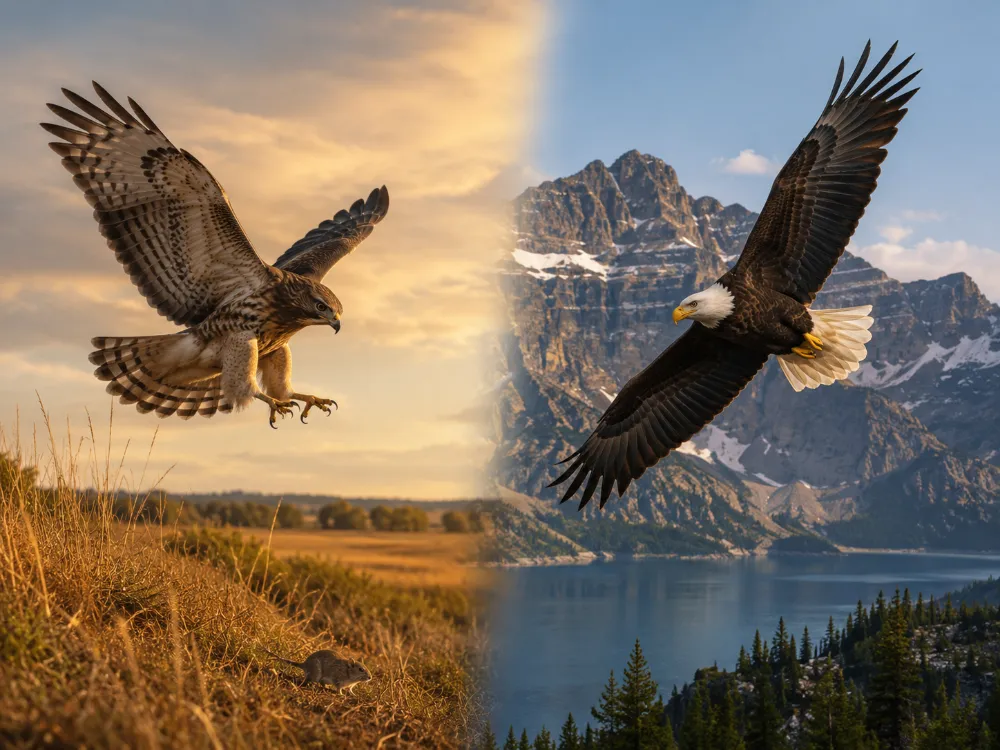
Hawks and eagles both fly well, but their flight styles often differ. Many hawks are built for agility. Accipiter hawks, such as Cooper’s hawks and sharp-shinned hawks, have relatively short rounded wings and long tails that help them twist through trees while chasing birds.
Soaring hawks, such as red-tailed hawks and ferruginous hawks, have broader wings and often circle on rising air currents. They may look eagle-like from far away, but they are usually smaller and less massive.
Eagles usually have long, broad wings built for soaring and powerful gliding. A bald eagle or golden eagle can travel long distances with slow, strong wingbeats and long glides. In the sky, an eagle often looks steadier and heavier than a hawk.
Head, Beak, and Talon Differences
Eagles usually have larger heads and deeper beaks than hawks. This gives them a more powerful profile. Their beaks are designed to tear flesh from larger prey or carrion. Their talons are also larger and stronger, allowing them to grip fish, mammals, birds, or reptiles.
Hawks also have sharp beaks and talons, but their weapons are usually scaled to smaller prey. A Cooper’s hawk has slender talons for catching birds. A red-tailed hawk has strong feet for gripping rodents and rabbits. An eagle’s feet are often much more massive.
| Body Part | Hawk | Eagle |
|---|---|---|
| Head | Usually smaller and more streamlined | Usually larger and heavier-looking |
| Beak | Hooked, sharp, but usually smaller | Large, deep, strongly hooked |
| Feet | Sharp and efficient for smaller prey | Huge, powerful, often able to grip larger animals |
| Talons | Curved and sharp | Thicker, longer, and stronger |
Diet Differences
Hawks and eagles are carnivores, but their prey differs because of size and habitat. Hawks commonly eat rodents, small birds, rabbits, snakes, lizards, frogs, insects, and other small animals. Some hawks specialize in birds, while others hunt mammals or reptiles.
Eagles often take larger prey. Bald eagles are strongly associated with fish and waterbirds, but they also scavenge carrion and steal food from other birds. Golden eagles hunt mammals such as rabbits, hares, ground squirrels, and sometimes larger prey. Large tropical eagles may hunt monkeys, sloths, or large birds.
| Food Type | Hawk | Eagle |
|---|---|---|
| Rodents | Very common | Common in many eagle species |
| Birds | Common, especially for accipiter hawks | Common for some eagles |
| Fish | Less common, except in some species | Very important for sea eagles |
| Reptiles | Common in some hawks | Common in some eagle species |
| Carrion | Sometimes | Often, especially bald eagles and some large eagles |
| Large prey | Less common | More common because of size and strength |
Hunting Style
Hawks often hunt by perching, watching, and launching a quick attack. A red-tailed hawk may sit on a pole or tree, scan for rodents, then drop suddenly. A Cooper’s hawk may fly fast through trees and shrubs to surprise small birds.
Eagles often hunt from high perches, soaring flight, or low glides. A bald eagle may watch water from a tall tree, then swoop down to grab a fish near the surface. A golden eagle may glide over open country and attack mammals with speed and power.
In simple terms:
Hawks: often quick, agile, and precise.
Eagles: often powerful, heavy, and capable of taking larger prey.
Habitat Differences
Hawks live in many habitats. Some prefer forests, some use open fields, some hunt in deserts, and others thrive around farms, roadsides, and cities. Their smaller size and flexible hunting strategies allow many hawks to live close to people.
Eagles often need larger territories and more open hunting space. Bald eagles are usually found near lakes, rivers, coasts, wetlands, and reservoirs. Golden eagles prefer open country, mountains, cliffs, grasslands, and deserts. Large eagles need enough prey and nesting space to support their size.
| Habitat | Hawks | Eagles |
|---|---|---|
| Forests | Common for many species | Used by some eagles, especially near nesting sites |
| Open fields | Very common for soaring hawks | Common for golden eagles and other open-country eagles |
| Lakes and rivers | Some hawks hunt nearby | Very important for bald eagles and other sea eagles |
| Cities and suburbs | Many hawks adapt well | Some eagles adapt, but usually need larger territories |
| Mountains and cliffs | Used by some species | Important for many eagle nests and hunting territories |
Nesting Differences
Both hawks and eagles build nests, but eagle nests are usually much larger. Many hawks build stick nests in trees, cliffs, or human structures. Their nests can be sturdy, but they are generally smaller than eagle nests.
Eagles often reuse the same nest for many years, adding new sticks each breeding season. Over time, an eagle nest can become enormous. Bald eagle nests are among the largest nests built by any bird. Golden eagles also build large nests on cliffs or in trees.
Nest clues include:
Medium stick nest in a tree: may be hawk.
Huge nest near water or on a cliff: may be eagle.
Nest reused and enlarged for years: common in eagles.
Vision and Senses
Both hawks and eagles have excellent eyesight. Their eyes are large relative to their skulls, and they can detect prey from impressive distances. This sharp vision is one of the defining features of raptors.
Eagles are often famous for long-distance vision because they soar high and search large areas. Hawks also have remarkable vision, especially species that detect small mammals moving through grass or birds moving through branches.
Both groups rely more on sight than smell. Their hunting success depends on detecting movement, judging distance, and striking with accuracy.
Strength Comparison
Eagles are generally stronger than hawks because they are larger and heavier. They have stronger feet, larger talons, and more powerful beaks. This allows many eagles to kill or carry prey that would be too large for most hawks.
Hawks are not weak. A hawk’s strength is simply scaled to its body size and prey. A Cooper’s hawk is extremely effective at catching birds. A red-tailed hawk can capture rodents, snakes, and rabbits. But compared with a bald eagle or golden eagle, most hawks are lighter predators.
If the question is raw power, eagles usually win. If the question is agility in tight spaces, many hawks have the advantage.
Speed and Agility
Hawks are often more agile than eagles, especially woodland hawks. Accipiter hawks can twist through trees, dodge branches, and chase birds in complex spaces. Their long tails help them steer quickly.
Eagles can be fast and powerful, especially in dives or long glides, but they are usually less maneuverable in dense forest. Their size helps them overpower prey, but it also makes tight turning more difficult.
Flight-style summary:
Hawks: faster turns, quick attacks, agile pursuit.
Eagles: powerful soaring, strong gliding, heavy strikes.
Hawk vs Eagle in Flight
In flight, hawks and eagles can be separated by wing shape, tail shape, head size, and overall impression. Eagles often look large-headed and broad-winged. Their wings may appear long, rectangular, and steady. Hawks often look smaller and may flap more often.
Common flight clues:
Large head projecting forward: often eagle.
Huge wings held flat or slightly raised: often eagle.
Small head and compact body: often hawk.
Long tail and short rounded wings in forest: often accipiter hawk.
Soaring in circles over fields: often buteo hawk, such as a red-tailed hawk.
Common Hawk Examples
There are many hawk species, and they do not all look the same. Some are woodland bird hunters, while others are open-country soarers.
Red-tailed hawk: Large common hawk often seen soaring over fields or perched beside roads.
Cooper’s hawk: Agile woodland and suburban bird hunter with rounded wings and long tail.
Sharp-shinned hawk: Small accipiter that hunts small birds.
Harris’s hawk: Social desert hawk known for cooperative hunting.
Ferruginous hawk: Very large open-country hawk that can look eagle-like from a distance.
Common Eagle Examples
Eagles vary widely around the world. Some are fish specialists, some hunt mammals, and some live in tropical forests.
Bald eagle: North American sea eagle with white head and tail as an adult.
Golden eagle: Large open-country eagle that hunts mammals and birds.
White-tailed eagle: Large Eurasian sea eagle closely associated with water.
Harpy eagle: Powerful tropical forest eagle that hunts monkeys, sloths, and large birds.
Steller’s sea eagle: Huge fish-eating eagle of northeastern Asia.
Hawk vs Eagle vs Falcon
Falcons are also birds of prey, but they belong to a different family from most hawks and eagles. Falcons usually have pointed wings, fast flight, and a more streamlined body. Many catch birds in midair.
| Raptor | Main Shape | Typical Hunting Style | Easy Clue |
|---|---|---|---|
| Hawk | Variable; often broad-winged or short-winged with long tail | Perch hunting, soaring, woodland pursuit | Agile and often medium-sized |
| Eagle | Large body, broad wings, heavy head and beak | Powerful hunting, soaring, scavenging, fish capture | Very large and powerful |
| Falcon | Sleek body, pointed wings, long tail | Fast aerial pursuit and dives | Pointed wings and high-speed flight |
Hawk vs Eagle vs Vulture
Vultures are often seen soaring like hawks and eagles, but they are usually scavengers with different body shapes. Many vultures have small heads, long wings, and a rocking flight style. Turkey vultures, for example, often hold their wings in a shallow V and wobble while soaring.
Eagles and hawks usually look more controlled and predatory in flight. They have stronger talons for catching prey, while vultures are more specialized for finding and eating carrion.
Are Hawks or Eagles More Dangerous?
To humans, neither hawks nor eagles are normally dangerous if left alone. They are wild predators and should not be handled, fed, or approached at nests. Eagles are more powerful and could cause more serious injury if a person tried to capture or harass one.
Risks are higher when:
People approach active nests.
People try to rescue injured raptors without training.
Small pets are left unsupervised in areas with large raptors.
Raptors become habituated to human food.
People use drones near nests or perches.
The best rule is to admire hawks and eagles from a distance.
Can Hawks and Eagles Carry Off Pets?
Large raptors can occasionally attack small animals, but stories are often exaggerated. Most hawks are too small to carry a medium or large pet. They may be capable of attacking very small animals, especially if the animal resembles natural prey.
Eagles are stronger than hawks and can take larger prey, but even eagles have limits. A bald eagle may catch fish, waterbirds, carrion, or small mammals. A golden eagle can hunt larger mammals than most hawks. Still, large dogs and cats are not normal prey.
Pet safety tips include:
Supervise small pets outdoors.
Use covered runs for small animals such as rabbits or chickens.
Do not leave pet food outside.
Keep young poultry protected from aerial predators.
Do not feed wild raptors.
Ecological Role
Hawks and eagles are important predators. They help regulate populations of rodents, birds, reptiles, fish, and other animals. They also remove carrion, especially in the case of some eagles.
As top or mid-level predators, they are indicators of ecosystem health. A landscape that supports hawks and eagles often has healthy prey populations, nesting sites, and open hunting areas.
Ecological benefits include:
Rodent control
Removal of weak or sick prey animals
Scavenging carrion
Balancing food webs
Supporting biodiversity through predator-prey dynamics
Conservation Differences
Hawk and eagle conservation status varies by species and region. Some hawks are common and adaptable. Others are declining because of habitat loss, poisoning, collisions, or reduced prey. Some eagles have recovered after strong protection, while others remain threatened.
Major threats include:
Habitat loss
Lead poisoning from contaminated carcasses
Pesticides and rodenticides
Power line collisions and electrocution
Vehicle strikes
Illegal shooting
Nest disturbance
Climate-related habitat changes
Protecting hawks and eagles requires safe nesting sites, healthy prey, reduced poisoning, and public respect for raptor habitats.
How to Identify a Hawk or Eagle in Your Area
To identify a raptor, do not rely on one feature. Look at size, shape, flight style, habitat, behavior, and markings. A distant bird can be difficult to identify, especially if lighting is poor.
Ask these questions:
How large is the bird compared with crows, geese, or vultures?
Are the wings broad, rounded, pointed, or long and rectangular?
Is the tail long, short, fan-shaped, or wedge-shaped?
Does the head look small or massive?
Is it soaring, flapping quickly, diving, or weaving through trees?
Is it near water, open fields, cliffs, forests, or suburbs?
What prey or behavior do you see?
A very large raptor near water with broad wings may be an eagle. A medium raptor circling over fields may be a hawk. A fast, pointed-winged raptor may be a falcon.
Common Myths About Hawks and Eagles
Myth: Eagles and hawks are completely unrelated.
Fact: Many hawks and eagles belong to the same broad raptor family.Myth: Eagles are just large hawks.
Fact: Eagles are usually larger and more powerful, but common names also reflect different lineages and traditions.Myth: Hawks cannot take birds.
Fact: Some hawks, especially accipiters, specialize in hunting birds.Myth: Eagles only eat fish.
Fact: Some eagles eat fish, but many also eat mammals, birds, reptiles, and carrion.Myth: A raptor circling high overhead is always an eagle.
Fact: Many hawks and vultures also soar in circles.Myth: Raptors are bad for nature because they kill animals.
Fact: Predators are essential parts of healthy ecosystems.
Final Takeaway
Hawks and eagles are both powerful birds of prey, but they are built for different levels of size and strength. Hawks are usually smaller, faster, and more agile. Eagles are usually larger, heavier, broader-winged, and more powerful, with stronger beaks and talons.
The easiest way to tell them apart is to look at size, wing shape, head size, flight style, and prey. A medium raptor hunting rodents or birds is often a hawk. A huge raptor soaring over water, mountains, or open country with massive wings and a heavy head is more likely an eagle.
Both hawks and eagles are vital predators. They control prey populations, clean up carrion, and reveal the health of the landscapes they inhabit.
FAQs About Hawk vs Eagle
What is the main difference between a hawk and an eagle?
The main difference is size and power. Eagles are usually larger, heavier, broader-winged, and stronger than hawks. Hawks are generally smaller, quicker, and more agile.
Are hawks and eagles related?
Yes. Many hawks and eagles belong to the same broad raptor family, Accipitridae. They are both birds of prey with hooked beaks, sharp talons, and excellent eyesight.
Is an eagle a type of hawk?
In everyday language, no. Eagles and hawks are treated as different raptor groups. Scientifically, many are related within the same family, but “eagle” usually refers to larger, more powerful species.
Which is bigger, a hawk or an eagle?
Eagles are usually bigger. A bald eagle or golden eagle is much larger than most hawks, with a broader wingspan, heavier body, and larger talons.
Which is stronger, a hawk or an eagle?
Eagles are generally stronger because they are larger and have more powerful feet, beaks, and bodies. Hawks are still strong for their size but usually take smaller prey.
Which has better eyesight, hawk or eagle?
Both have excellent eyesight. Eagles are famous for seeing prey from long distances, but hawks also have very sharp vision suited to detecting small prey.
Do hawks and eagles eat the same food?
They overlap in some foods, such as rodents, birds, reptiles, and carrion. Eagles more often take larger prey or fish, while hawks often hunt smaller animals.
Can a hawk beat an eagle?
Usually no. Eagles are much larger and stronger. However, hawks may harass eagles near nests or territories, especially in flight, where agility can help them avoid direct contact.
Do eagles eat hawks?
It is possible for large eagles to kill smaller raptors, including hawks, but hawks are not usually their main prey. Most eagles focus on fish, mammals, birds, carrion, or other available food.
How can you tell a hawk from an eagle in flight?
Eagles usually look larger, broader-winged, heavier-headed, and steadier in flight. Hawks often look smaller, quicker, and may have more compact bodies or longer tails depending on species.
Is a bald eagle a hawk?
No. A bald eagle is an eagle, specifically a sea eagle. It is related to hawks through the broader raptor family but is not called a hawk.
Is a red-tailed hawk an eagle?
No. A red-tailed hawk is a hawk. It is large for a hawk and often soars like an eagle, but it is much smaller than most eagles.
Which bird is faster, a hawk or an eagle?
It depends on the species and flight type. Many hawks are more agile in quick pursuit, while eagles are powerful soarers and can be fast in glides or dives. Falcons are usually the fastest raptors overall.
Are hawks or eagles dangerous to humans?
They are not usually dangerous to people if left alone. However, they are wild birds with sharp talons and should never be handled or approached at nests.
Why are eagles considered symbols of power?
Eagles are large, strong, high-soaring predators with impressive wings and commanding appearance. Many cultures associate them with strength, freedom, vision, courage, and authority.