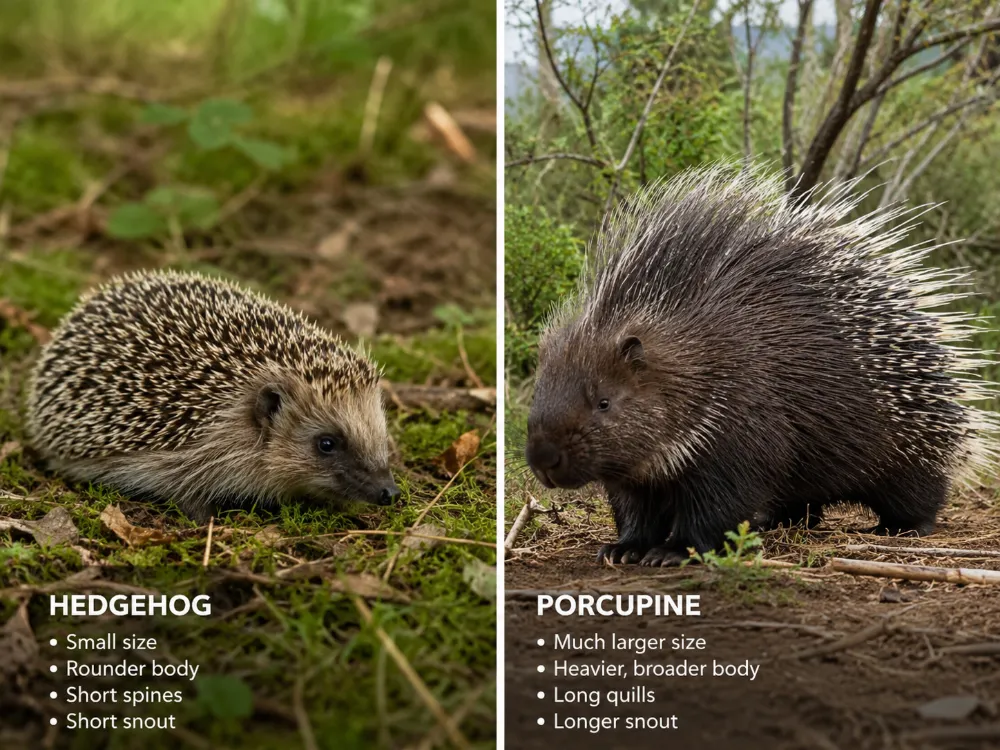
The short answer is that a hedgehog and a porcupine are not the same animal. Hedgehogs are small insect-eating mammals with short spines and a rounded body, while porcupines are much larger rodents with longer quills and a very different body shape. They are not close relatives, they live in different parts of the world, and they defend themselves in different ways. The similar spiky look is a case of similar adaptation, not close family relationship.
People often confuse hedgehogs and porcupines because both are famous for having sharp protective spines. At a quick glance, that seems like enough to make them close cousins. In reality, they belong to very different mammal groups and live very different lives.
In this guide, you will learn how hedgehogs and porcupines differ in size, anatomy, quills, habitat, diet, behavior, and evolution, plus the fastest ways to tell them apart correctly.
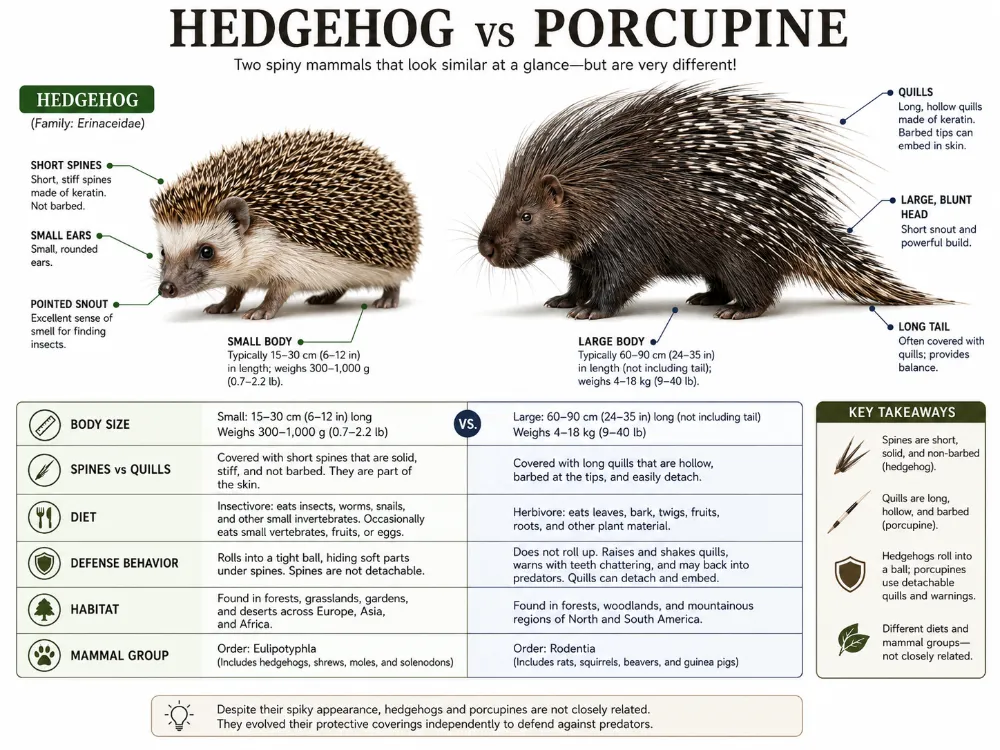
Quick comparison table
| Feature | Hedgehog | Porcupine |
|---|---|---|
| Main mammal group | Insectivore-like small mammal in the family Erinaceidae | Rodent |
| Overall size | Small and compact | Much larger and heavier |
| Spines | Shorter, finer spines covering the back | Longer, stronger quills mixed with hair depending on species |
| Defense style | Curls into a tight ball | Raises quills, turns back end, and warns or strikes backward |
| Diet | Mainly insects and other small invertebrates | Mainly plant material, bark, leaves, roots, and other vegetation |
| Body shape | Round, low, small-faced, short-legged | Larger, longer-bodied, rodent-like, often with a stronger tail |
| Range | Europe, Asia, and Africa | Africa, Europe, Asia, and the Americas depending on species group |
| Best quick clue | Small animal that rolls into a ball | Larger rodent with long quills |
They are not close relatives
This is the most important point in the whole comparison. Hedgehogs and porcupines are not close relatives. They did not inherit their spines from a recent common spiny ancestor. Instead, they evolved defensive spines separately.
That means their spiky look is an example of similar adaptation rather than close kinship. Nature sometimes produces similar solutions in very different animals when they face similar problems. In this case, the shared problem is defense against predators.
So although both animals are covered in sharp structures, a hedgehog is not a small porcupine, and a porcupine is not a giant hedgehog.
Porcupines are much bigger
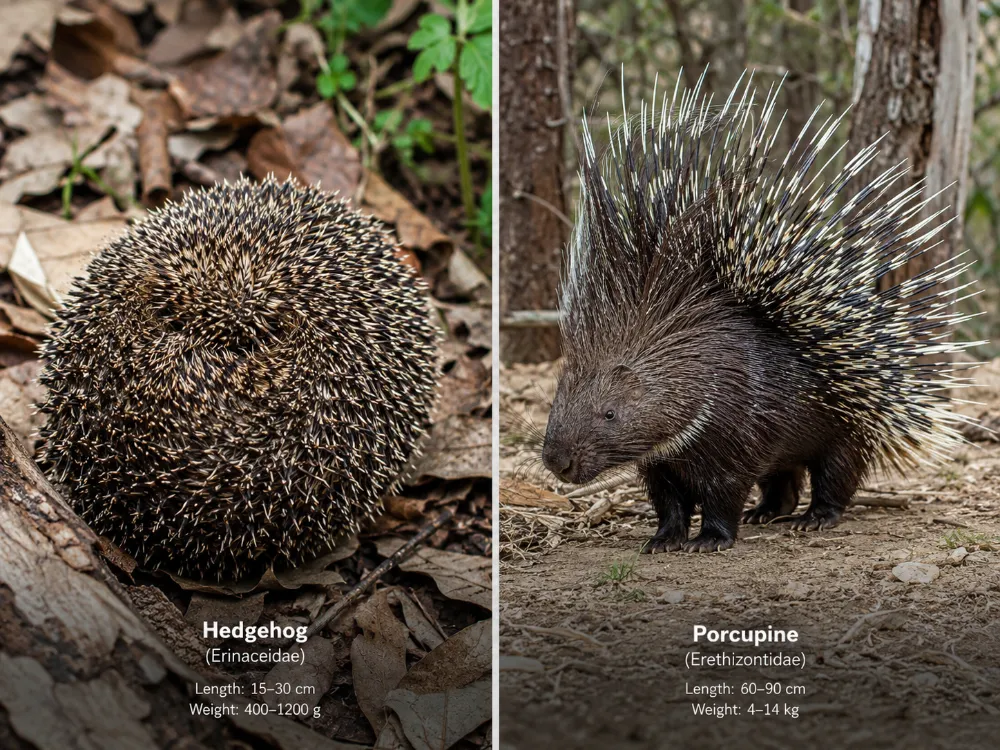
One of the easiest differences is size. Hedgehogs are small mammals. They often fit comfortably in two hands and usually give a compact, rounded impression. Even a large hedgehog still looks like a small ground animal.
Porcupines are much larger and heavier. Many species look bulky, thick-bodied, and powerful compared with a hedgehog. A porcupine can resemble a heavily armored rodent, while a hedgehog looks like a small, round insect hunter.
If the animal is large enough to look like a serious mid-sized mammal rather than a small garden creature, porcupine becomes much more likely.
Hedgehogs are not rodents, but porcupines are
Porcupines are rodents. That means they belong to the same broad mammal order as rats, mice, squirrels, beavers, and guinea pigs. Their teeth, skull structure, and feeding style reflect that rodent identity.
Hedgehogs are not rodents. They belong to their own family group and are more closely associated with small insect-eating mammal lineages than with gnawing plant-eaters. Their body and mouth are designed for a very different type of life.
This difference matters because it explains why a porcupine often has the look of a heavy gnawing mammal, while a hedgehog looks like a tiny nocturnal forager.
The spines are not exactly the same
People often use the words spines and quills loosely, but the structures do not look or function exactly the same in hedgehogs and porcupines. Hedgehog spines are shorter and usually form a dense protective covering across the back and sides.
Porcupine quills are usually longer, stronger, and more dramatic. In many species they are mixed with hair, and they may stand out in a more striking way when the animal becomes alarmed. Some are short and thick, others longer and more flexible depending on the species.
So while both are sharp defenses, the porcupine usually looks much more heavily armed in a large, visible way.
Hedgehogs defend themselves by rolling into a ball
The hedgehog’s most famous defense is curling into a tight ball. When threatened, it contracts powerful muscles that pull the skin and spines around the body. This hides the softer face, belly, and legs and exposes a nearly complete ball of spines.
This is one of the most remarkable mammal defenses in the world. A predator facing a curled hedgehog has very little safe place to grab.
Porcupines do not defend themselves this way. Their strategy is different and depends more on quill presentation, body posture, and warning behavior.
Porcupines do not roll up like hedgehogs
A porcupine usually stays extended rather than forming a ball. When threatened, it may raise its quills, chatter teeth, stamp, turn its back toward the threat, or lash with the tail in some species. The goal is to present the most dangerous part of the body to the attacker.
This creates a very different defensive style from that of the hedgehog. The porcupine is more like a walking fortress that warns and punishes contact. The hedgehog is more like a tiny armored ball that tries to become untouchable.
If the spiny mammal can curl completely into a ball, it is a hedgehog, not a porcupine.
Porcupines do not shoot their quills
This is one of the most common myths. Porcupines do not shoot quills through the air. The quills come loose when another animal makes contact with them. In some species, especially New World porcupines, the quills are very effective at embedding in skin after contact, which may make it seem as though they were launched.
Hedgehogs also do not shoot spines. Their defense is passive in a different way: predators get hurt when they bite or press against the curled animal.
So the popular image of a porcupine firing quills is dramatic but inaccurate.
Hedgehogs eat insects, porcupines eat plants
Their diets are very different. Hedgehogs mainly eat insects and other small invertebrates. Beetles, worms, caterpillars, slugs, and similar prey often make up much of their food. They may also take other small items depending on the species and environment.
Porcupines are mainly plant-eaters. They feed on bark, leaves, stems, roots, fruit, and other vegetation. Some species are especially well known for gnawing woody plant material.
This means the two animals play very different ecological roles. One is a small insect hunter. The other is a larger browsing rodent.
The face and teeth look different
Hedgehogs usually have a small pointed face with a narrow snout that suits sniffing and probing for insects. Their expression often looks delicate and curious, even though the back is fully armed with spines.
Porcupines usually have a blunter rodent face with stronger gnawing teeth and a more solid muzzle. Their head often looks broader and heavier than that of a hedgehog.
If the animal has a clear rodent look with a bigger gnawing mouth, porcupine becomes more likely. If it has a tiny pointed insect-hunting snout, hedgehog becomes more likely.
Porcupines often have a stronger tail
Many porcupines have a more noticeable and functionally important tail than hedgehogs do. In some species, the tail helps with climbing, balance, or defense. New World porcupines in particular may have tail adaptations suited to an arboreal lifestyle.
Hedgehogs have only a very small tail, often barely noticeable. Their defense depends much more on body shape and rolling behavior than on tail use.
If the animal has a significant tail that clearly matters to the body plan, porcupine is much more likely.
Hedgehogs are usually ground-foraging night animals
Hedgehogs are often nocturnal ground foragers. They move through grass, leaf litter, hedges, and garden edges using smell and hearing to locate food. Their daily life is usually hidden, quiet, and low to the ground.
Many porcupines are also nocturnal, but their size and movement style are different. Depending on the species, they may climb, browse, or move more slowly and visibly through vegetation while feeding on plant material.
So although both may be active at night, the way they use the landscape is not the same.
Porcupines are often more obviously powerful
A porcupine often gives the impression of weight and strength. Its body is larger, its head heavier, and its quills more visually dramatic. Even without moving quickly, it may look formidable.
A hedgehog usually feels more fragile in overall size, even though its defensive design is excellent. Its protection comes from shape and coverage rather than sheer mass and intimidating scale.
This difference helps explain why people often underestimate how unrelated the two animals really are. The porcupine looks like a large armored rodent. The hedgehog looks like a tiny spiny insectivore.
They live in different parts of the world
Geography also helps. Hedgehogs are naturally found in Europe, Asia, and Africa. They do not naturally belong to the wild mammal fauna of the Americas.
Porcupines have a broader global story because there are Old World porcupines in Africa and parts of Eurasia and New World porcupines in the Americas. That means porcupines occur across more than one major regional group.
So a small spiny mammal in Britain is far more likely to be a hedgehog. A large quilled mammal in North America is a porcupine, not a hedgehog.
Hedgehog babies and porcupine babies are very different in appearance
Young hedgehogs, sometimes called hoglets, are born with soft developing spines that become more protective as they grow. Because the adults are so small, the whole early life stage feels miniature and delicate.
Young porcupines are born as much larger babies, and in many species the quills are soft at birth and then harden later. This is another reminder that the animals may share a spiny theme, but they are built on very different scales from the start.
The difference in baby size reflects the very different adult bodies and life strategies.
Both use warning and caution, but differently
Hedgehogs often try to avoid trouble first, then curl up when danger becomes unavoidable. Their defense is compact and passive. They let the predator make the mistake of trying to bite a ball of spines.
Porcupines often make their danger more visible. Raised quills, stiff posture, and turning the back toward a threat all send a clearer message. The animal does not need to become a ball because its body is already a strong outward defense system.
So both are defensive specialists, but the style of warning is not the same.
Why they look similar even though they are unrelated
The answer is convergent evolution. When unrelated animals face similar predator problems, similar body solutions can evolve. Sharp body coverings are a strong defense when speed, size, or aggression are not the main strategy.
That is why hedgehogs and porcupines ended up with spiny coats even though they belong to very different mammal groups. The shared appearance is real, but the shared ancestry is not close.
This makes them a classic example of how evolution can repeat useful ideas in different lineages.
Why people confuse them so often
People confuse hedgehogs and porcupines because the spines are visually unforgettable. Once the eye notices “smallish mammal with sharp back,” the mind tends to group them together before checking size, face shape, and body plan.
Cartoons, toys, and simplified illustrations often make the confusion worse by drawing both animals as generic spiky creatures. Real anatomy tells a much clearer story.
Once you focus on size, defense style, and whether the animal looks like a tiny insect-eater or a large rodent, the distinction becomes much easier.
How to tell them apart quickly
If you need a fast identification guide, use these clues together:
Hedgehog: small body, short spines, pointed face, insect-eating lifestyle, curls into a tight ball
Porcupine: much larger body, longer quills, rodent face, plant-eating lifestyle, raises quills and presents back end in defense
No single clue is better than the combination of size and defense behavior. A spiny animal that rolls into a ball is a hedgehog. A large quilled rodent is a porcupine.
Which one is more dangerous?
For people, neither animal is normally aggressive, but the porcupine is usually more likely to cause serious injury simply because it is larger and carries longer, stronger quills. A dog or predator that attacks a porcupine can be badly injured.
Hedgehogs can also cause painful contact with their spines, but they are much smaller and usually less physically imposing. Their defense is excellent, but it works on a smaller scale.
So if the question is which animal can more seriously punish a bad decision by a predator, the porcupine usually has the advantage.
Final takeaway
The main difference between a hedgehog and a porcupine is that a hedgehog is a small insect-eating mammal that curls into a ball and carries short protective spines, while a porcupine is a much larger rodent with longer quills and a plant-based diet. They are not close relatives, even though both evolved sharp defenses. In simple terms, a hedgehog is a tiny spiny insect hunter, and a porcupine is a large quilled rodent.
FAQs
Is a hedgehog a porcupine?
No. Hedgehogs and porcupines are different mammals from different groups.
How can I tell a hedgehog from a porcupine fast?
Look at size and behavior. Hedgehogs are small and curl into a ball, while porcupines are much larger and defend themselves with raised quills.
Do porcupines shoot their quills?
No. Porcupines do not shoot quills. The quills come loose when another animal touches them.
Which is bigger, a hedgehog or a porcupine?
A porcupine is much bigger than a hedgehog.