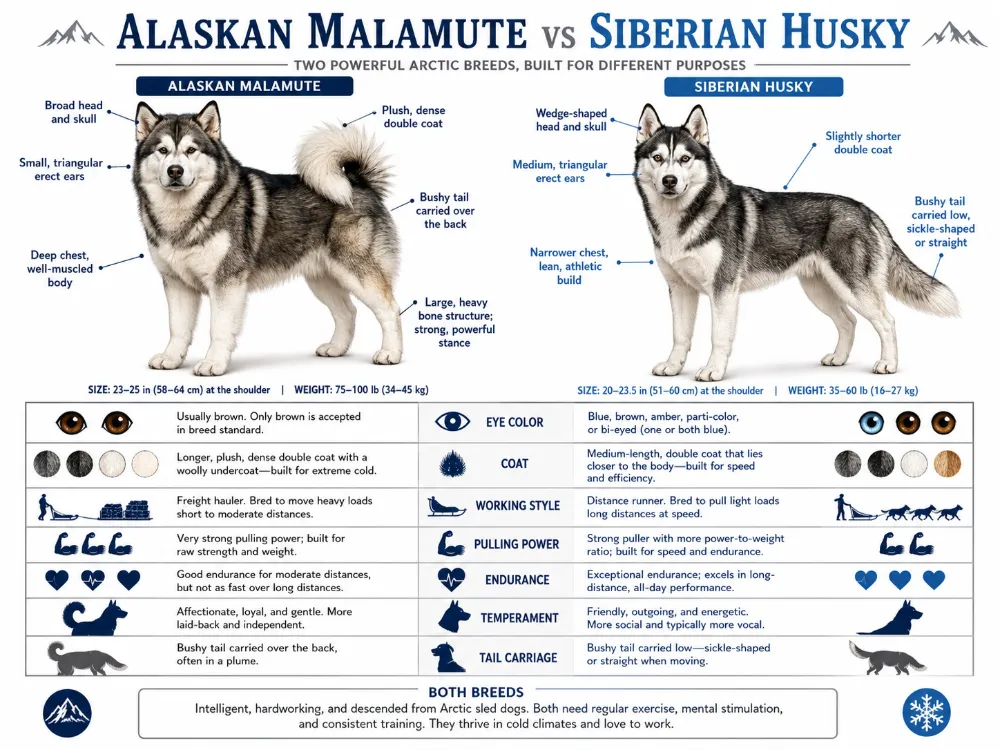
The easiest way to tell a Malamute from a Husky is to look at size, build, and overall expression. Alaskan Malamutes are usually bigger, heavier-boned, and more powerful, built for strength and heavy pulling. Siberian Huskies are usually lighter, faster, and more athletic-looking, built for endurance and speed over distance. Both are northern sled dogs with thick coats and wolf-like looks, but they are not the same breed and they often feel very different in daily life.
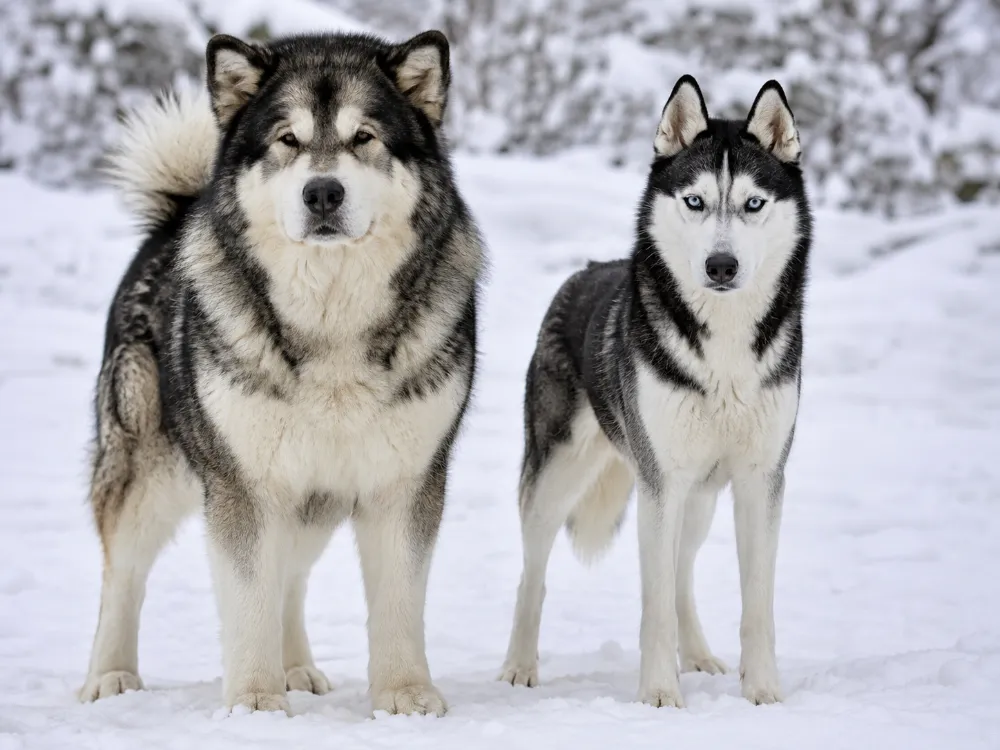
People confuse Malamutes and Huskies all the time because both are spitz-type northern dogs with upright ears, thick double coats, bushy tails, and a strong sled-dog image. At a quick glance, especially in photos, they can look like close variations of one breed.
In reality, the differences are important. These dogs were shaped for somewhat different jobs, and that affects their size, movement, personality, and handling needs.
In this guide, you will learn how Malamutes and Huskies differ in appearance, temperament, energy level, work style, and family fit, plus the fastest ways to tell them apart.
Quick comparison table
| Feature | Alaskan Malamute | Siberian Husky |
|---|---|---|
| Overall size | Larger and heavier | Smaller and lighter |
| Build | Broad, strong, heavy-boned | Lean, athletic, lighter-framed |
| Main traditional role | Heavy pulling and freight work | Fast endurance sled work |
| Head shape | Broader head and muzzle | Finer, more fox-like or wolf-like head |
| Eyes | Usually brown | Often brown, blue, or mixed |
| Tail | Often carried like a waving plume over the back | Usually brushy and carried in a softer sickle curve |
| Energy style | Strong, steady, powerful | Fast, active, high-endurance |
| Best quick clue | Bigger, bulkier, bear-like power | Lighter, quicker, more agile sled-dog look |
They are different breeds, not large and small versions of one dog
The Alaskan Malamute and the Siberian Husky are separate breeds with different breeding histories. They are both northern working dogs, but they were developed by different peoples in different regions and selected for somewhat different jobs.
The Malamute is strongly associated with strength and hauling power. The Husky is strongly associated with traveling efficiently over long distances at a quicker pace. Because those jobs are not identical, the dogs do not look or behave exactly the same.
So even though both are thick-coated sled dogs, a Malamute is not just a large Husky, and a Husky is not just a lighter Malamute.
Malamutes are usually much larger
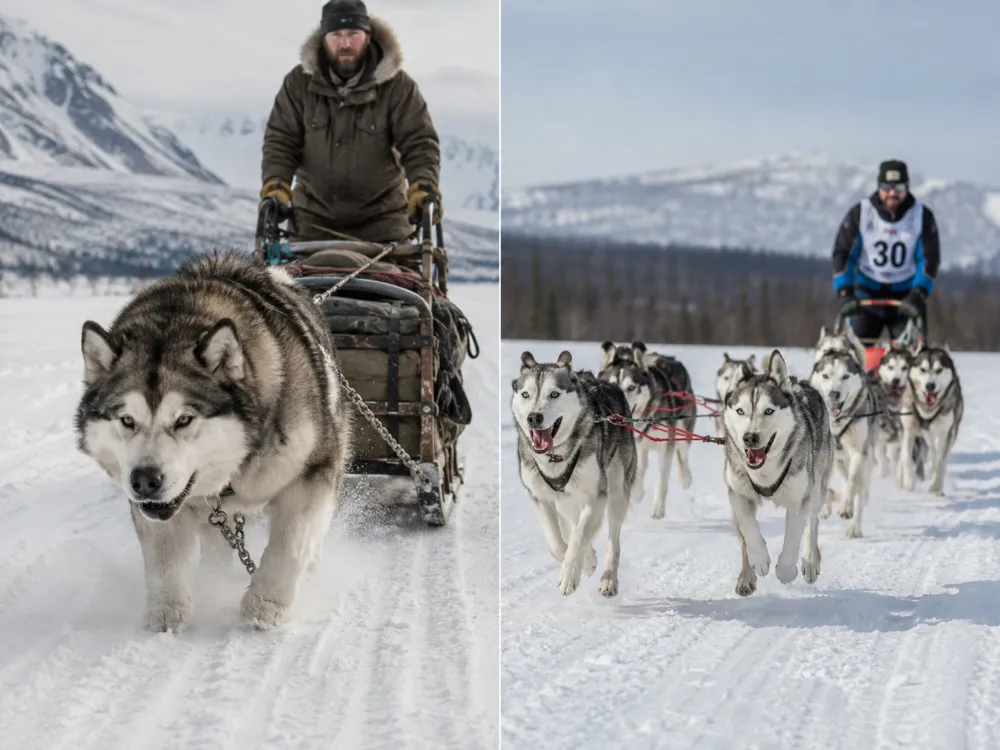
One of the clearest differences is size. Alaskan Malamutes are usually noticeably larger and heavier than Siberian Huskies. They often look broader in the chest, thicker through the neck and shoulders, and more substantial in bone and body mass.
Siberian Huskies are usually more moderate in size. They still look athletic and strong, but they usually do not carry the same bulk or heavy draft-dog impression that a Malamute does.
If the dog looks especially large, thick, and powerful, Malamute becomes more likely. If it looks leaner and more compact, Husky becomes more likely.
Malamutes are built for strength, Huskies for endurance and speed
This is one of the most important real-world differences. Malamutes were shaped more for pulling heavier loads with steady power. Their build reflects that purpose: strong frame, powerful chest, substantial bone, and a serious pulling body.
Huskies were shaped more for covering long distances efficiently with lighter loads and greater speed. Their frame is usually lighter, quicker, and more economical in movement. They often look like distance runners compared with the more draft-oriented Malamute.
So the difference is not just size. It is also the kind of work the body is built to do.
The head shape is different
Malamutes usually have a broader, heavier head with a fuller muzzle and a more substantial overall expression. Their face often looks strong, serious, and powerful.
Huskies usually have a finer, cleaner head shape. The muzzle often looks narrower and the overall expression may seem quicker, sharper, or lighter. Some people describe the Husky face as more fox-like or more refined compared with the heavier Malamute head.
When two dogs are standing side by side, the difference in head mass is often surprisingly obvious.
Eye color is a famous clue
Eye color is one of the best quick clues for beginners. Siberian Huskies are famous for having blue eyes, brown eyes, or one of each. Blue eyes are strongly associated with the Husky image.
Alaskan Malamutes, by contrast, are normally associated with brown eyes. A true Malamute does not have the same classic blue-eyed reputation as a Husky.
This means a blue-eyed northern sled dog is much more likely to be a Husky than a Malamute, though eye color alone should not replace looking at the whole body.
Malamutes often look bulkier and more plush
Both breeds have thick double coats, but Malamutes often look heavier and more plush overall because of their larger body and dense outer appearance. They may give a more bear-like visual impression, especially in full coat.
Huskies are also thick-coated, but they often look cleaner-lined and more athletic through the coat. Their outline usually stays more obviously that of a lighter running dog.
If the dog looks like a heavy snow freighter with a huge fluffy frame, Malamute becomes more likely. If it looks like a streamlined winter athlete, Husky becomes more likely.
The tail carriage often looks different
Malamutes often carry the tail in a prominent plume over the back. The tail can look full, waving, and decorative while still fitting the breed’s heavy northern style.
Huskies also have a bushy tail, but it often looks a bit lighter and more softly curved. The overall effect is usually less massive than the Malamute’s tail carriage.
This is not the first clue most people use, but it helps support the broader impression of heavy Malamute versus lighter Husky.
Huskies often look quicker and more agile
In motion, Siberian Huskies often look very efficient and light on their feet. They are famous for fluid movement, endurance, and a kind of effortless traveling energy. Even when standing still, they often seem ready to move.
Malamutes can also move beautifully, but they usually project more weight and more force. Their motion often feels more grounded and powerful than fast and airy.
If the dog looks like it was built to run far and fast, Husky is often the stronger guess. If it looks built to pull hard and steadily, Malamute is often the better answer.
Temperament is not exactly the same
Both breeds are intelligent, independent, and often stubborn compared with more eager-to-please working dogs such as herding breeds. However, their style of personality often feels different.
Malamutes are often described as dignified, strong-willed, and steady. They may feel more serious, more self-possessed, and sometimes more dominant or physically imposing in social situations.
Huskies are often described as lively, mischievous, outgoing, and energetic. Many have a playful, busy, almost comedic personality that makes them feel more chaotic than the average Malamute.
These are broad tendencies rather than strict rules, but many owners notice the difference quickly.
Huskies often have higher visible activity levels
Both breeds need real exercise and mental stimulation. Neither is a low-effort dog. Even so, Siberian Huskies often show more obvious day-to-day restlessness, movement, and desire to run. They may seem constantly ready for action.
Malamutes also need exercise, but their energy can feel heavier and less frantic. They often seem more like strong pullers than nonstop speed machines. A Malamute may be stubborn and demanding, but not always as visibly hyperactive as a typical Husky.
This makes Huskies especially famous for escape behavior, pacing, and turning boredom into trouble.
Neither breed is easy off-leash
Both Malamutes and Huskies often have strong independence and prey drive. That means reliable off-leash behavior can be difficult compared with more handler-focused breeds. Many individuals will run, explore, and ignore recall if the environment becomes more interesting than the person.
Huskies are especially famous for escaping yards, testing fences, and taking off at speed. Malamutes can also be escape artists, but the Husky’s combination of agility, stamina, and mischief makes this trait especially legendary.
So for most owners, both breeds require very secure containment and realistic expectations.
Huskies are often more vocal in a dramatic way
Both breeds can vocalize, but Siberian Huskies are especially famous for talking, howling, whining, and making expressive sounds that feel almost theatrical. Many Husky owners know the breed as noisy, expressive, and opinionated.
Malamutes can also be vocal and may “woo” or howl, but they are often less famous than Huskies for constant comedic commentary. The Husky tends to have the stronger reputation for dramatic vocal personality.
If the dog seems to argue with the entire world, many people will suspect Husky first.
Malamutes often have stronger same-sex dog challenges
This is a general tendency, not a rule for every individual, but Malamutes are often described as more likely to show serious same-sex dog tension or dominance-related issues, especially if poorly managed or poorly socialized. Their size and strength can make those issues more serious when they appear.
Huskies can also have conflicts, of course, but Malamutes often carry the stronger reputation for power-based dog-to-dog intensity.
This means social management matters for both breeds, but especially for the larger and more physically forceful Malamute.
Huskies are often friendlier with strangers
Siberian Huskies are often very social and open with people, including strangers. Many are poor guard dogs because they are too interested in greeting people rather than distrusting them.
Malamutes can also be affectionate and not especially suspicious compared with true guardian breeds, but they often feel a little more serious and imposing. Their size alone can make them look more protective even when their personality is friendly.
So neither breed should be assumed to be a classic guard dog, but the Husky often looks even less interested in that job.
Working style separates them clearly
If you reduce the entire comparison to one core idea, it is this: the Malamute is the heavier freight puller, and the Husky is the lighter endurance traveler. That difference shapes the body, movement, and often the whole emotional feel of the dog.
Malamutes often impress with strength. Huskies often impress with motion. Malamutes feel powerful and substantial. Huskies feel quick and tireless.
This is why experienced dog people often identify them immediately even before studying details like eyes or coat pattern.
Color and markings can confuse beginners
Both breeds can come in striking northern-dog colors and masks, which is one reason people mix them up. A gray-and-white Malamute and a gray-and-white Husky can look similar to an inexperienced eye if the photo hides scale.
That is why color is not the best clue. Size, bone, head shape, eye color, and movement style matter much more. A large heavy dog with a Husky-like mask may still be a Malamute because the body tells the real story.
So do not let face pattern fool you into ignoring structure.
Which breed is easier for the average owner?
Neither breed is especially easy for an unprepared owner. Both shed heavily, both need exercise, both can be stubborn, and both may ignore commands if they see no reason to cooperate. However, many people find the Husky more mentally chaotic and escape-prone, while the Malamute can be harder physically because of its size and strength.
The better answer is that each breed is challenging in a different way. The Husky often overwhelms with speed, noise, and mischief. The Malamute often overwhelms with power, independence, and stubborn force.
So the easier breed depends on what kind of difficulty an owner handles better.
Which one is better for families?
Both breeds can be affectionate family dogs in the right home, but both need management, exercise, and realistic expectations. Huskies often bring a more playful, social energy that some families enjoy, but they can also be noisy, destructive, and hard to contain.
Malamutes often bring a calmer but stronger presence. They can be loving and loyal, but their size and power demand more physical control and good supervision.
For most homes, the right answer depends less on “better breed” and more on whether the family can truly manage a powerful working northern dog every day.
Why people confuse them so often
People confuse Malamutes and Huskies because both fit the popular image of a wolf-like sled dog: upright ears, thick coat, curled tail, icy-weather look, and striking face markings. Photos without scale make the confusion even worse.
The breeds also overlap in color patterns, so beginners often focus too much on mask shape or eye-catching coat color and not enough on body structure. Once you learn to compare mass, head shape, and movement style, the difference becomes much easier to spot.
The biggest mistake is to focus on color and ignore the build.
How to tell them apart quickly
If you need a fast identification guide, use these clues together:
Alaskan Malamute: larger size, heavier bone, broader head, brown eyes, thick powerful frame, freight-puller look
Siberian Husky: lighter size, finer frame, often blue or mixed eyes, quicker movement, more agile endurance-runner look
No single clue is perfect in every dog, but this combination is usually very reliable.
Final takeaway
The main difference between a Malamute and a Husky is that the Alaskan Malamute is usually larger, heavier, and built for powerful pulling, while the Siberian Husky is usually lighter, faster, and built for endurance and speed. Malamutes often feel stronger, steadier, and more physically imposing. Huskies often feel quicker, more energetic, more vocal, and more restless. They may look similar at first glance, but once you compare size, eyes, head shape, and movement, they are much easier to tell apart.
FAQs
Is a Malamute bigger than a Husky?
Yes. Alaskan Malamutes are usually larger and heavier than Siberian Huskies.
How can I tell a Malamute from a Husky fast?
Look at size, bone, and eyes. Malamutes are usually bulkier and brown-eyed, while Huskies are lighter and often have blue or mixed eyes.
Which breed is more energetic, Malamute or Husky?
Both are active, but Huskies often show higher visible speed, restlessness, and day-to-day running energy.
Are Malamutes and Huskies good family dogs?
They can be, but both need experienced handling, strong exercise routines, secure containment, and realistic expectations.