Water bugs and roaches are often confused, but they are not the same insect. A true water bug is an aquatic insect that lives in ponds, lakes, wetlands, pools, or slow-moving water. A roach is a cockroach, usually a land-dwelling scavenger that may live outdoors or infest homes. The easiest difference is habitat: true water bugs live in or near water, while roaches usually live on land.
Water Bugs vs Roaches Quick Answer
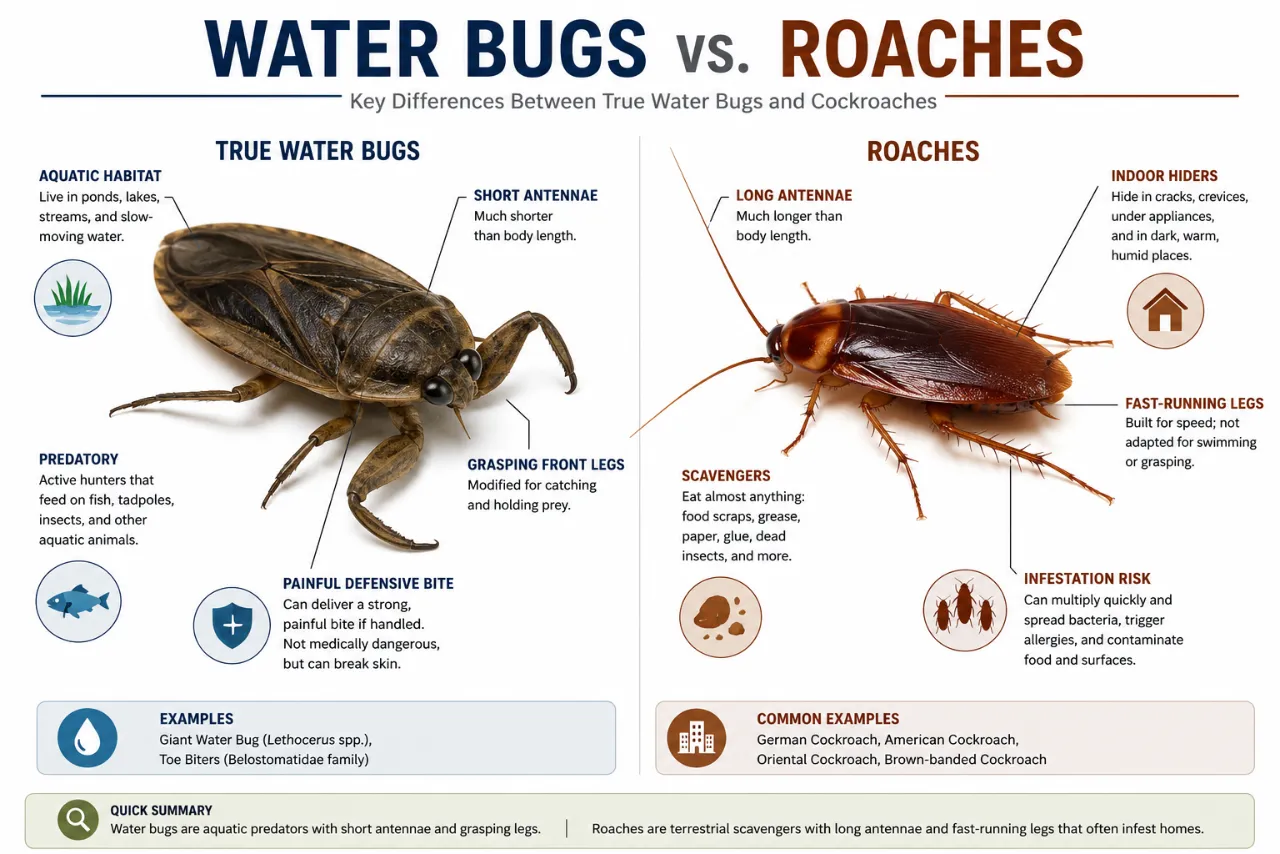
The main difference between water bugs and roaches is that true water bugs are aquatic predators, while roaches are mostly land-dwelling scavengers. A water bug may have short antennae, swimming legs, or grasping front legs and may bite painfully if handled. A roach usually has long antennae, spiny running legs, and hides in kitchens, bathrooms, basements, drains, sewers, or outdoor debris. Many people call large roaches “water bugs,” but that name is often inaccurate.
Water Bugs vs Roaches Summary Table
| Feature | True Water Bug | Roach / Cockroach |
|---|---|---|
| Scientific group | Usually aquatic true bugs in the order Hemiptera | Insects in the order Blattodea |
| Common examples | Giant water bug, backswimmer, water boatman, water scorpion | American roach, German roach, Oriental roach, smoky brown roach |
| Main habitat | Ponds, lakes, marshes, wetlands, pools, aquatic vegetation | Kitchens, bathrooms, drains, sewers, basements, crawl spaces, mulch, leaf litter |
| Body shape | Often broad, flat, oval, or shield-like | Flattened oval body built for squeezing into cracks |
| Antennae | Usually short or not very obvious | Very long and obvious |
| Legs | Often adapted for swimming or grabbing prey | Adapted for fast running and climbing |
| Diet | Often predatory; eats aquatic insects, tadpoles, small fish, or other small animals | Mostly scavenging omnivore; eats crumbs, grease, garbage, starches, and organic waste |
| Bite risk | Some can bite painfully if handled | Rarely bite people; usually run away |
| Infestation risk | Low; usually accidental indoors | Can be high, especially German and American roaches |
| Biggest clue | Found in water or near aquatic habitats | Found repeatedly indoors near food, moisture, warmth, or hiding places |
What Is a Water Bug?
A true water bug is an aquatic or semi-aquatic insect. Many true water bugs belong to the order Hemiptera, the same broad order that includes other “true bugs.” They are not roaches. Common examples include giant water bugs, backswimmers, water boatmen, water scorpions, and water striders.
True water bugs are adapted to life in water. Some swim with paddle-like legs. Some grab prey with strong front legs. Some breathe air while spending much of their time underwater. Many are predators that hunt small aquatic animals such as insect larvae, tadpoles, snails, small fish, or other invertebrates.
The term “water bug” becomes confusing because people also use it as a nickname for large roaches. In pest-control conversations, “water bug” often means American roach or Oriental roach, especially when the insect is found near drains or damp basements. Scientifically, however, those insects are roaches, not true water bugs.
What Is a Roach?
A roach is a cockroach. Roaches belong to the order Blattodea and are usually land-dwelling insects with flattened oval bodies, very long antennae, spiny legs, and fast running ability. Most roach species live outdoors and help break down organic matter, but a few species are major indoor pests.
Common pest roaches include German roaches, American roaches, Oriental roaches, brown-banded roaches, and smoky brown roaches. They may live in kitchens, bathrooms, drains, sewers, basements, wall voids, restaurants, apartments, and warm cracks near food and moisture.
Roaches are usually scavengers. They feed on crumbs, grease, trash, pet food, starches, decaying material, paper glue, and many other organic substances. Unlike true water bugs, they are not aquatic predators.
Why People Call Roaches Water Bugs
People often call large roaches “water bugs” because some roaches are strongly associated with moisture. American roaches may live in sewers, drains, damp basements, and crawl spaces. Oriental roaches also prefer cool, moist areas and are commonly found near floor drains, wet foundations, and outdoor debris.
Because these roaches appear near water, the nickname “water bug” became common. But a roach found near a sink or drain is still a roach. It does not become a true water bug just because it likes moisture.
This naming confusion matters because the control method is different. A true water bug usually enters by accident and can be removed. A roach sighting may indicate an indoor infestation that needs sanitation, exclusion, moisture control, and possibly bait treatment.
Quick Visual Difference
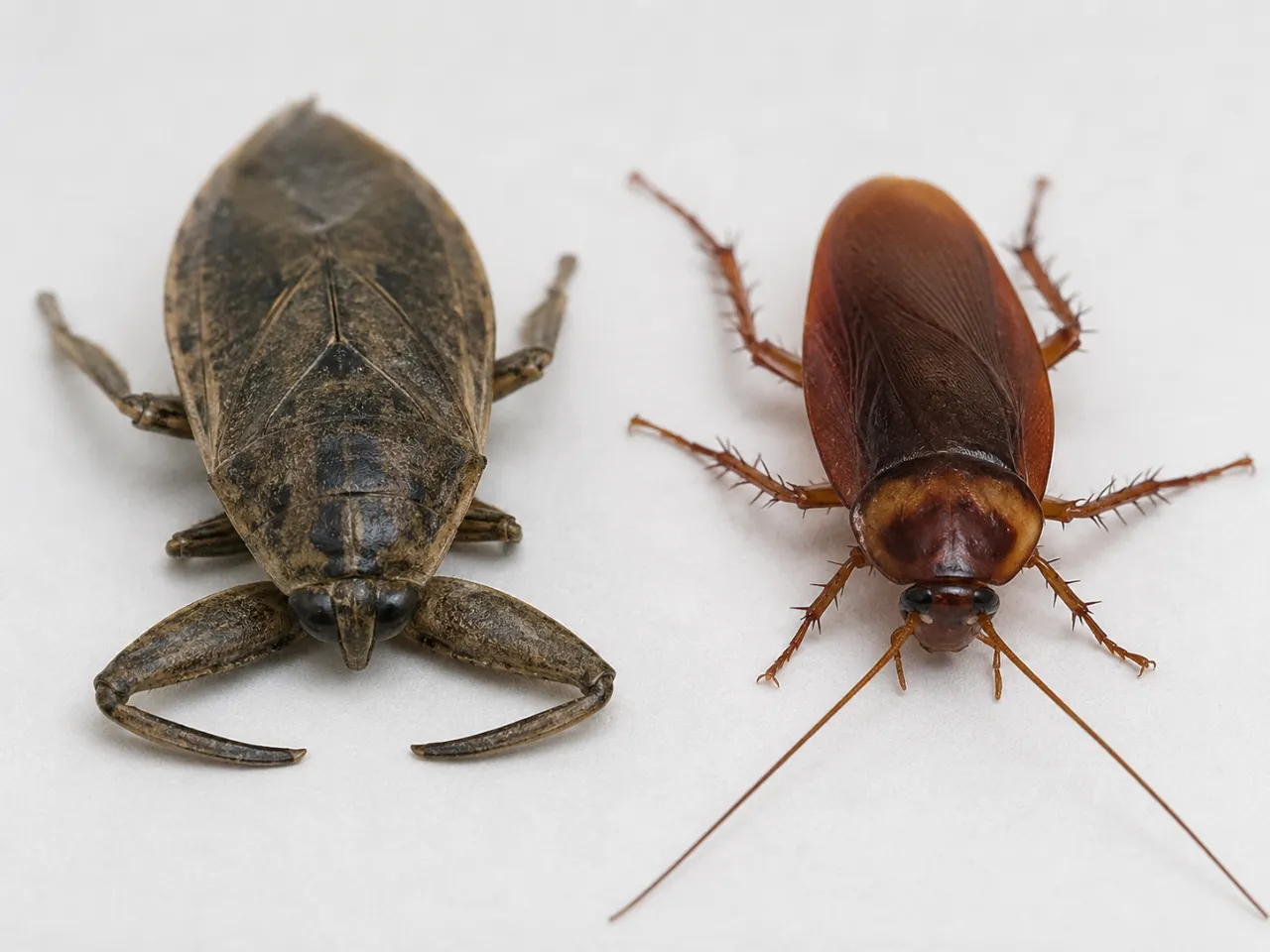
A true water bug often looks like an aquatic predator. It may have a broad body, shorter antennae, and legs adapted for swimming or grabbing prey. A roach usually has long antennae, a smooth flattened body, and legs built for fast running.
True water bug: short or hidden antennae, aquatic legs, found in ponds, pools, or wetlands.
Roach: long antennae, spiny running legs, found in buildings, drains, basements, kitchens, or outdoor debris.
True water bug: may bite if handled.
Roach: usually avoids people and runs into cracks.
Habitat: Water vs Land
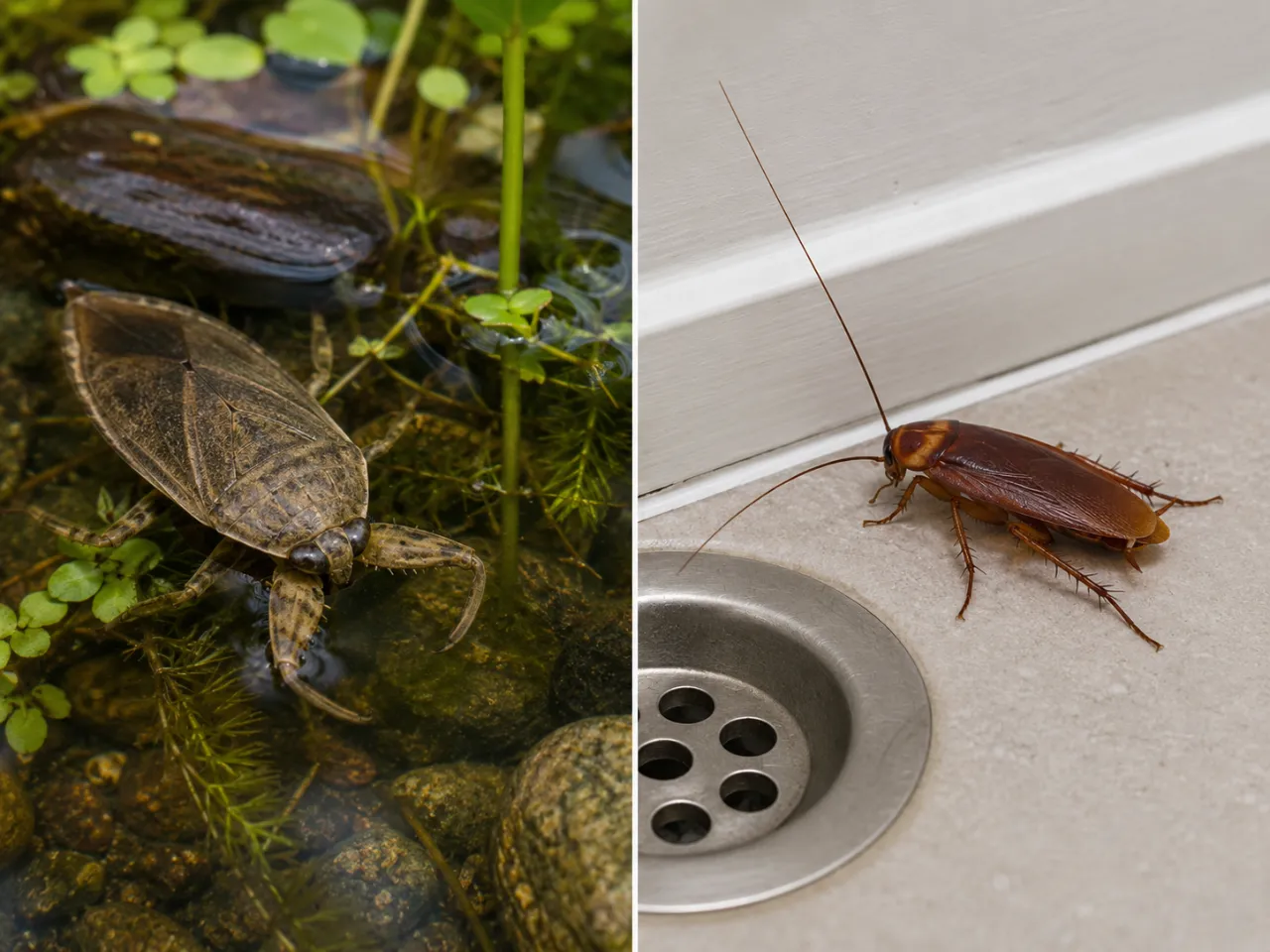
Habitat is the best clue. True water bugs live in water or very close to it. You may find them in ponds, marshes, lakes, slow streams, swimming pools, rain barrels, ditches, or aquatic vegetation. Some fly at night and may land near porch lights or pool lights.
Roaches live mostly on land. Indoor pest roaches search for food, moisture, warmth, and hiding places. German roaches commonly infest kitchens and bathrooms. American roaches often live in sewers, drains, basements, and utility spaces. Oriental roaches prefer damp, cool areas such as crawl spaces and floor drains.
If the insect is swimming, clinging to aquatic plants, or found in a pool, it may be a true water bug. If it runs behind a refrigerator, under a sink, or into a wall crack, it is probably a roach.
Body Shape and Antennae
True water bugs often have compact, broad, or shield-like bodies. Giant water bugs have powerful front legs and short, less noticeable antennae. Backswimmers and water boatmen have swimming legs adapted for moving through water.
Roaches have long, thread-like antennae that are easy to see. These antennae help them sense food, moisture, air movement, obstacles, and danger in dark spaces. Their flattened bodies help them hide in narrow cracks.
A simple rule is: very long antennae usually mean roach; short antennae with aquatic legs usually mean true water bug.
Legs and Movement
Water bugs often move like swimmers, rowers, or aquatic hunters. Some use paddle-like hind legs to swim. Others use strong front legs to seize prey. Water striders use long legs to stand and move on the water surface.
Roaches are fast runners. Their legs are spiny and designed for speed across floors, walls, pipes, cardboard, and rough surfaces. Many roaches sprint away when lights turn on. Some species can climb well, while others stay closer to the ground.
Movement gives a strong clue: swimming or rowing suggests water bug; sprinting into a crack suggests roach.
Diet: Predator vs Scavenger
Many true water bugs are predators. Giant water bugs may catch aquatic insects, tadpoles, small fish, and other small animals. Their mouthparts are designed for piercing and sucking fluids from prey. They are part of freshwater food webs.
Roaches are mostly scavengers. They feed on whatever organic material is available: food crumbs, grease, garbage, pet food, decaying plants, glue, paper residue, and kitchen waste. Their flexibility is one reason they survive so well around humans.
A true water bug hunts in water. A roach scavenges on land.
Do Water Bugs Bite?
Some true water bugs can bite if handled or threatened. Giant water bugs are especially known for a painful defensive bite. They do not usually chase people, but they can pierce skin if picked up, stepped on, or trapped against the body.
If you find a large aquatic bug in a pool or near a light, do not handle it with bare hands. Use a container, net, gloves, or paper to move it safely.
Do Roaches Bite?
Roaches rarely bite people. They are not blood-feeding insects and usually try to avoid humans. In unusual situations, they may nibble at food residue or dead skin, but this is not their normal behavior.
The bigger concern with roaches is sanitation. Roaches can move through garbage, drains, sewers, and food-preparation areas. Their droppings, shed skins, and body fragments may also trigger allergies or asthma in sensitive people.
Are Water Bugs Dangerous?
True water bugs are not usually dangerous household pests. They can be startling and may bite if handled, but they do not normally infest kitchens, eat stored food, or reproduce inside dry homes.
Outdoors, true water bugs are useful predators in freshwater ecosystems. They help control aquatic insects and are food for fish, birds, frogs, turtles, and other animals.
A single true water bug indoors is usually an accident, not an infestation.
Are Roaches Dangerous?
Roaches are more concerning indoors because they can become pests. A roach infestation may contaminate surfaces, leave droppings, create unpleasant odors, and worsen allergies or asthma. German roaches are especially serious because they reproduce quickly and hide in small cracks near food and water.
Seeing one roach does not always mean a major infestation, but repeated sightings should be investigated. Nymphs, droppings, egg cases, shed skins, and nighttime activity are warning signs.
Water Bug vs American Roach
The American roach is one of the insects most often called a “water bug.” It is large, reddish-brown, and has long antennae. It often lives in sewers, drains, basements, crawl spaces, and warm damp structures.
Despite the nickname, the American roach is not a true water bug. It does not live as an aquatic predator. It is a land-dwelling cockroach that likes moisture.
If the insect is large, reddish-brown, fast-running, and has very long antennae, it is probably an American roach.
Water Bug vs Oriental Roach
The Oriental roach is another species commonly called a water bug. It is usually dark brown to black, shiny, and often found in damp areas such as basements, drains, crawl spaces, garages, and wet outdoor debris.
Oriental roaches like moisture, but they are not aquatic insects. They do not swim and hunt like true water bugs. They are scavenging roaches that may enter buildings from outside or through structural gaps.
If a dark, shiny “water bug” is crawling near a basement drain, it may be an Oriental roach.
Water Bug vs German Roach
German roaches are much smaller than the large roaches people usually call water bugs. They are light brown and usually have two dark stripes behind the head. They are strongly associated with indoor infestations, especially in kitchens, bathrooms, restaurants, and apartments.
If you see small roaches near cabinets, appliances, sinks, or food areas, do not assume they are harmless water bugs. German roaches reproduce quickly and should be controlled early.
Do Water Bugs Infest Homes?
True water bugs usually do not infest homes. They need aquatic habitats, prey, and water-based living conditions. If one enters a house, it likely flew toward a light, came from a nearby pool or pond, or entered through an open door.
If you are seeing many “water bugs” inside, they are probably roaches, not true water bugs. Repeated indoor sightings should be treated as a possible cockroach problem until the insect is identified.
Do Roaches Infest Homes?
Yes. Some roach species can infest homes and buildings. German roaches are the most common serious indoor roach in many places. American and Oriental roaches may also become structural pests, especially where drains, sewers, basements, crawl spaces, or moisture problems exist.
Roach infestations often include more than adult insects. You may see small nymphs, dark droppings, egg cases, shed skins, or roaches of different sizes. Seeing roaches during the day may suggest a larger hidden population.
How to Identify One in a Photo
When looking at a photo, use several clues together:
Check the antennae: very long antennae usually suggest roach.
Check the legs: swimming legs or grasping front legs suggest true water bug.
Check the habitat: pond, pool, or wetland suggests true water bug.
Check the setting: kitchen, bathroom, drain, basement, or cabinet suggests roach.
Check movement: swimming or rowing suggests water bug; fast running suggests roach.
Check the number: one insect near water may be a water bug; repeated indoor sightings suggest roaches.
Common Misidentifications
The most common mistake is calling a large roach a water bug. American roaches and Oriental roaches are especially likely to get this nickname. They may like damp places, but they are still roaches.
Another mistake is assuming one true water bug indoors means an infestation. A single aquatic bug near a porch light or pool is usually accidental.
A third mistake is assuming all large flat insects are roaches. Some true water bugs are large and flat, but their shorter antennae, aquatic legs, and water-based habitat separate them from roaches.
How to Remove a True Water Bug Indoors
If you find one true water bug indoors, avoid touching it with bare hands. Use a cup, jar, paper, net, or gloves to move it outside. Because some species can bite, gentle handling from a distance is best.
Turn off unnecessary outdoor lights near pools or ponds.
Keep windows and doors screened.
Seal gaps around doors, windows, and utility lines.
Use pool nets to remove aquatic insects safely.
Do not crush or pick up large water bugs with bare hands.
A true water bug usually does not require indoor pest treatment.
How to Prevent Roaches
Roach prevention is different because roaches need food, water, shelter, and hiding places. Good sanitation and exclusion are important.
Clean crumbs, grease, and spills quickly.
Store food in sealed containers.
Do not leave pet food out overnight.
Empty trash regularly and clean trash bins.
Fix leaking pipes and dripping faucets.
Seal cracks around baseboards, pipes, doors, and windows.
Reduce clutter, cardboard piles, and damp storage areas.
Inspect drains, crawl spaces, basements, and utility rooms.
If roaches are established indoors, cockroach baits and professional pest-control strategies are often more effective than random spraying.
When to Call Pest Control
You usually do not need pest control for a single true water bug found near a pool, pond, or outdoor light. Remove it safely and check entry points.
You should consider professional help if you repeatedly see roaches indoors, especially in kitchens, bathrooms, drains, cabinets, basements, or apartment buildings. German roaches should be addressed quickly because they can spread fast and become difficult to eliminate.
Correct identification is important. Treating a true water bug like a roach problem wastes effort, while ignoring roaches because they are called “water bugs” can allow an infestation to grow.
Ecological Role of True Water Bugs
True water bugs play important roles in freshwater ecosystems. Many are predators that help regulate aquatic insect populations. They may also become food for fish, frogs, turtles, birds, and larger aquatic animals.
Although they may look intimidating, true water bugs are not dirty house pests. Outdoors, they are part of a normal pond, marsh, or wetland community.
Ecological Role of Roaches
Most roach species are not household pests. Outdoors, roaches help recycle dead leaves, wood, fungi, and organic debris. They are also food for birds, reptiles, amphibians, spiders, and small mammals.
The problem is that a few roach species have adapted extremely well to human buildings. These indoor roaches create sanitation and allergy concerns. So roaches are ecologically useful outdoors but unwanted when they infest homes.
Final Comparison
Water bugs and roaches are different insects, even though the names are often mixed up. A true water bug is an aquatic insect that lives in water and may bite if handled. A roach is a land-dwelling cockroach that scavenges and may infest buildings.
If the insect is in a pond, pool, or wetland and has swimming or grasping legs, think true water bug. If it has long antennae, runs fast, and appears near food, drains, cabinets, basements, or appliances, think roach.
Related Insect Comparisons
Water Bug vs Cockroach
Wood Roach vs Cockroach
German Roach vs American Roach
Palmetto Bug vs Roach
Cricket vs Roach
Drain Fly vs Fruit Fly
FAQs About Water Bugs vs Roaches
Are water bugs and roaches the same?
No. True water bugs are aquatic insects, while roaches are land-dwelling cockroaches. However, people often call large roaches “water bugs,” especially when they appear near drains or damp areas.
Why are roaches called water bugs?
Some roaches, such as American roaches and Oriental roaches, are often found in damp places like sewers, drains, basements, and crawl spaces. Because of this moisture association, people call them water bugs, even though they are not true aquatic water bugs.
How can I tell a water bug from a roach?
Look at habitat and body features. A true water bug is usually found in or near water and may have swimming or grasping legs. A roach usually has very long antennae, fast-running legs, and is found indoors or in damp land-based hiding places.
Do water bugs bite?
Some true water bugs can bite painfully if handled or threatened. Giant water bugs are especially known for defensive bites. They should not be picked up with bare hands.
Do roaches bite?
Roaches rarely bite people. They usually avoid humans and run away when disturbed. The bigger problem is contamination, allergens, droppings, and indoor infestation.
Do water bugs infest houses?
True water bugs usually do not infest houses. If one appears indoors, it probably entered accidentally from a nearby aquatic habitat or was attracted to light.
Do roaches infest houses?
Yes. Some roaches, especially German roaches, can build indoor infestations. American and Oriental roaches may also become indoor pests in damp buildings.
What roach is most often called a water bug?
American roaches and Oriental roaches are most often called water bugs because they are large and commonly associated with moisture, drains, sewers, and basements.
Should I worry if I see one water bug indoors?
If it is a true water bug and you see only one, it is usually not a major concern. Remove it safely and check screens or doors. If you see many roach-like insects indoors, investigate for a possible roach infestation.
What is the fastest way to prevent roaches?
Remove food and water sources, seal entry points, fix leaks, reduce clutter, clean grease and crumbs, and use proper cockroach baits if needed. For heavy infestations, professional pest control is usually best.