The easiest way to tell a jaguar from a leopard is to look at the build, head, and spots. Jaguars are usually stockier, more muscular, and broader-headed, with larger rosettes that often contain small central dots. Leopards are usually slimmer, more lightly built, and longer-bodied, with smaller rosettes that usually do not contain central spots. They also live on different continents, use habitats differently, and hunt in slightly different ways.
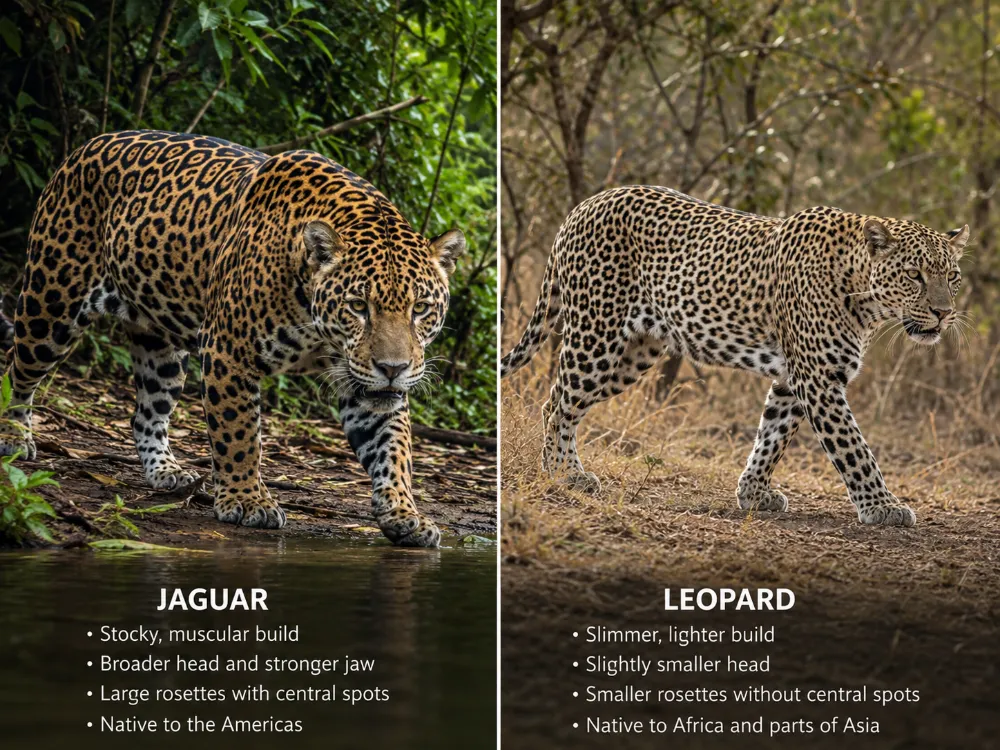
People confuse jaguars and leopards because both are large spotted cats with golden coats and rosette patterns. At a glance, especially in photos, they can look almost interchangeable. But once you know what features to check, the differences become much easier to see.
In this guide, you will learn how jaguars and leopards differ in appearance, range, habitat, behavior, and hunting style, plus the fastest ways to identify them correctly.
Quick comparison table
| Feature | Jaguar | Leopard |
|---|---|---|
| Main range | Central and South America | Africa and parts of Asia |
| Build | Stockier, heavier, more muscular | Slimmer, lighter, more graceful-looking |
| Head shape | Broad, powerful, blockier head | Smaller, narrower, less massive head |
| Rosettes | Larger rosettes, often with central dots | Smaller rosettes, usually without central dots |
| Body shape | Compact, deep-chested, sturdy | Longer-bodied, leaner, more lightly built |
| Tree use | Can climb, but often hunts on the ground or near water | Excellent climber, often rests and stores prey in trees |
| Water habits | Often very comfortable in water | Usually less closely associated with water |
| Bite style | Very powerful bite, often crushes skull or shell | Usually kills by throat bite or suffocation |
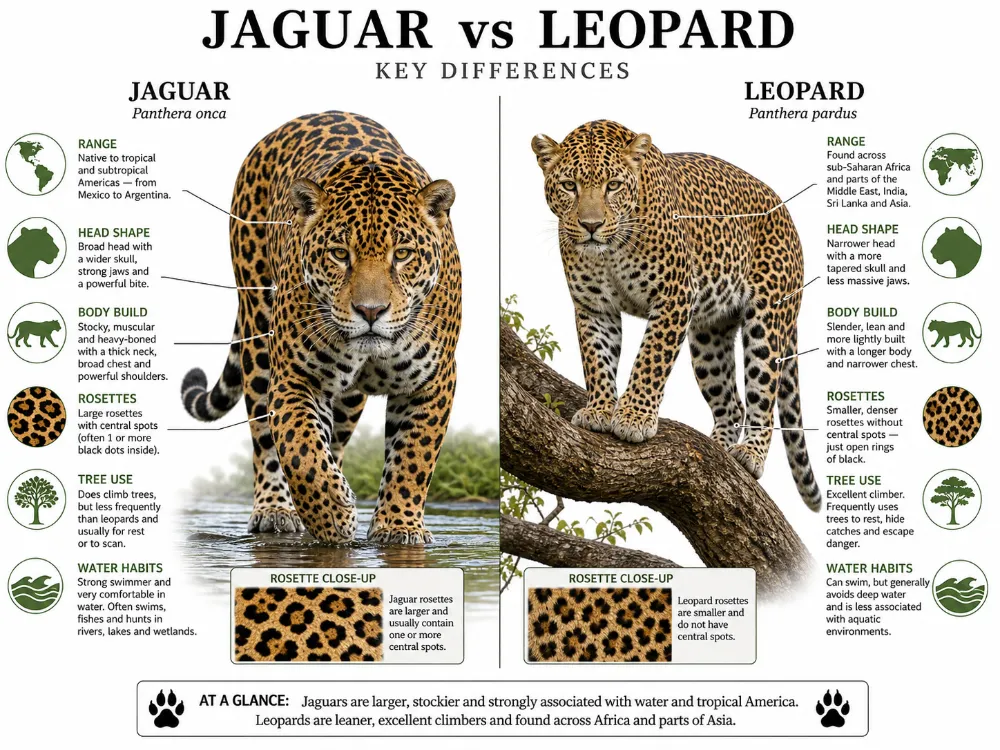
They are related, but they are not the same cat
Jaguars and leopards are both big cats in the genus Panthera, so they are close relatives. That is one reason they look similar. Both have spotted coats, flexible bodies, strong jaws, and the stealthy hunting style typical of large ambush predators.
However, they are separate species with different evolutionary histories and different home ranges. A jaguar is native to the Americas, while a leopard belongs to Africa and parts of Asia.
This means they may look alike, but they are not regional versions of the same animal.
Jaguars are usually heavier and more muscular
One of the clearest differences is overall build. Jaguars usually look much stockier and more heavily built than leopards. Their chest, shoulders, and neck often appear thick and powerful, giving them a dense, compact look.
Leopards are also strong cats, but they usually appear leaner, longer, and more lightly framed. Their body shape often looks more graceful and athletic rather than heavy and blocky.
If the cat looks especially powerful for its length, with a broad front half and solid body, it is more likely to be a jaguar.
The head shape is an excellent clue
Jaguars usually have a broad, heavy head with a powerful jawline. The face often looks shorter and more massive, which matches the jaguar’s reputation for having one of the strongest bites among big cats relative to body size.
Leopards usually have a smaller, narrower head with a more refined profile. Their face often looks less blocky and less oversized compared with the body.
In close photos, head shape is one of the easiest ways to separate the two species.
The spots are not exactly the same
Both cats have rosettes, but the pattern is different. Jaguar rosettes are usually larger and more open, and they often contain one or more small black dots inside the rosette. This is one of the most famous jaguar field marks.
Leopard rosettes are usually smaller, tighter, and more densely packed. They generally do not have the same obvious central dots inside them.
This is not a perfect rule in every single photo, because coat patterns vary somewhat, but it is one of the best identification clues when the coat is clearly visible.
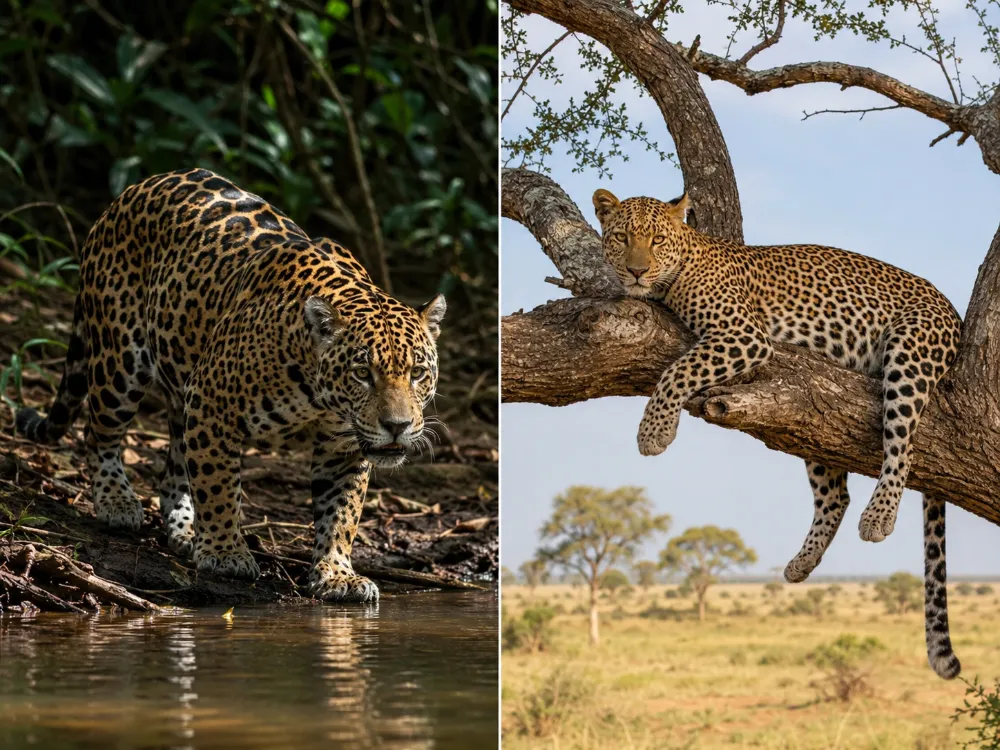
Leopards often look longer and lighter
Leopards usually have a more stretched, lightly built appearance. Their body often looks longer in proportion to height, and their limbs can seem more delicate compared with the dense power of a jaguar.
This body form suits a cat that is highly versatile, an excellent climber, and able to move easily through many habitats. Leopards often appear more agile-looking, while jaguars often appear more compact and forceful.
If the cat seems almost panther-like but elegant and long-bodied, leopard becomes more likely.
They live on different continents
Range is one of the simplest differences. Jaguars live in the Americas, especially in parts of Central and South America. Historically they ranged farther north, but today they are strongly associated with tropical forests, wetlands, and river systems from Mexico southward.
Leopards live in Africa and parts of Asia. They are among the most adaptable big cats and can occur in savannas, forests, mountains, scrub, and in some places quite close to human-modified landscapes.
So if you are looking at a wild spotted big cat in Brazil, it is a jaguar. If you are looking at one in Kenya or India, it is a leopard.
Jaguars are more strongly linked with water
Jaguars are especially well known for their comfort around water. They often live in wet forests, swamps, river edges, and floodplains, and they may swim readily. In some areas, water is a very important part of jaguar habitat and hunting behavior.
Leopards can swim too, but they are not usually as strongly associated with water as jaguars are. Leopards are more often thought of as all-around adaptable cats that use a broad range of habitats rather than as water-oriented predators.
This is one reason jaguars are often shown in dense tropical, river-rich environments.
Leopards are famous tree climbers
Leopards are excellent climbers and are famous for carrying prey into trees. This helps protect their food from scavengers and competitors. A leopard resting on a branch with a kill is one of the classic wildlife images of Africa.
Jaguars can climb as well, but they are usually less strongly associated with tree-dragging behavior in the popular imagination. They often hunt and dominate at ground level, especially in dense cover and near water.
So if you see a spotted big cat comfortably draped across a tree branch with prey, leopard is often the first guess.
Jaguars have an unusually powerful bite
Jaguars are famous for their bite force. They often kill in a different way from many other big cats by biting directly through the skull or into hard parts of the prey, especially in smaller animals or reptiles. They are also well known for preying on armored or hard-bodied animals such as turtles and caimans in some habitats.
Leopards usually kill with a more classic big-cat method, often using a throat bite or suffocating grip on mammals. They are powerful predators too, but they are not as famous for skull-crushing kills as jaguars are.
This difference reflects the jaguar’s especially robust skull and jaw power.
Prey choice can differ
Jaguars often hunt in habitats where they encounter capybaras, peccaries, deer, caimans, turtles, fish, and other wetland or forest-edge animals. Their broad diet reflects both strength and habitat.
Leopards also eat a wide range of prey, including antelope, monkeys, rodents, birds, reptiles, and smaller mammals. They are highly adaptable and can switch prey depending on local opportunity.
Both are opportunistic ambush predators, but jaguars are especially associated with heavy-bodied prey and wet tropical systems, while leopards are often associated with flexible prey use across many habitats.
Behavior and temperament in the wild
Both cats are usually solitary and secretive, but they give slightly different impressions. Jaguars often feel like deep-cover power predators, especially in riverine forest and swamp landscapes. Leopards often feel like adaptable stealth cats that can survive in a huge range of environments if cover is available.
Leopards are especially famous for surviving close to people in some regions because they are so adaptable and elusive. Jaguars are also elusive, but their ecological image is often more tied to intact forest and wetland systems.
These are general patterns, not strict rules, but they help explain how each cat is viewed in the wild.
Black jaguars and black leopards add to the confusion
Both jaguars and leopards can appear in melanistic forms, meaning they look very dark or nearly black. These animals are often casually called black panthers. This adds even more confusion because once the usual golden coat is hidden, the species difference becomes harder to see.
In a black individual, the rosettes are often still faintly visible in the right light. Location becomes especially important in those cases. A black panther in the Americas is a jaguar, while one in Africa or Asia is a leopard.
This is why geography is so useful when coat color becomes less informative.
Why people confuse them so often
People confuse jaguars and leopards because both are medium-to-large spotted panther cats with golden coats and black rosettes. In photos without scale or context, the difference can be subtle. Movies, stock images, and casual online labels often make the problem worse.
At a quick glance, both can look like “a big spotted cat.” But the body shape, head, and rosettes tell a much clearer story once you know what to watch for.
The biggest mistake is focusing only on the fact that both are spotted instead of noticing how the spots are arranged and how the body is built.
How to tell them apart quickly
If you need a fast field guide, use these clues together:
Jaguar: stockier body, broader head, larger rosettes with central dots, strong water association, Americas
Leopard: slimmer body, smaller head, tighter rosettes without central dots, strong tree use, Africa or Asia
No single clue is perfect every time, but this combination is usually very reliable.
Which one is stronger?
If strength means raw muscular power and bite force relative to body build, the jaguar usually has the stronger reputation. Its compact body, broad head, and crushing bite make it seem like a powerhouse among spotted big cats.
If strength means adaptability across habitats, climbing ability, and survival in many landscapes, the leopard is often the more versatile cat. Leopards succeed in places where many other big cats would struggle.
So the answer depends on what kind of strength you mean. Jaguar usually wins for brute force, while leopard often wins for ecological flexibility.
Final takeaway
The main difference between a jaguar and a leopard is that jaguars are heavier, broader-headed, more powerfully built spotted cats of the Americas, while leopards are slimmer, more lightly built spotted cats of Africa and Asia. Jaguars usually have larger rosettes with central dots and are more strongly associated with water and crushing bite power. Leopards usually have smaller rosettes without central dots and are especially famous for climbing and storing prey in trees. They may look similar at first glance, but once you learn the key clues, they are much easier to tell apart.
FAQs
Is a jaguar bigger than a leopard?
Jaguars are usually heavier and more powerfully built, while leopards are usually slimmer and lighter overall.
How can I tell a jaguar from a leopard fast?
Look at the body and spots. Jaguars are stockier with bigger rosettes that often have central dots, while leopards are slimmer with smaller rosettes that usually do not.
Do jaguars and leopards live in the same places?
No. Jaguars live in the Americas, while leopards live in Africa and parts of Asia.
Which cat climbs trees better, the jaguar or the leopard?
Leopards are especially famous for climbing and often carry prey into trees, though jaguars can climb too.