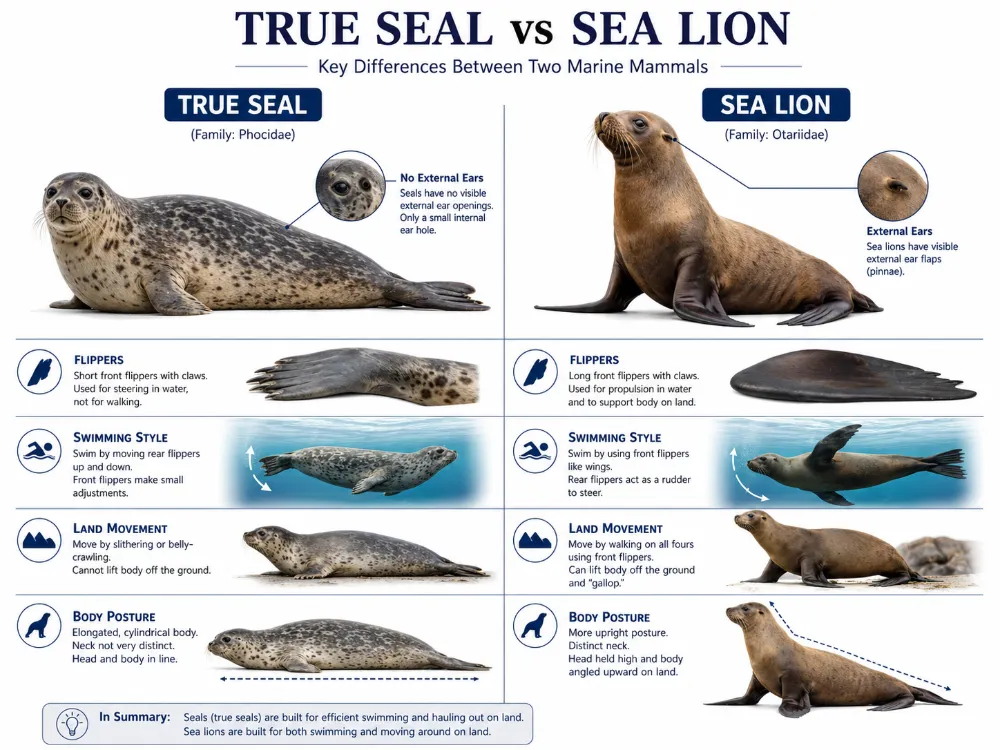
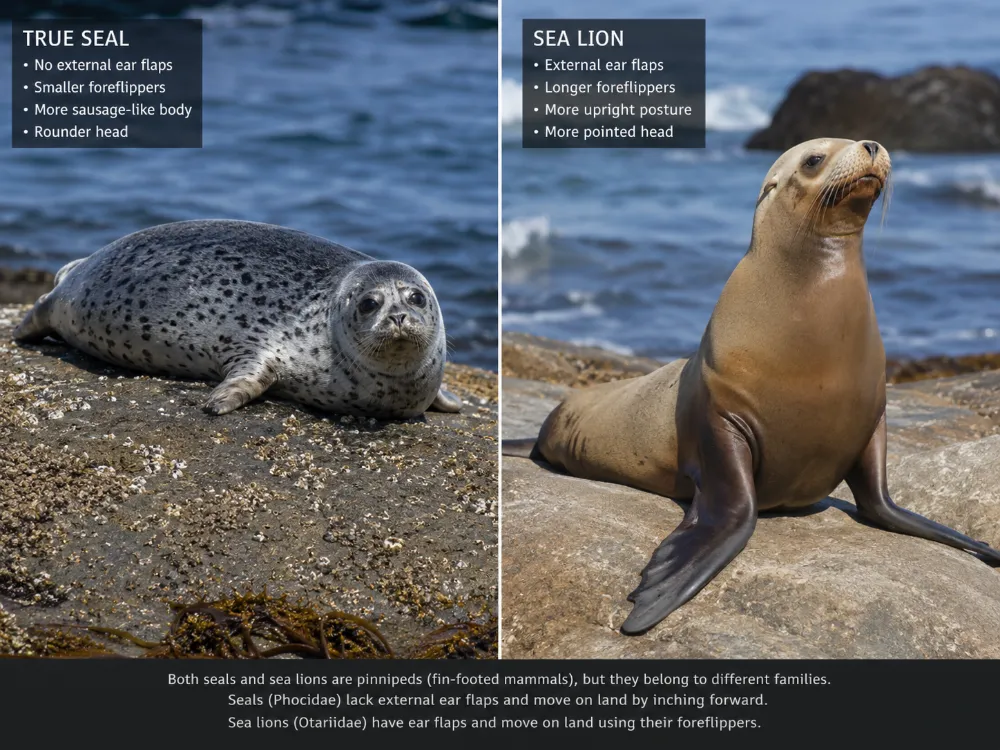
The easiest way to tell a seal from a sea lion is to look at the ears, front flippers, and how the animal moves on land. Sea lions have visible external ear flaps, larger front flippers, and can rotate their hind flippers under the body to “walk” on land. True seals do not have visible ear flaps, have smaller front flippers, and usually wriggle on land with a more awkward crawling motion.

People often confuse seals and sea lions because both are marine mammals with sleek bodies, flippers, whiskers, and a similar “blubbery” look. They also spend time both in the water and on shore, which makes them seem almost interchangeable in casual conversation.
In this guide, you will learn the clearest differences between seals and sea lions, how to identify them quickly, and why their body design reflects different ways of moving and living.
Quick comparison table
| Feature | Seal | Sea Lion |
|---|---|---|
| External ears | No visible ear flaps | Visible external ear flaps |
| Front flippers | Shorter and smaller | Longer and stronger |
| Movement on land | Wriggles or undulates on belly | Can lift body and “walk” on flippers |
| Swimming style | Uses hind flippers and body more strongly | Uses powerful front flippers more like underwater wings |
| Body shape | Often rounder and more tapered | Often more upright-chested and flexible |
| Voice | Usually quieter or less bark-like on land | Often loud, barking, and more vocal in colonies |
| Social behavior | Varies, often less obviously noisy | Often highly social and noisy on shore |
| Main group | True seals | Eared seals |
They are related, but they are not the same animal
Seals and sea lions are both pinnipeds, a group of marine mammals adapted for life in the water while still depending on land or ice for resting, breeding, and raising young. This is why they share broad similarities such as streamlined bodies, thick layers of fat, and flippers instead of feet.
However, they belong to different branches within the pinniped world. Sea lions belong to the eared seal group, while what people usually call “seals” in this comparison are true seals.
That difference explains why they can look alike at a distance but behave and move quite differently when you watch them closely.
Sea lions have visible ear flaps
One of the fastest identification clues is the ear. Sea lions have small but visible external ear flaps on the sides of the head. If you look carefully, you can usually see that they have an obvious outer ear.
True seals do not have these visible ear flaps. Instead, they have ear openings without the little external flap that sea lions show.
This is one of the best quick field marks, especially when the animal is resting on shore and you can see the side of the head clearly.
Sea lions usually have bigger front flippers
Sea lions have long, strong front flippers that play a major role in both swimming and moving on land. Their front flippers often look noticeably larger and more muscular than those of true seals.
Seals usually have smaller front flippers that are less useful for lifting the body on land. Their flippers still work well in the water, but they do not give the same “upright” impression as a sea lion’s flippers do.
If the animal’s front flippers look large and wing-like, sea lion becomes much more likely.
Movement on land is very different
Sea lions are much better at moving on land than true seals. They can rotate their hind flippers forward under the body and support themselves on all four flippered limbs. This allows them to shuffle, walk, and climb much more effectively on beaches, rocks, and docks.
True seals cannot rotate the hind flippers under the body in the same way. As a result, they usually move by wriggling, bouncing, or undulating on the belly. This often makes them look more awkward and less flexible on land.
If the animal can sit upright and move around with surprising confidence on shore, it is probably a sea lion.
Swimming style is not the same
Sea lions usually swim by using their large front flippers as the main source of propulsion. In the water, they may look almost like they are flying underwater with powerful strokes from the front limbs.
Seals usually rely more heavily on the hind flippers and the rear part of the body for propulsion. Their swimming style often looks smoother, more fish-like, and more wave-driven from the back half.
Both are excellent swimmers, but they achieve that ability in different ways.
Sea lions often look more upright
Sea lions often have a posture that looks more upright and alert when they are out of the water. Because they can lift the chest and neck more easily, they often appear more “dog-like” or “performer-like” when sitting on rocks or docks.
Seals usually look flatter, rounder, and more spread out when resting. Their posture is often lower to the ground, and they may seem more torpedo-shaped even when lying still.
This difference in body posture is not just visual. It reflects real structural differences in the skeleton and flippers.
Sea lions are often noisier
Sea lions are usually more obviously vocal on land. Many people know them for their loud barking calls, especially in crowded colonies or zoo settings. Their social gatherings can be noisy and energetic.
Seals can vocalize too, but they are often less famous for barking behavior in everyday public experience. Depending on the species, their sounds may be quieter, softer, or less dramatic to human ears when compared with a barking sea lion colony.
If the colony is loud, barking, and full of upright animals calling back and forth, sea lions are a strong possibility.
Body shape can help with identification
Seals often look smoother, rounder, and more tapered from head to tail. Their neck may seem less obvious, and the whole body can appear more unified into a sleek torpedo shape.
Sea lions often look more open in the shoulder and chest area, with a clearer neck and a more flexible upper body. This can make them seem more expressive and easier to read when they are on land.
From a distance this clue is less reliable than ears or flippers, but it still helps when combined with other features.
Whiskers and face shape vary too
Both seals and sea lions have whiskers that help them sense movement and water disturbance, but the face can still look a little different overall. Many true seals have a softer, rounder facial profile with large dark eyes and a gentler expression that people often find “puppy-like.”
Sea lions often have a longer face, clearer ear region, and a more angular or alert expression. Again, this is not a perfect rule, but it contributes to the different overall look of the two animals.
When people say seals look cuter and sea lions look more theatrical, they are often reacting to these subtle face and posture differences.
They use different habitats in slightly different ways
Both seals and sea lions can be found in marine environments ranging from cold regions to temperate coasts, depending on the species. However, sea lions are often especially familiar around rocky coasts, islands, piers, and human marine structures where their social and vocal behavior is easy to notice.
True seals are also found on coastlines, beaches, ice, and offshore environments, but many species give a more quiet, low-profile impression when hauled out. Some are strongly associated with colder waters and ice-covered habitats.
The exact habitat depends on the species, but the general body differences still hold across the comparison.
Social behavior is often more obvious in sea lions
Sea lions are often highly social and are commonly seen in groups resting, barking, posturing, and interacting on shore. Their colonies can feel active and dramatic, especially during breeding periods.
Seals can also gather in large numbers, but they often seem quieter and less animated in the way casual observers describe them. Their social life can still be complex, but it is often less obviously “showy” than that of sea lions.
This is one reason sea lions are often remembered more easily by people visiting coasts or marine parks.
Why people confuse them so often
People confuse seals and sea lions because both are flippered marine mammals that haul out on land and have similar broad silhouettes from far away. In casual speech, many people use “seal” as a catch-all word for almost any pinniped.
Popular media also tends to blur the difference. A sea lion may be called a seal in a photo caption, cartoon, or travel post, which reinforces the confusion.
Once you learn the ear and flipper clues, however, the difference becomes much easier to spot.
How to tell them apart quickly
If you need a fast field guide, use these clues together:
Sea lion: visible ear flaps, long front flippers, upright posture, loud barking, can “walk” on land
Seal: no visible ear flaps, shorter front flippers, flatter posture, quieter look, wriggles on land
No single feature is perfect every time, but this combination works very well in most situations.
Which one is friendlier?
Neither should be thought of as a friendly pet-like animal in the wild. Both seals and sea lions are wild marine mammals that can bite, defend themselves, and react strongly if stressed or approached too closely.
Sea lions may seem bolder and more interactive because they are more vocal and more mobile on land, but that does not make them safer. Seals may look gentler, but they also deserve full respect and distance.
The best way to think about both is not in terms of friendliness, but in terms of wild behavior and appropriate caution.
Final takeaway
The main difference between a seal and a sea lion comes down to ears, flippers, posture, and movement. Sea lions have visible ear flaps, larger front flippers, louder voices, and can move around on land much more effectively. True seals lack visible ear flaps, have smaller front flippers, and usually wriggle on land in a more awkward way. They are closely related pinnipeds, but once you know the key clues, they are much easier to tell apart.
FAQs
Is a sea lion a seal?
A sea lion is a type of pinniped, but in everyday comparison it is usually separated from true seals because it belongs to the eared seal group.
How can I tell a seal from a sea lion fast?
Look for visible ear flaps and large front flippers. If you can see ear flaps and the animal moves well on land, it is likely a sea lion.
Why do sea lions bark more than seals?
Sea lions are often more obviously vocal in social groups on land, especially in colonies.
Can seals and sea lions both swim well?
Yes. Both are excellent swimmers, but they use different flipper motions and body mechanics in the water.