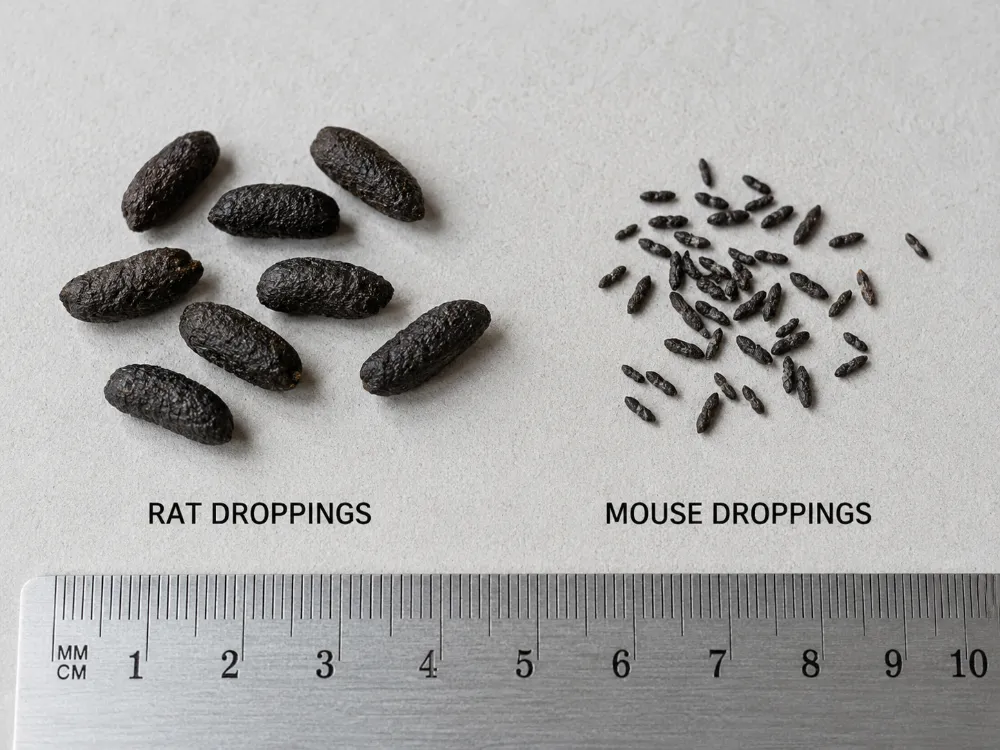
Rat poop is usually larger, thicker, and more widely spaced, while mouse poop is smaller, thinner, and often scattered in greater numbers. Mouse droppings look like dark rice grains, usually about 3–6 mm long. Rat droppings are often 12–20 mm long and may look like dark capsules or large beans. Both can carry health risks, so avoid touching, sweeping, or vacuuming dry droppings.
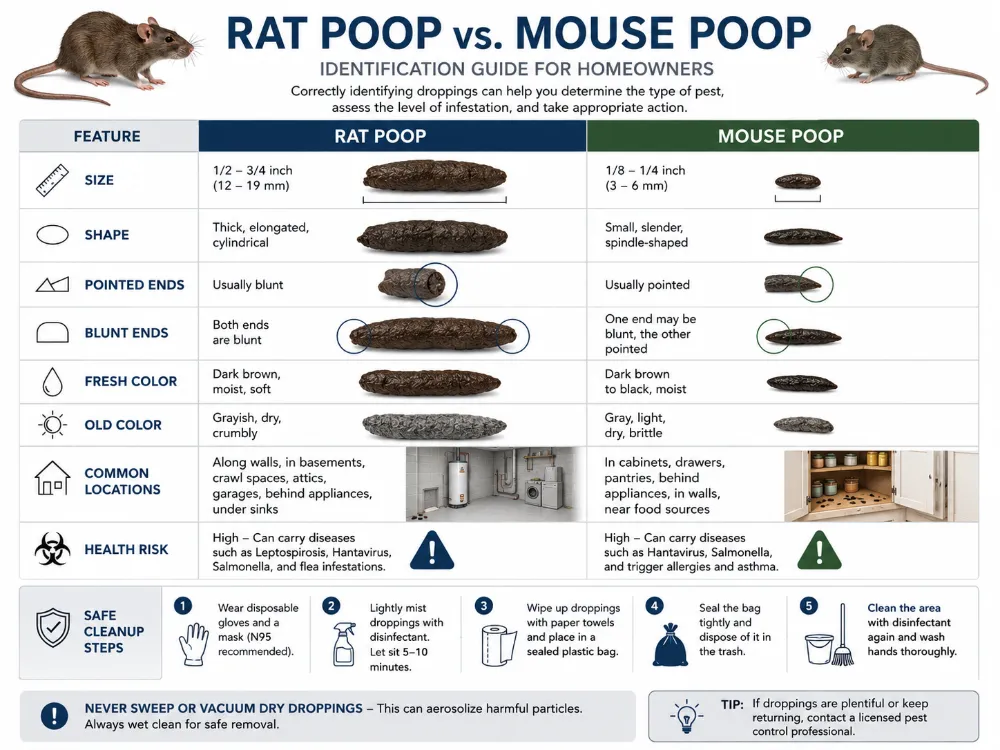
Rat Poop vs Mouse Poop Summary Table
| Feature | Rat Poop | Mouse Poop |
|---|---|---|
| Typical size | About 12–20 mm long, sometimes larger | About 3–6 mm long |
| Common comparison | Looks like a dark capsule, bean, or large grain | Looks like a dark grain of rice or black sesame-sized pellet |
| Shape | Thicker, heavier, more blunt or capsule-like | Thin, narrow, rod-like, often pointed at one or both ends |
| Ends | Norway rat droppings are often blunt; roof rat droppings may be more pointed or curved | Often pointed or tapered at the ends |
| Color when fresh | Dark brown to black, often shiny or moist-looking | Dark brown to black, often shiny when fresh |
| Color when old | Gray, dull, dry, brittle, or dusty | Gray, dull, dry, crumbly, or faded |
| Quantity | Often fewer droppings than mice, but larger and more obvious | Often many small droppings scattered along travel routes |
| Common locations | Basements, garages, crawl spaces, attics, wall edges, under appliances, near pet food, drains, and outdoor foundations | Kitchen cabinets, drawers, pantries, under sinks, behind appliances, closets, attic insulation, and wall edges |
| Travel pattern | Often follows walls, pipes, beams, fences, and outdoor routes | Often follows walls, cabinets, baseboards, food storage areas, and hidden indoor paths |
| Odor | May come with strong musky smell, urine odor, or greasy rub marks | May come with stale, ammonia-like urine smell in active areas |
| Main concern | Larger rodent, stronger chewing damage, serious contamination risk | Fast breeding, food contamination, hidden nesting, indoor infestation risk |
| Best quick clue | Large, thick, capsule-like droppings | Small, rice-like, pointed droppings |
What Does Rat Poop Look Like?
Rat poop is usually large, dark, and capsule-shaped. Compared with mouse poop, it is much thicker and easier to notice. Fresh rat droppings are often dark brown to black and may look slightly shiny. Older droppings become dull, grayish, dry, and brittle.
The exact shape can vary depending on the rat species. Norway rat droppings are often thick with blunt ends. Roof rat droppings are often slightly smaller, more pointed, and sometimes curved like a small banana. In both cases, rat droppings are much larger than typical mouse droppings.
If you find dark pellets that are about the size of a large raisin, bean, or capsule, you may be dealing with rats rather than mice.
What Does Mouse Poop Look Like?
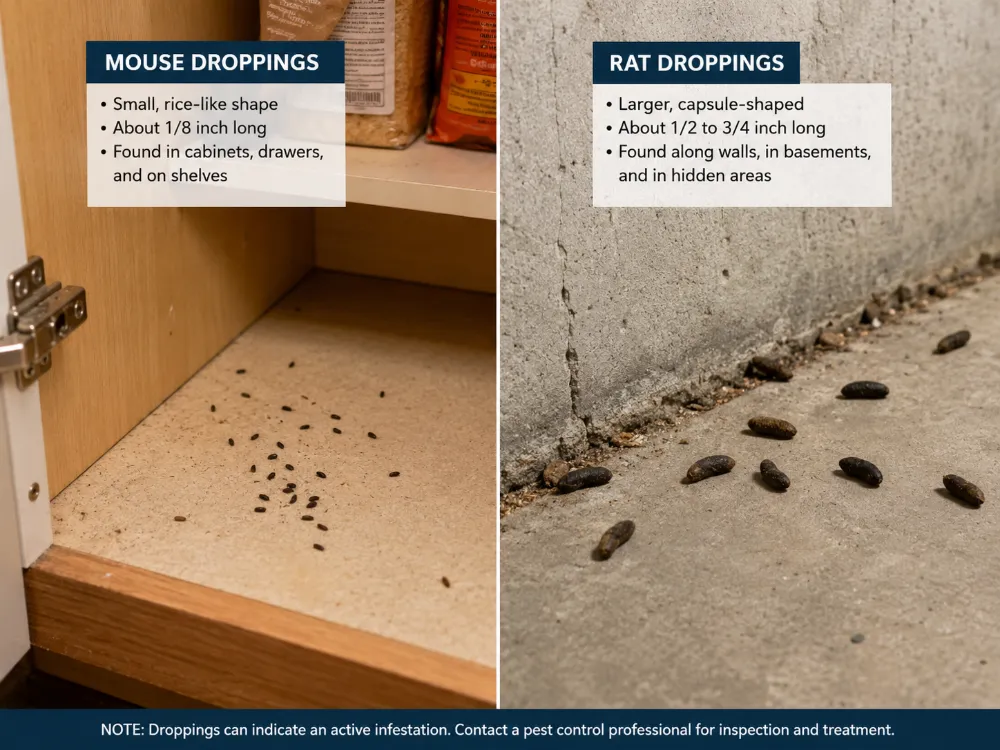
Mouse poop is much smaller than rat poop. It usually looks like tiny dark grains of rice. Mouse droppings are narrow, rod-shaped, and often pointed at one or both ends. Fresh droppings are dark and may look slightly shiny. Old droppings become gray, dry, and crumbly.
Mice produce many droppings as they move through an area. You may find them scattered along baseboards, inside drawers, under sinks, behind appliances, in pantries, or near food packaging.
If you see many tiny black pellets that look like rice grains, mouse activity is more likely than rat activity.
The Biggest Difference Is Size
Size is the easiest way to separate rat poop from mouse poop. Mouse droppings are usually only a few millimeters long. Rat droppings are usually several times larger.
Mouse poop is commonly about 3–6 mm long. Rat poop is commonly about 12–20 mm long. This means rat droppings may be three or four times longer than mouse droppings and much thicker overall.
If the droppings are tiny and rice-like, think mouse. If they are large, thick, and capsule-like, think rat.
Shape Differences
Mouse poop is usually thin, narrow, and pointed at the ends. It often looks like a small black grain of rice. Because mice are small and active, their droppings may appear scattered rather than neatly piled.
Rat poop is thicker and heavier. Norway rat droppings often have blunt ends and a capsule-like shape. Roof rat droppings may be more pointed and slightly curved, but they are still much larger than mouse droppings.
Shape can help, but size is usually more reliable. A very small pointed pellet is likely mouse poop. A large thick pellet is more likely rat poop.
Fresh vs Old Droppings
Fresh rodent droppings are usually dark, soft-looking, and sometimes shiny. They may appear moist if very recent. Old droppings become lighter, duller, drier, and more crumbly.
Fresh droppings suggest recent or active rodent movement. Old droppings may mean a past infestation, but they should still be cleaned carefully because dried droppings can become dusty and unsafe to disturb.
Do not crush droppings with bare hands to test freshness. Instead, use location, number, smell, and repeated findings over time to judge whether activity is ongoing.
Where Rat Droppings Are Commonly Found
Rats often travel along walls, fences, pipes, beams, foundations, and hidden edges. Their droppings may be found in basements, garages, crawl spaces, attics, sheds, outdoor storage areas, and around garbage or pet food.
Norway rats are strong burrowers and often stay low, near ground level, basements, drains, foundations, and crawl spaces. Roof rats are better climbers and may leave droppings in attics, rafters, trees, rooflines, and upper storage areas.
If droppings are large and found near structural gaps, gnaw marks, greasy rub marks, or burrow openings, rats may be the problem.
Where Mouse Droppings Are Commonly Found
Mouse droppings are often found indoors near food, warmth, and nesting materials. Common areas include kitchen cabinets, drawers, pantries, under sinks, behind ovens, behind refrigerators, closets, garages, attic insulation, and wall edges.
Mice can squeeze through very small openings and often nest close to food sources. Their droppings may appear inside food storage areas, near chewed packaging, or along hidden travel routes.
If you find many tiny droppings in cabinets, drawers, or near stored food, mice are more likely than rats.
Quantity and Scattering Pattern
Mice usually produce many small droppings and scatter them throughout their travel paths. A single active mouse can leave numerous droppings in one night. Because mice explore constantly, droppings may appear in many small clusters.
Rats also leave droppings, but their droppings are larger and may be fewer in number in a single visible area. Rat droppings often appear along regular routes, near feeding areas, or close to burrows and shelter.
Lots of tiny pellets across several indoor areas often suggest mice. Fewer but much larger droppings often suggest rats.
Rat Poop vs Mouse Poop by Smell
Droppings alone may not smell strongly, but active rodent areas often have a musky or stale urine odor. Mouse infestations can produce a sharp ammonia-like smell in enclosed spaces such as cabinets, drawers, closets, and wall voids.
Rat infestations may produce a heavier musky odor, especially in basements, garages, crawl spaces, attics, and outdoor nesting areas. Rats may also leave greasy rub marks along walls or beams because their fur contacts the same surfaces repeatedly.
Odor is not enough to identify the species, but odor plus dropping size, location, and gnaw marks can help.
Gnaw Marks and Other Signs
Rodent droppings are often found with other clues. Mice leave small gnaw marks on food packaging, cardboard, insulation, wires, and soft materials. Their nests may be made from shredded paper, fabric, insulation, or dried plant material.
Rats leave larger gnaw marks and can damage wood, plastic, pipes, wiring, doors, vents, and storage containers. Their teeth are stronger, and their damage may look rougher and more serious.
Other signs include footprints, tail marks in dust, scratching sounds, pet behavior changes, damaged food packaging, urine stains, burrow holes, and repeated droppings in the same places.
Rat Poop vs Mouse Poop vs Cockroach Droppings
Cockroach droppings are often confused with mouse droppings. Small cockroach droppings may look like black pepper, coffee grounds, or tiny dark specks. Larger cockroach droppings may look like small ridged cylinders.
Mouse droppings are usually larger than cockroach specks and more rice-shaped. They often have pointed ends. Rat droppings are much larger than both mouse and cockroach droppings.
If the material looks like fine black pepper near cabinets, appliances, or cracks, cockroaches may be involved. If it looks like small rice grains, mice are more likely.
Rat Poop vs Mouse Poop vs Bat Droppings
Bat droppings can resemble mouse droppings, but they often collect under roosting areas such as attic beams, eaves, vents, or entry points. Bat droppings are usually crumbly and may contain shiny insect fragments.
Mouse droppings are usually firmer, smoother, and found along travel paths near food or nesting sites. Bat droppings are more likely to appear in piles directly below where bats hang.
If droppings are found in an attic under a gap, vent, or roofline and crumble into shiny insect pieces, bats may be the source rather than mice.
Rat Poop vs Mouse Poop vs Squirrel Droppings
Squirrel droppings can sometimes resemble rat droppings, especially in attics. Squirrel droppings are often larger than mouse droppings and may be more rounded or oval. They may lighten with age and are commonly found near nesting areas in attics, roof spaces, or tree-access points.
Rat droppings are usually darker, more capsule-shaped, and associated with greasy rub marks, gnawing, burrows, or lower-level travel routes depending on species.
If you hear daytime scratching in the attic, see chewed entry holes near the roofline, and find larger oval droppings, squirrels may be possible. Rats and mice are more often active at night.
Why Rodent Droppings Are a Health Concern
Rat and mouse droppings can contaminate food, surfaces, storage areas, and indoor air if disturbed. Rodents may carry bacteria, viruses, parasites, and allergens. Their urine and nesting materials can also contribute to contamination.
The biggest mistake is treating droppings like ordinary dirt. Dry sweeping or vacuuming can stir up dust and particles. This may increase exposure risk, especially in enclosed areas with heavy contamination.
Droppings should be handled carefully, with ventilation, gloves, disinfectant, and safe disposal methods. If contamination is heavy, professional cleanup may be safer.
How to Clean Rat or Mouse Droppings Safely
Before cleaning, ventilate the area if possible and keep people and pets away. Wear disposable gloves. Do not sweep or vacuum dry droppings. Instead, wet the droppings and surrounding area with disinfectant or a bleach solution prepared according to product guidance.
Let the area stay wet long enough for disinfection. Then use paper towels or disposable cloths to pick up the droppings. Place waste in a sealed bag and discard it safely. Clean and disinfect surfaces afterward. Wash hands thoroughly after removing gloves.
For heavy infestations, droppings in air ducts, large attic contamination, or repeated exposure, contact a pest control or cleanup professional.
What Not to Do
Do not vacuum dry rodent droppings with a regular vacuum. Do not sweep them with a dry broom. Do not blow them with compressed air. Do not touch them with bare hands. Do not ignore droppings near food, children’s items, pet bowls, or kitchen surfaces.
Also avoid using only droppings as your full control plan. Cleaning removes evidence, but it does not solve the infestation if rodents still have entry points, food sources, water, and nesting sites.
Identification, cleanup, exclusion, trapping, and prevention should work together.
How to Know If the Infestation Is Active
Fresh dark droppings, new gnaw marks, scratching sounds at night, disturbed food, urine smell, and repeated droppings after cleaning all suggest active rodent presence.
You can also look for droppings in the same place over several nights. If new droppings appear after careful cleanup, rodents are still active. Small dusty footprints or tail marks in flour-like tracking dust may also reveal movement, but this should be done carefully and away from food areas.
If activity continues, the rodents are still entering, nesting, or feeding nearby.
Why Correct Identification Matters
Rat and mouse control strategies overlap, but they are not identical. Mice can enter through very tiny gaps and often nest indoors close to food. Rats need larger openings but can be stronger, more cautious, and more destructive.
Rat traps, mouse traps, bait stations, exclusion materials, and placement strategies differ by species. A trap that works for mice may be too small for rats. A rat may avoid poorly placed traps, while mice may explore them quickly.
Correctly identifying the droppings helps you choose the right control method and understand the seriousness of the problem.
How Mice Get Indoors
Mice can squeeze through very small gaps around doors, pipes, vents, utility lines, garage doors, foundations, and damaged siding. Once inside, they search for food, warmth, nesting material, and hidden shelter.
Because mice are small, even a gap that looks minor can be enough. They often move through wall voids, cabinets, crawl spaces, and attics. Food crumbs, pet food, bird seed, and poorly sealed pantry items can support an infestation.
Sealing entry points and removing food access are essential for long-term control.
How Rats Get Indoors
Rats may enter through gaps around foundations, drains, vents, doors, crawl spaces, garages, rooflines, and damaged exterior materials. Norway rats often burrow near foundations, sheds, compost areas, or garbage storage. Roof rats may use trees, vines, fences, wires, and roofs to reach upper entry points.
Rats are strong chewers and can enlarge small openings. They may also exploit broken vents, loose screens, gaps around pipes, or damaged garage doors.
Because rats are larger and more cautious, a serious rat problem often requires careful inspection and professional control.
Prevention Tips
Store food in sealed containers. Keep pet food closed and avoid leaving it out overnight. Clean crumbs and grease. Remove clutter that provides nesting space. Keep garbage sealed. Trim vegetation away from buildings. Repair gaps, cracks, screens, vents, and door sweeps.
Outdoors, reduce shelter near the foundation by moving wood piles, junk, dense vegetation, and unused materials away from walls. Check sheds, garages, compost areas, and bird-feeding zones for signs of rodents.
Prevention works best when food, water, shelter, and entry points are all addressed.
When to Call a Professional
Call a pest control professional if you find large rat droppings, repeated droppings after cleaning, strong urine odor, droppings in multiple rooms, damaged wiring, sounds in walls or ceilings, burrows near the foundation, or signs near children’s rooms, kitchens, or stored food.
Professional help is also recommended for heavy attic contamination, crawl spaces, HVAC areas, insulation damage, or situations where you are unsure whether droppings are from rats, mice, bats, squirrels, or cockroaches.
A serious rodent problem is easier to solve early than after a large breeding population becomes established.
How to Tell Rat Poop from Mouse Poop Quickly
Check size: mouse poop is small and rice-like; rat poop is much larger and capsule-like.
Check shape: mouse poop is thin and often pointed; rat poop is thicker and may be blunt or curved.
Check quantity: mice often leave many small scattered droppings; rats often leave fewer but larger droppings.
Check location: mice are common in cabinets and pantries; rats are common in basements, attics, garages, crawl spaces, and outdoor edges.
Check other signs: large gnaw marks and greasy rub marks suggest rats; tiny chewed food packaging suggests mice.
Clean safely: never dry sweep or vacuum rodent droppings.
Rat Poop vs Mouse Poop: Final Comparison
Rat poop and mouse poop are easiest to tell apart by size. Mouse droppings are small, dark, narrow, and rice-like, often scattered in large numbers near food, cabinets, drawers, and hidden indoor routes. Rat droppings are larger, thicker, and capsule-like, often found along walls, foundations, basements, attics, garages, crawl spaces, or outdoor travel paths.
Both types of droppings should be treated as contamination, not ordinary dust. Identify the rodent, clean safely, seal entry points, remove food sources, and take action early. If droppings keep appearing or the contamination is heavy, professional pest control is the safest next step.
FAQs About Rat Poop vs Mouse Poop
What is the main difference between rat poop and mouse poop?
The main difference is size. Mouse poop is small, narrow, and rice-like, usually about 3–6 mm long. Rat poop is much larger, thicker, and capsule-like, often about 12–20 mm long.
Does mouse poop look like black rice?
Yes. Mouse droppings often look like tiny black or dark brown grains of rice. They are usually narrow and may be pointed at the ends.
Does rat poop look like mouse poop?
Rat poop can look similar in color, but it is much larger and thicker. Rat droppings may look like dark capsules, beans, or large pellets rather than tiny rice grains.
How can I tell if rodent poop is fresh?
Fresh droppings are usually dark, soft-looking, and sometimes shiny. Old droppings are dull, grayish, dry, and crumbly. Do not touch or crush droppings to test them.
Where do mice usually leave droppings?
Mice often leave droppings in kitchen cabinets, drawers, pantries, under sinks, behind appliances, closets, garages, attics, and along baseboards or wall edges.
Where do rats usually leave droppings?
Rats may leave droppings in basements, garages, crawl spaces, attics, sheds, around foundations, near pet food, along walls, near drains, and close to burrows or regular travel routes.
Is rat poop dangerous?
Rat poop can be a health concern because it may contaminate surfaces, food, and indoor spaces. It should be cleaned carefully with gloves, disinfectant, and safe disposal methods.
Is mouse poop dangerous?
Mouse poop can also be a health concern. It may contaminate food and surfaces, and dried droppings should not be swept or vacuumed because dust can be disturbed.
Can I vacuum mouse or rat droppings?
No. Do not vacuum dry rodent droppings with a regular vacuum. Wet the droppings with disinfectant first and pick them up with disposable materials while wearing gloves.
Can I sweep rodent droppings?
No. Dry sweeping can stir up dust. Use disinfectant to wet the droppings and surrounding area before removal.
How many droppings does a mouse leave?
A mouse can leave many droppings in a single night. If you see numerous tiny pellets scattered in several areas, mice may be active nearby.
How many droppings does a rat leave?
Rats also leave droppings regularly, but their droppings are larger and may appear in smaller visible numbers than mouse droppings. Finding even a few large rat droppings should be taken seriously.
What else looks like mouse poop?
Cockroach droppings, bat droppings, and small insect debris can sometimes look like mouse poop. Cockroach droppings may look like black pepper or coffee grounds, while bat droppings often crumble and may contain shiny insect fragments.
What else looks like rat poop?
Squirrel droppings, large cockroach droppings, and some bat droppings can be confused with rat droppings. Location, size, texture, odor, and other signs help identify the source.
What should I do if I find droppings in my kitchen?
Keep children and pets away, avoid sweeping or vacuuming, disinfect the area, remove contaminated food, store food in sealed containers, inspect for entry points, and consider pest control if new droppings appear.
When should I call pest control?
Call pest control if droppings keep appearing, you find large rat droppings, you hear scratching in walls, you see gnaw damage, you find droppings in multiple rooms, or contamination is heavy in attics, crawl spaces, or food areas.