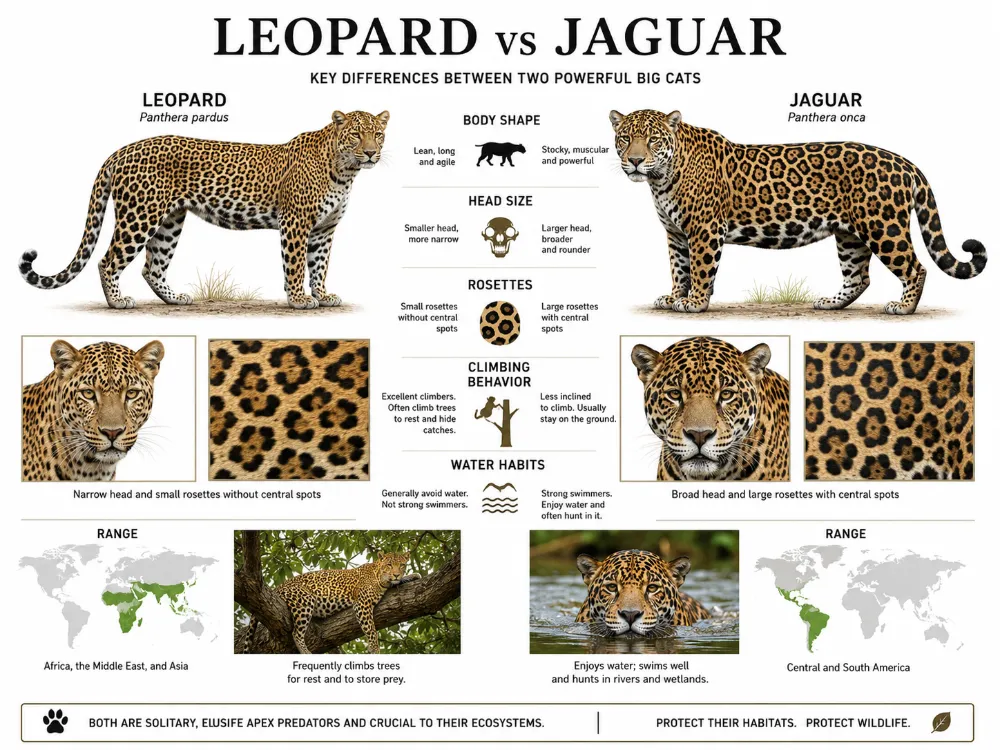
The easiest way to tell a leopard from a jaguar is to look at the body, head, and rosettes. Jaguars are usually stockier, broader-headed, and more muscular, with larger rosettes that often contain small central dots. Leopards are usually slimmer, lighter-built, and longer-bodied, with smaller rosettes that usually do not contain central spots. They also live on different continents, use habitat differently, and hunt in slightly different ways.
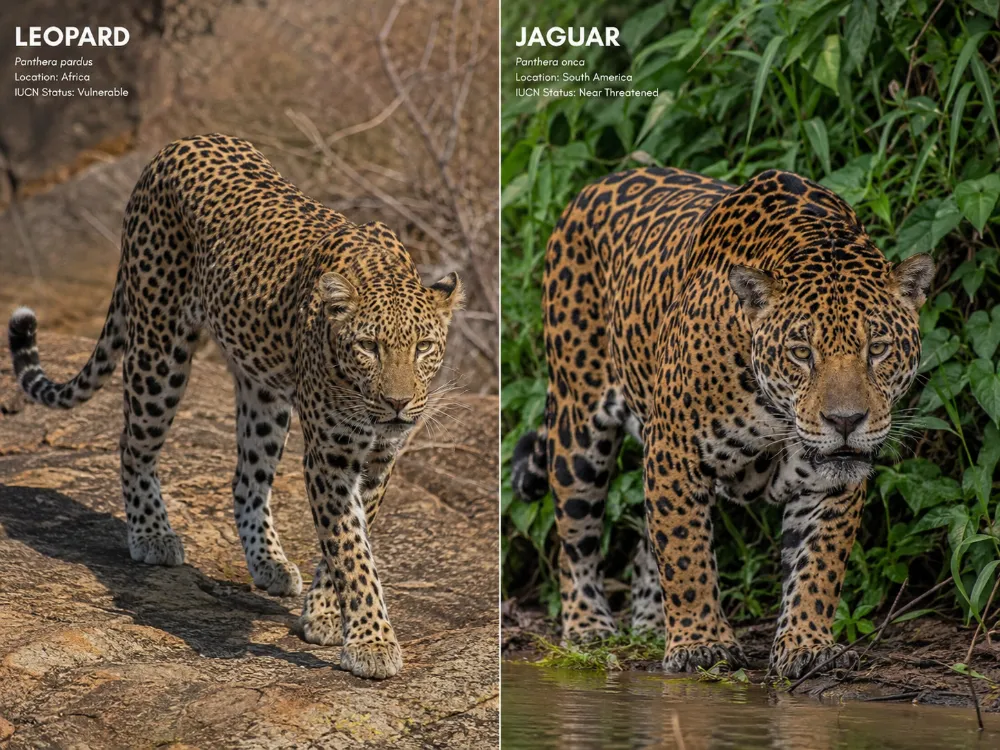
People confuse leopards and jaguars because both are powerful spotted cats with golden coats and black markings. In photographs, especially when there is no clear scale, they can look almost interchangeable. Once you know what to check, however, the differences become much easier to spot.
In this guide, you will learn how leopards and jaguars differ in appearance, range, behavior, hunting style, and habitat, plus the quickest ways to identify them correctly.
Quick comparison table
| Feature | Leopard | Jaguar |
|---|---|---|
| Main range | Africa and parts of Asia | Central and South America |
| Build | Slimmer, lighter, longer-bodied | Stockier, heavier, more muscular |
| Head shape | Narrower and less massive | Broader, deeper, more powerful-looking |
| Rosettes | Smaller rosettes, usually without central dots | Larger rosettes, often with central dots |
| Tree use | Excellent climber, often stores prey in trees | Can climb, but more strongly associated with ground hunting and water |
| Water habits | Can swim, but usually less water-associated | Often very comfortable in water |
| Bite style | Usually throat bite or suffocation | Very powerful bite, often crushes skull or shell |
| Overall impression | Graceful, adaptable, stealthy | Compact, forceful, powerfully built |
They are close relatives, but not the same cat
Leopards and jaguars are both big cats in the genus Panthera, so they are closely related. That shared ancestry explains why both have spotted coats, strong bodies, retractable claws, and stealthy hunting behavior.
However, they are different species that evolved in different parts of the world. The leopard is native to Africa and parts of Asia, while the jaguar is native to the Americas. Their separate evolutionary histories shaped differences in build, prey choice, and habitat use.
So even though they may look alike at first glance, they are not regional versions of the same animal.
Jaguars are usually heavier and more compact
One of the clearest differences is overall build. Jaguars usually look more compact, deeper-chested, and more powerfully muscled than leopards. Their body often seems dense and solid, especially through the shoulders, neck, and chest.
Leopards are strong cats too, but they usually look longer and lighter. Their body shape often appears more stretched and athletic rather than blocky and thick.
If the cat looks unusually robust for its size, with a heavy front half and compact power, it is more likely to be a jaguar.
The head shape is a major clue
Jaguars usually have a broader, heavier head than leopards. The skull looks deeper, the jaw area looks thicker, and the entire face often appears more massive.
Leopards generally have a smaller, narrower, and more refined head. They still look powerful, but not as broad-faced as jaguars.
In close photos, the head can be one of the quickest ways to separate the two. A large, blocky head usually points toward jaguar.
The rosettes are not the same
Both cats have rosettes, but the details are different. Jaguar rosettes are usually larger, more open, and often contain one or more small black dots inside. This is one of the best-known jaguar features.
Leopard rosettes are usually smaller, more tightly packed, and generally do not have the same obvious central dots. Their pattern tends to look more crowded and finer-textured.
If the rosettes look large and often contain inner spots, think jaguar. If they look smaller and cleaner inside, think leopard.
Leopards usually look more graceful and stretched
Leopards often have a more elegant outline. Their body can look longer in proportion to height, and their limbs may seem slimmer and more lightly built.
Jaguars often look shorter, broader, and more heavily set. Even when walking, they tend to project a sense of brute power rather than lightness.
This is why leopards are often described as sleek, while jaguars are often described as muscular and compact.
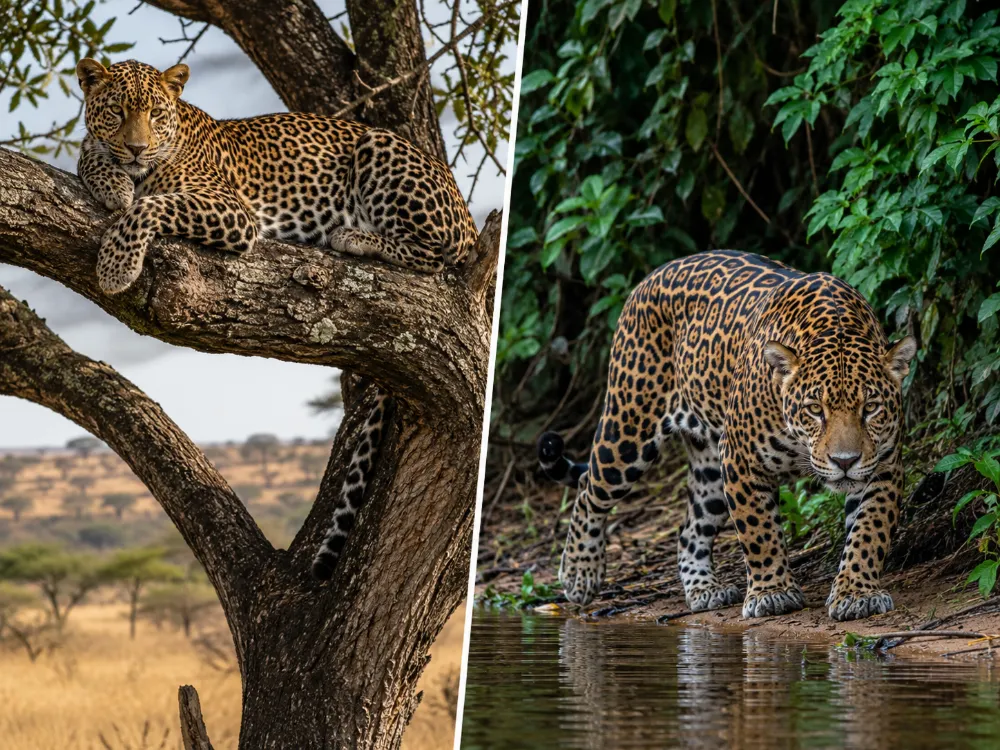
Range is one of the easiest differences
Leopards are found in Africa and parts of Asia. Their range is broad and includes savannas, forests, mountains, scrublands, and some human-modified landscapes.
Jaguars live in Central and South America, with their strongest populations now associated with tropical forests, wetlands, and river systems. Historically they ranged farther north, but today they are mainly a cat of the Americas.
So geography alone can often solve the question. In Africa or India, the spotted big cat is far more likely to be a leopard. In Brazil or the Pantanal, it is far more likely to be a jaguar.
Jaguars are more strongly linked with water
Jaguars are especially well known for their comfort around water. They often live in wet forests, river edges, swamps, floodplains, and other water-rich environments. They swim readily and may hunt aquatic or semi-aquatic prey more often than leopards do.
Leopards can swim too, but they are not usually as strongly associated with water-based hunting. They are better known as highly flexible cats that use cover across many types of land habitat.
This difference helps shape their image: the jaguar is often the spotted cat of rivers and wetlands, while the leopard is the spotted cat of many landscapes.
Leopards are famous for climbing and storing prey in trees
Leopards are excellent climbers and are famous for dragging prey into trees. This helps protect kills from scavengers and larger predators. A leopard resting on a branch with a carcass is one of the classic images of African wildlife.
Jaguars can climb as well, but they are usually less strongly associated with tree-stored prey in popular wildlife observation. Their reputation is more grounded in strength at ground level and power near water.
If a spotted cat is comfortably draped across a tree branch with a kill, leopard is usually the stronger guess.
Jaguars have a famously powerful bite
Jaguars are known for having an extremely powerful bite relative to their size. They often kill in ways that reflect this strength, including biting through skulls or piercing hard-bodied prey such as turtles and caimans in some habitats.
Leopards are also effective killers, but they are more commonly associated with the classic throat bite or suffocating grip used by many big cats. They depend on stealth, precision, and control rather than the same reputation for skull-crushing force.
This difference is closely tied to the jaguar’s deeper skull and heavier jaw musculature.
They use habitat differently
Leopards are among the most adaptable big cats in the world. They can survive in forests, savannas, rocky hills, dry scrub, mountain country, and even near human settlement when cover and prey remain available.
Jaguars also use a range of habitats, but they are especially linked with dense vegetation, tropical forest, wetlands, and river systems. They often seem more tied to thick cover and water-rich landscapes.
So while both are stealthy spotted cats, the leopard often feels like a generalist, while the jaguar often feels like a specialist in heavy, productive cover.
Prey choice often reflects their environment
Leopards eat a wide variety of prey, including antelope, monkeys, rodents, birds, reptiles, and smaller mammals. Their adaptability means they can switch prey according to local opportunity.
Jaguars also eat many kinds of prey, but they are especially associated with animals such as peccaries, capybaras, deer, caimans, turtles, and other heavy-bodied or wetland-linked prey. Their jaw power helps them exploit prey that other big cats may handle differently.
Both are opportunistic ambush predators, but jaguars are more strongly associated with crushing power and wetland prey, while leopards are more famous for wide ecological flexibility.
Black leopards and black jaguars add to the confusion
Both leopards and jaguars can occur in melanistic forms, often called black panthers. In the right light, the rosette pattern is usually still faintly visible beneath the dark coat.
This can make identification even harder because the normal golden background is partly hidden. In those cases, location becomes extremely important. A black panther in Africa or Asia is usually a leopard, while a black panther in the Americas is a jaguar.
So geography becomes even more useful when color no longer helps much.
Why people confuse them so often
People confuse leopards and jaguars because both are spotted, muscular, and golden-toned big cats with rosettes. In photos without scale or habitat clues, the difference can be subtle at first.
Popular culture also tends to blur them together. A generic “spotted jungle cat” may be labeled incorrectly, and many viewers do not know to look for head shape and rosette details.
The biggest mistake is seeing only “spots” and ignoring the structure of the body and the pattern of the coat.
How to tell them apart quickly
If you need a fast field guide, use these clues together:
Leopard: slimmer body, narrower head, smaller rosettes without central dots, strong tree use, Africa or Asia
Jaguar: stockier body, broader head, larger rosettes often with central dots, strong water association, Americas
No single clue is perfect every time, but this combination is usually very reliable.
Which one is stronger?
If strength means raw muscular power and bite force, the jaguar usually has the stronger reputation. Its compact body and heavy skull make it seem especially powerful among spotted big cats.
If strength means ecological flexibility and the ability to survive across many different landscapes, the leopard often stands out. Leopards are among the most adaptable big cats in the world.
So the answer depends on what kind of strength you mean. Jaguar usually wins in brute force, while leopard often wins in versatility.
Final takeaway
The main difference between a leopard and a jaguar is that leopards are slimmer, narrower-headed spotted cats of Africa and Asia, while jaguars are heavier, broader-headed, more powerfully built spotted cats of the Americas. Leopards usually have smaller rosettes without central dots and are famous for climbing and storing prey in trees. Jaguars usually have larger rosettes with central dots and are especially associated with water, strong jaws, and crushing bite force. They may look similar at first, but once you check the build, head, and spots, the difference becomes much clearer.
FAQs
How can I tell a leopard from a jaguar fast?
Look at the body and rosettes. Leopards are slimmer with smaller rosettes, while jaguars are stockier with larger rosettes that often contain central dots.
Is a jaguar bigger than a leopard?
Jaguars are usually heavier and more powerfully built, while leopards are generally slimmer and lighter in appearance.
Do leopards and jaguars live in the same place?
No. Leopards live in Africa and parts of Asia, while jaguars live in Central and South America.
Which climbs trees better, a leopard or a jaguar?
Leopards are especially famous for climbing and carrying prey into trees, although jaguars can climb too.