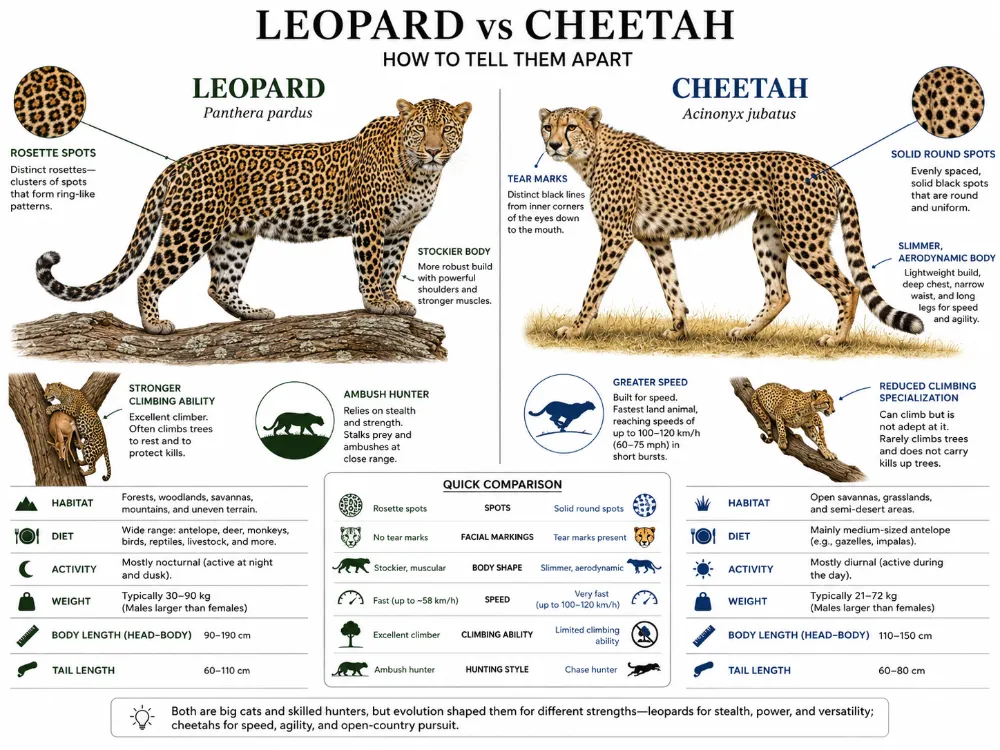
The easiest way to tell a leopard from a cheetah is to look at the body, face, and spots. Cheetahs are slimmer, longer-legged, and built for speed, with solid black spots and dark tear marks running from the eyes to the mouth. Leopards are stockier, more muscular, and better climbers, with rosette-shaped spots instead of solid dots. They also hunt differently, use habitat differently, and belong to different branches of the big cat world.
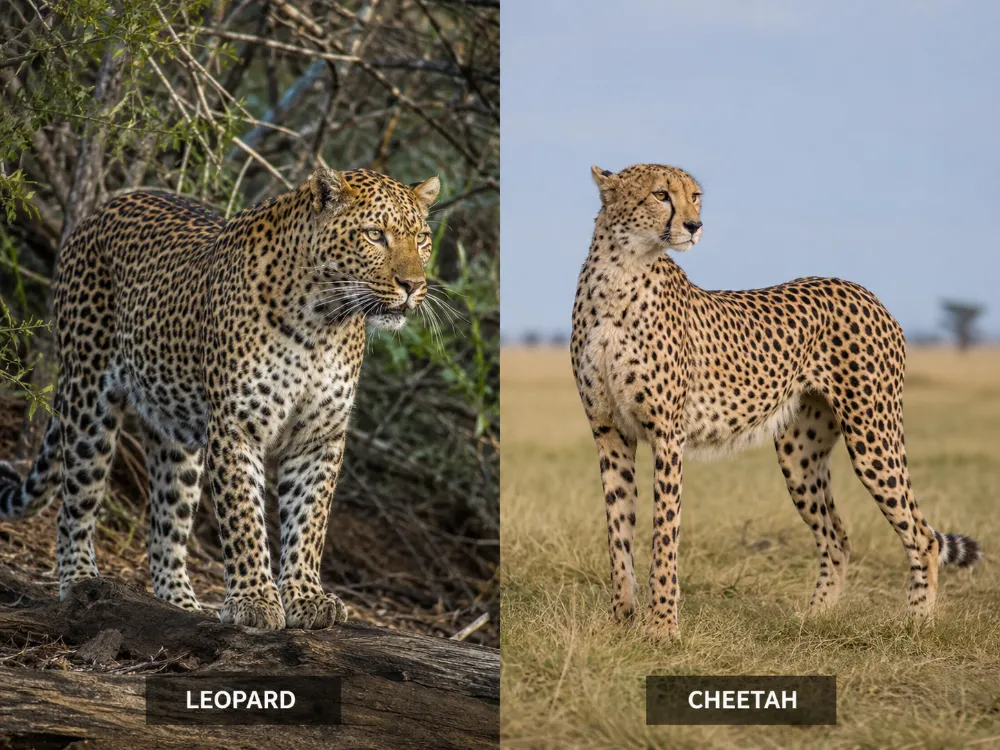
People confuse leopards and cheetahs because both are spotted cats with golden coats and an African range. At a quick glance, especially in photos, they can look similar. Once you know what to look for, though, the differences are obvious.
In this guide, you will learn how leopards and cheetahs differ in appearance, behavior, hunting style, habitat, and movement, plus the fastest ways to identify them correctly.
Quick comparison table
| Feature | Leopard | Cheetah |
|---|---|---|
| Body build | Stockier, heavier, more muscular | Slimmer, lighter, built for speed |
| Spot pattern | Rosettes with open centers | Solid round black spots |
| Face markings | No dark tear lines | Distinct black tear marks from eyes to mouth |
| Head shape | Broader, heavier head | Smaller, lighter, more aerodynamic head |
| Main hunting style | Stealth and ambush | High-speed chase |
| Tree use | Excellent climber, often stores prey in trees | Can climb a little, but much less tree-focused |
| Typical range | Africa and parts of Asia | Africa, with a very small remnant population in Iran |
| Best quick clue | Rosettes and stocky body | Tear marks and solid spots |
They are different cats, not just different names
Leopards and cheetahs are both members of the cat family, but they are not the same kind of cat. Leopards belong to the genus Panthera, the same broader group as lions, tigers, and jaguars. Cheetahs belong to a different genus and are more specialized for speed than for brute power.
This difference matters because it helps explain why their bodies work so differently. Leopards are built more like stealthy, muscular ambush predators. Cheetahs are built more like lightweight sprint specialists.
So while both are spotted cats, they are not simply two versions of the same animal.
Cheetahs are built for speed
The cheetah is the more lightly built cat. It has a narrow body, long legs, a deep chest, a flexible spine, and a long tail that helps with balance during fast turns. Everything about the cheetah’s shape supports speed.
This is why a cheetah often looks taller and leggier than a leopard. Even when standing still, it usually appears lean, athletic, and almost delicate compared with the heavier build of a leopard.
If the cat looks like a sprinting machine with long legs and a narrow waist, it is much more likely to be a cheetah.
Leopards are stronger and more muscular
Leopards usually look heavier, denser, and more powerful. Their body is compact and muscular, with a broader chest and thicker neck than a cheetah. They are not built for extreme speed over open ground in the same way.
Instead, leopards are built for stealth, power, climbing, and dragging prey. A leopard often looks like a cat that could wrestle with heavy prey and then carry it into a tree.
If the animal looks solid, strong, and stocky rather than long-legged and lightweight, leopard becomes much more likely.
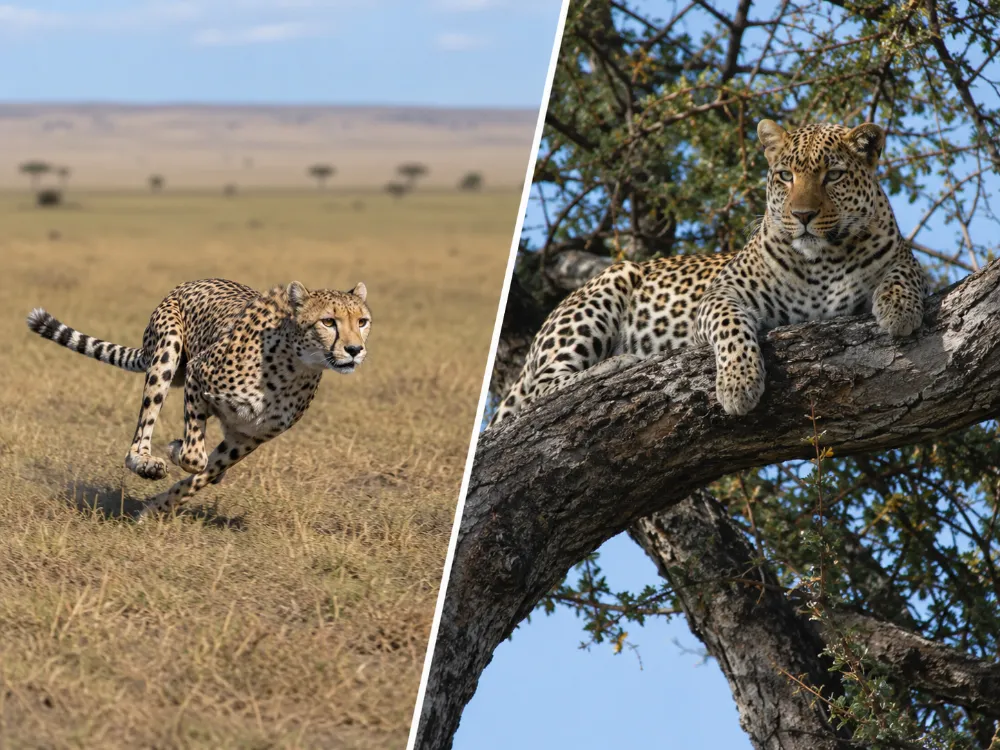
The spots are one of the clearest clues
Spot pattern is one of the fastest ways to separate the two. Cheetahs have solid black spots that are fairly evenly distributed across the body. These are true dots, not open-centered patterns.
Leopards have rosettes instead of simple solid spots. A rosette looks like a ring or cluster of dark markings with a lighter center. From a distance, these patterns can seem like spots, but up close they are clearly different.
If the markings look like plain black dots, think cheetah. If they look like rose-shaped clusters, think leopard.
Cheetahs have tear marks on the face
The cheetah’s face usually has a very distinctive feature: black tear marks running from the inner corners of the eyes down toward the mouth. These dark lines make the face look dramatic and are one of the most famous cheetah field marks.
Leopards do not have the same strong tear lines. Their face may still show markings and spots, but not the bold dark streaks that make a cheetah look almost painted.
If you can see the face clearly and those tear marks are present, the cat is almost certainly a cheetah.
Leopards have a broader head
Leopards usually have a larger, broader, and heavier-looking head than cheetahs. The jaw area looks stronger, and the whole skull appears more powerful relative to body size.
Cheetahs usually have a smaller, more aerodynamic head. This makes sense because a speed-adapted predator benefits from reduced drag and lighter build.
This head difference is especially helpful in side view or close photographs.
They hunt in very different ways
Cheetahs are famous for high-speed pursuit. They usually hunt by spotting prey, stalking to a reasonable distance, and then launching a fast chase. Their success depends on acceleration, speed, and balance.
Leopards usually hunt more like classic ambush cats. They use cover, shadows, and stealth to approach closely, then explode in a short rush or leap. They rely less on open speed and more on surprise and strength.
This is one of the biggest ecological differences between them. A cheetah is a sprinter. A leopard is a stealth attacker.
Cheetahs are faster, but leopards are more powerful
If the question is speed, the cheetah is the clear winner. It is the most famous sprinting cat in the world and is specialized for rapid bursts across open ground.
If the question is strength, climbing, and carrying power, the leopard usually has the advantage. Leopards are known for dragging heavy prey into trees, something far more difficult for a cheetah.
So each cat is outstanding, but in very different ways. Cheetahs dominate the sprint. Leopards dominate the power game.
Leopards are much better climbers
Leopards are excellent climbers and often haul prey into trees to protect it from scavengers such as hyenas or lions. This tree-carrying behavior is one of the classic leopard traits.
Cheetahs can climb somewhat, especially onto low mounds, fallen trees, or gentle rises to scan the landscape, but they are not built like dedicated tree-hauling cats. Their lighter build helps them run, not wrestle carcasses into branches.
If you see a spotted cat comfortably resting in a tree with prey, leopard is the more likely answer.
They use different habitats differently
Leopards are extremely adaptable. They can live in savannas, forests, mountains, scrub, and in some places surprisingly close to human settlement if enough cover and prey remain. Their flexibility is one of the reasons they have such a broad range.
Cheetahs are more closely associated with open habitats where speed matters, such as grasslands, plains, and open savannas. They need room to see prey and space to run effectively.
This means the same landscape can suit both cats, but they often use it differently. Leopards prefer cover and ambush opportunities. Cheetahs prefer visibility and open chase space.
Leopards are more secretive around people
Leopards are famous for stealth and secrecy. In some regions they survive close to humans partly because they are so elusive and adaptable. They can move quietly, hide well, and remain unseen even in occupied landscapes.
Cheetahs are also cautious, but they are usually less associated with dense cover and more with daylight activity in open country. Their visibility in open land makes them feel different in the field.
So while both can be hard to see, leopards often feel more like hidden shadows of the landscape.
Cheetahs usually hunt in daylight
Cheetahs often hunt by day, especially in the early morning or late afternoon. This may help them avoid some competition from stronger predators that are more active at other times, and it suits an animal that depends on visual tracking across open ground.
Leopards are more flexible and often strongly nocturnal or crepuscular, using darkness and cover to approach prey without being seen.
This difference is not absolute, but it adds to the overall contrast in lifestyle between the two species.
Range is a major clue
Leopards are found across much of Africa and also in parts of Asia. Their range is broader and more geographically varied than that of the cheetah.
Cheetahs are now found mainly in Africa, with only a tiny remnant population in Iran. This much narrower modern range reflects both ecological specialization and historical decline.
So in Asia, a wild spotted big cat is much more likely to be a leopard than a cheetah.
Black leopards add to the confusion
Leopards can occur in melanistic forms, often called black panthers. In the right light, the rosettes are still usually visible beneath the dark coat. This melanistic form is well known in leopards.
Cheetahs do not have the same iconic “black panther” role in popular culture. Their spotted appearance is one of their clearest identifying traits.
This means that if a “black panther” is being discussed in Africa or Asia, it is usually a leopard, not a cheetah.
Why people confuse them so often
People confuse leopards and cheetahs because both are medium-to-large spotted cats with golden coats. In casual speech, many people just see “a spotted wild cat” and stop there.
Photos without scale, distance, or habitat clues make the problem worse. If you cannot see the face clearly and the body posture is unclear, both animals can seem surprisingly similar.
Once you focus on tear marks, spot type, and body build, the confusion usually disappears.
How to tell them apart quickly
If you need a fast field guide, use these clues together:
Cheetah: slim body, long legs, small head, solid black spots, black tear marks, built for speed
Leopard: stockier body, broader head, rosettes instead of solid dots, stronger climber, built for stealth and power
No single clue is perfect every time, but this combination is usually very reliable.
Which one is more dangerous?
Both are wild predators and should be treated with respect. Leopards are generally the more powerful and more versatile predator, especially in close combat or ambush situations. They are also stronger relative to body size and more capable of handling heavy prey.
Cheetahs are dangerous animals too, but they are more lightly built and less suited to fighting larger competitors head-on. Their survival depends more on speed and caution than on dominating every confrontation.
So if the question is raw predatory power, the leopard usually has the stronger reputation.
Final takeaway
The main difference between a leopard and a cheetah is that cheetahs are lightweight sprint specialists with solid black spots and dark tear marks, while leopards are stockier ambush predators with rosette-shaped spots and a more powerful build. Cheetahs are built for speed across open ground, while leopards are built for stealth, climbing, and strength. They may both be spotted cats, but once you know the face, spot, and body clues, they are much easier to tell apart.
FAQs
How can I tell a leopard from a cheetah fast?
Look at the face and spots. Cheetahs have black tear marks and solid spots, while leopards have no tear marks and rosette-shaped markings.
Is a cheetah faster than a leopard?
Yes. The cheetah is much faster and is specially built for sprinting.
Which one climbs trees better, leopard or cheetah?
Leopards are much better climbers and often carry prey into trees.
Do leopards and cheetahs live in the same places?
They can overlap in parts of Africa, but they use habitat differently. Leopards often prefer more cover, while cheetahs usually prefer more open country.