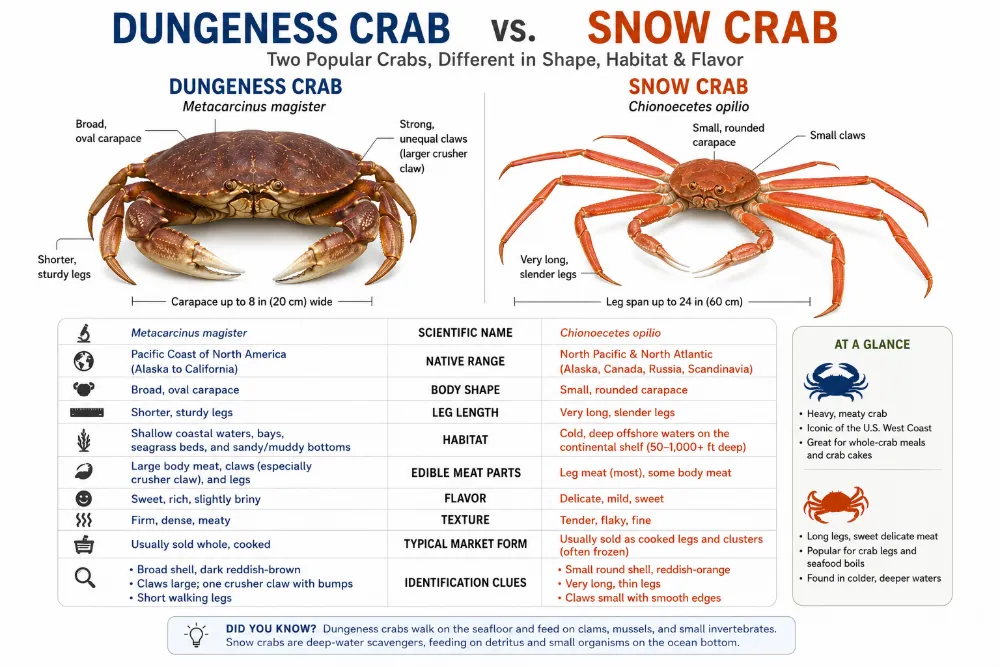
Dungeness crab and snow crab are different crab types with different shapes, habitats, and meat qualities. Dungeness crab is a broad-bodied Pacific coast crab with a large edible body, sweet briny flavor, and firm meat. Snow crab is a cold-water crab with long slender legs, smaller body, and delicate sweet leg meat. Dungeness is often valued for whole-crab meat, while snow crab is famous for leg clusters.
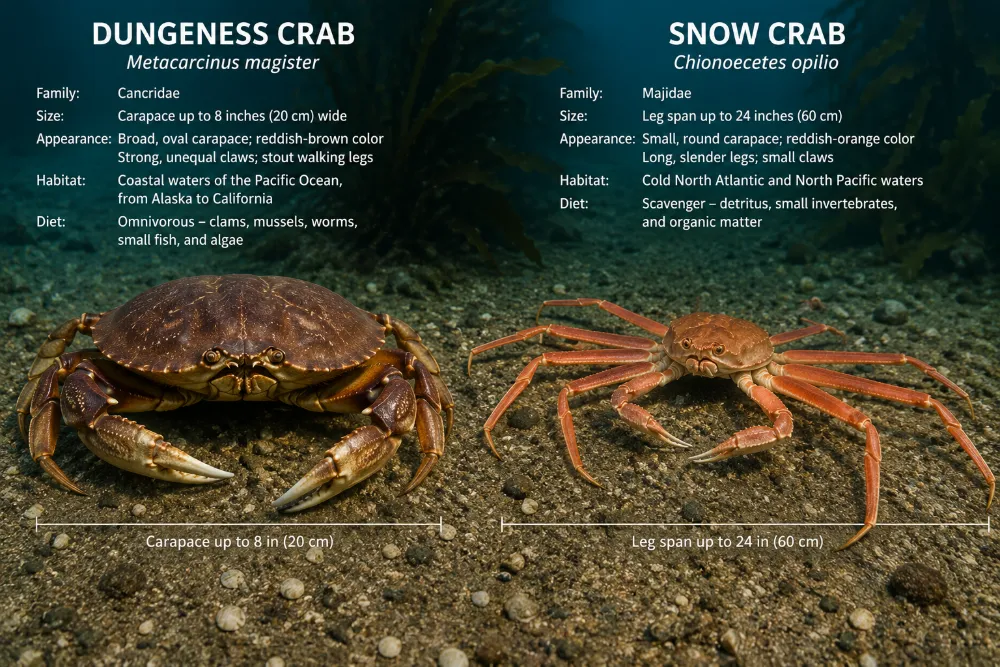
Quick Comparison Table
| Feature | Dungeness Crab | Snow Crab |
|---|---|---|
| Common name | Dungeness crab | Snow crab |
| Scientific name | Metacarcinus magister | Usually Chionoecetes opilio, though “snow crab” can refer to related species |
| Native range | Pacific coast of North America | Cold northern waters of the North Atlantic and North Pacific |
| Body shape | Wide, oval, heavy-bodied crab | Smaller body with long, slender legs |
| Typical market form | Often sold whole, cooked, or as picked meat | Often sold as cooked leg clusters |
| Main edible parts | Body, legs, and claws | Mostly legs and claws |
| Meat texture | Firm, moist, slightly flaky | Tender, delicate, stringy leg meat |
| Flavor | Sweet, briny, rich, slightly nutty | Sweet, mild, clean, delicate |
| Habitat | Sandy and muddy coastal bottoms, bays, estuaries, nearshore waters | Cold deeper seafloor habitats on continental shelves |
| Best identification clue | Broad oval shell and heavy body | Long thin legs and smaller central body |
What Is a Dungeness Crab?
The Dungeness crab is a large edible crab native to the Pacific coast of North America. Its scientific name is Metacarcinus magister. It is especially associated with coastal waters from California to Alaska, where it lives on sandy, muddy, and gravelly seafloors.
Dungeness crabs have broad oval shells, strong claws, and a relatively heavy body compared with long-legged crabs. The shell is usually purplish-brown, reddish-brown, or gray-brown on top, with a lighter underside. The claws often have pale tips, and the body is built for walking across the seafloor rather than swimming through open water.
As seafood, Dungeness crab is prized because much of the body contains edible meat. Unlike some crabs that are mainly eaten for their legs, Dungeness crab offers meat from the body, legs, and claws. Its flavor is sweet, clean, briny, and slightly nutty.
What Is a Snow Crab?
Snow crab is the common name for cold-water crabs in the genus Chionoecetes, especially Chionoecetes opilio. Snow crabs live in cold northern oceans, including parts of the North Atlantic and North Pacific. They are adapted to chilly seafloor habitats and are often harvested from deeper waters than Dungeness crabs.
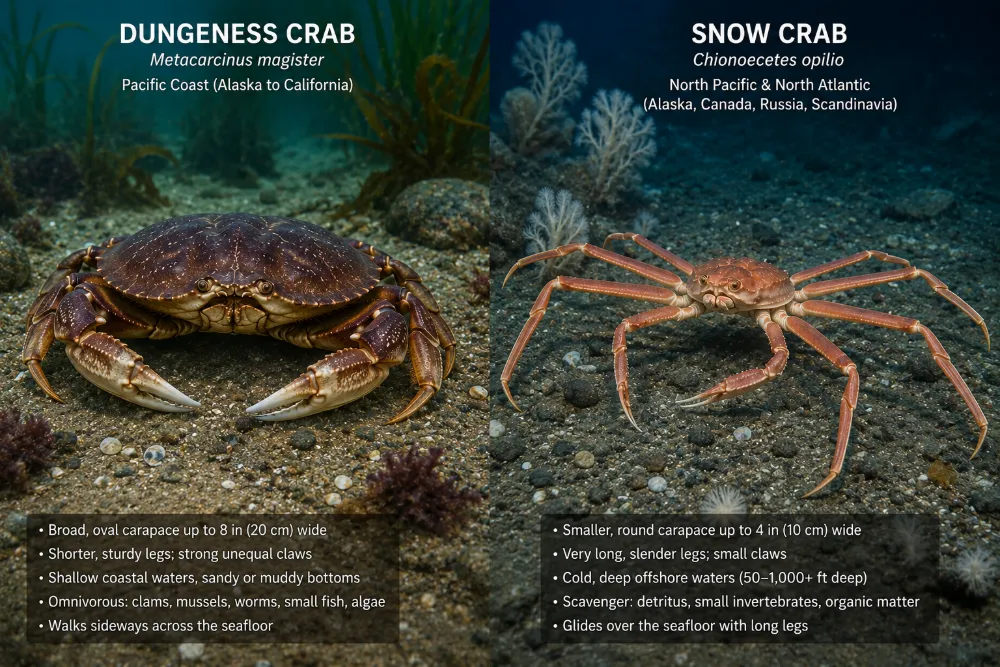
Snow crabs have long, slender legs and a smaller central body. Their body shape looks more spider-like than the broad, heavy shape of a Dungeness crab. This long-legged form is one reason snow crab is usually sold as leg clusters rather than whole crabs.
Snow crab meat is known for being sweet, mild, tender, and easy to pull from the legs in long strands. It is less rich and less body-heavy than Dungeness crab, but many people enjoy its delicate flavor and convenient leg meat.
The Main Difference Between Dungeness Crab and Snow Crab
The main difference is body design. Dungeness crab is a broad-bodied coastal crab with a large edible body and firm, sweet meat. Snow crab is a cold-water long-legged crab with a smaller body and tender, sweet leg meat.
Dungeness crab is often eaten whole or picked for body, leg, and claw meat. Snow crab is most often sold as cooked leg clusters because the legs are the most valuable and convenient edible part.
If the crab has a wide oval shell and a heavy body, it is likely Dungeness. If it has long thin legs and a smaller body, it is likely snow crab.
Size and Body Shape
Dungeness crabs have a broad, solid body. Mature market-sized individuals often have a shell width of around 6 to 8 inches, though size varies. The crab looks compact, strong, and heavy, with a wide carapace and relatively shorter legs compared with snow crab.
Snow crabs have smaller bodies but much longer legs. The body may not look as impressive as a Dungeness crab’s body, but the leg span can be large. Their long, slender legs are the reason snow crab portions are often sold in clusters.
In simple visual terms, Dungeness crab looks like a classic wide coastal crab, while snow crab looks more like a long-legged cold-water crab.
Shell, Color, and Identification
Dungeness crabs usually have a smooth, broad shell with a slightly scalloped front edge. The top of the shell is often brownish, purplish, or reddish-brown, while the underside is pale. The claws are strong and rounded, with lighter tips.
Snow crabs usually have a reddish-brown upper shell and pale underside. Their legs are long, thin, and jointed, with a more delicate appearance. The central body is much smaller relative to the legs.
For quick identification, look at proportions. A crab with a large edible body and moderate legs is probably Dungeness. A crab with very long legs and a small body is probably snow crab.
Habitat and Natural Range
Dungeness crabs live along the Pacific coast of North America. They are commonly found in bays, estuaries, coastal waters, and sandy or muddy seafloor habitats. Juveniles may use protected shallow habitats, while adults can move into deeper nearshore waters.
Snow crabs live in colder northern seas. They are associated with cold seafloor habitats, often on continental shelves. Their range includes parts of the North Pacific and North Atlantic, depending on the species being discussed.
This habitat difference affects their biology. Dungeness crabs are coastal bottom-walkers in temperate Pacific waters. Snow crabs are cold-water seafloor crabs adapted to colder, often deeper environments.
Diet and Feeding Behavior
Dungeness crabs are opportunistic bottom feeders. They eat clams, mussels, small fish, worms, shrimp, carrion, and other organic material they can find on the seafloor. Their claws help them handle food, break shells, and tear apart prey or carrion.
Snow crabs also feed on seafloor animals. Their diet may include worms, clams, brittle stars, small crustaceans, detritus, and other benthic organisms. Like many crabs, they are opportunistic and will feed on both live prey and dead organic matter.
Both species play important ecological roles as scavengers and predators. They help recycle nutrients on the seafloor and connect smaller bottom-dwelling organisms to larger predators.
Meat Location and Yield
One of the biggest culinary differences is where the meat is found. Dungeness crab has valuable meat in the body, legs, and claws. This makes it popular as a whole crab, because the body is worth picking carefully.
Snow crab is mainly valued for its legs and claws. The body is smaller and less commonly the focus of the meal. When people buy snow crab, they usually buy clusters that include several legs attached to a shoulder section.
If you enjoy picking meat from a whole crab, Dungeness can be more satisfying. If you want easy-to-access leg meat, snow crab is often more convenient.
Taste and Texture
Dungeness crab meat is sweet, briny, firm, and slightly nutty. The body meat can be especially flavorful, while the claw and leg meat are firmer and clean-tasting. Many people describe Dungeness as richer and more complex than snow crab.
Snow crab meat is sweet, mild, and delicate. The leg meat often pulls out in long, tender strands. It is less rich than Dungeness crab but very pleasant for people who prefer a cleaner, lighter crab flavor.
In simple food terms, Dungeness is fuller-bodied and more crab-forward, while snow crab is lighter, sweeter, and easier to eat from the legs.
Dungeness Crab vs Snow Crab in Cooking
Dungeness crab is commonly steamed, boiled, roasted, cracked, served chilled, or used in crab cakes, crab salads, pasta, soups, and seafood stews. Because the body meat is important, many preparations focus on the whole crab.
Snow crab is often pre-cooked and frozen soon after harvest, then reheated by steaming, boiling, baking, or grilling. Since the leg meat is the main attraction, snow crab is commonly served with melted butter, lemon, garlic, or simple dipping sauces.
Dungeness crab can stand up well in recipes where crab flavor should be prominent. Snow crab is excellent for simple meals where the sweetness of the leg meat is the focus.
Which Crab Is Easier to Eat?
Snow crab is usually easier for beginners to eat because the legs are long and the meat can often be pulled out in strips. The shells are generally easier to crack than thicker crab shells, and the leg clusters are convenient.
Dungeness crab requires more picking, especially if you want to get the body meat. This can take more time, but it also gives a higher variety of textures and flavors from different parts of the crab.
If convenience matters most, snow crab may be easier. If flavor variety and whole-crab experience matter more, Dungeness is often more rewarding.
Life Cycle and Molting
Like all crabs, Dungeness and snow crabs grow by molting. Their hard outer shell cannot expand, so the crab must shed it and form a new, larger shell. After molting, the crab is soft and vulnerable until the new shell hardens.
Dungeness crabs often use coastal habitats during different life stages. Young crabs may live in protected areas where they can hide and grow before moving into broader adult habitats.
Snow crabs also molt as they grow, but their cold-water environment affects growth rates and timing. Cold water can slow metabolism, and snow crab populations can be strongly influenced by temperature, food availability, predation, and fishing pressure.
Male and Female Differences
In many crab fisheries, regulations focus heavily on male crabs and minimum size limits. This helps protect breeding females and allows young crabs to grow before harvest. Dungeness crab fisheries commonly use size, sex, and season rules to support sustainability.
Snow crab fisheries also often focus on larger males. Male snow crabs grow larger than females, and the leg clusters sold in markets usually come from legal-sized males.
From a biological view, these management rules matter because crabs do not all reproduce or grow at the same rate. Protecting reproductive capacity is essential for maintaining healthy crab populations.
Predators and Ecological Role
Dungeness crabs are both predators and prey. They eat smaller animals on the seafloor, but they are also eaten by fish, octopuses, sea otters, seals, birds, and humans. Juvenile Dungeness crabs are especially vulnerable to many predators.
Snow crabs are also important in cold-water food webs. They feed on bottom organisms and are eaten by fish, seals, larger crabs, and other marine predators. In northern ecosystems, snow crab populations can influence both commercial fisheries and natural predator-prey relationships.
Both crabs are more than seafood species. They are active members of seafloor ecosystems.
Conservation and Fishery Concerns
Dungeness crab and snow crab are both important commercial species, so fishery management is a major issue. Healthy crab fisheries depend on careful monitoring, size limits, seasonal closures, gear rules, and protection of breeding populations.
Dungeness crab fisheries can be affected by ocean conditions, harmful algal blooms, marine heatwaves, whale entanglement concerns, and changes in coastal ecosystems. Snow crab populations can be strongly affected by cold-water habitat conditions, fishing pressure, and climate-related changes in northern seas.
For animal education, it is important to view these crabs not just as food items but as wild marine animals whose populations depend on healthy ocean habitats.
Common Myths About Dungeness Crab and Snow Crab
Myth: Snow crab is just a small Dungeness crab
This is false. Snow crab and Dungeness crab are different crab types with different scientific classifications, body shapes, habitats, and ranges.
Myth: Dungeness crab is eaten only for its claws
This is false. Dungeness crab has valuable meat in the body, legs, and claws. The body meat is one reason it is often sold whole.
Myth: Snow crab has no body meat
This is misleading. Snow crab does have body meat, but the legs and claws are the main edible parts sold and eaten commercially.
Myth: Bigger crabs always taste better
This is false. Flavor depends on species, freshness, handling, cooking method, season, and personal preference. Dungeness and snow crab are both valued for different reasons.
Simple Identification Checklist
| Question | Likely Dungeness Crab | Likely Snow Crab |
|---|---|---|
| What is the body shape? | Wide, oval, heavy body | Small body with long slender legs |
| Where is most of the meat? | Body, legs, and claws | Mainly legs and claws |
| How is it commonly sold? | Whole crab, cooked crab, or picked meat | Cooked leg clusters |
| What does it taste like? | Sweet, briny, rich, slightly nutty | Sweet, mild, delicate |
| Where does it live? | Pacific coast nearshore habitats | Cold northern seafloor habitats |
| Best visual clue | Broad shell and strong body | Long thin legs and smaller body |
Final Verdict: Dungeness Crab vs Snow Crab
Dungeness crab and snow crab are both popular edible crabs, but they are easy to tell apart. Dungeness crab is a broad-bodied Pacific crab with a large edible body, firm texture, and rich sweet flavor. Snow crab is a cold-water long-legged crab famous for tender, mild, sweet leg meat.
The fastest rule is simple: Dungeness crab looks like a wide, heavy coastal crab and is often eaten whole; snow crab has long slender legs and is usually eaten as leg clusters. Both are important marine animals, valuable seafood species, and key members of their seafloor ecosystems.
FAQs About Dungeness Crab and Snow Crab
Is Dungeness crab the same as snow crab?
No. Dungeness crab and snow crab are different crabs. Dungeness crab is a broad-bodied Pacific coast crab, while snow crab is a cold-water long-legged crab usually sold as leg clusters.
Which is bigger, Dungeness crab or snow crab?
Dungeness crab usually has a larger, heavier body. Snow crab has a smaller body but much longer legs, so its leg span can look impressive.
Which tastes better, Dungeness crab or snow crab?
It depends on preference. Dungeness crab has a richer, firmer, slightly nutty flavor. Snow crab is sweeter, milder, and more delicate, especially in the leg meat.
Which crab has more meat?
Dungeness crab often provides more whole-crab edible meat because the body, legs, and claws are all valuable. Snow crab is mainly valued for its leg and claw meat.
Why is snow crab usually sold in clusters?
Snow crab has long slender legs and a smaller body, so the legs are the main edible portion. Clusters make the crab easier to package, cook, serve, and eat.
Is Dungeness crab sweeter than snow crab?
Both are sweet, but in different ways. Dungeness crab is sweet with a richer briny and slightly nutty flavor. Snow crab is sweet, clean, and mild.
Is snow crab easier to eat than Dungeness crab?
Usually yes. Snow crab leg meat often pulls out in long pieces, making it easier for many people. Dungeness crab takes more picking, especially from the body.
Where do Dungeness crabs live?
Dungeness crabs live along the Pacific coast of North America, especially in sandy and muddy coastal habitats, bays, estuaries, and nearshore waters.
Where do snow crabs live?
Snow crabs live in cold northern waters of the North Atlantic and North Pacific, usually on cold seafloor habitats of continental shelves.
Are Dungeness crab and snow crab sustainable?
Sustainability depends on the specific fishery, region, season, and management rules. Well-managed crab fisheries use size limits, seasons, monitoring, and gear rules to protect crab populations and marine ecosystems.