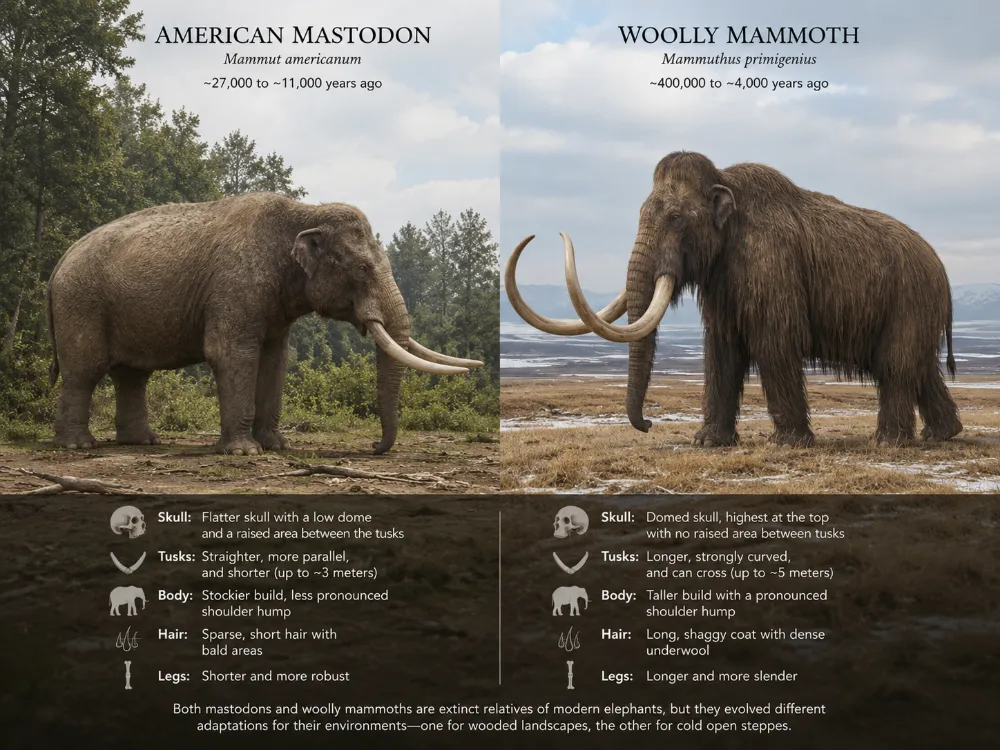
Mastodons and mammoths were both extinct elephant-like mammals, but they were not the same animal. Mammoths were closer relatives of modern elephants and usually had high-domed skulls, long curved tusks, and ridged teeth for grazing. Mastodons belonged to a more distant branch, had flatter heads, stockier bodies, straighter tusks, and cone-shaped teeth for browsing leaves, twigs, shrubs, and forest plants.
| Feature | Mastodon | Mammoth | Quick Difference |
|---|---|---|---|
| Scientific group | Family Mammutidae, especially genus Mammut | Family Elephantidae, genus Mammuthus | Mammoths were closer to modern elephants. |
| Common example | American mastodon, Mammut americanum | Woolly mammoth, Mammuthus primigenius; Columbian mammoth, Mammuthus columbi | “Mammoth” includes several species, not only woolly mammoths. |
| Head shape | Flatter, lower skull | Higher, domed skull | Mammoths often had a more raised head profile. |
| Body shape | Stockier, lower, more muscular-looking | Often taller, with a high shoulder hump in some species | Mastodons looked more compact; mammoths looked taller. |
| Tusks | Usually straighter and less dramatically curved | Often long and strongly curved; some crossed at the tips | Mammoth tusks were usually more curved. |
| Teeth | Cone-shaped cusps | Flat ridged plates | Teeth are the best fossil clue. |
| Diet | Browsed leaves, twigs, shrubs, conifer branches, and woody plants | Often grazed grasses and sedges, though diet varied by species and habitat | Mastodons were browsers; many mammoths were grazers. |
| Habitat | Forests, wetlands, woodlands, bogs, and mixed habitats | Open grasslands, steppe-tundra, plains, and cold open habitats for woolly mammoths | Mastodons preferred more wooded environments. |
| Relationship to elephants | More distant elephant relative | Close relative of modern elephants | Mammoths were more elephant-like evolutionarily. |
| Extinction | Disappeared near the end of the Ice Age | Most disappeared near the end of the Ice Age; some island mammoths survived much later | Climate change and human pressure likely both mattered. |
Are Mastodons and Mammoths the Same?
No. Mastodons and mammoths were both large extinct proboscideans, meaning they belonged to the broader group of trunked mammals that includes modern elephants. However, they were not the same animal, and they were not simply two names for one Ice Age giant.
Mammoths belonged to the elephant family, Elephantidae, along with modern Asian and African elephants. Mastodons belonged to a different and older branch called Mammutidae. This means mammoths were more closely related to living elephants than mastodons were.
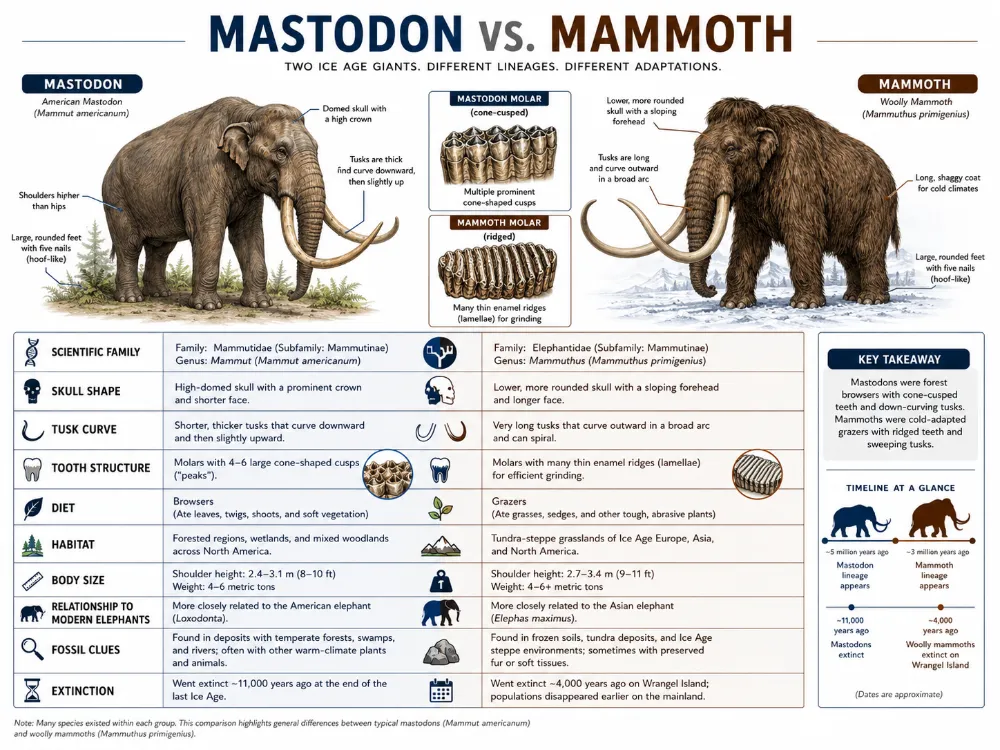
The easiest way to separate them is by teeth. Mastodon teeth had tall cone-shaped cusps that were good for crushing leaves, twigs, and branches. Mammoth teeth had flat ridged plates that were better for grinding grasses and tough steppe plants.
What Was a Mastodon?
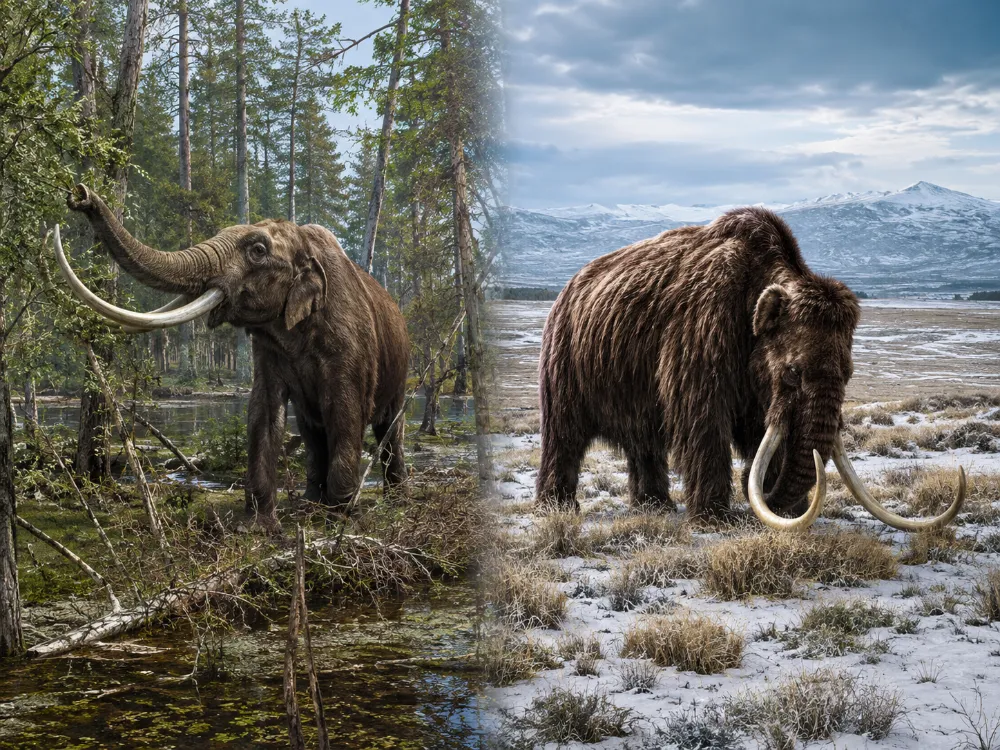
A mastodon was an extinct elephant-like mammal best known from North America. The most famous species is the American mastodon, Mammut americanum. Mastodons were large, strong, trunked herbivores with tusks, heavy bodies, and teeth adapted for browsing woody vegetation.
Mastodons were not woolly mammoths. They were generally stockier, lower-slung, and more associated with forests, wetlands, bogs, and wooded landscapes. Their teeth show that they often ate leaves, twigs, shrubs, conifer branches, and other coarse plant material.
Important mastodon traits include:
Stocky body
Relatively flat skull
Long trunk
Usually straighter tusks than mammoths
Cone-shaped molars
Browsing diet
Strong association with forests and wetlands
What Was a Mammoth?
A mammoth was an extinct elephant in the genus Mammuthus. Mammoths were close relatives of modern elephants, especially Asian elephants. The most famous species is the woolly mammoth, but there were several mammoth species, including the Columbian mammoth, steppe mammoth, imperial mammoth, and dwarf island mammoths.
When most people imagine a mammoth, they picture a woolly mammoth with shaggy fur, a high shoulder hump, a domed head, small ears, and long curved tusks. That image is accurate for woolly mammoths, but not all mammoths were equally woolly or equally adapted to extreme cold.
Important mammoth traits include:
Closer relationship to modern elephants
High-domed skull
Long, often strongly curved tusks
Ridged grinding teeth
Often adapted for grazing
Some species adapted to cold steppe-tundra
Several species across Eurasia, Africa, and North America
The Main Difference Between Mastodons and Mammoths
The main difference is evolutionary identity and diet. Mammoths were true elephant-family animals with teeth designed for grinding grasses. Mastodons were more distant proboscideans with teeth designed for crushing woody plants.
This difference in teeth reflects a bigger ecological difference. Mastodons were usually browsers that fed in wooded environments. Mammoths, especially woolly mammoths, were often grazers in open steppe or grassland environments.
In simple terms:
Mastodon: forest browser with cone-shaped teeth.
Mammoth: elephant relative, often an open-country grazer with ridged teeth.
Best fossil clue: the molars.
Scientific Classification
| Classification | Mastodon | Mammoth |
|---|---|---|
| Kingdom | Animalia | Animalia |
| Phylum | Chordata | Chordata |
| Class | Mammalia | Mammalia |
| Order | Proboscidea | Proboscidea |
| Family | Mammutidae | Elephantidae |
| Common genus | Mammut | Mammuthus |
| Modern relatives | Distant relatives of elephants | Close relatives of modern elephants |
Both animals belonged to Proboscidea, the order of trunked mammals. But they were separated by millions of years of evolution and belonged to different families within that broader group.
Teeth: The Best Way to Tell Them Apart
Teeth are the most reliable difference between mastodons and mammoths. Fossil bones can sometimes look similar to non-specialists, but their molars are very different.
Mastodon molars had pointed cone-like cusps. These cusps worked well for crushing twigs, leaves, shrubs, and woody plants. This is why the name “mastodon” is linked to the shape of the teeth.
Mammoth molars had many flat ridges arranged like plates. These teeth acted like grinding surfaces, excellent for processing grasses, sedges, and other abrasive plants. Grass contains silica and can wear teeth heavily, so mammoths needed strong ridged molars for their grazing lifestyle.
| Tooth Feature | Mastodon | Mammoth |
|---|---|---|
| Molar shape | Pointed cone-shaped cusps | Flat ridged plates |
| Best for | Crushing woody browse | Grinding grasses |
| Diet clue | Leaves, twigs, shrubs, branches | Grass, sedges, steppe plants |
| Fossil identification | Cusped tooth surface | Ridged washboard-like surface |
Diet Differences
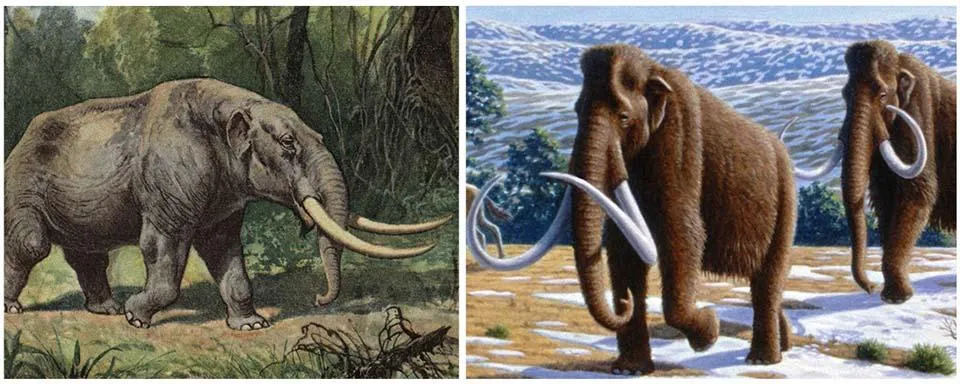
Mastodons and mammoths were herbivores, but they did not eat the same foods in the same way. Mastodons were browsers. They fed on leaves, twigs, shrubs, bark, conifers, and other woody or leafy plants. Their teeth were designed to crush and break plant material rather than grind grass all day.
Mammoths, especially woolly mammoths, were more often grazers. Their teeth were well suited to grinding grasses, sedges, and tough steppe vegetation. Some mammoth species may have eaten mixed diets depending on habitat, season, and region, but their molars were more grazing-adapted than mastodon teeth.
Diet summary:
Mastodons: browsers of wooded and wetland plants.
Mammoths: often grazers of open grassland and steppe plants.
Ecological meaning: mastodons preferred more forested habitats, while many mammoths thrived in open environments.
Habitat Differences
Mastodons were strongly associated with forests, woodlands, wetlands, bogs, and mixed landscapes. Their browsing diet fits places where trees, shrubs, and woody plants were common.
Mammoths lived in a wider range of habitats depending on species. Woolly mammoths are strongly linked to cold steppe-tundra environments, open plains, and grass-rich landscapes. Columbian mammoths lived farther south in North America and often occupied grasslands, savannas, and open habitats.
| Habitat Feature | Mastodon | Mammoth |
|---|---|---|
| Typical landscape | Forests, wetlands, bogs, wooded valleys | Grasslands, steppe, tundra, open plains, savannas |
| Food availability | Leaves, twigs, shrubs, branches | Grass, sedges, herbs, open-country vegetation |
| Famous environment | North American woodlands and wetlands | Ice Age mammoth steppe for woolly mammoths |
| Ecological role | Large browser | Large grazer or mixed feeder depending on species |
Body Shape Differences
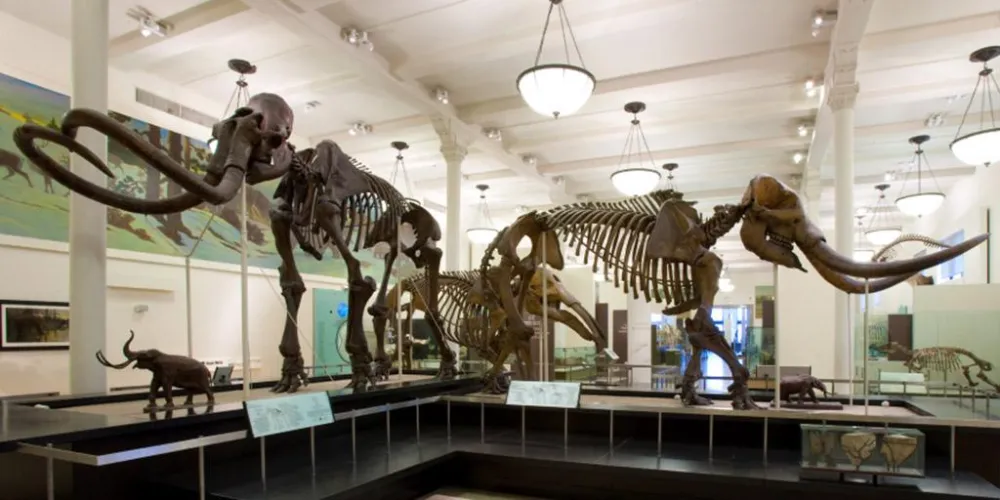
Mastodons were generally stockier and lower-bodied than mammoths. Their bodies often appear heavy, muscular, and compact in reconstructions. They did not have the same high-domed profile seen in many mammoths.
Mammoths often had a more elephant-like body, but with species-specific traits. Woolly mammoths had a high shoulder hump, sloping back, domed skull, small ears, and thick coat. Columbian mammoths were taller and less heavily furred, adapted to warmer open habitats than woolly mammoths.
Body shape clues:
Mastodon: stocky body, flatter head, lower profile.
Woolly mammoth: high shoulder hump, domed head, shaggy coat.
Columbian mammoth: very large, tall, open-habitat mammoth.
Size Comparison
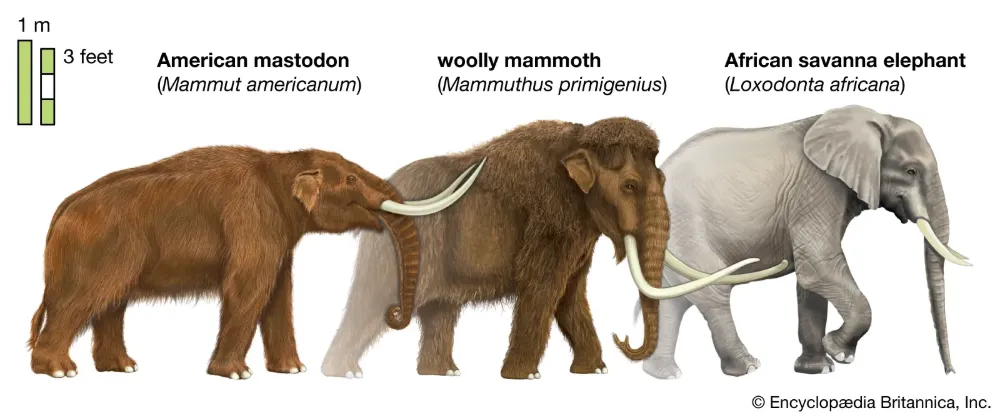
Both mastodons and mammoths were large animals, but size varied by species, sex, age, and region. Many mammoths were taller than mastodons, especially large species such as the Columbian mammoth. Mastodons were often shorter but powerfully built.
| Size Feature | Mastodon | Mammoth |
|---|---|---|
| General height | Often shorter than large mammoths | Often taller, depending on species |
| Body build | Stocky and robust | Tall, often high-shouldered |
| Largest examples | Large, but generally not as tall as the biggest mammoths | Some species became extremely tall and massive |
| Visual impression | Compact forest browser | Large open-country elephant relative |
The common idea that “mammoths were always bigger” is too simple. Many mammoths were larger than mastodons, but size alone is not the best identification feature. Teeth, skull shape, tusks, and habitat are more reliable.
Which Was Bigger?
In general, many mammoths were taller than mastodons. Columbian mammoths could be especially large. Woolly mammoths were often similar in size to modern elephants, though their shaggy coat and curved tusks made them look especially dramatic.
Mastodons were not small. They were massive Ice Age animals with strong bodies and long tusks. But compared with the largest mammoths, they were usually shorter and more compact.
The best answer is: mammoths were often taller, while mastodons were usually stockier.
Tusk Differences
Both mastodons and mammoths had tusks, but the shape was often different. Mammoth tusks were usually longer and more strongly curved. In some individuals, the tusks curved inward so dramatically that the tips nearly crossed or actually crossed.
Mastodon tusks were often straighter and less dramatically curved. Some mastodons also had small lower tusks, especially in earlier or certain individuals, though upper tusks are the most obvious feature.
| Tusk Feature | Mastodon | Mammoth |
|---|---|---|
| Upper tusks | Long, usually straighter | Long, often strongly curved |
| Curve | Less dramatic | Often dramatic, sweeping curve |
| Lower tusks | Sometimes present in some forms or individuals | Generally not a major feature in classic mammoths |
| Popular image | Straighter tusks on a stocky body | Huge curved tusks on a shaggy or tall body |
Skull and Head Shape
The head shape is another strong difference. Mastodons had a flatter, lower skull. Mammoths often had a higher, more domed skull. This difference is visible in museum skeletons and paleoart reconstructions.
The mammoth’s domed skull gave the head a more raised profile, especially in woolly mammoths. The mastodon skull looks flatter and more elongated by comparison.
Quick head-shape rule:
Flat head profile: mastodon.
High domed skull: mammoth.
Hair and Cold Adaptations
Woolly mammoths were famous for cold-weather adaptations. They had thick fur, a dense undercoat, a layer of fat, small ears, and a short tail to reduce heat loss. These features helped them survive in cold steppe-tundra environments.
Mastodons may have had hair, especially in colder regions, but they are not defined by the same extreme cold-adapted image as woolly mammoths. Their typical habitat was more wooded and often less open than the mammoth steppe.
It is important to remember that not all mammoths were woolly mammoths. Some mammoth species lived in warmer regions and did not need the same dense coat.
Where Did Mastodons Live?
Mastodons are especially well known from North America. The American mastodon lived across much of the continent, often in forested and wetland environments. Fossils are frequently found in bogs, marshes, ponds, and other places where bones could be buried and preserved.
They were browsers in landscapes with woody vegetation. Their remains often occur in environments that suggest forests, swamps, mixed woodlands, or water-rich habitats.
Common mastodon environments included:
Forests
Woodlands
Bogs
Wetlands
Marsh edges
River valleys
Mixed forest-grassland zones
Where Did Mammoths Live?
Mammoths lived across parts of Africa, Eurasia, and North America over their long evolutionary history. Different species occupied different environments. Woolly mammoths are strongly associated with northern Eurasia and North America during the Ice Age, especially open cold steppe-tundra.
Columbian mammoths lived farther south in North America and were generally larger and less cold-specialized than woolly mammoths. Dwarf mammoths evolved on some islands, where limited space and resources favored smaller body size.
Common mammoth environments included:
Open grasslands
Steppe-tundra
Savannas
Plains
River valleys
Cold northern landscapes for woolly mammoths
Warmer open habitats for some non-woolly species
Mastodon vs Woolly Mammoth
The most common comparison is between the American mastodon and the woolly mammoth. These two animals overlapped in North America during parts of the late Ice Age, but they used the landscape differently.
| Feature | American Mastodon | Woolly Mammoth |
|---|---|---|
| Scientific name | Mammut americanum | Mammuthus primigenius |
| Family | Mammutidae | Elephantidae |
| Diet | Browsed woody plants | Grazed grasses and sedges |
| Habitat | Forests and wetlands | Cold open steppe-tundra |
| Teeth | Cone-cusped molars | Flat ridged grinding molars |
| Body profile | Stockier and lower | High shoulder hump and domed head |
Mammoth Does Not Always Mean Woolly Mammoth
The word “mammoth” is often used as if it only means the woolly mammoth. That is a common mistake. Woolly mammoths were one species within the genus Mammuthus. Other mammoths included Columbian mammoths, steppe mammoths, southern mammoths, imperial mammoths, and dwarf mammoths.
This matters because not all mammoths looked exactly like the shaggy Ice Age animal in popular art. Some lived in warmer areas, had less hair, and reached different sizes.
When comparing mastodon vs mammoth, the safest question is: which mammoth species? The woolly mammoth is the most famous, but it is not the only one.
Relationship to Modern Elephants
Mammoths were close relatives of modern elephants. They belonged to the same family, Elephantidae. Genetic and fossil evidence shows that mammoths were especially close to Asian elephants compared with many other extinct proboscideans.
Mastodons were more distant relatives. They were still trunked mammals and part of the larger proboscidean order, but their family had branched away earlier from the line that led to modern elephants and mammoths.
Relationship summary:
Modern elephants: living elephant-family animals.
Mammoths: extinct members of the elephant family.
Mastodons: extinct relatives from a separate proboscidean family.
Did Mastodons and Mammoths Live Together?
Yes, in some regions and time periods mastodons and mammoths both lived in North America. However, they did not use the environment in exactly the same way. Mastodons favored wooded and wetland habitats, while mammoths often used more open grassland or steppe habitats.
This ecological separation helped them coexist. They were not simply competing for the same food in the same places. Their teeth and diets show different feeding strategies.
In a mixed Ice Age landscape, a mastodon might browse near forest edges and wetlands, while a mammoth might graze across open plains or steppe-like grasslands.
Predators and Threats
Adult mastodons and mammoths were enormous, so few predators could attack a healthy adult easily. However, calves, sick individuals, injured adults, or isolated animals could be vulnerable.
Possible predators and scavengers included:
Saber-toothed cats in some regions
American lions
Dire wolves
Large bears
Hyenas in some Old World ecosystems
Humans
Large carnivores may have targeted young animals or scavenged carcasses. Humans also hunted mammoths and mastodons in some regions, although the importance of hunting versus climate change in extinction is still discussed.
Extinction: Why Did Mastodons and Mammoths Disappear?
Mastodons and most mammoths disappeared near the end of the Ice Age. Their extinction likely involved several overlapping causes rather than one simple explanation.
Major factors may have included:
Rapid climate change
Habitat shifts after the Ice Age
Loss of preferred vegetation
Human hunting pressure
Small population size in some areas
Changing water and plant communities
Combined ecological stress
For mastodons, the loss or fragmentation of wooded and wetland habitats may have been especially important. For mammoths, changes to the mammoth steppe and hunting pressure may both have contributed.
Did Mammoths Survive Longer Than Mastodons?
Yes, some mammoths survived longer than mastodons. Most mainland mammoths and mastodons disappeared near the end of the Pleistocene, but small island mammoth populations survived much later. The best-known late survivors were woolly mammoths on Wrangel Island in the Arctic, which persisted thousands of years after mainland populations had vanished.
Mastodons did not survive into historic times. Mammoth survival on islands shows how isolation, fewer predators, and different ecological pressures can allow a small population to persist after mainland extinction.
Human Interaction
Humans lived alongside mastodons and mammoths in parts of the world. Archaeological evidence shows that people hunted or scavenged these animals in some places. Mammoth bones, ivory, and images are also known from Ice Age human cultures.
Woolly mammoths were especially important to some Ice Age peoples. Their bones and tusks could be used for tools, shelters, carvings, and fuel where wood was scarce. Cave art and carvings show that humans observed mammoths closely.
Mastodons were also encountered by early humans in North America, though they are less common in art and popular culture than woolly mammoths.
Fossils and Preservation
Mastodon fossils are often found in wetlands, bogs, ponds, and other water-rich environments. These places can preserve bones well by burying them in low-oxygen sediments. Some mastodon skeletons are remarkably complete.
Mammoth fossils are found in many settings, including river deposits, permafrost, caves, tar pits, and open plains. Woolly mammoths are especially famous because frozen remains from permafrost can preserve hair, skin, muscle, and even stomach contents.
| Fossil Feature | Mastodon | Mammoth |
|---|---|---|
| Common preservation setting | Bogs, wetlands, ponds, forested deposits | Permafrost, plains, river deposits, tar pits, caves |
| Most useful identification clue | Cone-cusped teeth | Ridged grinding teeth |
| Soft tissue preservation | Rare | Famous in frozen woolly mammoth remains |
| Popular museum display | American mastodon skeletons | Woolly and Columbian mammoth skeletons |
Mastodon vs Mammoth vs Modern Elephant
Mastodons, mammoths, and modern elephants all had trunks and tusks, but they were not equally related. Mammoths were closer to modern elephants. Mastodons were more distant relatives with a different tooth design and feeding ecology.
| Feature | Mastodon | Mammoth | Modern Elephant |
|---|---|---|---|
| Status | Extinct | Extinct | Living |
| Family | Mammutidae | Elephantidae | Elephantidae |
| Teeth | Cusped browsing teeth | Ridged grinding teeth | Ridged grinding teeth adapted to species diet |
| Diet tendency | Browser | Often grazer | Mixed feeding depending on species |
| Closest relationship | Distant elephant relative | Close elephant relative | Living relatives of mammoths |
Common Myths About Mastodons and Mammoths
Myth: Mastodons and mammoths were the same animal.
Fact: They belonged to different proboscidean families and had different teeth, diets, and habitats.Myth: All mammoths were woolly mammoths.
Fact: Woolly mammoths were only one species of mammoth.Myth: Mastodons were just smaller mammoths.
Fact: Mastodons were a separate branch with browsing teeth and forest-adapted habits.Myth: Mammoths were dinosaurs.
Fact: Mammoths were mammals, not dinosaurs.Myth: Mastodons were carnivores because their teeth look pointed.
Fact: They were herbivores; their teeth crushed woody plants.Myth: Climate change alone or humans alone caused all extinctions.
Fact: Extinction likely involved multiple interacting pressures.
How to Identify a Fossil Tooth
If you had only one fossil tooth, you could often tell whether it came from a mastodon or a mammoth. Mastodon molars look bumpy, with cone-like peaks. Mammoth molars look flatter and ridged, almost like a washboard or stack of plates.
Identification clues:
Bumpy tooth with cone-shaped cusps: mastodon.
Flat tooth with many ridges: mammoth.
Woody browsing adaptation: mastodon.
Grass grinding adaptation: mammoth.
Teeth are so important because they directly record feeding style. They are also among the most durable fossils, making them common in museum collections and paleontological sites.
Which One Would Win in a Fight?
A fight between a mastodon and a mammoth is a fictional scenario. These animals were herbivores, and their survival depended more on feeding, migration, social life, and avoiding danger than fighting other giant proboscideans.
If two large males competed, body size, age, tusk shape, health, and motivation would matter. A large mammoth may have had height and tusk reach advantages, while a mastodon had a stocky, powerful build. But there is no single scientific answer to “who would win.”
The more meaningful comparison is ecological: mastodons were better adapted for browsing in wooded habitats, while mammoths were better adapted for grazing in open environments.
Final Takeaway
Mastodons and mammoths were both remarkable Ice Age proboscideans, but they were not the same animal. Mastodons were stockier, more forest-associated browsers with cone-cusped teeth. Mammoths were closer relatives of modern elephants, often taller, with ridged grinding teeth, domed skulls, and long curved tusks.
The easiest way to tell them apart is by teeth. Mastodon teeth look bumpy and cone-shaped for crushing woody plants. Mammoth teeth look flat and ridged for grinding grasses.
Both animals disappeared after a time of major climate change, habitat transformation, and human expansion. Their fossils remain some of the most powerful evidence of the lost giants that once shaped Ice Age ecosystems.
FAQs About Mastodon vs Mammoth
What is the main difference between a mastodon and a mammoth?
The main difference is teeth and diet. Mastodons had cone-shaped molars for browsing woody plants, while mammoths had ridged molars for grinding grasses and tougher open-country vegetation.
Were mastodons and mammoths the same animal?
No. They were both extinct trunked mammals, but they belonged to different families. Mammoths were closer to modern elephants, while mastodons were more distant relatives.
Which was bigger, mastodon or mammoth?
Mammoths were often taller, especially large species such as Columbian mammoths. Mastodons were usually shorter and stockier, though still very large animals.
Were mammoths bigger than elephants?
Some mammoths were larger than modern elephants, while others were similar in size or smaller. Woolly mammoths were often roughly comparable to modern elephants, while some Columbian mammoths were larger.
Were mastodons bigger than elephants?
Mastodons were large and could overlap with elephants in size, but many were shorter and stockier than the largest modern elephants and large mammoths.
Did mastodons have hair?
Mastodons may have had some hair, especially in cooler regions, but they are not as famously shaggy as woolly mammoths. The amount of hair likely varied by climate and population.
Did all mammoths have woolly fur?
No. Woolly mammoths had thick fur for cold environments, but other mammoth species lived in warmer areas and were likely less shaggy.
What did mastodons eat?
Mastodons ate leaves, twigs, shrubs, conifer branches, bark, and other woody or leafy plants. They were mainly browsers.
What did mammoths eat?
Many mammoths ate grasses, sedges, and open-country plants. Woolly mammoths were strongly adapted to grazing in cold steppe-tundra environments.
Where did mastodons live?
Mastodons lived in North America and favored forests, wetlands, bogs, wooded valleys, and mixed habitats with plenty of browsing vegetation.
Where did mammoths live?
Mammoths lived across parts of Africa, Eurasia, and North America. Woolly mammoths lived in cold northern steppe-tundra, while other mammoths occupied warmer open habitats.
Are mammoths related to elephants?
Yes. Mammoths were close relatives of modern elephants and belonged to the same family, Elephantidae.
Are mastodons related to elephants?
Yes, but more distantly. Mastodons were proboscideans like elephants, but they belonged to a separate family called Mammutidae.
Did humans hunt mammoths and mastodons?
Yes, humans hunted or scavenged mammoths and mastodons in some regions. Human pressure may have contributed to their extinction, along with climate and habitat changes.
Why did mastodons and mammoths go extinct?
Their extinction likely resulted from a combination of climate change, habitat shifts, changing vegetation, human hunting pressure, and ecological stress near the end of the Ice Age.