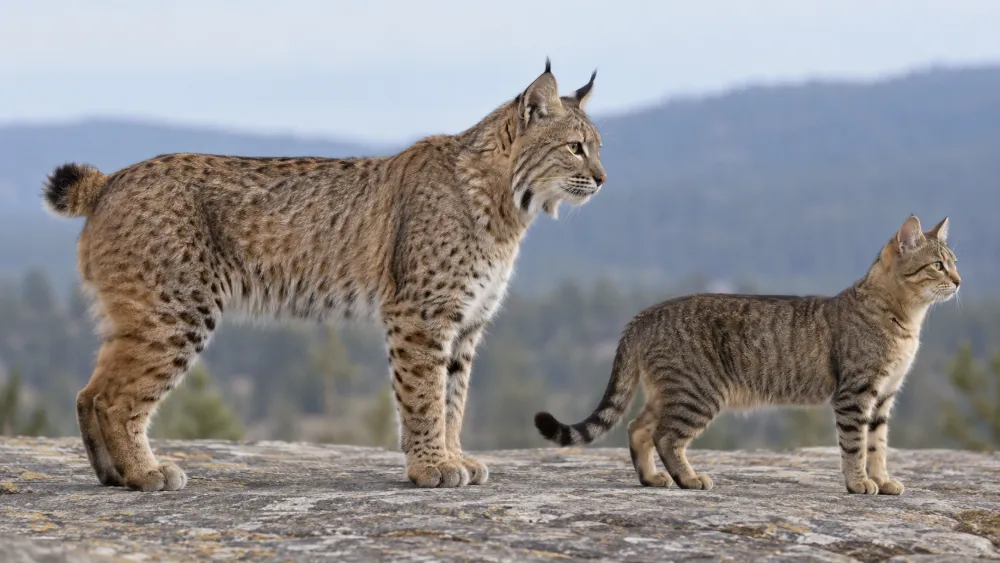
Bobcats and mountain lions are both wild cats, but they are very different animals. A bobcat is a medium-sized lynx with a short “bobbed” tail, spotted coat, and tufted ears. A mountain lion is much larger, with a long tail, plain tawny coat, and powerful body. If you see a large cat with a tail almost as long as its body, it is almost certainly a mountain lion, not a bobcat.
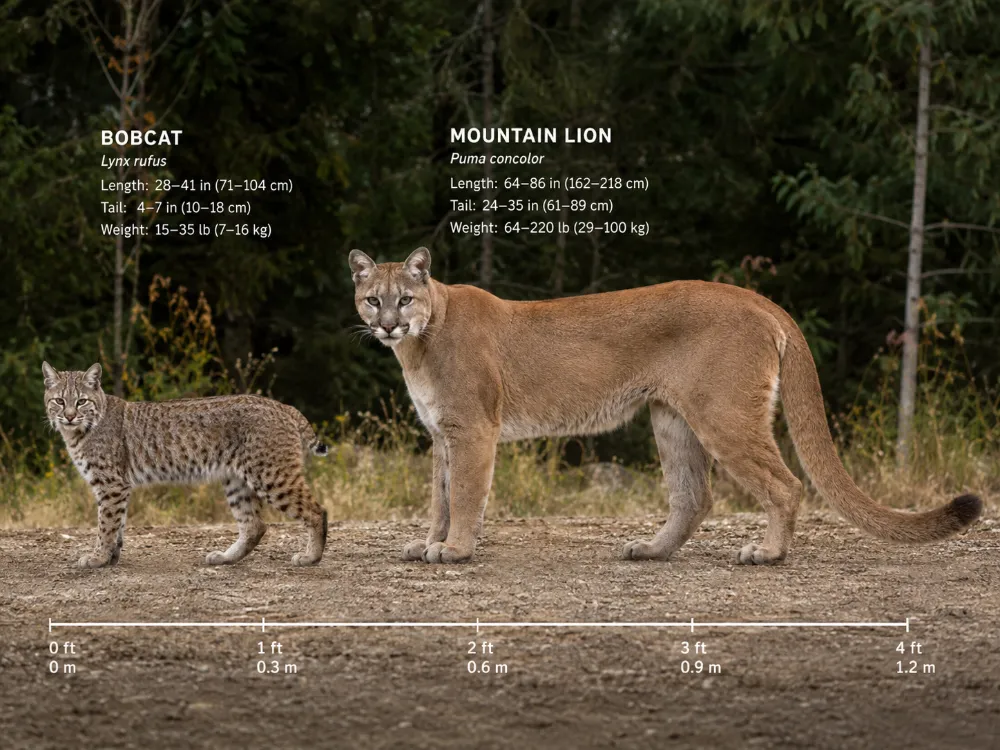
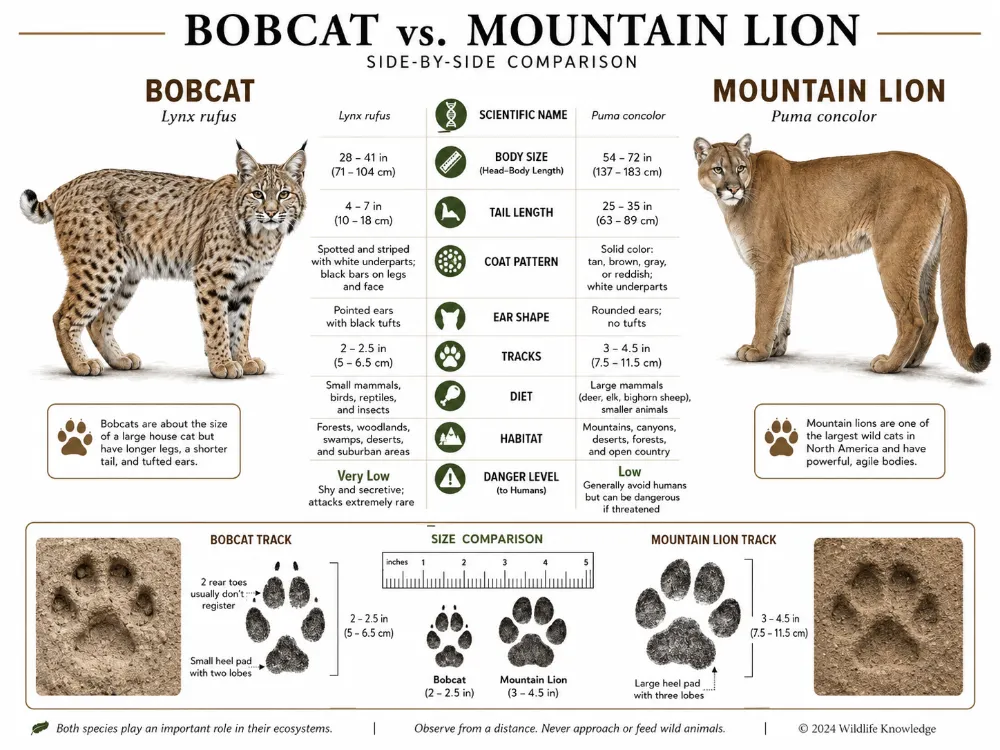
| Feature | Bobcat | Mountain Lion |
|---|---|---|
| Scientific name | Lynx rufus | Puma concolor |
| Cat group | Lynx | Puma / cougar |
| Typical adult weight | About 15–35 lb | About 80–180 lb, sometimes more |
| Body length | About 2–3.5 ft, not including tail | About 5–9 ft including tail |
| Tail | Short, bobbed, usually 4–7 inches | Long, thick, and balancing, often 2–3 ft |
| Coat pattern | Spotted or streaked, especially on legs and belly | Plain tan, grayish, or tawny as an adult |
| Ears | Pointed with small black tufts | Rounded, without lynx-like tufts |
| Tracks | Smaller, usually around 1.5–2.5 inches wide | Larger, often around 3–4.5 inches wide |
| Main prey | Rabbits, rodents, birds, reptiles, small mammals | Deer, elk calves, bighorn sheep, smaller mammals |
| Danger to humans | Very low; attacks are extremely rare | Still rare, but potentially more serious because of size |
What Is a Bobcat?
The bobcat is a medium-sized wild cat native to North America. Its scientific name is Lynx rufus, and it belongs to the lynx group, although it is generally smaller and more adaptable than the Canada lynx. Bobcats live in forests, deserts, wetlands, mountains, grasslands, and even the edges of suburban areas.
The name “bobcat” comes from its short, bobbed tail. This tail is one of the easiest ways to recognize the species. A bobcat also has a compact body, long legs for its size, pointed ears with dark tufts, and a coat that often shows spots, streaks, or mottled markings. These markings help it disappear into brush, rocks, dry grass, and forest shadows.
Bobcats are mostly solitary and secretive. They are excellent hunters of rabbits, hares, squirrels, rats, mice, birds, reptiles, and occasionally young deer. They usually avoid people and are much more often seen on trail cameras than in direct encounters.
What Is a Mountain Lion?
The mountain lion is a large wild cat with the scientific name Puma concolor. It is also called a cougar, puma, panther, catamount, or painter in different regions. Despite the name “mountain lion,” it is not a true lion. It is more closely associated with the puma lineage of cats.
Mountain lions are among the largest wild cats in the Americas. They have long, muscular bodies, powerful shoulders, strong hind legs, and a very long tail used for balance. Adult mountain lions usually have a plain tawny, grayish, or reddish-brown coat, with lighter fur on the underside. Kittens have spots, but adults generally do not.
Mountain lions are highly capable predators. Their main prey is deer, but they may also hunt elk calves, bighorn sheep, raccoons, rabbits, coyotes, and other animals depending on the region. Like bobcats, they are solitary and usually avoid humans, but their larger size means encounters should be treated more seriously.
Bobcat vs Mountain Lion Size
Size is the clearest difference between a bobcat and a mountain lion. A bobcat is roughly the size of a large house cat or medium dog, while a mountain lion is closer in size to a large dog, wolf, or even a small adult human in body length.
Most adult bobcats weigh about 15 to 35 pounds, although large males may exceed this range. Their bodies are compact, and their short tails make them look even smaller from a distance.
Mountain lions are much heavier and longer. Adult females often weigh around 80 to 130 pounds, while adult males commonly range from about 120 to 180 pounds and can occasionally be larger. Their long tail adds greatly to their overall length, making them appear sleek and powerful rather than compact.
If the animal looks “big but short-tailed,” it may be a bobcat. If it looks long-bodied, heavy, and has a tail that nearly reaches the ground, it is likely a mountain lion.
Tail Shape Is the Fastest Field Clue
The tail is often the best feature for quick identification.
A bobcat has a short tail that looks cut off or “bobbed.” It is usually only a few inches long. The upper side may have dark markings, and the underside can look pale or white. Because the tail is so short, it may be hard to see when the animal is moving through grass or brush.
A mountain lion has a long, thick tail that may be nearly one-third of the animal’s total length. The tail often has a darker tip and is carried low behind the body. This tail helps the mountain lion balance when climbing, running, jumping, or turning sharply during a chase.
In most real-world sightings, tail length is more reliable than color. Light, shadow, distance, and movement can make coat color confusing, but a long tail versus a bobbed tail is usually obvious.
Coat Color and Markings
Bobcats usually have more visible markings than mountain lions. Their coat may be grayish, reddish-brown, buff, or tan, depending on region and season. Many bobcats have spots on the belly, legs, and sides. The face often has a ruff of fur along the cheeks, giving the head a slightly wide appearance.
Mountain lions are more uniform in color as adults. Their coat is usually plain tan, tawny, gray-brown, or reddish-brown, with a lighter chest, belly, and inner legs. Adult mountain lions normally lack the strong spots seen in bobcats. Young mountain lion kittens, however, are spotted, which can sometimes create confusion if someone sees a juvenile.
Another useful difference is the ears. Bobcats have pointed ears with short black tufts. Mountain lions have rounded ears without lynx-like tufts.
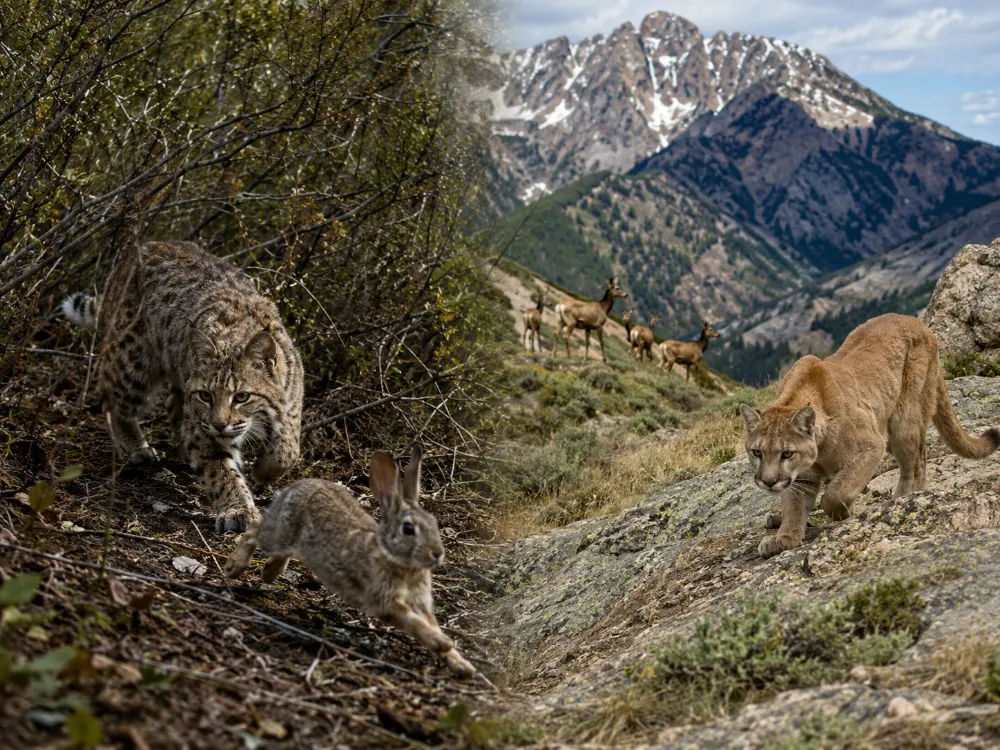
Face and Body Shape
A bobcat’s face often looks more “ruffed” or framed by cheek fur. Its head is relatively small but may appear broad because of facial hair. The body is short, muscular, and compact, with relatively long legs for moving through brush and snow.
A mountain lion has a smoother, more streamlined face. Its head is rounded, the muzzle is stronger, and the body is long and athletic. The shoulders, back, and hindquarters look powerful. When walking, a mountain lion often has a low, fluid, deliberate movement.
From a distance, a bobcat may look like a wild version of a large domestic cat. A mountain lion looks more like a true large predator, with a long body, heavy paws, and a long balancing tail.
Tracks: How to Tell Their Prints Apart
Both bobcats and mountain lions leave cat-like tracks with four toes, a broad heel pad, and usually no visible claw marks. Cats retract their claws while walking, so claw marks are often absent unless the ground is slippery, steep, or very soft.
Bobcat tracks are much smaller. They are often around 1.5 to 2.5 inches wide. The print is rounded, compact, and may be confused with a domestic cat track, although bobcat tracks are usually larger and more robust.
Mountain lion tracks are much larger, commonly around 3 to 4.5 inches wide. The heel pad is broad, and the whole print looks powerful. A mountain lion’s walking pattern may show a direct-register gait, where the hind foot lands close to the front foot’s track, producing a neat line of prints.
A simple field rule: if the track is about the size of a small house cat’s print, it is not a mountain lion. If it is as wide as an adult human palm, it may be a mountain lion.
Habitat and Range
Bobcats are extremely adaptable. They live across much of North America, including forests, deserts, swamps, rocky hills, grasslands, and suburban edges. They can survive close to human development if there is cover and prey.
Mountain lions also occupy a wide range of habitats, but they usually need larger territories and enough large prey. They are found in mountains, forests, canyons, deserts, and rugged open landscapes. In North America, they are especially associated with the western United States, western Canada, parts of Florida, and many regions of Central and South America under the broader puma range.
In areas where both species occur, they may use some of the same landscapes, but they do not play the same ecological role. The mountain lion is a top predator that can regularly kill deer-sized prey. The bobcat is a smaller mesopredator that focuses more on rabbits, rodents, and birds.
Diet and Hunting Style
Bobcats are ambush hunters. They stalk quietly, then make a short rush or pounce. Their most important prey in many areas includes rabbits and hares, but they also eat rodents, birds, reptiles, insects, and carrion. A bobcat can kill animals larger than itself, but it usually focuses on prey it can overpower quickly.
Mountain lions are also ambush predators, but they hunt much larger animals. They often stalk deer from cover, then leap onto the prey using powerful hind legs. A mountain lion may bite the neck or throat to subdue prey. After a successful kill, it may drag the carcass to cover and return to feed over several days.
This difference in diet shapes their behavior. Bobcats can live in smaller territories because their prey is abundant and widely distributed. Mountain lions need much larger home ranges because large prey is more spread out.
Behavior Around Humans
Both species generally avoid people. Most bobcats are shy and will flee if they realize a human is nearby. Bobcats may pass through yards, farms, or suburban greenbelts, especially at dawn, dusk, or night. They can be attracted by rodents, bird feeders, chickens, pet food, or unsecured small animals.
Mountain lions are also secretive, but because they are much larger, sightings deserve more caution. Most mountain lions do not want contact with humans. However, they may move through residential edges if deer are common nearby. Pets, livestock, and small children should be supervised in mountain lion country.
If you see a bobcat, give it space and do not try to feed or approach it. If you see a mountain lion, stay calm, face the animal, make yourself look larger, keep children close, and slowly back away. Do not run, because running can trigger a chase response in predators.
Are Bobcats or Mountain Lions More Dangerous?
Mountain lions are more potentially dangerous because they are much larger and stronger. However, attacks on humans are still rare compared with everyday risks from vehicles, domestic animals, or outdoor accidents.
Bobcats are rarely dangerous to people. A healthy bobcat usually avoids humans. Problems are more likely if a bobcat is cornered, sick, habituated to food, or defending itself. Pets and small livestock are at greater risk than adult humans.
The best safety approach is prevention: never feed wild cats, keep pet food indoors, supervise pets outdoors, secure chickens and small livestock, and avoid leaving attractants around the home.
Bobcat vs Mountain Lion Scat and Scrapes
Tracks are usually easier to identify than scat, but scat and scrapes can provide clues. Bobcat scat is generally smaller and may contain fur, bone fragments, feathers, or plant material. It may be left along trails, roads, or territorial routes.
Mountain lion scat is larger and may contain deer hair, bone fragments, and other remains from large prey. Mountain lions also make scrapes: small piles of leaves, soil, or debris kicked backward with the hind feet. These scrapes can be used to mark territory, especially by males.
Because scat size can vary and can overlap with coyotes or large dogs, it should not be used alone for identification. Track size, tail length in sightings, nearby prey remains, and location all matter.
Could a Bobcat and Mountain Lion Be Confused?
Yes, especially during brief sightings. Many reports of “mountain lions” in residential areas turn out to be bobcats, domestic cats, large dogs, or other animals seen under poor light. A bobcat standing on a slope, crossing a road at night, or seen only for a second can appear larger than it really is.
The most common source of confusion is size estimation. People often overestimate the size of a fast-moving wild animal. The tail is usually the best correction. A bobcat has a short tail. A mountain lion has a long tail that is clearly visible behind the body.
Juvenile mountain lions can also confuse observers because they are smaller and may still show spots. However, even young mountain lions have a longer tail than a bobcat.
Do Bobcats and Mountain Lions Fight?
Bobcats and mountain lions can live in the same broad region, but direct fights are not common because they usually avoid each other. Mountain lions are much larger and would dominate a direct encounter. A bobcat’s best strategy is avoidance, using dense cover, rocky terrain, trees, and smaller hunting areas.
They may compete indirectly for some prey, especially rabbits or small mammals, but their main diets are different enough that they can coexist. Mountain lions focus heavily on deer-sized prey, while bobcats specialize in smaller animals.
Which Cat Are You More Likely to See?
In many parts of North America, you are more likely to see a bobcat than a mountain lion. Bobcats are more widespread, more adaptable near human edges, and can live in smaller territories. Even so, they remain secretive and are often active when people are less likely to notice them.
Mountain lions are harder to see because they are wide-ranging, elusive, and often active at dawn, dusk, or night. In many regions, people may live near mountain lion habitat for years without ever seeing one directly.
Simple Identification Checklist
| Question | Likely Bobcat | Likely Mountain Lion |
|---|---|---|
| Was the tail short or long? | Short, bobbed tail | Long tail, often with dark tip |
| How large did it look? | Large house cat to medium dog size | Large dog size or bigger |
| Were spots visible? | Often spotted or streaked | Adult usually plain-colored |
| What shape were the ears? | Pointed with small tufts | Rounded, no tufts |
| How big were the tracks? | Usually under 2.5 inches wide | Often 3 inches wide or larger |
| What prey remains were nearby? | Small mammals, birds, rabbits | Deer-sized carcass may be present |
Final Verdict: Bobcat vs Mountain Lion
The biggest differences between a bobcat and a mountain lion are size, tail length, coat pattern, and ecological role. A bobcat is a smaller lynx with a short bobbed tail, spotted coat, tufted ears, and a diet centered on rabbits and small animals. A mountain lion is a much larger puma with a long tail, plain tawny adult coat, powerful body, and the ability to hunt deer-sized prey.
For quick identification, look at the tail first. A short tail points to bobcat. A long, heavy tail points to mountain lion. Then compare body size, coat markings, ear shape, and tracks. These clues together can usually separate the two cats with confidence.
FAQs About Bobcats and Mountain Lions
Is a bobcat the same as a mountain lion?
No. A bobcat and a mountain lion are different wild cat species. The bobcat is Lynx rufus, a medium-sized lynx. The mountain lion is Puma concolor, a much larger puma also known as a cougar or puma.
Which is bigger, a bobcat or a mountain lion?
A mountain lion is much bigger. Bobcats usually weigh about 15–35 pounds, while adult mountain lions often weigh 80–180 pounds and can be much longer because of their long tail.
How can I tell a bobcat from a mountain lion quickly?
Look at the tail. A bobcat has a short, bobbed tail. A mountain lion has a long, thick tail that may be several feet long. Mountain lions are also much larger and usually have a plain tawny adult coat.
Do bobcats have long tails?
No. Bobcats have short tails, usually only a few inches long. This “bobbed” tail is one of their most important identification features.
Do mountain lions have spots?
Adult mountain lions usually do not have obvious spots. They are typically plain tan, tawny, grayish, or reddish-brown. Mountain lion kittens have spots, but these fade as they grow older.
Are bobcats dangerous to humans?
Bobcats are rarely dangerous to humans. They are shy, secretive animals that usually avoid people. However, they should never be fed, cornered, or approached.
Are mountain lions dangerous to humans?
Mountain lions can be dangerous because of their size and strength, but attacks on people are rare. In mountain lion country, keep children close, supervise pets, avoid running from a lion, and back away slowly if you encounter one.
Can bobcats and mountain lions live in the same area?
Yes. Their ranges can overlap, especially in western North America. They usually avoid direct contact, and they focus on different prey sizes. Bobcats mainly hunt small animals, while mountain lions often hunt deer.
Which animal is more common near homes?
Bobcats are more likely to appear near suburban edges because they can live in smaller territories and hunt abundant small prey. Mountain lions may also pass near homes, especially where deer are common, but they usually require larger habitat areas.
What should I do if I see a wild cat in my yard?
Do not approach or feed it. Bring pets and children indoors. If it is a bobcat, it will usually leave on its own. If it appears to be a mountain lion, stay calm, make yourself look larger, face the animal, and slowly back away without running.