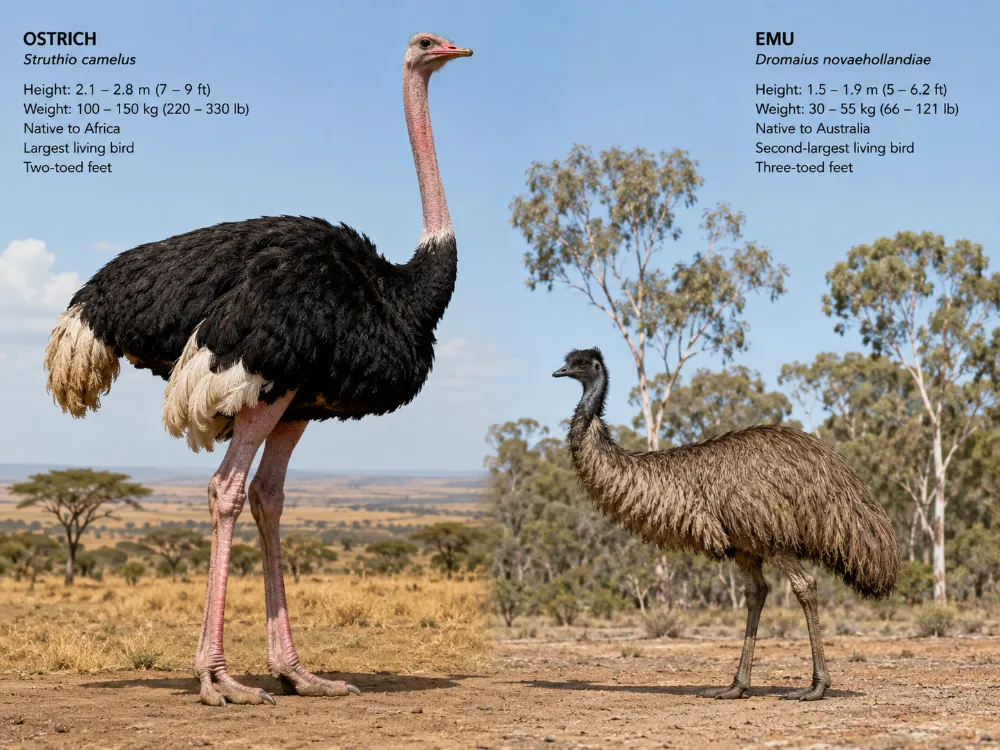
Ostriches and emus are both large flightless birds, but they are not the same animal. Ostriches are native to Africa, grow much taller and heavier, have two toes on each foot, and can run faster. Emus are native to Australia, are smaller, have three toes, shaggy brown feathers, and lay dark green eggs. The fastest way to tell them apart is by size, continent, toe number, and egg color.
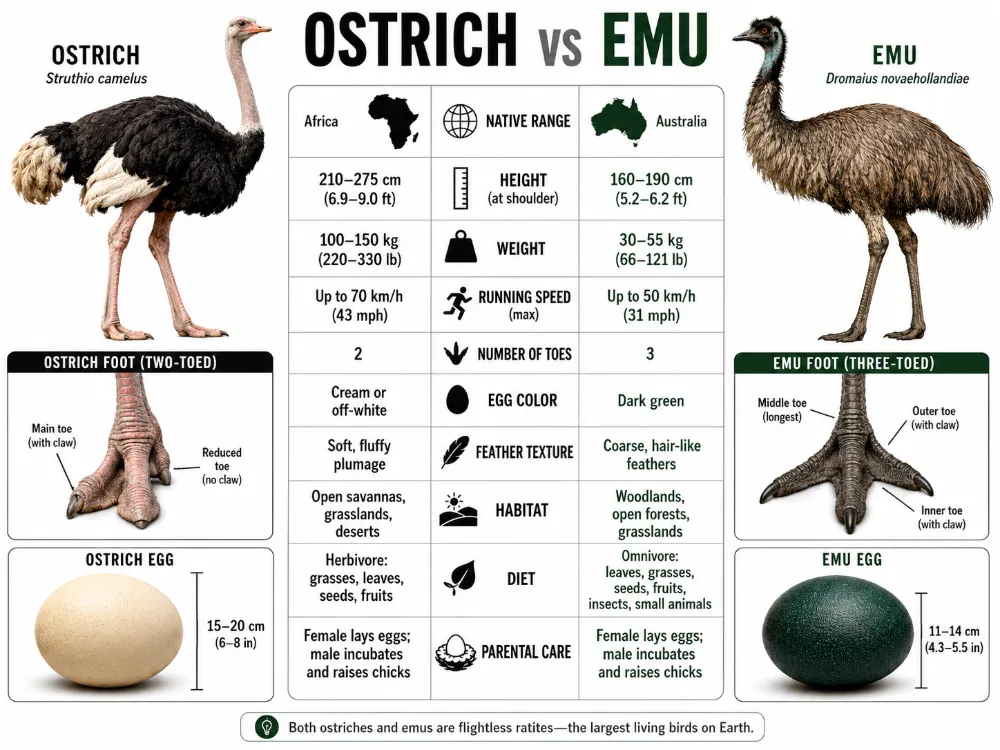
Quick Comparison Table
| Feature | Ostrich | Emu |
|---|---|---|
| Scientific name | Struthio camelus | Dromaius novaehollandiae |
| Native range | Africa | Australia |
| Bird group | Ratite, family Struthionidae | Ratite, family Casuariidae |
| Flight ability | Flightless | Flightless |
| Typical adult height | Up to about 9 feet | Up to about 6 feet |
| Typical adult weight | Often 220–350 pounds | Often 80–130 pounds |
| Top running speed | About 40–45 mph | About 30 mph |
| Number of toes | Two toes per foot | Three toes per foot |
| Egg color | Large cream-colored eggs | Dark green eggs |
| Feather appearance | Males black and white; females gray-brown | Mostly shaggy brown to gray-brown |
| Main habitat | Savannas, grasslands, semi-deserts | Open woodlands, grasslands, scrublands |
| Defense | Powerful forward kick and fast running | Strong kick, sharp claws, fast running |
What Is an Ostrich?
The ostrich is the largest living bird in the world. It is a flightless ratite native to Africa and is best known for its tall body, long neck, powerful legs, and incredible running speed. The common ostrich, Struthio camelus, lives in open habitats such as savannas, dry grasslands, and semi-desert regions where long legs and excellent eyesight help it detect danger from far away.
Ostriches cannot fly, but their bodies are highly adapted for running. Their wings are not used for powered flight, but they can help with balance, courtship displays, shading chicks, and quick changes of direction while running. Ostriches also have a unique foot structure among living birds: only two toes on each foot. The large inner toe acts almost like a hoof, helping the bird push powerfully against the ground.
Adult male ostriches are usually black with white wing and tail feathers, while females are mostly gray-brown. This difference in plumage makes adult ostriches easier to sex than emus. Ostriches also produce the largest eggs of any living bird, although compared with the size of the adult bird, the egg is not as proportionally large as many people imagine.
What Is an Emu?
The emu is the second-largest living bird by height after the ostrich. It is native to Australia and belongs to the same broader group of flightless birds known as ratites, but it is not simply a smaller ostrich. The emu is in a different family and has its own evolutionary history, body shape, behavior, and reproductive strategy.
Emus have long legs, small wings, long necks, and shaggy brown to gray-brown feathers. Their feathers have a loose, hair-like appearance, which helps them tolerate Australia’s hot and variable climate. Unlike ostriches, emus have three toes on each foot. This is one of the clearest anatomical differences between the two birds.
Emus are highly mobile birds. They may travel long distances in search of food and water, especially in dry regions. They eat a mixed diet that includes seeds, fruits, flowers, grasses, insects, and other small food items. Emus are also famous for their dark green eggs and unusual parenting system, in which the male incubates the eggs and cares for the chicks.
Size Difference
The ostrich is much larger than the emu. A large male ostrich may reach about 9 feet tall and weigh more than 300 pounds. Even smaller adult ostriches are still extremely large birds, with a long neck, high body, and thick, muscular legs.
Emus are still impressive birds, but they are noticeably smaller. An adult emu may stand around 5 to 6 feet tall and often weighs around 80 to 130 pounds. From a distance, an emu may look large and powerful, but next to an ostrich it appears shorter, lighter, and less massive.
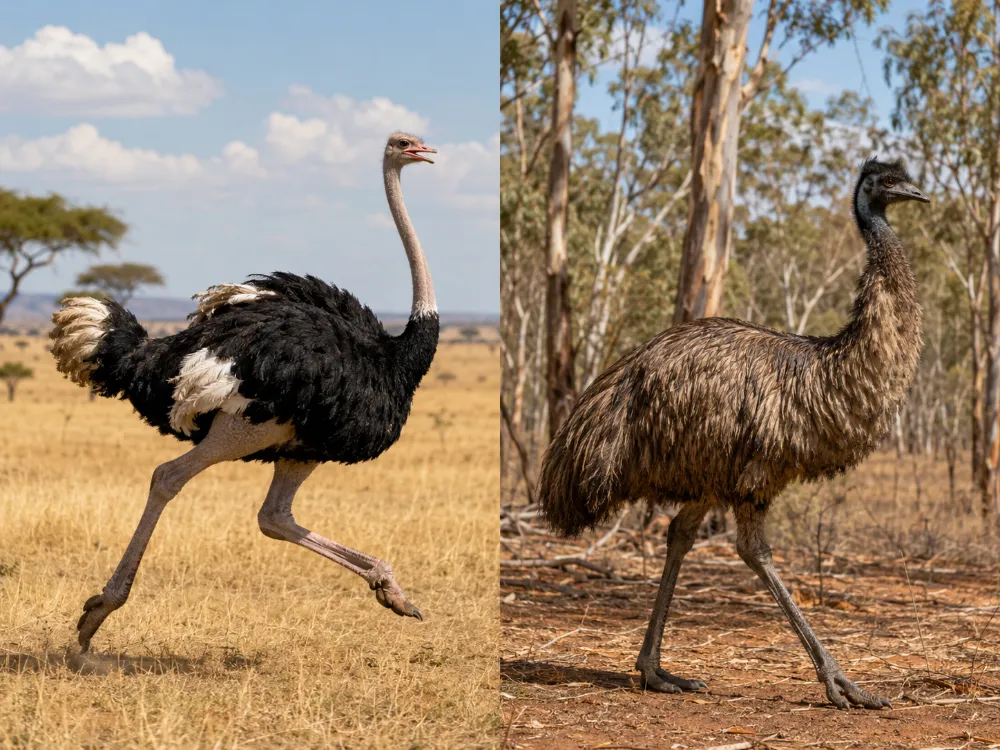
If you see the two birds side by side, the difference is obvious. The ostrich is taller, heavier, longer-necked, and more powerful-looking. The emu is tall but slimmer, with a more compact body and shaggier feathers.
Speed and Running Ability
Both ostriches and emus are excellent runners, but the ostrich is faster. Ostriches are often considered the fastest running birds on Earth. They can reach speeds of about 40 to 45 miles per hour in short bursts and can maintain fast speeds over distance using long, springy strides.
Emus are also fast, but not as fast as ostriches. They can run at about 30 miles per hour and use their strong legs to escape predators or move across open landscapes. Their stride is shorter than an ostrich’s, and their body is lighter.
The ostrich’s two-toed foot is an important speed adaptation. The large main toe provides strong forward propulsion, while the smaller second toe assists with balance. Emus, with three toes, have a different foot structure that still supports fast running but does not produce the same extreme speed as the ostrich.
Toe Number: The Easiest Anatomy Clue
One of the simplest ways to separate ostriches from emus is by counting the toes.
Ostriches have two toes on each foot. This is unusual among birds and is part of their specialization for high-speed running. The larger toe carries much of the bird’s weight and ends in a strong nail.
Emus have three toes on each foot. Their feet look more like the feet of other ratites, such as cassowaries and rheas. The toes are strong and clawed, giving the emu traction on soil, grass, scrub, and uneven ground.
In photographs, footprints, or close-up views, toe number is one of the most reliable identification clues: two toes means ostrich; three toes means emu.
Feathers and Appearance
Ostriches and emus have very different feather textures and color patterns. Adult male ostriches have striking black body feathers with white feathers on the wings and tail. Females and young ostriches are duller, usually gray-brown or sandy-brown, which provides better camouflage in open landscapes.
Emus are generally more uniform in color. Their feathers are shaggy, loose, and brown to gray-brown. From a distance, an emu can look almost hairy rather than feathery. This rough feather texture helps protect the bird from heat and sunlight.
The neck and head also differ. Ostriches often have a more exposed-looking neck and head with sparse feathers. Emus have a darker head and neck, and their facial skin can appear bluish or grayish depending on the light and individual bird.
Eggs and Reproduction
Ostrich eggs are the largest eggs laid by any living bird. They are usually pale cream to off-white and have a thick, strong shell. A single ostrich egg is enormous compared with a chicken egg, but it still represents a relatively small portion of the adult female’s body size.
Emu eggs are smaller than ostrich eggs but are still very large compared with most bird eggs. Their most famous feature is their dark green color. Fresh emu eggs may appear deep green, bluish-green, or almost black-green, with a thick shell and slightly textured surface.
The two birds also differ in parental care. In ostriches, dominant males and females may share nesting duties in a communal nesting system. In emus, the male plays the central role after the eggs are laid. He incubates the eggs for weeks, eats very little during incubation, and later guards the chicks.
Habitat and Native Range
Ostriches are African birds. They are adapted to open, dry, and semi-dry environments where visibility and speed are important. Their habitats include savannas, open plains, grasslands, scrublands, and semi-desert regions.
Emus are Australian birds. They live in a wide range of open habitats, including grasslands, open woodlands, savannas, scrublands, and agricultural edges. They generally avoid very dense forests and extremely dry areas where food and water are too limited, but they can travel long distances when conditions change.
In nature, ostriches and emus do not meet. If you see one in the wild in Africa, it is an ostrich. If you see one in the wild in Australia, it is an emu.
Diet and Feeding Behavior
Ostriches are omnivorous, though much of their diet is plant-based. They eat grasses, seeds, leaves, flowers, roots, fruits, and sometimes insects, lizards, or small animals. They also swallow small stones and grit, which help grind food in the gizzard because birds do not chew with teeth.
Emus are also omnivorous. They eat seeds, fruits, shoots, grasses, flowers, insects, and other small food items. Their diet can change seasonally depending on rainfall and plant growth. In agricultural areas, emus may feed on crops or fallen grain, which sometimes brings them into conflict with farmers.
Both birds are opportunistic feeders, but their native ecosystems shape what they eat. Ostriches are adapted to African open-country food sources, while emus are adapted to Australia’s highly variable landscape and seasonal food availability.
Behavior and Social Life
Ostriches may live alone, in pairs, or in groups. In open landscapes, grouping can help with predator detection. Their excellent eyesight allows them to spot threats from long distances, and they may associate loosely with grazing mammals such as zebras, antelopes, or wildebeest in some areas.
Emus are often seen alone, in pairs, or in loose groups, especially when food is abundant. They may move nomadically across the landscape rather than defending a fixed territory year-round. During breeding, males become more focused on nesting and chick care.
Neither bird is domesticated in the same way as chickens or ducks, although both ostriches and emus are farmed in some regions for meat, oil, leather, feathers, or eggs. They remain powerful wild-type birds that require specialized handling.
Defense and Danger
Both ostriches and emus can defend themselves with powerful kicks. An ostrich’s kick is especially dangerous because of its large body size, strong legs, and sharp toe claw. A forward kick from an adult ostrich can seriously injure a predator or a person.
Emus can also kick and scratch with their strong legs and claws. They are less massive than ostriches, but they should still be treated with respect. A frightened or cornered emu may run, kick, or lash out defensively.
In general, neither bird is naturally aggressive toward humans when left alone, but both can be dangerous if provoked, trapped, handled incorrectly, or kept in poor conditions.
Are Ostriches and Emus Related?
Yes, ostriches and emus are both ratites, a group of mostly large flightless birds that also includes cassowaries, rheas, and kiwis. Ratites have small or reduced wings and a breastbone without the large keel needed for powerful flight muscles.
However, ostriches and emus are not close enough to be considered the same kind of bird. Ostriches belong to the family Struthionidae, while emus belong to the family Casuariidae, the same broader family group that includes cassowaries. Their similarities come from shared ancestry as ratites and from similar adaptations to running, not because emus are simply “Australian ostriches.”
Can Ostriches and Emus Breed?
No, ostriches and emus cannot naturally breed with each other. They are different species from different bird families, with different anatomy, genetics, mating behavior, and evolutionary history.
Although both are large flightless birds, they are not close enough to produce hybrid offspring. Their similarity is more like a broad family resemblance within the ratite group, not a sign that they can interbreed.
Which Bird Is Bigger?
The ostrich is bigger. It is the largest living bird in both height and weight. A large ostrich can be more than twice as heavy as a large emu and can stand several feet taller.
The emu is the second-tallest living bird, but it is much lighter than an ostrich. In practical terms, an ostrich looks like a giant open-plains runner, while an emu looks like a tall, shaggy, fast-moving Australian bird.
Which Bird Is Faster?
The ostrich is faster. Ostriches can run at about 40 to 45 miles per hour, making them the fastest birds on land. Their long legs, two-toed feet, and elastic stride help them cover ground very efficiently.
Emus are still fast runners and can reach around 30 miles per hour. This is fast enough to escape many threats, but it does not match the top speed of an ostrich.
Which Bird Has Bigger Eggs?
The ostrich has bigger eggs. Ostrich eggs are the largest eggs of any living bird and are pale cream in color. They are famous for their size and thick shells.
Emu eggs are smaller than ostrich eggs but still large. Their dark green color makes them especially distinctive. In fact, egg color is one of the easiest ways to identify the two species when the eggs are seen side by side.
Simple Identification Checklist
| Question | Likely Ostrich | Likely Emu |
|---|---|---|
| Where is it native? | Africa | Australia |
| How many toes? | Two toes | Three toes |
| How big is it? | Very tall and very heavy | Tall but lighter |
| What are the feathers like? | Male black and white; female gray-brown | Shaggy brown or gray-brown |
| What color are the eggs? | Cream or off-white | Dark green |
| Which runs faster? | Ostrich | Fast, but slower than ostrich |
Final Verdict: Ostrich vs Emu
The ostrich and the emu are both impressive flightless birds, but they are easy to separate once you know the main clues. Ostriches are African birds, much larger and faster, with two toes, pale eggs, and strong sexual differences in plumage. Emus are Australian birds, smaller and shaggier, with three toes, dark green eggs, and male-based incubation.
If you need a quick field rule, remember this: ostrich equals Africa, giant size, two toes, and cream-colored eggs; emu equals Australia, shaggy brown body, three toes, and dark green eggs.
FAQs About Ostriches and Emus
Is an emu the same as an ostrich?
No. Emus and ostriches are different species from different continents. Ostriches are native to Africa, while emus are native to Australia.
Which is bigger, an ostrich or an emu?
The ostrich is much bigger. It is the largest living bird in the world, while the emu is the second-tallest living bird but much lighter.
Which is faster, an ostrich or an emu?
The ostrich is faster. Ostriches can run about 40 to 45 miles per hour, while emus can run about 30 miles per hour.
How many toes does an ostrich have?
An ostrich has two toes on each foot. This is one of its most important running adaptations.
How many toes does an emu have?
An emu has three toes on each foot. This is an easy way to tell it apart from an ostrich in close-up views or tracks.
Do ostriches and emus fly?
No. Both ostriches and emus are flightless birds. Their wings are too small for powered flight, but their legs are highly adapted for running.
Do emus lay green eggs?
Yes. Emu eggs are usually dark green to bluish-green. This is one of the most distinctive differences between emu eggs and pale ostrich eggs.
Are ostriches dangerous?
Ostriches can be dangerous if threatened or mishandled. Their powerful forward kicks and sharp toe claws can cause serious injury.
Are emus dangerous?
Emus are usually not aggressive when left alone, but they can kick and scratch if cornered, frightened, or handled incorrectly.
Can an ostrich and an emu mate?
No. Ostriches and emus are too different genetically and biologically to produce hybrid offspring.