A liger and a tigon are both lion-tiger hybrids, but they are not the same animal. A liger has a male lion father and a female tiger mother, while a tigon has a male tiger father and a female lion mother. Ligers usually grow much larger than both parent species, while tigons are usually closer to lion-sized or smaller. Both are captive-bred hybrids, not natural wild species.
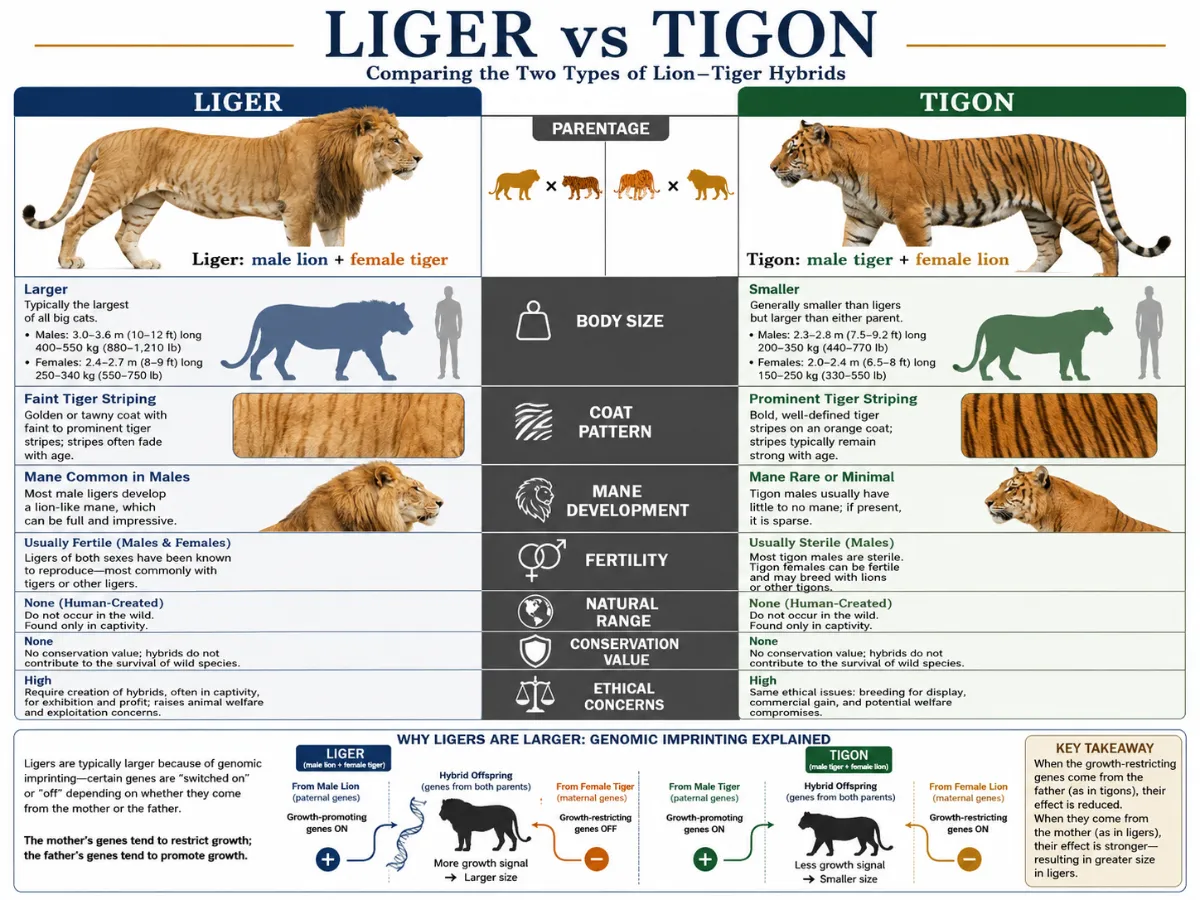
| Feature | Liger | Tigon |
|---|---|---|
| Parentage | Male lion × female tiger | Male tiger × female lion |
| Scientific background | Hybrid of Panthera leo and Panthera tigris | Hybrid of Panthera tigris and Panthera leo |
| Typical size | Often larger than both lions and tigers | Usually similar to or smaller than a lion |
| Common appearance | Large body, faint tiger-like stripes, lion-like face, sometimes a small mane in males | More compact body, mixed lion-tiger features, may show stripes and spots |
| Natural wild occurrence | Does not normally occur in the wild | Does not normally occur in the wild |
| Reason for existence | Captive breeding | Captive breeding |
| Fertility | Males are generally sterile; females may sometimes be fertile | Males are generally sterile; females may sometimes be fertile |
| Conservation value | Does not help restore wild lion or tiger populations | Does not help restore wild lion or tiger populations |
| Main ethical concern | Often bred for display rather than conservation | Often bred for display rather than conservation |
What Is a Liger?
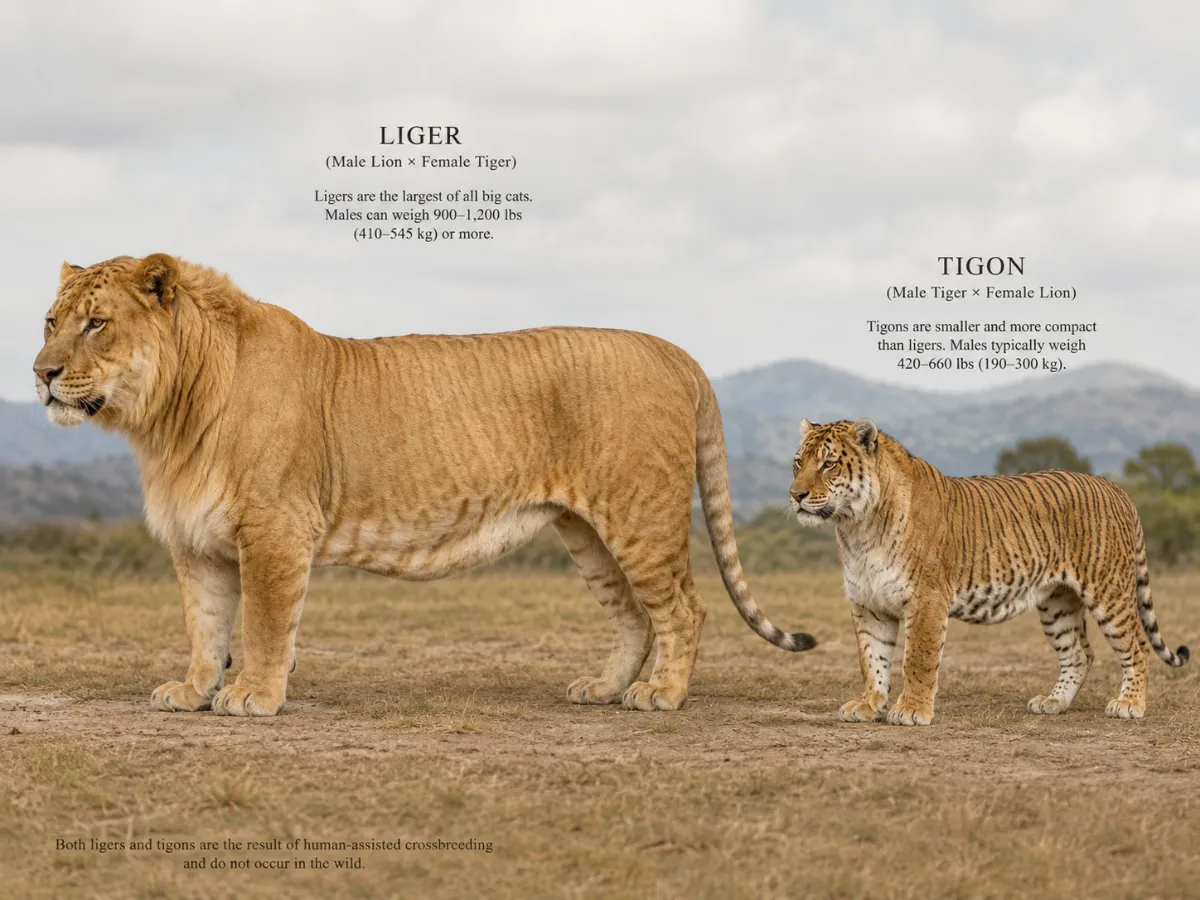
A liger is the hybrid offspring of a male lion and a female tiger. Its name combines “lion” and “tiger,” with the first part of the word coming from the lion father. Ligers are among the most famous big cat hybrids because of their enormous size.
In appearance, a liger often looks like a giant tawny cat with faint tiger-like stripes. Its head may appear somewhat lion-like, while the body can show tiger influence in the striping, body length, and sometimes a fondness for water. Male ligers may develop a mane, but it is usually smaller and less impressive than the mane of a full male lion.
Ligers are not a natural species. They are produced only when lions and tigers are kept together or deliberately bred in captivity. In the wild, lions and tigers have different ranges, different social systems, and different mating behaviors, so such breeding is not a normal part of nature.
What Is a Tigon?
A tigon is the hybrid offspring of a male tiger and a female lion. Its name also combines “tiger” and “lion,” but the first part of the word comes from the tiger father. Although tigons are similar to ligers in being lion-tiger hybrids, they usually do not grow as large as ligers.
A tigon may show a mixture of lion and tiger traits. It can have a tawny or orange-brown coat, faint stripes, spots, and a body shape that looks intermediate between the two parent species. Some male tigons may develop a small mane or mane-like ruff, but this varies between individuals.
Tigons are less famous than ligers, partly because they are usually smaller and have received less public attention. Like ligers, they are captive-bred hybrids rather than wild animals with a natural ecological role.
Parentage Is the Main Difference
The most important difference between a liger and a tigon is the direction of the cross.
A liger comes from a male lion and a female tiger. A tigon comes from a male tiger and a female lion. This may sound like a small detail, but in hybrid animals, the sex of each parent can strongly influence growth, appearance, and development.
This is why ligers and tigons can look and grow differently even though both have one lion parent and one tiger parent. The genes are not just inherited as a simple half-lion, half-tiger mixture. Some genes are affected by whether they come from the father or the mother.
Why Are Ligers Usually Bigger Than Tigons?
The most famous difference is size. Ligers are often much larger than either parent species, while tigons are usually closer to the size of a lion or tiger and may even be smaller than both parents.
One common explanation involves genomic imprinting. In simple terms, some genes behave differently depending on whether they are inherited from the mother or the father. Lions and tigers have different reproductive systems in nature. Lions live in social prides, where cubs may face competition among offspring from different males. Tigers are mostly solitary, and a tigress usually mates with one male during a breeding period.
Because of these different evolutionary pressures, growth-promoting and growth-limiting signals may not balance in the same way when lions and tigers hybridize. In a liger, the male lion’s growth-promoting influence and the female tiger’s genetic background may allow unusually large growth. In a tigon, the male tiger and female lion combination tends not to produce the same extreme size.
However, it is important not to oversimplify this. Not every liger is gigantic, and not every tigon is small. Nutrition, health, age, sex, and individual genetics all affect final body size.
Liger vs Tigon Appearance
Ligers often look like oversized lions with subtle tiger markings. Their background coat is usually golden, tawny, sandy, or light orange-brown. The stripes may be faint, especially from a distance, but they are often visible on the body, legs, or tail. Some ligers also show pale underparts, similar to tigers.
Tigons may show more mixed markings. They can have stripes from the tiger father and spots or rosettes influenced by the lion mother, especially because young lions naturally have spotted markings that may fade with age. Tigons are usually more compact than ligers and may not have the same extremely elongated, massive appearance.
In males, mane development varies. A male liger may grow a partial mane, but usually not the full mane of a male lion. A male tigon may also grow a small mane or ruff, depending on the individual. Neither hybrid should be expected to look exactly like a lion or exactly like a tiger.
Behavior and Temperament
Ligers and tigons may show behavioral traits associated with both lions and tigers, but behavior is also heavily shaped by captivity, human handling, enclosure design, early development, and individual personality.
Lions are social cats that live in prides, while tigers are solitary hunters. A liger may show some lion-like social tolerance and some tiger-like interest in water, but this does not mean it behaves predictably like either parent. A tigon may also show a mixture of traits, but there is no single universal “tigon personality.”
Because ligers and tigons are large predators, they remain dangerous animals regardless of how tame or familiar they may appear. Even hand-raised hybrids retain the strength, instincts, and physical ability of big cats.
Do Ligers and Tigons Live in the Wild?
Ligers and tigons do not normally occur in the wild. Lions and tigers historically overlapped only in limited parts of Asia, and even where their ranges came close, their behavior and habitat preferences made natural hybridization unlikely.
Modern lions and tigers are also separated by geography. Wild lions today are mainly found in parts of Africa, with a small population of Asiatic lions in India. Wild tigers live in parts of Asia. Their remaining natural populations do not normally mix in a way that would produce hybrids.
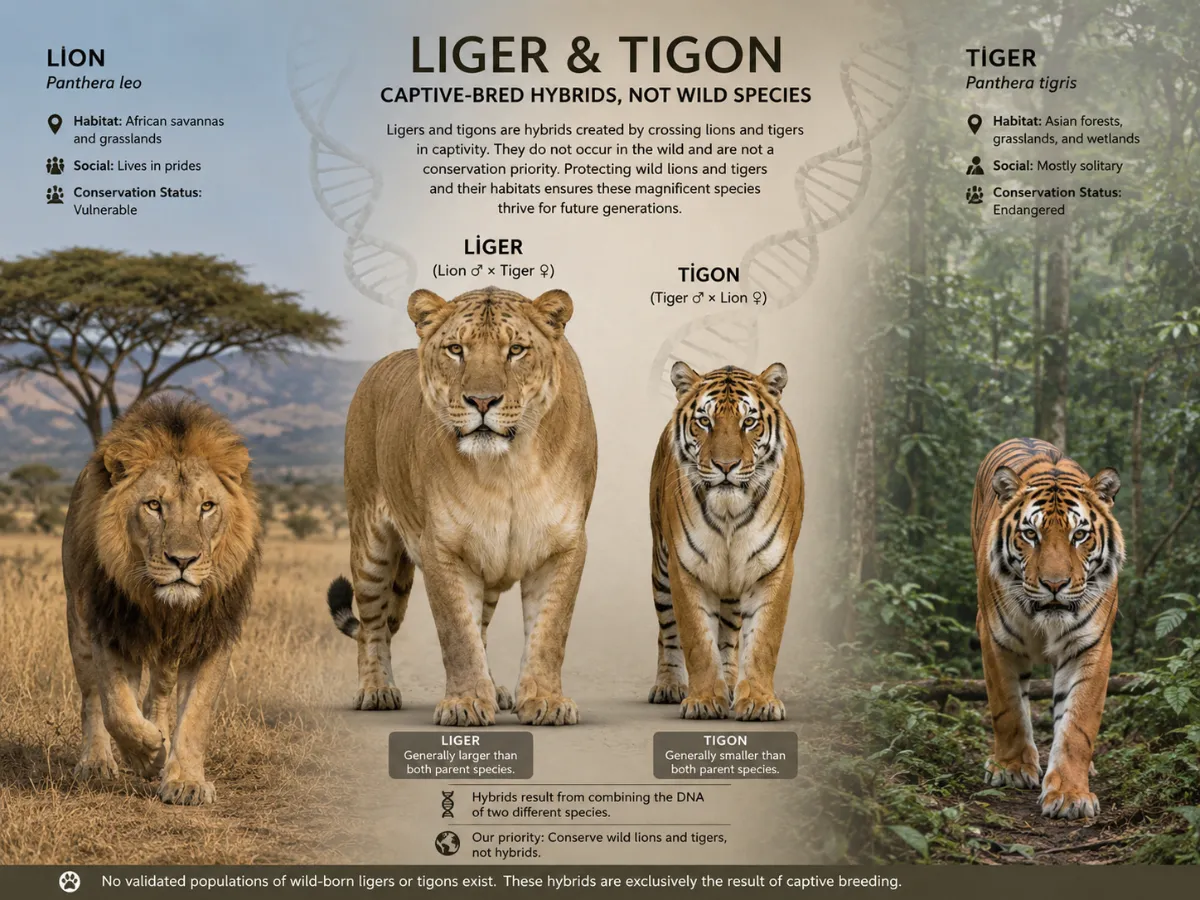
For this reason, ligers and tigons should be understood as captive-bred hybrids, not wild species. They do not have a natural range, natural population, or natural conservation role.
Are Ligers and Tigons Fertile?
Male ligers and male tigons are generally sterile. This pattern is common in many hybrids, especially when the parents are different species. In mammals, the male is often the sex more likely to be sterile in such crosses.
Female ligers and female tigons may sometimes be fertile. There are recorded cases of female lion-tiger hybrids producing offspring when bred with lions or tigers. However, this does not mean breeding them is biologically or ethically advisable. Fertility in hybrids can be variable, and second-generation hybrids may face additional health and welfare concerns.
For a science-based animal website, the safest wording is: male ligers and tigons are usually sterile, while females may occasionally be fertile.
Health and Welfare Concerns
Ligers and tigons are often presented as fascinating animals, but their existence raises serious welfare questions. Because they are not wild species and are usually bred for novelty, entertainment, or private display, they do not contribute to lion or tiger conservation.
Large body size in ligers can place stress on bones, joints, organs, and overall development. Hybrid big cats may also face complications related to growth, birth, neurological development, fertility, and long-term health. Not every individual will suffer the same problems, but the risk is one reason many conservation-minded zoologists and sanctuaries discourage breeding them.
Responsible big cat conservation focuses on protecting natural species, preserving habitat, reducing poaching, preventing illegal trade, and maintaining genetically appropriate breeding programs for lions and tigers—not producing hybrids for public attention.
Do Ligers and Tigons Help Conservation?
No. Ligers and tigons do not help restore wild lion or tiger populations. They are hybrids, so they are not suitable for release into the wild, and they do not preserve the genetic identity of either species.
In conservation biology, maintaining species integrity matters. A tiger conservation program should protect real tiger subspecies and their habitats. A lion conservation program should protect lions, their prey, and their ecosystems. A lion-tiger hybrid does not solve the problems facing either species.
This is why many wildlife experts view ligers and tigons as educationally interesting but conservation-poor animals. They can teach people about hybridization and genetics, but breeding them is not a meaningful conservation strategy.
Liger vs Tigon Size Comparison
| Size Factor | Liger | Tigon |
|---|---|---|
| General size trend | Usually very large | Usually moderate compared with liger |
| Compared with lions | Often larger than lions | Often similar to or smaller than lions |
| Compared with tigers | Often larger than tigers | Often similar to or smaller than tigers |
| Main reason | Likely linked to parent-specific gene expression and growth regulation | Different parent combination does not usually produce the same overgrowth |
| Best known for | Extreme size | Rarity and mixed features |
Common Myths About Ligers and Tigons
Myth: Ligers are a natural wild species
This is false. Ligers are captive-bred hybrids. They do not have a normal wild population or natural range.
Myth: Tigons are baby ligers
This is false. A tigon is not a young liger. It is a different hybrid cross with a male tiger father and a female lion mother.
Myth: All ligers keep growing forever
This is misleading. Ligers can grow very large and may take time to reach full size, but they do not literally grow forever. Like other mammals, their skeletal growth eventually stops.
Myth: Ligers and tigons are useful for saving tigers
This is false. Hybrid breeding does not protect wild tiger populations or tiger subspecies. Real tiger conservation depends on habitat protection, anti-poaching work, prey recovery, and responsible species-specific breeding programs.
Which Is More Common: Liger or Tigon?
Ligers are generally more famous and more commonly discussed than tigons, largely because of their impressive size. Their unusual growth has made them popular in media, zoos, private collections, and online animal discussions.
Tigons are less commonly seen and less widely promoted. Since they usually do not reach the same extreme size as ligers, they have attracted less public attention. However, from a zoological point of view, both are equally important examples of hybridization between closely related big cat species.
Final Verdict: Liger vs Tigon
The difference between a liger and a tigon comes down to parentage. A liger has a male lion father and a female tiger mother. A tigon has a male tiger father and a female lion mother. This difference affects body size, growth pattern, and sometimes appearance.
Ligers are usually much larger and are often described as the largest living cats. Tigons are usually smaller and more compact, often closer in size to lions or tigers. Both may show mixed features such as stripes, spots, tawny coats, partial manes, and blended facial traits.
Neither hybrid is a natural wild species, and neither has real conservation value. They are best understood as unusual captive-bred hybrids that can teach us about genetics, reproductive biology, and the ethical limits of breeding animals for novelty.
FAQs About Ligers and Tigons
What is the main difference between a liger and a tigon?
A liger is the offspring of a male lion and a female tiger. A tigon is the offspring of a male tiger and a female lion.
Which is bigger, a liger or a tigon?
A liger is usually much bigger than a tigon. Ligers often grow larger than both lions and tigers, while tigons are usually closer to normal big cat size.
Are ligers real animals?
Yes, ligers are real, but they are captive-bred hybrids rather than natural wild species.
Are tigons real animals?
Yes, tigons are real lion-tiger hybrids. They are less famous than ligers but are produced by the opposite parent combination.
Can ligers and tigons live in the wild?
No. They do not have a natural wild population and are not adapted as a species to any wild ecosystem. They are produced in captivity.
Can ligers reproduce?
Male ligers are generally sterile, but female ligers may sometimes be fertile.
Can tigons reproduce?
Male tigons are generally sterile, while female tigons may occasionally be fertile.
Why are ligers so large?
The leading explanation involves parent-specific gene expression, also called genomic imprinting. The male lion and female tiger combination may reduce normal growth-limiting effects, allowing unusually large size.
Do ligers have stripes?
Yes, many ligers have faint tiger-like stripes, although the markings may be subtle against a tawny or golden coat.
Do tigons have manes?
Some male tigons may develop a small mane or mane-like ruff, but it is usually not as full as the mane of a male lion.
Are ligers and tigons good for conservation?
No. They do not protect wild lions or tigers and are not part of responsible species conservation programs.