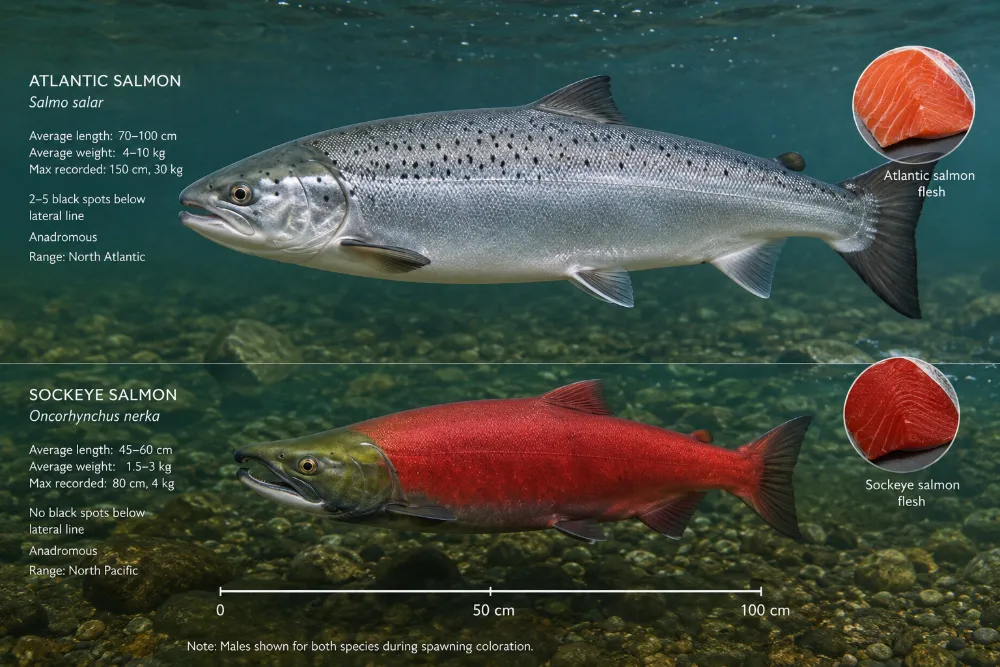
Sockeye salmon and Atlantic salmon are different salmon species from different branches of the salmon family. Sockeye salmon are Pacific salmon known for deep red flesh, strong flavor, and dramatic red spawning color. Atlantic salmon are native to the North Atlantic, often larger, milder in flavor, and widely farmed. Sockeye salmon usually die after spawning, while Atlantic salmon can sometimes survive and spawn again.
Quick Comparison Table
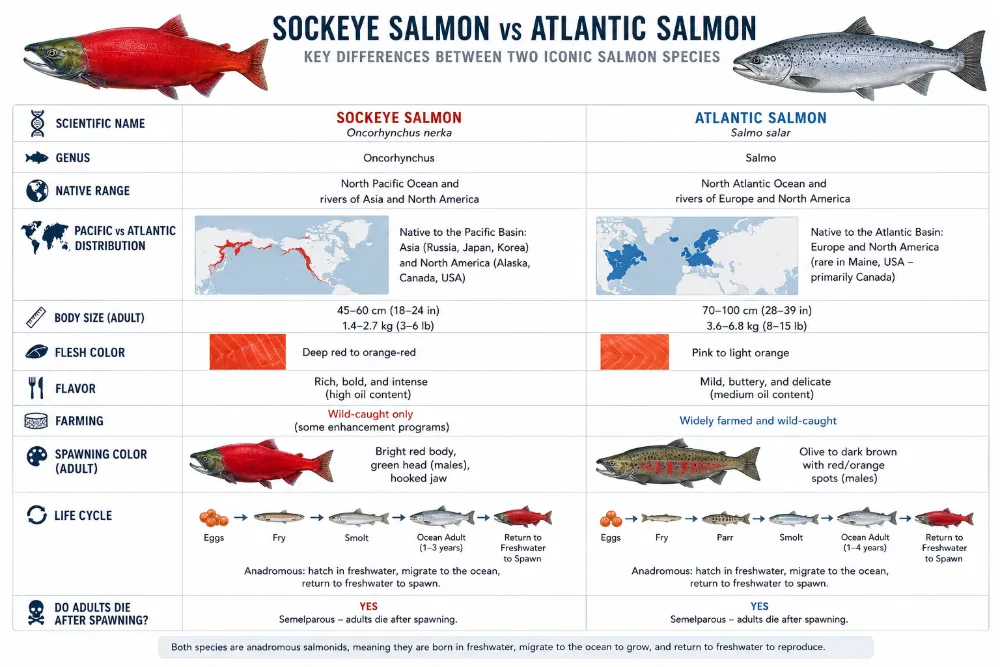
| Feature | Sockeye Salmon | Atlantic Salmon |
|---|---|---|
| Scientific name | Oncorhynchus nerka | Salmo salar |
| Salmon group | Pacific salmon | Atlantic salmon |
| Native range | North Pacific, especially Alaska, British Columbia, and parts of Russia and the Pacific Northwest | North Atlantic, including eastern North America and western Europe |
| Typical adult size | Usually smaller, often about 4–15 lb | Usually larger, often 8–20 lb, sometimes much larger |
| Flesh color | Deep red to orange-red | Pink to orange, often lighter than sockeye |
| Flavor | Rich, bold, firm, “salmon-forward” taste | Milder, fattier, softer texture, especially when farmed |
| Spawning color | Bright red body with green head | Darkens to bronze, brown, or reddish tones, often with spots |
| Life cycle after spawning | Dies after spawning | May survive and spawn more than once |
| Farming | Mostly wild-caught; large-scale farming is uncommon | Widely farmed around the world |
| Best known for | Red flesh, strong flavor, spectacular spawning migration | Large size, mild flavor, global aquaculture production |
What Is Sockeye Salmon?
Sockeye salmon is a Pacific salmon species with the scientific name Oncorhynchus nerka. It is one of the most recognizable salmon in North America because of its deep red flesh and dramatic spawning appearance. When sockeye salmon return from the ocean to freshwater, adults transform from silvery ocean fish into bright red fish with green heads.
Sockeye salmon are strongly associated with cold, clean freshwater systems connected to the North Pacific Ocean. Many populations hatch in lakes or lake-fed rivers, migrate to sea, grow in the ocean, and then return to their natal freshwater habitat to spawn. Some sockeye populations remain landlocked throughout life; these freshwater forms are commonly called kokanee salmon.
As food, sockeye is famous for its firm texture, deep color, and rich flavor. Its red flesh comes from natural pigments in its diet, especially carotenoid-rich plankton and small crustaceans.
What Is Atlantic Salmon?
Atlantic salmon is a different salmon species with the scientific name Salmo salar. It is native to the North Atlantic region, including rivers of eastern North America and western Europe. Unlike sockeye, Atlantic salmon belongs to the genus Salmo, making it more closely related to brown trout than to Pacific salmon such as sockeye, chinook, coho, chum, and pink salmon.
Atlantic salmon are anadromous fish, meaning many are born in freshwater, migrate to the ocean to grow, and later return to freshwater to spawn. However, some populations can live entirely in freshwater lakes. Atlantic salmon are powerful swimmers and can travel long distances between ocean feeding areas and natal rivers.
In markets, Atlantic salmon is commonly farm-raised. This has made it one of the most widely available salmon types worldwide. Its flavor is typically milder than sockeye, and its texture is often softer and fattier, especially in farmed fish.
Species and Classification
The most important biological difference is that sockeye salmon and Atlantic salmon are not the same species or even the same genus.
Sockeye salmon belong to the Pacific salmon genus Oncorhynchus. This group includes sockeye, chinook, coho, chum, pink, and several trout species such as rainbow trout. Most Pacific salmon are semelparous, meaning they reproduce once and die afterward.
Atlantic salmon belong to the genus Salmo. This group includes Atlantic salmon and brown trout. Atlantic salmon are iteroparous, meaning some individuals can survive spawning and return to the ocean before spawning again in a later year.
This difference affects their evolution, life cycle, spawning behavior, and ecology.
Native Range and Habitat
Sockeye salmon are native to the North Pacific basin. Important populations occur in Alaska, British Columbia, the Pacific Northwest, and parts of Russia and Japan. They depend on cold freshwater rivers, streams, and lakes for reproduction and early development. Many sockeye populations are closely tied to lake systems, where juveniles may spend one or more years before migrating to the sea.
Atlantic salmon are native to the North Atlantic basin. Historically, they occurred in rivers from northeastern North America to Europe. They use cold, oxygen-rich rivers for spawning and juvenile growth, then migrate to the Atlantic Ocean to feed and grow.
Their native ranges do not naturally overlap in the same way. Sockeye are Pacific salmon; Atlantic salmon are Atlantic fish. When Atlantic salmon are found outside their native range, it is usually because of aquaculture, stocking, or human introduction.
Size Difference
Atlantic salmon are generally larger than sockeye salmon. Adult sockeye often weigh about 4 to 15 pounds, although some individuals can be larger. They are strong, streamlined fish built for long migrations, but they are not usually among the largest salmon.
Atlantic salmon commonly reach 8 to 20 pounds, and large wild individuals can grow much heavier. Farmed Atlantic salmon are often harvested at market size before reaching maximum potential size, but they still tend to appear thicker and fattier than sockeye.
If the fish is compact, bright red-fleshed, and from the North Pacific, it may be sockeye. If it is larger, milder, fattier, and farm-raised, it is more likely Atlantic salmon.
Color and Appearance
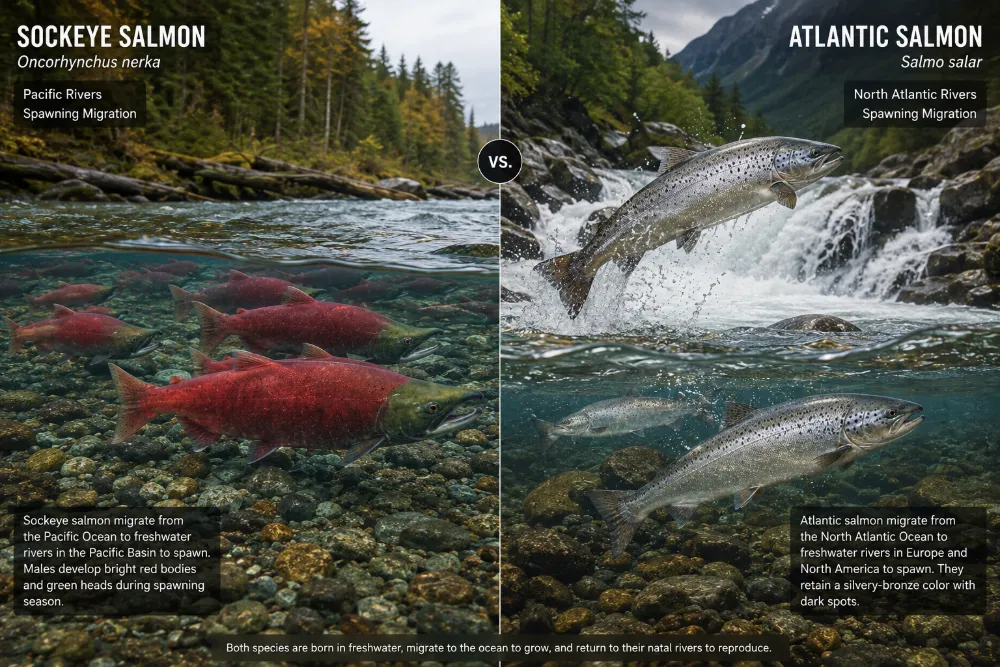
In the ocean, both sockeye and Atlantic salmon are generally silvery fish. This ocean coloration helps them blend into open water and avoid predators. The biggest visual differences appear during spawning.
Sockeye salmon are famous for their spawning transformation. Mature adults turn bright red on the body, while the head becomes greenish. Males also develop a hooked jaw called a kype and a more humped back. This red-and-green breeding color is one of the most iconic images in salmon biology.
Atlantic salmon also change during spawning, but usually not in the same vivid red-and-green pattern. They may become darker, bronze, brownish, or reddish, with more visible spots. Males may develop a pronounced kype, but the overall breeding color is typically less dramatically red than sockeye.
Flesh Color and Why Sockeye Is Redder
Sockeye salmon usually have deeper red flesh than Atlantic salmon. This color comes mainly from astaxanthin and related carotenoid pigments in their natural diet. Sockeye feed heavily on zooplankton and small crustaceans that contain these pigments, which accumulate in the muscle tissue.
Atlantic salmon flesh is usually pink to orange. Wild Atlantic salmon also gain color from their diet, while farmed Atlantic salmon receive carotenoid pigments through formulated feed. Without dietary pigments, salmon flesh would be much paler.
In simple terms, sockeye is usually redder because of its natural feeding ecology and pigment-rich diet. Atlantic salmon is usually lighter, although color varies by diet, origin, and farming practices.
Taste and Texture
Sockeye salmon has a bold, rich flavor. Its texture is firm, dense, and meaty. Many people describe sockeye as having a stronger “wild salmon” taste than Atlantic salmon. Because it is relatively lean compared with farmed Atlantic salmon, sockeye can become dry if overcooked.
Atlantic salmon is usually milder and fattier. Farmed Atlantic salmon, in particular, has a softer texture and more oil in the flesh. This makes it forgiving to cook and popular in restaurants, sushi, and home kitchens.
For flavor comparison, sockeye is usually best for people who like a stronger salmon taste and firm texture. Atlantic salmon is better for people who prefer a milder, buttery, softer fish.
Wild vs Farmed Salmon
One of the biggest practical differences is production. Sockeye salmon sold in markets is usually wild-caught. Large-scale sockeye farming is uncommon because sockeye have a life cycle and feeding ecology that make them more difficult to farm commercially than Atlantic salmon.
Atlantic salmon, by contrast, is one of the world’s major farmed fish. Many Atlantic salmon sold in supermarkets and restaurants comes from aquaculture operations. Farmed Atlantic salmon are raised in controlled systems and fed formulated diets.
This does not mean one is automatically “good” and the other is automatically “bad.” Wild fisheries and aquaculture both have environmental challenges. Wild salmon depend on healthy rivers and ocean conditions. Farmed salmon production must manage issues such as waste, disease, parasites, escapes, feed sourcing, and local ecosystem impacts.
Life Cycle and Migration
Sockeye salmon have a dramatic life cycle. They hatch in freshwater, often spend time in lakes as juveniles, migrate to the ocean, grow for several years, and then return to their natal waters to spawn. After spawning, sockeye die. Their bodies release nutrients back into rivers, lakes, forests, and food webs.
Atlantic salmon have a similar freshwater-to-ocean migration, but they differ in one major way: some adults survive spawning. After spawning, surviving Atlantic salmon are called kelts. They may return to the ocean, recover, and later spawn again.
This difference is biologically important. Sockeye put all their remaining energy into one final reproductive event. Atlantic salmon can, at least in some cases, invest in more than one spawning season.
Spawning Behavior
Female sockeye salmon dig nests called redds in gravel beds. Males compete for access to females, and spawning adults use their bright colors, body size, and hooked jaws during competition. After eggs are deposited and fertilized, the adults soon die.
Atlantic salmon also spawn in gravel nests. Females dig redds, males compete, and eggs develop in cold, oxygen-rich freshwater. Unlike sockeye, some Atlantic salmon may survive after spawning, although survival depends on condition, river difficulty, predation, and energy reserves.
Both species require clean gravel, cold water, and access between rivers and the sea. Dams, warming water, pollution, and habitat degradation can seriously reduce spawning success.
Diet and Feeding Ecology
Sockeye salmon have an unusual feeding pattern compared with many salmon. Juvenile sockeye often feed on zooplankton in lakes. In the ocean, adult sockeye continue to consume plankton, small crustaceans, squid, and small fish. Their strong link to plankton is one reason their flesh becomes so richly colored.
Atlantic salmon are more fish-oriented as they grow. Juveniles eat aquatic insects, larvae, and small invertebrates in rivers. At sea, they feed on small fish, crustaceans, and other marine prey. Their diet supports rapid growth and long-distance migration.
Both species are predators, but sockeye are especially connected to plankton-based food webs, while Atlantic salmon often rely more heavily on fish and larger marine prey as adults.
Conservation Status and Threats
Sockeye salmon populations vary widely. Some runs remain strong, especially in parts of Alaska, while others have declined due to dams, habitat loss, warming water, overharvest, pollution, and changes in ocean conditions. Sockeye conservation often focuses on protecting entire river-lake systems and maintaining access to spawning habitat.
Wild Atlantic salmon have declined severely in many parts of their historical range. Threats include river barriers, habitat degradation, warming waters, marine survival changes, pollution, overfishing, and interactions with aquaculture. Many wild Atlantic salmon populations are now carefully managed or protected.
For both species, healthy salmon populations depend on connected ecosystems: cold headwater streams, clean gravel beds, productive oceans, and migration routes free from major barriers.
Ecological Role
Sockeye salmon are especially important nutrient carriers. When they return from the ocean and die after spawning, their bodies feed bears, eagles, wolves, insects, microbes, forests, and freshwater ecosystems. In some regions, salmon nutrients can even be traced into trees and plants near spawning streams.
Atlantic salmon also play important ecological roles as predators, prey, and nutrient transporters. Because some can survive spawning, their nutrient contribution pattern differs from Pacific salmon, but they still connect marine and freshwater ecosystems.
Both species are more than food fish. They are ecosystem engineers in the broad sense: their migrations move energy and nutrients across habitats.
Which Is Better to Eat?
From a biological perspective, neither species is “better”; they are simply different. From a culinary perspective, the answer depends on personal preference.
Sockeye salmon is better if you want a stronger flavor, deep red color, firm texture, and wild salmon character. It works well grilled, broiled, smoked, baked, or used in dishes where a bold salmon taste is desired.
Atlantic salmon is better if you prefer a milder, fattier, softer fish. It is easier to cook without drying out and is commonly used in sushi, roasting, pan-searing, and restaurant dishes.
Simple Identification Checklist
| Question | Likely Sockeye Salmon | Likely Atlantic Salmon |
|---|---|---|
| Is it Pacific or Atlantic? | Pacific salmon | Atlantic salmon |
| What is the scientific genus? | Oncorhynchus | Salmo |
| What color is the flesh? | Deep red to orange-red | Pink to orange, often lighter |
| What is the flavor like? | Bold, rich, firm | Mild, fatty, soft |
| Is it usually farmed? | Usually wild-caught | Often farm-raised |
| Does it die after spawning? | Yes, as a typical Pacific salmon | Not always; some survive and spawn again |
| Spawning appearance | Bright red body, green head | Darker bronze, brown, or reddish tones |
Final Verdict: Sockeye Salmon vs Atlantic Salmon
Sockeye salmon and Atlantic salmon are both remarkable migratory fish, but they are easy to separate once you know the main clues. Sockeye salmon are Pacific salmon with deep red flesh, bold flavor, strong ties to lake systems, and a life cycle that ends after spawning. Atlantic salmon are North Atlantic fish, often larger and milder, widely farmed, and capable of spawning more than once in some cases.
The fastest rule is this: sockeye salmon are red-fleshed Pacific salmon famous for bold flavor and red spawning color; Atlantic salmon are North Atlantic salmon famous for larger size, milder taste, and global farming.
FAQs About Sockeye Salmon and Atlantic Salmon
Is sockeye salmon the same as Atlantic salmon?
No. Sockeye salmon and Atlantic salmon are different species. Sockeye is Oncorhynchus nerka, a Pacific salmon. Atlantic salmon is Salmo salar, a North Atlantic species.
Which is healthier, sockeye salmon or Atlantic salmon?
Both can be nutritious sources of protein and omega-3 fatty acids. Sockeye is often leaner and more intensely flavored, while farmed Atlantic salmon is often fattier. The best choice depends on diet goals, sourcing, and personal preference.
Which tastes better, sockeye or Atlantic salmon?
Sockeye has a stronger, richer salmon flavor and firmer texture. Atlantic salmon is milder, softer, and fattier. People who like bold wild salmon often prefer sockeye, while people who like a buttery mild taste often prefer Atlantic salmon.
Why is sockeye salmon so red?
Sockeye salmon is red because its diet is rich in natural pigments, especially carotenoids from plankton and small crustaceans. These pigments accumulate in the flesh.
Is Atlantic salmon always farmed?
No, wild Atlantic salmon exist, but most Atlantic salmon sold commercially is farm-raised. Wild Atlantic salmon are protected or strictly managed in many areas because many populations have declined.
Is sockeye salmon usually wild?
Yes. Sockeye salmon sold in stores is usually wild-caught, especially from Alaska or other North Pacific regions. Large-scale sockeye farming is uncommon compared with Atlantic salmon farming.
Which salmon is bigger?
Atlantic salmon are generally larger than sockeye salmon. Sockeye are usually medium-sized salmon, while Atlantic salmon can grow heavier and longer.
Do sockeye salmon die after spawning?
Yes. Sockeye salmon typically die after spawning, like most Pacific salmon. Their bodies then provide nutrients to freshwater and surrounding ecosystems.
Do Atlantic salmon die after spawning?
Not always. Some Atlantic salmon survive spawning, return to the ocean, and may spawn again in a later year.
Can sockeye salmon and Atlantic salmon interbreed?
No. They are different species from different genera, with different evolutionary histories and reproductive biology. Natural interbreeding is not part of their life cycle.