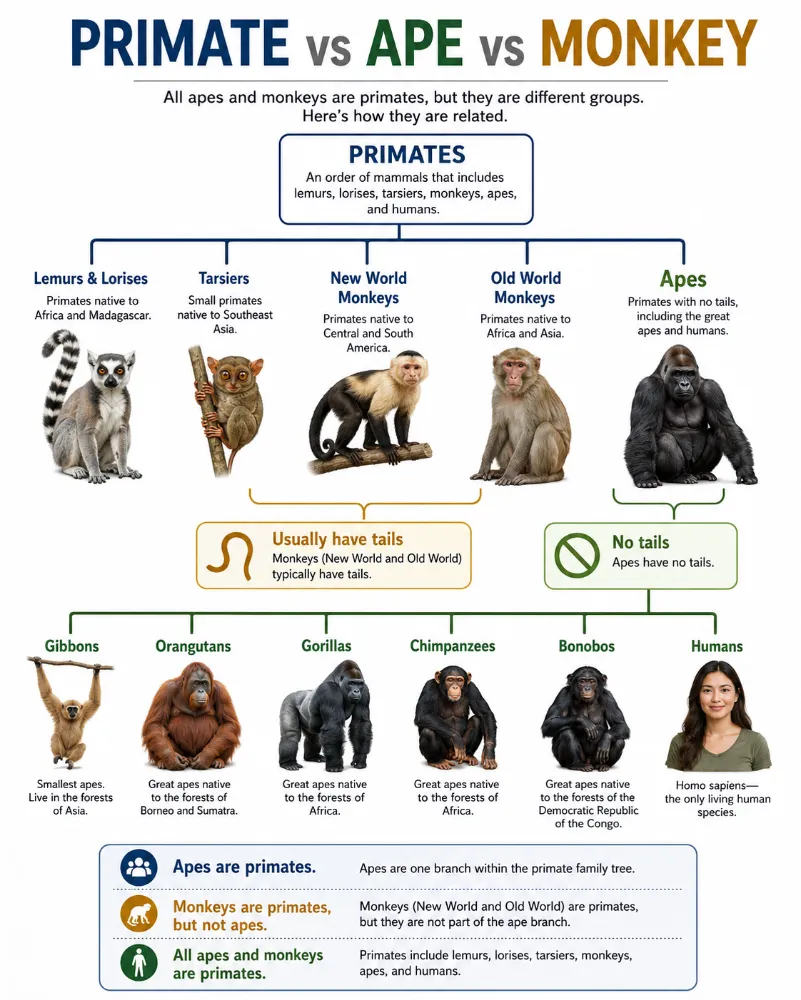
A primate is the broadest category. It includes lemurs, lorises, tarsiers, monkeys, apes, and humans. An ape is a tailless primate with a large brain, flexible shoulders, and close evolutionary ties to humans. A monkey is also a primate, but most monkeys have tails, smaller bodies, and different movement styles. In simple terms: all apes and monkeys are primates, but not all primates are apes or monkeys.
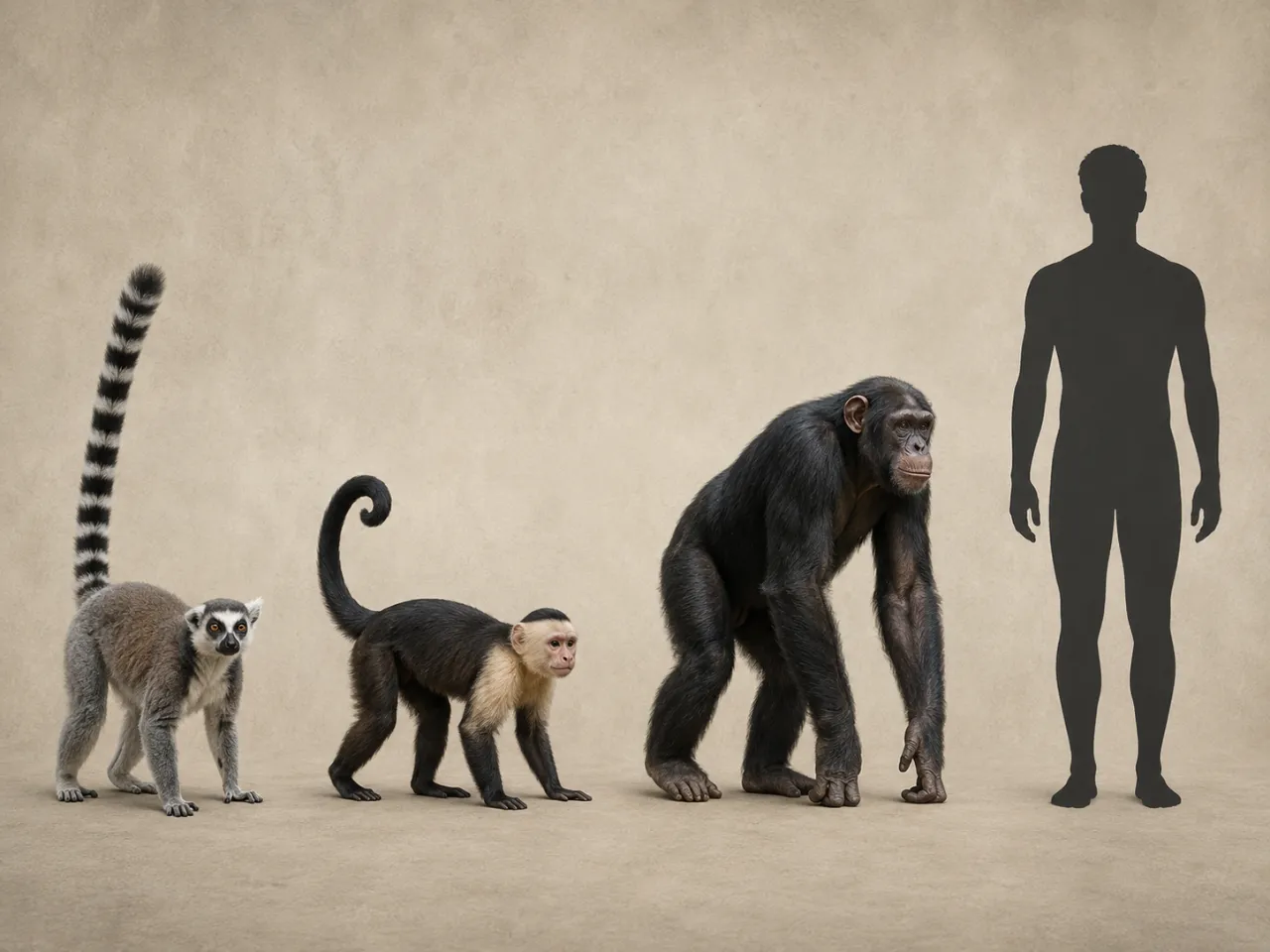
Primate vs Ape vs Monkey Quick Answer
The easiest way to understand the difference is by hierarchy. “Primate” is the big biological order. “Monkey” is a common name for many smaller to medium-sized primates, including New World monkeys and Old World monkeys. “Ape” refers to gibbons, orangutans, gorillas, chimpanzees, bonobos, and humans. Apes generally lack tails, have broader chests, more mobile shoulders, and larger brains compared with most monkeys.
Primate vs Ape vs Monkey Summary Table
| Feature | Primate | Ape | Monkey |
|---|---|---|---|
| Basic meaning | A broad mammal order | A tailless primate group within the apes | A common name for many non-ape primates |
| Includes | Lemurs, lorises, tarsiers, monkeys, apes, humans | Gibbons, orangutans, gorillas, chimpanzees, bonobos, humans | Marmosets, capuchins, howler monkeys, macaques, baboons, colobus monkeys, and many others |
| Tail | Depends on group | No external tail | Usually has a tail, but some monkeys have very short or absent-looking tails |
| Brain size | Generally large relative to many mammals | Usually larger and more complex | Variable, often smaller than apes relative to body size |
| Shoulders | Variable | Highly mobile, useful for climbing, hanging, and arm-swinging | Usually less specialized for hanging than apes |
| Body posture | Variable | Often more upright through the torso | Often more horizontal when moving on branches or ground |
| Locomotion | Climbing, leaping, walking, swinging, brachiation, knuckle-walking, bipedalism | Climbing, suspensory movement, brachiation, knuckle-walking, bipedalism in humans | Climbing, running, leaping, quadrupedal walking, some tail-assisted movement |
| Examples | Lemur, macaque, chimpanzee, human | Gorilla, chimpanzee, orangutan, gibbon, human | Capuchin, macaque, baboon, squirrel monkey, howler monkey |
| Human relationship | Humans are primates | Humans are great apes | Humans are not monkeys in common biological usage |
| Quick clue | Umbrella category | No tail, larger brain, flexible shoulders | Usually tailed, often smaller and more branch-running |
What Is a Primate?
A primate is a mammal belonging to the order Primates. This order includes some of the most intelligent, social, and visually oriented mammals on Earth. Primates are not one single type of animal. They include tiny mouse lemurs, long-fingered aye-ayes, big-eyed tarsiers, acrobatic gibbons, powerful gorillas, clever capuchins, and humans.
Most primates share several broad traits. They often have forward-facing eyes, good depth perception, flexible hands or feet, nails instead of claws on many digits, sensitive fingertips, relatively large brains, and complex social behavior. These traits are linked to life in trees, where seeing distance accurately, grasping branches, and learning from others are extremely useful.
However, not every primate has every trait in the same way. A lemur is not built like a gorilla. A tarsier is not built like a baboon. A human is not built like a spider monkey. “Primate” is the large umbrella category that contains many different evolutionary branches.
What Is an Ape?
An ape is a primate in the superfamily Hominoidea. Living apes include gibbons, siamangs, orangutans, gorillas, chimpanzees, bonobos, and humans. Apes are generally larger-brained than monkeys, have no external tail, and have shoulders adapted for a wide range of arm movement.
Apes are divided into two main groups: lesser apes and great apes. Lesser apes include gibbons and siamangs, which are small to medium-sized, highly agile, and famous for swinging through trees using their arms. Great apes include orangutans, gorillas, chimpanzees, bonobos, and humans. Great apes tend to be larger, more intelligent, and more behaviorally complex.
Apes are especially important in discussions of human evolution because humans are great apes. This does not mean humans evolved from modern chimpanzees or gorillas. It means humans and other apes share common ancestors in the evolutionary past.
What Is a Monkey?
A monkey is a common name for many primates that are not apes, lemurs, lorises, or tarsiers. Monkeys are usually divided into New World monkeys and Old World monkeys. New World monkeys live in Central and South America. Old World monkeys live in Africa and Asia.
Most monkeys have tails, although not all tails are used the same way. Some New World monkeys, such as spider monkeys and howler monkeys, have prehensile tails that can grasp branches. Old World monkeys, such as macaques and baboons, may have tails, but their tails are not prehensile. A few monkeys, such as Barbary macaques, have very short tails and may look almost tailless.
Monkeys are extremely diverse. Some are tiny and tree-dwelling, like marmosets. Some are intelligent tool users, like capuchins. Some are ground-adapted and powerful, like baboons. This diversity makes “monkey” a useful common word, but it is less precise than a formal scientific group.
The Simple Rule: Primate Is the Umbrella Term
The simplest way to remember the relationship is:
Primate is the broad group.
Monkey is one common type of primate.
Ape is another type of primate.
Humans are primates and great apes.
So, a gorilla is a primate and an ape, but not a monkey. A capuchin is a primate and a monkey, but not an ape. A lemur is a primate, but not a monkey or an ape. A human is a primate and a great ape, but not a monkey in common zoological usage.
Taxonomy: Where They Fit
Modern primate classification can be simplified like this:
| Level | Group | Examples |
|---|---|---|
| Order | Primates | Lemurs, lorises, tarsiers, monkeys, apes, humans |
| Suborder | Strepsirrhines | Lemurs, lorises, galagos |
| Suborder | Haplorhines | Tarsiers, monkeys, apes, humans |
| Major group | New World monkeys | Capuchins, marmosets, tamarins, spider monkeys, howler monkeys |
| Major group | Old World monkeys | Macaques, baboons, colobus monkeys, langurs, mandrills |
| Major group | Apes | Gibbons, orangutans, gorillas, chimpanzees, bonobos, humans |
One important scientific detail is that apes are evolutionarily closer to Old World monkeys than either group is to New World monkeys. In casual language, people often say “monkeys and apes” as separate categories. In evolutionary history, their relationships are more connected and branching.
Tail Differences
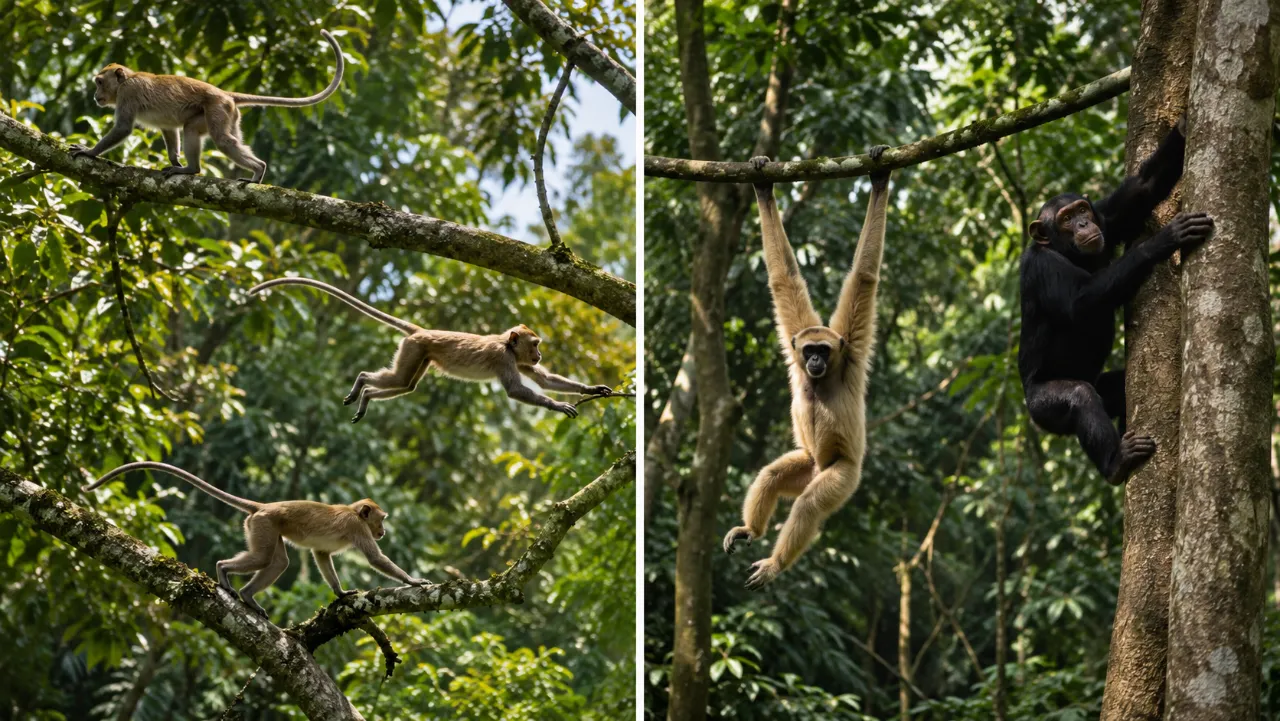
The tail is the most famous difference between apes and monkeys. Apes do not have external tails. Monkeys usually do. This rule works well most of the time, but it has exceptions and needs careful wording.
Most monkeys have visible tails. New World monkeys may have long tails, and some species use their tails as a fifth limb. Spider monkeys, woolly monkeys, and howler monkeys can use prehensile tails to grip branches. This is especially useful in the forest canopy.
Old World monkeys usually have non-prehensile tails. Their tails may help with balance, communication, or body posture, but they cannot grasp branches like a hand. Some Old World monkeys, such as Barbary macaques, have very short tails, which can confuse people.
Apes have no external tail. If a primate is a gorilla, chimpanzee, orangutan, gibbon, bonobo, or human, it is an ape and does not have a tail.
Body Shape and Shoulders
Apes and monkeys often move differently because their bodies are shaped differently. Apes tend to have broader chests, more flexible shoulders, and arms that can move in a wide range of directions. These features are especially useful for climbing, hanging below branches, and swinging.
Gibbons are the best example of arm-swinging movement, called brachiation. They can swing rapidly from branch to branch using their long arms and flexible shoulders. Orangutans also use powerful arms and flexible joints to move carefully through trees.
Monkeys are generally more adapted for running and climbing along the tops of branches. Many move on all fours, with the body held more horizontally. Some leap between branches. Others, such as baboons, spend a lot of time on the ground.
This is a useful visual clue: apes often look more upright through the torso, while monkeys often look more horizontal when moving.
Brain Size and Intelligence
Primates are generally intelligent mammals, but intelligence varies widely across the order. Apes are especially known for large brains, complex social learning, problem-solving, tool use, emotional expression, and flexible behavior.
Chimpanzees, bonobos, orangutans, and gorillas can solve problems, use tools, recognize social relationships, learn from observation, and show complex communication. Humans are the most cognitively specialized apes, with language, symbolic thought, culture, technology, and cumulative learning.
Monkeys can also be highly intelligent. Capuchins use tools and solve complex foraging problems. Macaques show social learning and flexible behavior. Baboons maintain complicated social hierarchies. The difference is not that monkeys are unintelligent; it is that apes generally show larger brains and more complex cognition in many areas.
Movement: Climbing, Swinging, Walking, and Leaping
Different primates move in different ways. This reflects their habitats, body shapes, and evolutionary histories.
Many monkeys move quadrupedally, using all four limbs on branches or on the ground. Baboons and macaques are strong ground walkers. Colobus monkeys and langurs can leap impressively through trees. Spider monkeys combine long limbs with prehensile tails to move through the canopy.
Apes show more suspensory movement. Gibbons swing under branches. Orangutans climb slowly and carefully through trees. Gorillas and chimpanzees often use knuckle-walking on the ground. Humans are unique among living apes because we are habitual bipeds, meaning we normally walk upright on two legs.
Primates as a whole show one of the widest ranges of movement styles among mammals.
New World Monkeys vs Old World Monkeys
Monkeys are not all the same. New World monkeys and Old World monkeys split from each other long ago and have several important differences.
| Feature | New World Monkeys | Old World Monkeys |
|---|---|---|
| Location | Central and South America | Africa and Asia |
| Nose shape | Often wider, with nostrils facing more sideways | Narrower, with nostrils facing more downward |
| Tail | Often long; some have prehensile tails | Usually present but not prehensile; sometimes very short |
| Examples | Capuchins, marmosets, tamarins, spider monkeys, howler monkeys | Macaques, baboons, colobus monkeys, langurs, mandrills |
| Typical habitat | Mostly forest and canopy habitats | Forests, savannas, mountains, cities, rocky habitats |
New World monkeys are famous for prehensile tails in some species. Old World monkeys are more closely related to apes, but they do not have the same tailless, broad-chested body plan as apes.
Lesser Apes vs Great Apes
Apes are divided into lesser apes and great apes. The word “lesser” does not mean less important. It refers mainly to size and classification.
Lesser apes include gibbons and siamangs. They are smaller than great apes, highly agile, and excellent brachiators. They have long arms, no tails, and often form strong pair bonds. Their loud calls can travel through forests.
Great apes include orangutans, gorillas, chimpanzees, bonobos, and humans. They are larger-bodied, larger-brained, and behaviorally complex. Great apes show advanced problem-solving, long childhoods, social learning, and strong emotional bonds.
| Ape Group | Examples | Main Traits |
|---|---|---|
| Lesser apes | Gibbons, siamangs | Small to medium size, long arms, fast brachiation, no tail |
| Great apes | Orangutans, gorillas, chimpanzees, bonobos, humans | Larger brains, larger bodies, complex social and cognitive behavior |
Are Humans Primates, Apes, or Monkeys?
Humans are primates. More specifically, humans are great apes. We belong to the same broad ape group as chimpanzees, bonobos, gorillas, and orangutans. Humans are not monkeys in the usual modern biological sense.
This can sound surprising because people often use “ape” to mean only non-human apes. Scientifically, humans are part of the ape lineage. Our bodies show this ancestry: we have no tail, we have flexible shoulders, we have grasping hands, we have forward-facing eyes, and we have a large brain.
Humans did not evolve from modern monkeys or modern chimpanzees. Instead, humans, chimpanzees, monkeys, and other primates share common ancestors at different points in evolutionary history.
Are Apes More Evolved Than Monkeys?
No. This is a common misunderstanding. Evolution is not a ladder with humans at the top, apes in the middle, and monkeys below. Evolution is a branching tree. Monkeys, apes, lemurs, and humans are all modern animals shaped by their own evolutionary paths.
A spider monkey is not trying to become an ape. A baboon is not an unfinished human. Each species is adapted to its own environment, diet, predators, social structure, and reproductive strategy.
Apes may have larger brains and more flexible shoulders than many monkeys, but monkeys are highly successful in their own ways. Some live in forests, some in mountains, some in savannas, and some even thrive near human cities.
Habitat Differences
Primates live in many habitats, though most are associated with tropical or subtropical environments. Lemurs are famously associated with Madagascar. New World monkeys live in the Americas, especially tropical forests. Old World monkeys live across Africa and Asia. Apes live in Africa and Asia, except humans, who are globally distributed.
Monkeys often occupy a wide range of habitats. Capuchins live in forests. Baboons live in savannas, rocky areas, and woodlands. Macaques can live in forests, mountains, temples, and cities. This flexibility has helped some monkey species survive close to humans.
Non-human apes are more limited in distribution today. Gorillas, chimpanzees, and bonobos live in Africa. Orangutans live in Southeast Asia. Gibbons live in Asian forests. Many apes depend heavily on forests and are threatened by habitat loss.
Diet Differences
Primates eat a wide range of foods. Many eat fruit, leaves, flowers, seeds, insects, gum, nectar, bark, and small animals. Diet varies strongly by species.
Monkeys are often flexible feeders. Capuchins may eat fruit, insects, nuts, eggs, and small animals. Howler monkeys eat many leaves. Baboons eat grasses, roots, seeds, insects, and sometimes small vertebrates. Macaques are famously adaptable and may eat natural foods as well as human food when available.
Apes also vary. Gorillas eat many leaves, stems, shoots, and fruit depending on region. Orangutans are heavily fruit-focused but also eat leaves, bark, insects, and other foods. Chimpanzees and bonobos eat fruit, leaves, insects, and sometimes hunt small mammals. Humans have an unusually broad, culturally shaped diet.
Social Behavior
Primates are often social, but their societies are very different. Some lemurs live in female-dominant groups. Some monkeys live in large troops with complex hierarchies. Some gibbons live in small family groups. Orangutans are more solitary than many other apes. Chimpanzees and bonobos live in flexible communities with complex alliances.
Monkeys often have highly visible group behavior. Baboons groom, form alliances, compete for rank, and protect young. Macaques have complex dominance systems. Capuchins cooperate, learn from one another, and use social knowledge when foraging.
Apes often show deep social learning and emotional complexity. Chimpanzees form political alliances. Bonobos use social behavior to reduce conflict. Gorillas live in groups often led by a silverback. Humans build the most complex social systems of any primate, including language-based culture, laws, cities, and technology.
Communication Differences
Primates communicate with vocal sounds, facial expressions, body postures, gestures, scent signals, grooming, and touch. Their communication systems are not all the same, but many are sophisticated.
Monkeys often use alarm calls, contact calls, threat faces, grooming, and body displays. Some monkeys have different calls for different types of danger. For example, a monkey may respond differently to a snake, eagle, or leopard threat.
Apes are especially known for gestures and social learning. Chimpanzees, bonobos, gorillas, and orangutans use facial expressions, body signals, vocalizations, and learned behaviors. Humans are unique because symbolic language became central to our communication, culture, and survival.
Common Misidentifications
One common mistake is calling every primate a monkey. Lemurs are primates, but they are not monkeys. Gorillas are primates, but they are apes, not monkeys. Humans are primates and apes, not monkeys in the usual biological sense.
Another mistake is using tail presence as an absolute rule. It is a very useful clue, but a few monkeys have very short tails. A tailless-looking monkey is still not automatically an ape. Body shape, ancestry, shoulders, face, and classification matter too.
A third mistake is thinking “ape” means “primitive human.” Apes are not failed humans. They are modern animals with their own adaptations. Humans are one branch of the ape family, not the goal of primate evolution.
How to Identify One in a Photo
When looking at a photo, use several clues together:
Look for a tail: a clear tail usually suggests monkey, not ape.
Check the body shape: broad chest and long arms may suggest ape.
Check the face: apes often have more expressive faces and larger heads relative to body size.
Check the movement: arm-swinging, knuckle-walking, or upright posture may suggest ape.
Check the habitat and species: lemurs in Madagascar are primates but not monkeys or apes.
Check for prehensile tail: a grasping tail suggests certain New World monkeys.
Photo identification is easiest when the whole body is visible. A close-up face alone may not show the tail, body posture, or movement style needed for accurate identification.
Primate vs Monkey
A monkey is a primate, but a primate is not always a monkey. This is like saying a sparrow is a bird, but not every bird is a sparrow.
Primates include monkeys, apes, lemurs, lorises, tarsiers, and humans. Monkeys are only one major part of the primate order. If someone says “all primates are monkeys,” that is incorrect. A lemur is a primate, but it is not a monkey. A human is a primate, but not a monkey in common biological usage.
Ape vs Monkey
The ape vs monkey difference is the one most people search for. The practical clues are tail, body shape, shoulders, and brain size.
| Feature | Ape | Monkey |
|---|---|---|
| Tail | No external tail | Usually has a tail |
| Shoulders | Highly flexible | Usually less flexible for hanging |
| Chest | Often broader | Often narrower and more horizontal |
| Movement | Hanging, swinging, climbing, knuckle-walking, bipedalism | Branch-running, climbing, leaping, quadrupedal walking |
| Examples | Gorilla, chimpanzee, orangutan, gibbon | Macaque, baboon, capuchin, howler monkey |
Lemurs, Lorises, and Tarsiers: Why They Matter
Lemurs, lorises, and tarsiers are important because they show why “primate” is broader than “monkey” or “ape.” These animals are primates, but they are not apes and not monkeys.
Lemurs live naturally only in Madagascar. Many have long tails, strong leaping ability, and social systems very different from monkeys and apes. Lorises and galagos are mostly nocturnal primates with large eyes and specialized movement. Tarsiers are small, big-eyed primates that hunt insects and small animals at night.
These groups remind us that primate evolution is not only about monkeys and apes. The primate order is much richer and older than the familiar zoo categories suggest.
Conservation Status
Many primates are threatened by habitat loss, hunting, illegal wildlife trade, climate change, disease, and conflict with humans. Forest destruction is especially serious because so many primates depend on trees for food, shelter, movement, and reproduction.
Great apes face severe conservation pressure. Orangutans are threatened by forest loss and fragmentation. Gorillas, chimpanzees, and bonobos face hunting, disease risk, and habitat destruction. Gibbons are threatened by deforestation and the pet trade.
Many monkeys are also threatened, especially species with small ranges or specialized habitats. Some primates adapt well to human environments, but many cannot survive without intact forests. Protecting primates also protects forests, biodiversity, water systems, and many other species.
Why the Difference Matters
Understanding primate, ape, and monkey differences is not just about vocabulary. It helps people understand evolution, conservation, animal behavior, and human biology more accurately.
If people call every primate a monkey, they miss important evolutionary relationships. If people think humans are separate from animals, they misunderstand our place in nature. If people think apes are just bigger monkeys, they miss the unique body plans and behaviors that define the ape lineage.
Correct terms help us talk about animals with more respect and scientific clarity.
Final Comparison
Primate, ape, and monkey are related terms, but they do not mean the same thing. A primate is any member of the order Primates, including lemurs, lorises, tarsiers, monkeys, apes, and humans. A monkey is a common name for many tailed or mostly tailed primates outside the ape lineage. An ape is a tailless primate with flexible shoulders, a larger brain, and a body plan different from most monkeys.
The simplest summary is: all apes and monkeys are primates, but apes are not monkeys in common zoological usage. Humans are primates and great apes. Monkeys are a diverse group of primates that usually have tails and are found in the Americas, Africa, and Asia.
Related Animal Comparisons
Ape vs Monkey
Gorilla vs Chimpanzee
Chimpanzee vs Bonobo
Lemur vs Monkey
Orangutan vs Gorilla
Human vs Chimpanzee
FAQs About Primate vs Ape vs Monkey
Is a primate the same as a monkey?
No. A monkey is a type of primate, but not all primates are monkeys. Primates also include lemurs, lorises, tarsiers, apes, and humans.
Is an ape a monkey?
In common zoological usage, no. Apes and monkeys are different primate groups. Apes have no external tail and usually have broader chests, more flexible shoulders, and larger brains than monkeys.
Are humans primates?
Yes. Humans are primates. More specifically, humans are great apes, closely related to chimpanzees, bonobos, gorillas, and orangutans.
Are humans monkeys?
Humans are not monkeys in the usual modern biological sense. Humans are apes. However, humans, apes, and monkeys all belong to the larger primate order.
What is the main difference between apes and monkeys?
The most obvious difference is that apes do not have external tails, while most monkeys do. Apes also tend to have larger brains, more flexible shoulders, and different body posture and movement patterns.
Do all monkeys have tails?
Most monkeys have tails, but there are exceptions. Some monkeys, such as Barbary macaques, have very short tails and may look almost tailless. Tail length alone should not be the only identification clue.
Are gorillas monkeys or apes?
Gorillas are apes. They are great apes, along with orangutans, chimpanzees, bonobos, and humans.
Are lemurs monkeys?
No. Lemurs are primates, but they are not monkeys. They belong to a different primate branch and live naturally only in Madagascar.
Are chimpanzees monkeys?
No. Chimpanzees are apes, not monkeys. They have no external tail, large brains, flexible shoulders, and complex social behavior.
Which is smarter, apes or monkeys?
Apes generally have larger brains and often show more complex problem-solving and social learning. However, many monkeys are also highly intelligent, especially capuchins, macaques, and baboons.