A rooster is a chicken, but not every chicken is a rooster. “Chicken” is the general name for the domesticated bird species Gallus gallus domesticus. A rooster is an adult male chicken. A hen is an adult female chicken. Roosters usually have larger combs, longer tail feathers, pointed neck feathers, stronger spurs, louder crowing, and a protective role in the flock. Hens lay eggs; roosters do not.
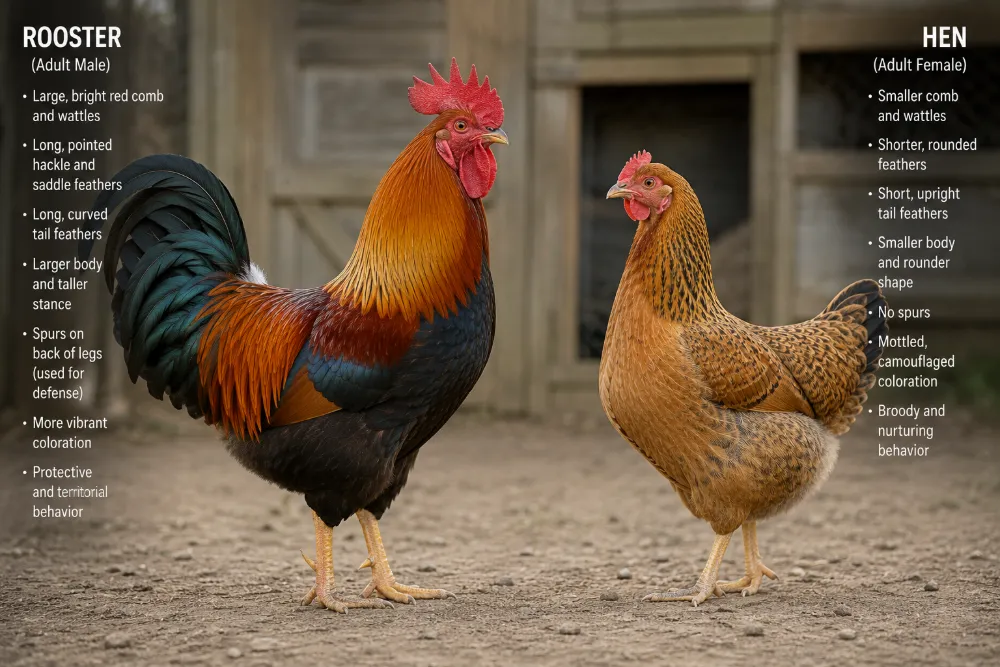
Quick Comparison Table
| Feature | Rooster | Chicken |
|---|---|---|
| Meaning | An adult male chicken | The general name for the domesticated bird species |
| Scientific name | Gallus gallus domesticus | Gallus gallus domesticus |
| Sex | Male | Can be male or female |
| Female term | Not applicable | Hen |
| Young male term | Cockerel | Young chickens are called chicks |
| Egg laying | Does not lay eggs | Female chickens, or hens, lay eggs |
| Crowing | Common and often loud | Hens may vocalize, but usually do not crow like roosters |
| Comb and wattles | Usually larger and brighter | Varies; hens usually have smaller combs and wattles |
| Tail feathers | Often long, arched, and showy | Usually shorter and less dramatic in hens |
| Spurs | Usually larger and more developed | Usually smaller or absent, though some hens can have spurs |
| Main flock role | Protection, mating, alert calls, flock leadership | General species term; hens mainly lay eggs and raise chicks |
What Is a Chicken?
A chicken is a domesticated bird descended mainly from the red junglefowl of South and Southeast Asia. The scientific name of the domestic chicken is Gallus gallus domesticus. Chickens are among the most widespread domestic animals in the world and are kept for eggs, meat, breeding, pest control, exhibition, and companionship.
The word “chicken” can refer to the whole species, regardless of sex or age. A rooster is a chicken. A hen is a chicken. A chick is also a chicken. This is why the comparison “rooster vs chicken” can be confusing: it is not a comparison between two separate species. It is a comparison between one specific type of chicken and the broader category of chickens.
In everyday language, many people use “chicken” to mean a hen, especially when talking about backyard flocks and egg laying. Scientifically and zoologically, however, chicken is the general species term.
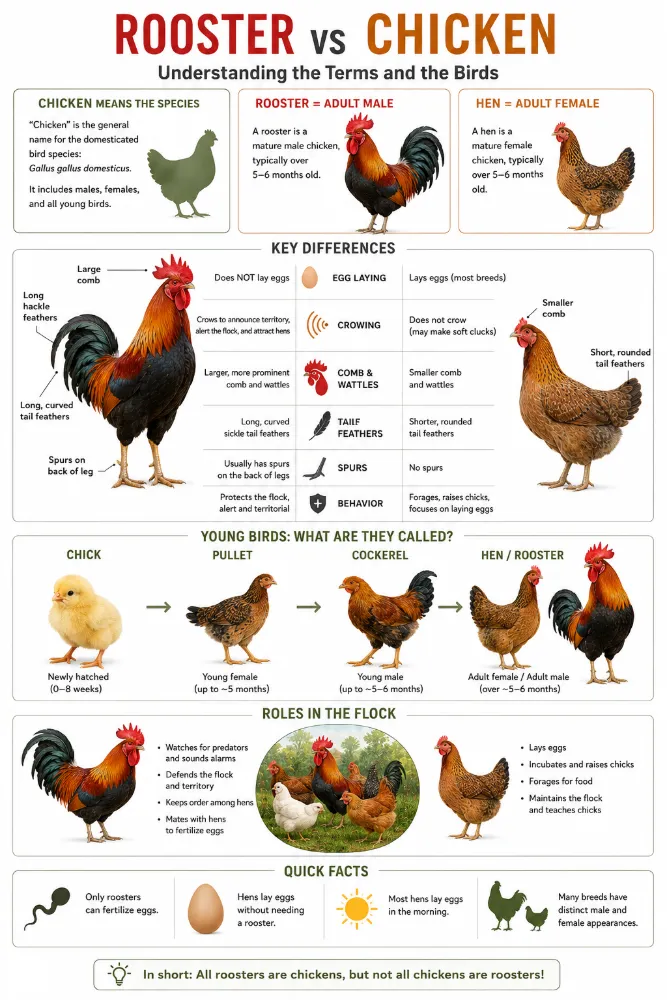
What Is a Rooster?
A rooster is an adult male chicken. In many regions, the word “cock” is also used for an adult male chicken, while “cockerel” means a young male chicken that has not fully matured. In American English, “rooster” is the more common polite everyday term.
Roosters are best known for crowing, guarding the flock, mating with hens, and showing more dramatic physical features than hens. They often have larger combs, brighter wattles, longer tail feathers, pointed hackle feathers on the neck, pointed saddle feathers near the back, and more developed leg spurs.
A rooster’s biological role is reproduction and flock defense. If a flock has hens and a fertile rooster, the hens can produce fertilized eggs that may develop into chicks if incubated properly. Without a rooster, hens can still lay eggs, but those eggs will not be fertile.
The Main Difference Between a Rooster and a Chicken
The main difference is that “rooster” describes sex, while “chicken” describes the species. A rooster is a male chicken. A hen is a female chicken. A chick is a young chicken.
If someone asks, “Is a rooster a chicken?” the answer is yes. A rooster is a chicken in the same way a bull is cattle or a stallion is a horse. The word rooster identifies an adult male within the species.
The easiest rule is: all roosters are chickens, but not all chickens are roosters.
Rooster vs Hen vs Chicken
| Term | Meaning | Simple Explanation |
|---|---|---|
| Chicken | The domesticated bird species | Can be male, female, young, or adult |
| Rooster | Adult male chicken | Crows, mates with hens, often guards the flock |
| Hen | Adult female chicken | Lays eggs and may brood chicks |
| Cockerel | Young male chicken | A juvenile male before full adult maturity |
| Pullet | Young female chicken | A young female before or near egg-laying age |
| Chick | Baby chicken | A newly hatched or young chicken |
| Capon | Castrated male chicken | Historically raised for meat in some poultry systems |
Appearance Differences
Roosters are usually more colorful and dramatic than hens, especially in breeds with strong sexual dimorphism. Sexual dimorphism means males and females of the same species look different.
A rooster often has a larger comb on top of the head and larger wattles under the beak. These fleshy structures may be bright red and can help signal health, maturity, and reproductive condition. Roosters also often have long, curved tail feathers called sickle feathers, as well as pointed hackle and saddle feathers.
Hens are often rounder, less flashy, and more camouflaged. This makes biological sense because hens may need to sit on nests and avoid predators while incubating eggs. However, breed matters. Some chicken breeds have small combs, unusual feather shapes, or reduced differences between males and females.
Comb, Wattles, and Feather Shape
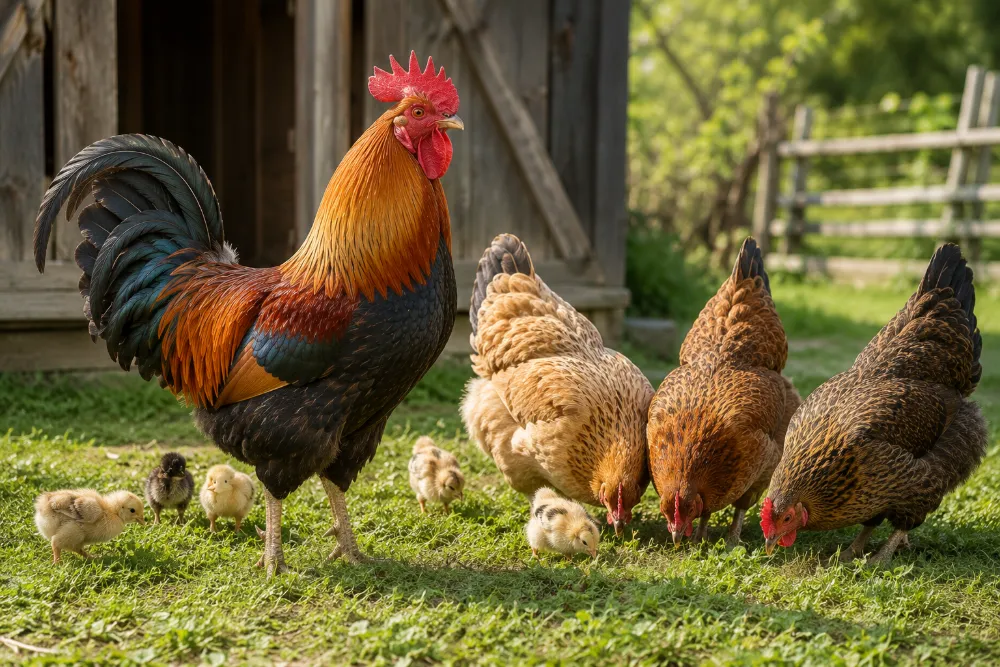
The comb and wattles are useful clues when identifying a rooster, but they are not perfect. Roosters usually develop larger, redder combs and wattles earlier than hens. In young birds, a cockerel may show a larger comb before his tail feathers become obvious.
Feather shape can be even more useful. Roosters often have pointed hackle feathers around the neck and pointed saddle feathers near the lower back. Hens usually have more rounded feathers in these areas.
Tail feathers are also important. Mature roosters often grow long, curved, glossy tail feathers. Hens generally have shorter, more practical tails, although some breeds and individuals can make identification less obvious.
Spurs and Legs
Roosters often have stronger legs and more developed spurs than hens. Spurs are pointed bony projections covered with keratin that grow on the back of the legs. Roosters may use them during fights with other males or in defense against threats.
Hens can also develop spurs, especially in some breeds or older individuals, so spurs alone do not prove a bird is male. However, large, sharp, well-developed spurs are more typical of roosters.
Leg thickness may also differ. Roosters are often more muscular and heavier in the legs, while hens may look more compact and rounded. Again, breed and age can affect this.
Crowing and Vocal Behavior
Crowing is one of the most famous rooster behaviors. Roosters crow to announce territory, communicate with the flock, respond to light changes, and signal their presence to other males. Although people often associate crowing with sunrise, roosters can crow at many times of day.
Hens make many sounds too. They cluck, call to chicks, make alarm calls, produce food calls, and often give a loud “egg song” after laying. Some hens may occasionally make crow-like sounds, especially in flocks without roosters, but regular loud crowing is much more typical of roosters.
If a chicken repeatedly crows loudly and displays male feathering, it is almost certainly a rooster.
Egg Laying
Roosters do not lay eggs. Hens lay eggs because they have the female reproductive system required to produce them. A hen can lay eggs without a rooster, just as many female birds can produce unfertilized eggs without mating.
The rooster’s role is fertilization. If a rooster mates with a hen, her eggs may be fertile for a period of time. A fertile egg can develop into a chick only if it is incubated under the right temperature and humidity conditions.
Store-bought eggs and backyard eggs from flocks without roosters are usually unfertilized. They are still normal eggs, but they cannot hatch into chicks.
Flock Role and Social Behavior
Roosters often act as flock guardians. A good rooster watches for predators, gives alarm calls, guides hens toward food, and may place himself between the flock and danger. He may also perform courtship displays and food-calling behavior to attract hens.
However, rooster behavior varies. Some roosters are calm, attentive, and protective. Others can become aggressive toward people, other roosters, or hens. Genetics, breed, handling, social structure, flock size, and environment all influence temperament.
Hens also have complex social lives. They form pecking orders, communicate with chicks, choose nesting sites, dust bathe, forage, and make social decisions. A flock can function without a rooster, especially in backyard egg-laying settings.
Do You Need a Rooster for Hens to Lay Eggs?
No. Hens do not need a rooster to lay eggs. Egg laying is part of the hen’s reproductive cycle and can happen whether or not mating occurs.
You need a rooster only if you want fertile eggs that can hatch into chicks. Without a rooster, eggs are unfertilized. They can be eaten normally but will not develop into embryos.
This is one of the most common misunderstandings about chickens. Roosters are needed for breeding, not for ordinary egg production.
Can Chickens Change Sex?
Chickens do not change sex in the simple way some fish species can. However, rare hormonal or reproductive conditions can cause a hen to develop rooster-like traits, such as crowing, larger comb growth, or male-like feathering.
This can happen if the functioning ovary is damaged or if hormone balance changes significantly. The hen may look or act more rooster-like, but this is not the same as a normal complete sex change into a fertile male.
In practical flock care, a crowing hen is unusual but possible. A bird with full male feathering, mating behavior, large spurs, and repeated crowing is more likely a rooster.
Rooster vs Chicken in Meat and Food Terms
In food language, “chicken” usually refers to meat from domesticated chickens, often from young birds bred for meat production. It does not necessarily mean female chicken. Both male and female chickens can be used for meat, depending on the poultry system.
Rooster meat can be tougher than meat from young broiler chickens because adult roosters are older, more muscular, and more active. Traditional cooking methods for older roosters often use slow cooking, stewing, braising, or soups.
Egg-laying hens, broilers, heritage chickens, cockerels, and roosters may all appear in different culinary traditions. The terms used in farming and cooking do not always match simple backyard language.
Rooster vs Chicken in Backyard Flocks
In a backyard flock, the main difference is management. Hens are usually kept for eggs, companionship, pest control, and garden foraging. Roosters may be kept for breeding, protection, natural flock behavior, or maintaining a self-sustaining flock.
However, roosters are not allowed in all neighborhoods because of noise. Crowing can happen early in the morning and throughout the day. Before keeping a rooster, owners should check local rules and consider nearby neighbors.
Roosters also require responsible handling. A human-aggressive rooster can be dangerous, especially to children. Calm handling, proper flock ratios, and careful breed selection can reduce problems, but temperament is still individual.
How to Tell If a Young Chicken Is a Rooster
Sexing young chickens can be difficult, especially before obvious adult feathers develop. However, several clues may help. Young males, or cockerels, often develop larger combs and wattles earlier than pullets. They may stand taller, show bolder posture, spar with other chicks, or develop pointed saddle and hackle feathers as they mature.
Crowing is a strong clue, but it may not appear immediately. Some cockerels crow early, while others take longer. Tail shape, feather shine, and body posture become more useful as the bird grows.
Some breeds are auto-sexing or sex-linked, meaning males and females can be identified by color or markings at hatch. In many mixed or ornamental breeds, identification takes time.
Common Myths About Roosters and Chickens
Myth: Roosters are a different species from chickens
This is false. A rooster is an adult male chicken. It belongs to the same species as hens, pullets, cockerels, and chicks.
Myth: Hens need roosters to lay eggs
This is false. Hens can lay eggs without roosters. Roosters are needed only for fertilized eggs that can hatch into chicks.
Myth: Only roosters have combs
This is false. Hens also have combs, but rooster combs are often larger, brighter, and more developed.
Myth: All roosters are aggressive
This is false. Some roosters are aggressive, but many are calm and manageable. Temperament depends on genetics, handling, environment, and individual personality.
Myth: Roosters crow only at sunrise
This is false. Roosters often crow at sunrise, but they can crow during the day, at night, after hearing other roosters, or in response to disturbances.
Simple Identification Checklist
| Question | Likely Rooster | Likely Hen or General Chicken |
|---|---|---|
| Does it crow regularly? | Yes, usually loud and repeated | Usually no, though hens can be noisy |
| Does it lay eggs? | No | Hens lay eggs |
| Comb and wattles | Usually larger and brighter | Usually smaller, depending on breed |
| Neck and saddle feathers | Often pointed and glossy | Usually rounded |
| Tail feathers | Long, curved, showy sickle feathers | Shorter and less dramatic |
| Spurs | Often larger and sharper | Usually smaller or absent, but exceptions exist |
| Flock behavior | May guard, crow, mate, and challenge rivals | May forage, lay eggs, brood, and care for chicks |
Final Verdict: Rooster vs Chicken
The difference between a rooster and a chicken is simple but often misunderstood. A chicken is the species. A rooster is an adult male chicken. A hen is an adult female chicken. Therefore, a rooster is always a chicken, but a chicken is not always a rooster.
Roosters are usually identified by crowing, larger combs and wattles, pointed feathers, long curved tail feathers, stronger spurs, and protective or mating behavior. Hens are the egg-laying females and usually have more rounded bodies and less dramatic feathering. For quick identification, remember: rooster means adult male; chicken means the whole domesticated bird species.
FAQs About Roosters and Chickens
Is a rooster a chicken?
Yes. A rooster is an adult male chicken. The word “chicken” refers to the species, while “rooster” refers specifically to the adult male.
What is the difference between a rooster and a chicken?
A rooster is a male chicken. Chicken is the general term for the domesticated bird species and can refer to males, females, chicks, or adults.
What is a female chicken called?
An adult female chicken is called a hen. A young female chicken is called a pullet.
What is a young rooster called?
A young male chicken is called a cockerel. Once mature, he is usually called a rooster.
Do roosters lay eggs?
No. Roosters do not lay eggs. Only female chickens, or hens, lay eggs.
Do hens need roosters to lay eggs?
No. Hens can lay eggs without roosters. A rooster is needed only if you want the eggs to be fertilized and potentially hatch into chicks.
Why do roosters crow?
Roosters crow to communicate, announce territory, respond to light changes, and signal their presence to the flock or other roosters.
Can hens crow?
Rarely, some hens may make crow-like sounds, especially in certain social or hormonal situations. However, regular loud crowing is much more typical of roosters.
Are roosters more aggressive than hens?
Roosters are often more territorial and defensive than hens, but not all roosters are aggressive. Temperament depends on breed, genetics, handling, flock structure, and individual personality.
How can you tell if a chick is a rooster?
As chicks grow, cockerels may develop larger combs and wattles, pointed saddle and hackle feathers, stronger legs, bolder posture, and eventually crowing. Some breeds can be sexed by color at hatch, but many require time to identify accurately.