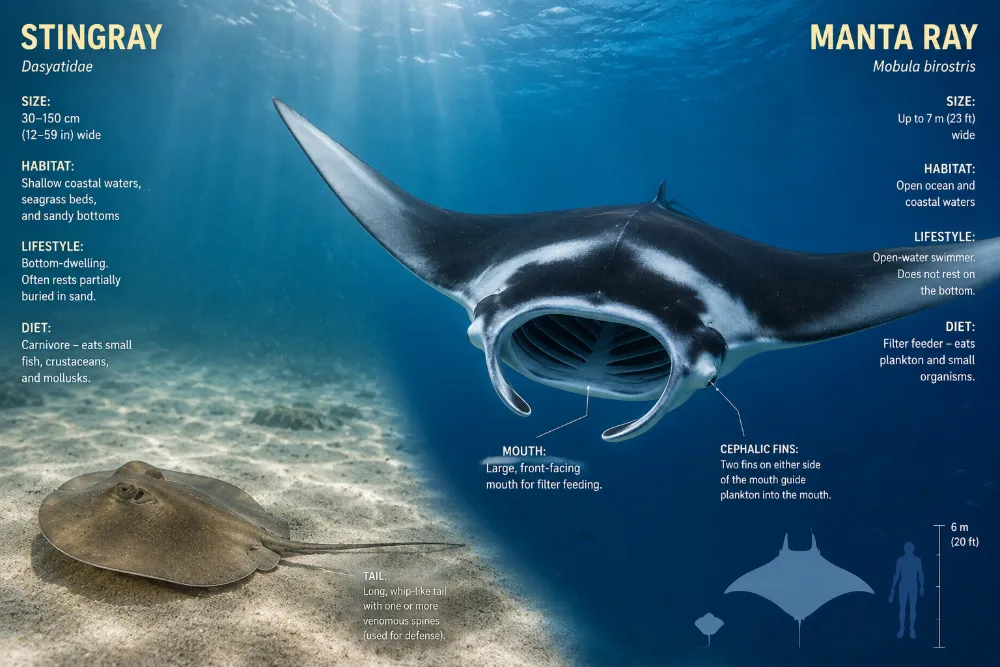
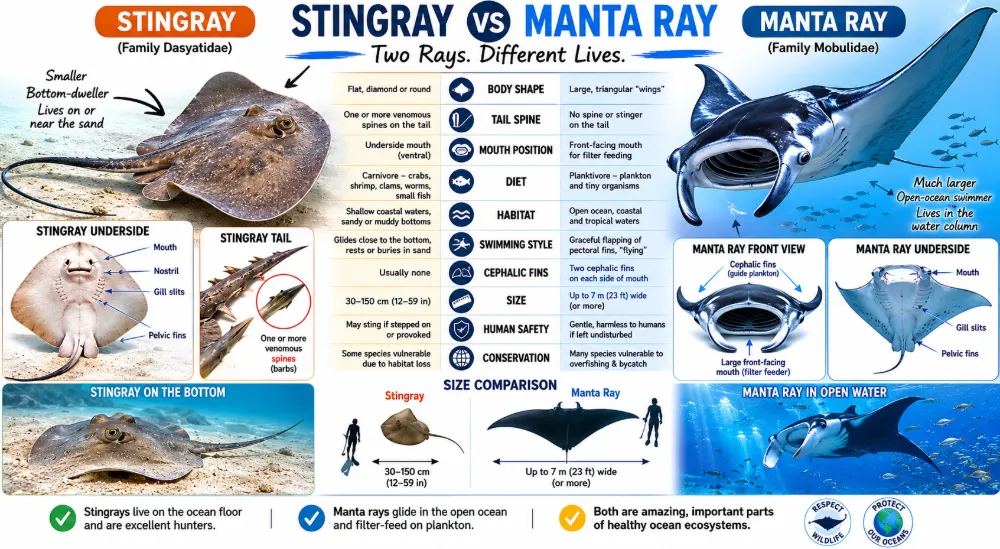
Stingrays and manta rays are both flat-bodied cartilaginous fish, but they are very different animals. Stingrays are usually bottom-dwelling rays with a whip-like tail that may carry a venomous spine. Manta rays are giant, open-water filter feeders with wide wing-like fins, horn-shaped cephalic fins, and no functional stinging barb. The easiest difference is this: stingrays rest on the seafloor; manta rays glide through open water.
Quick Comparison Table
| Feature | Stingray | Manta Ray |
|---|---|---|
| Scientific meaning | Broad common name for many ray species | A specific group of large rays in the genus Mobula |
| Body type | Flat, often round or diamond-shaped | Very wide, wing-like, triangular body |
| Typical lifestyle | Mostly bottom-dwelling | Mostly open-water swimmer |
| Tail | Long, whip-like tail, often with venomous spine | Long tail but no functional stinging barb |
| Diet | Shellfish, worms, small fish, crustaceans, mollusks | Plankton and tiny drifting animals |
| Feeding method | Crushes or sucks prey from sand and mud | Filter-feeds while swimming |
| Mouth position | Usually on the underside | At the front of the head |
| Special head feature | No cephalic fins | Two rolled or horn-like cephalic fins near the mouth |
| Size range | Small to large, depending on species | Among the largest rays in the world |
| Danger to humans | Can injure with venomous tail spine if stepped on or threatened | Generally gentle; no stinging defense like stingrays |
| Best identification clue | Bottom-resting body and stinging tail spine | Huge wings, open-water gliding, front mouth, cephalic fins |
What Is a Stingray?
A stingray is not just one species. It is a broad common name for many rays with flattened bodies and long tails, often armed with one or more venomous spines. Stingrays belong to a larger group of cartilaginous fish related to sharks, skates, guitarfish, and manta rays.
Most stingrays live close to the seafloor. They often rest partly buried in sand or mud, where their flat bodies help them hide from predators and ambush small prey. Their eyes sit on the top of the body, while the mouth, gill openings, and nostrils are usually on the underside.
Stingrays feed mostly on animals living in or near the bottom, such as clams, shrimp, crabs, worms, snails, and small fish. Many have strong crushing teeth that help them break hard shells.
What Is a Manta Ray?
A manta ray is a giant, open-water ray best known for its broad wing-like fins and graceful swimming style. Modern taxonomy places manta rays within the genus Mobula, along with closely related devil rays. The best-known manta rays include the reef manta ray and the giant oceanic manta ray.
Manta rays are filter feeders. Instead of hunting clams or crabs on the seafloor, they swim through the water with their mouths open, filtering plankton and small drifting animals. Their cephalic fins, the two flexible “horns” near the mouth, help guide food-rich water into the mouth.
Unlike typical stingrays, manta rays do not use a venomous tail spine for defense. They are generally gentle animals and are famous for their intelligence, curiosity, and elegant movement.
The Main Difference Between Stingrays and Manta Rays
The main difference is lifestyle. Stingrays are usually bottom-dwelling predators that feed on animals in sand, mud, reefs, or shallow coastal habitats. Manta rays are open-water filter feeders that swim continuously through the ocean searching for plankton.
The tail is another major difference. Many stingrays have a defensive venomous spine on the tail. Manta rays have long tails, but they do not have the same functional stinging barb used by stingrays.
The mouth position also helps. A stingray’s mouth is usually on the underside of the body because it feeds along the bottom. A manta ray’s mouth is at the front of the head because it filter-feeds while swimming forward.
Body Shape and Size
Stingrays vary greatly in size. Some are small enough to fit in shallow tide pools, while others can grow several feet across. Their bodies are often round, oval, or diamond-shaped. Many have a flattened disc that allows them to rest on the seafloor and blend into sand or mud.
Manta rays are much larger than most stingrays. The giant oceanic manta ray can reach an enormous wingspan, making it one of the largest rays in the world. Its body is broad and triangular, with long pectoral fins that flap like underwater wings.
If the ray looks like a flat disc resting on the bottom, it is more likely a stingray. If it looks like a huge underwater bird gliding through open water, it is more likely a manta ray.
Tail and Stinger
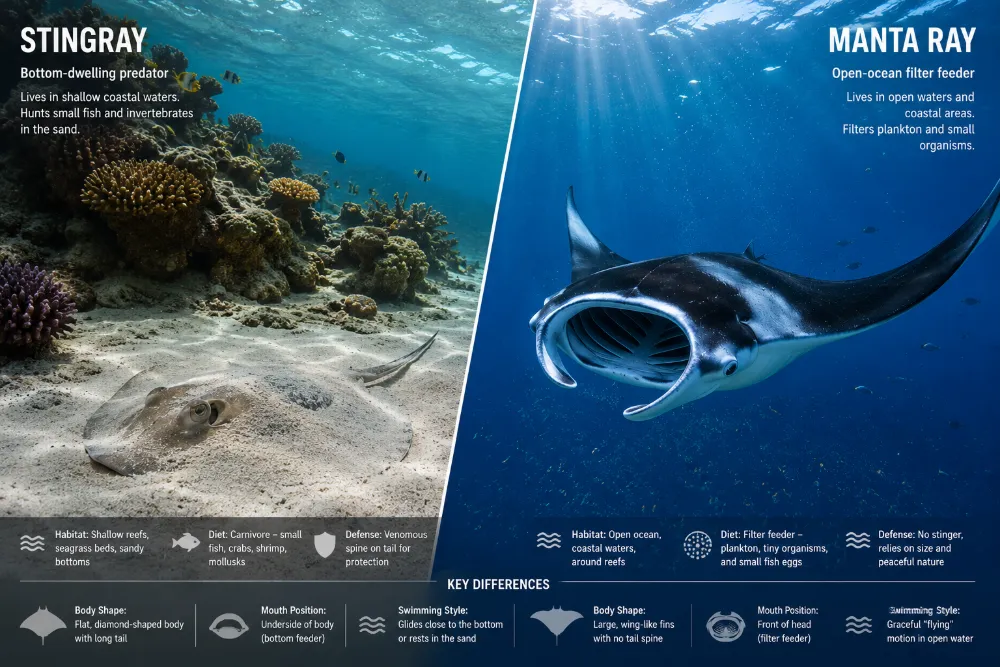
The word “stingray” comes from the animal’s tail spine. Many stingrays have one or more sharp, serrated spines near the base or middle of the tail. These spines contain venom and are used for defense, not hunting. A stingray does not chase people to sting them, but it may lash its tail if stepped on, grabbed, or threatened.
Manta rays do not have a functional stinger like typical stingrays. Their tails are long and thin, but they are not used as venomous weapons. This is one reason manta rays are often considered safer to swim near than stingrays, although all wild animals should still be respected and given space.
A simple safety rule in shallow coastal water is to shuffle your feet through the sand instead of stepping straight down. This can alert buried stingrays and give them time to swim away.
Mouth Position and Feeding Style
Stingrays usually have their mouths on the underside of the body. This makes sense because they feed on the seafloor. They use smell, electroreception, and touch to find prey hidden in sand or mud. Some suck prey into the mouth, while others crush shells with strong dental plates.
Manta rays have a front-facing mouth. They swim through plankton-rich water with the mouth open, filtering tiny food from the water. Their gill plates trap plankton while water passes out through the gills.
This feeding difference is one of the clearest biological separations between the two. Stingrays are mostly bottom-feeding hunters; manta rays are giant filter-feeding swimmers.
Cephalic Fins: The Manta Ray’s “Horns”
Manta rays have two special structures near the mouth called cephalic fins. When rolled up, they can look like horns, which is why manta rays and related devil rays have sometimes been called “devilfish.” When feeding, these fins unroll and help direct water and plankton into the mouth.
Stingrays do not have cephalic fins. Their head and body are more directly fused into a flat disc, and their feeding structures are adapted for bottom prey rather than plankton filtering.
If you see two curled lobes at the front of a huge ray’s head, you are looking at a manta ray or a close relative, not a typical stingray.
Habitat and Range
Stingrays live in many aquatic habitats. They are common in warm coastal seas, estuaries, lagoons, sandy flats, coral reef edges, and shallow bays. Some species also live in freshwater rivers. Their habitat depends on species, but many are strongly associated with the bottom.
Manta rays are mostly marine and are usually found in tropical and subtropical oceans. Reef manta rays are often seen around coral reefs, cleaning stations, and productive coastal areas. Giant oceanic manta rays range more widely through open ocean environments, often following plankton blooms.
In short, stingrays are often encountered by beachgoers in shallow sandy water, while manta rays are more often seen by divers, snorkelers, or researchers in clear tropical seas and offshore waters.
Diet and Ecological Role
Stingrays play an important role as bottom predators. By feeding on clams, crabs, shrimp, worms, and small fish, they help shape seafloor communities. As they dig and stir sand while searching for prey, they can also disturb sediment and create small feeding pits used by other animals.
Manta rays play a different role. They are large filter feeders that connect plankton productivity to larger marine food webs. By feeding on tiny drifting organisms, they help transfer energy from plankton-rich waters into the bodies of large ocean animals.
Both are ecologically important, but they occupy very different feeding niches. A stingray is more like a seafloor forager. A manta ray is more like a giant plankton-filtering glider.
Swimming Style
Stingrays swim by undulating or flapping their pectoral fins, depending on the species. Many move close to the bottom and may settle into the sand after short swimming bursts. Some stingrays glide gracefully, but they are generally not as continuously open-water oriented as manta rays.
Manta rays swim with powerful, smooth wingbeats. Their broad pectoral fins move like wings, allowing them to glide, turn, and rise through the water with remarkable control. Manta rays may also perform loops while feeding in dense plankton patches.
A manta ray’s swimming style is one of the most recognizable movements in the ocean: slow, elegant, and bird-like.
Behavior and Intelligence
Stingray behavior varies by species. Some are shy and spend much of the day buried. Others are more active and may gather in feeding areas. Stingrays rely on camouflage, electroreception, and sudden movement to survive.
Manta rays are known for complex behavior. They may visit cleaning stations where small fish remove parasites from their skin. They may travel long distances, form loose social groups, and show curiosity around divers. Their large brains relative to body size have made them especially interesting to marine biologists.
This does not mean manta rays are “smarter” in every human sense, but they are among the most behaviorally fascinating fish in the ocean.
Reproduction
Both stingrays and manta rays give birth to live young rather than laying hard-shelled eggs like many bony fish. The embryos develop inside the mother and are born as miniature versions of the adults.
Stingray litter size varies widely by species. Some may give birth to several pups at a time. Manta rays, by contrast, usually have very low reproductive rates. A female manta often gives birth to a single pup after a long pregnancy, and she may not reproduce every year.
This slow reproduction makes manta rays especially vulnerable to overfishing. When large adults are removed from the population, recovery can take a long time.
Are Stingrays Dangerous?
Stingrays are not aggressive, but they can be dangerous if stepped on or handled. Most injuries happen in shallow water when a person accidentally steps on a buried stingray. The ray reacts defensively by whipping its tail upward, driving the spine into the foot, ankle, or leg.
A stingray injury can be painful and may require medical care because of venom, tissue damage, and possible infection. The best prevention is to avoid touching stingrays and to shuffle your feet in sandy shallows where stingrays may be resting.
Stingrays should not be feared as monsters. They are defensive animals, not attackers. Respectful distance greatly reduces risk.
Are Manta Rays Dangerous?
Manta rays are generally not dangerous to humans. They do not have a functional stinging barb, do not bite people, and feed on tiny plankton. Divers and snorkelers often describe manta encounters as peaceful and awe-inspiring.
However, manta rays are still large wild animals. People should never chase, grab, ride, block, or harass them. Touching manta rays can damage the protective mucus layer on their skin and may stress the animal.
The safest and most ethical approach is to observe calmly, keep distance, and let the manta ray choose whether to approach or swim away.
Conservation Status and Threats
Stingray conservation status depends on species. Some stingrays remain common, while others are threatened by overfishing, habitat loss, pollution, bycatch, and coastal development. Freshwater stingrays can be especially vulnerable because river habitats are easily altered by dams, mining, and pollution.
Manta rays face serious conservation concerns. Their slow reproduction makes them vulnerable to fishing pressure. They may be caught intentionally or as bycatch, and in some regions their gill plates have been traded commercially. Boat strikes, entanglement, plastic pollution, and habitat disturbance can also affect them.
Protecting rays requires healthy coastal habitats, responsible fisheries, reduced bycatch, marine protected areas, and careful wildlife tourism rules.
Common Myths About Stingrays and Manta Rays
Myth: Manta rays are just giant stingrays
This is misleading. Manta rays and stingrays are related, but manta rays are specialized filter feeders without a functional stinging spine. They are not simply oversized stingrays.
Myth: All rays can sting
This is false. Many stingrays have venomous tail spines, but manta rays do not have a functional stinging barb.
Myth: Stingrays attack people
This is false. Stingrays usually sting defensively when stepped on or threatened. They do not hunt or actively attack humans.
Myth: Manta rays eat large fish
This is false. Manta rays are filter feeders. They mainly eat plankton and tiny drifting organisms.
Simple Identification Checklist
| Question | Likely Stingray | Likely Manta Ray |
|---|---|---|
| Where is it swimming? | Near or on the seafloor | In open water or above reefs |
| Does it have a stinging tail spine? | Often yes | No functional stinging barb |
| Where is the mouth? | On the underside | At the front of the head |
| What does it eat? | Bottom animals such as clams, worms, shrimp, and crabs | Plankton and tiny drifting organisms |
| Does it have cephalic fins? | No | Yes, two horn-like fins near the mouth |
| Body shape | Round, oval, or diamond-shaped disc | Huge triangular wingspan |
| Typical human risk | Defensive sting if stepped on or handled | Very low; observe without touching |
Final Verdict: Stingray vs Manta Ray
Stingrays and manta rays are both rays, but they represent very different lifestyles. Stingrays are usually bottom-dwelling rays that use camouflage, underside mouths, crushing teeth, and defensive tail spines. Manta rays are giant open-water filter feeders with front-facing mouths, cephalic fins, broad wings, and no functional stinging barb.
The fastest identification rule is simple: a flat ray resting on the sand with a whip-like defensive tail is probably a stingray; a huge ray gliding through open water with horn-like head fins is probably a manta ray.
FAQs About Stingrays and Manta Rays
Is a manta ray a type of stingray?
A manta ray is related to stingrays, but it is not a typical stinging ray. Manta rays are specialized filter feeders and do not have a functional venomous tail spine like many stingrays.
What is the biggest difference between a stingray and a manta ray?
The biggest difference is lifestyle and tail defense. Stingrays usually live near the seafloor and may have venomous tail spines. Manta rays swim in open water, filter-feed on plankton, and lack a functional stinging barb.
Can manta rays sting humans?
No. Manta rays do not sting humans because they do not have a functional stinging spine. They are generally gentle filter feeders.
Can stingrays sting humans?
Yes. Many stingrays can sting defensively with a venomous tail spine, usually when stepped on, grabbed, or threatened.
Do manta rays have teeth?
Manta rays have tiny reduced teeth, but they do not use them to bite large prey. They feed mainly by filtering plankton from the water.
Do stingrays have teeth?
Yes. Many stingrays have strong crushing tooth plates that help them eat clams, crabs, shrimp, snails, and other bottom-dwelling animals.
Which is bigger, a stingray or a manta ray?
Manta rays are usually much larger than most stingrays. The giant oceanic manta ray is one of the largest rays in the world.
Why do manta rays have horn-like fins?
Those structures are called cephalic fins. Manta rays use them to guide plankton-rich water into the mouth while filter-feeding.
Do stingrays and manta rays lay eggs?
No. Like many rays, they give birth to live young. The young develop inside the mother and are born as small versions of the adults.
Are manta rays friendly?
Manta rays are often calm and curious around divers, but they are wild animals. They should never be touched, chased, ridden, or blocked.
Are stingrays aggressive?
No. Stingrays are not aggressive toward humans. Most stings happen when a person accidentally steps on or handles a ray, causing it to defend itself.