Manta rays and stingrays are both cartilaginous fish related to sharks, but they are not the same animal. Manta rays are large, open-water filter feeders with horn-like cephalic fins and no venomous tail stinger. Stingrays are a diverse group of mostly bottom-dwelling rays, many of which have a venomous barbed spine on the tail for defense.
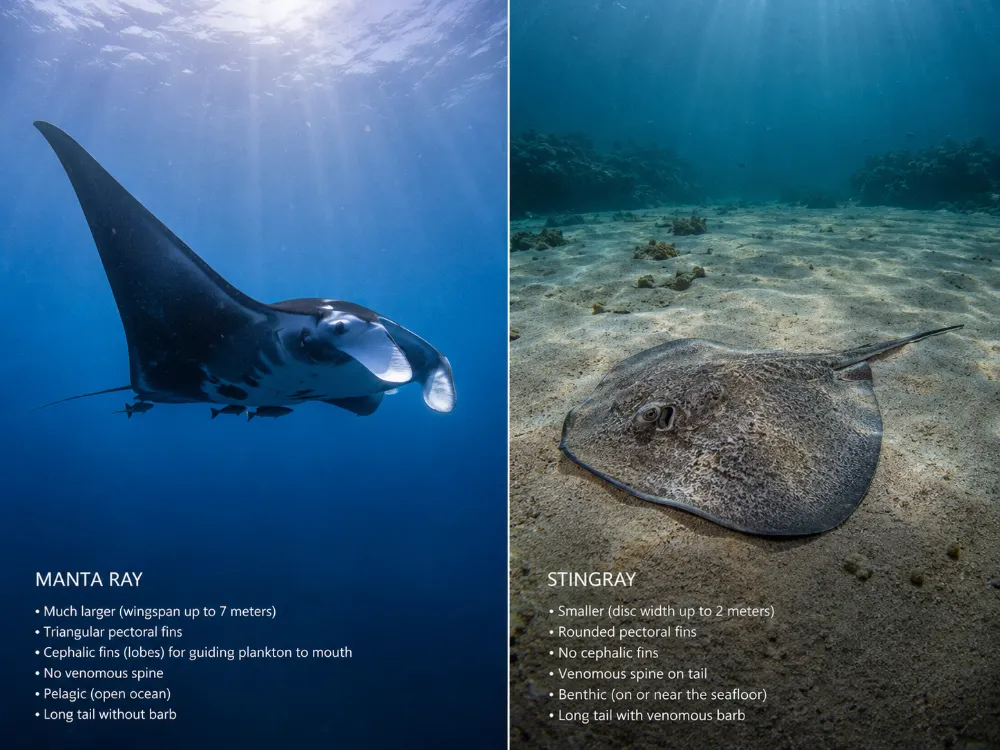
Manta Ray vs Stingray Summary Table
| Feature | Manta Ray | Stingray |
|---|---|---|
| Animal type | Large ray in the genus Mobula | Common name for many ray species, especially bottom-dwelling rays with tail spines |
| Closest relatives | Sharks, skates, and other rays | Sharks, skates, and other rays |
| Typical size | Very large; giant oceanic manta rays may reach about 7 m across | Highly variable; some are small, while large species may exceed 2 m across |
| Body shape | Broad, wing-like body with large triangular pectoral fins | Usually flatter, rounder, diamond-shaped, or disc-like body |
| Tail | Long, thin tail without a functional venomous stinger | Many species have one or more venomous barbed tail spines |
| Head features | Has cephalic fins that look like small horns when rolled | No cephalic fins; head shape varies by species |
| Main diet | Plankton and tiny drifting animals filtered from seawater | Bottom animals such as worms, shrimp, crabs, clams, and small fish |
| Feeding style | Filter feeding while swimming through open water | Foraging along the seafloor, often using smell and electroreception |
| Habitat | Tropical and subtropical oceans, reefs, cleaning stations, and open water | Coastal shallows, sandy bottoms, estuaries, reefs, lagoons, and sometimes freshwater |
| Swimming style | Graceful “flying” movement through open water | Often glides close to the bottom; some bury in sand |
| Danger to humans | Generally harmless and non-stinging | Usually not aggressive, but can sting defensively if stepped on or threatened |
| Social behavior | May gather at feeding sites, cleaning stations, or during courtship | Varies widely; many are solitary or loosely grouped |
What Is a Manta Ray?
A manta ray is a large, graceful ray known for its enormous wing-like fins, wide mouth, and peaceful filter-feeding behavior. Manta rays belong to the genus Mobula. The two best-known living manta rays are the giant oceanic manta ray, Mobula birostris, and the reef manta ray, Mobula alfredi.
Manta rays are among the largest rays in the world. Instead of hunting large prey, they swim through the water with their mouths open and filter out plankton. Their cephalic fins, located on either side of the mouth, help guide food-rich water into the mouth. When rolled up, these fins can look like small horns, which is why manta rays were historically associated with the name “devil rays.”
Despite their dramatic size and appearance, manta rays are gentle animals. They do not have a functional venomous tail barb and are not dangerous predators of humans.
What Is a Stingray?
A stingray is not one single species. It is a common name used for many different rays, especially those with flattened bodies and defensive tail spines. Stingrays belong to several related groups of cartilaginous fish and are close relatives of sharks, skates, eagle rays, and manta rays.
Most stingrays live close to the seafloor. They may rest on sandy bottoms, hide under sediment, or glide over reefs and shallow coastal areas. Many use their mouths to crush or suck up small animals such as clams, worms, shrimp, crabs, and small fish.
The feature that gives stingrays their name is the venomous barb, or spine, usually located on the tail. This spine is not used for hunting. It is a defensive weapon used when the animal is threatened, grabbed, stepped on, or attacked by a predator.
Body Shape and Appearance
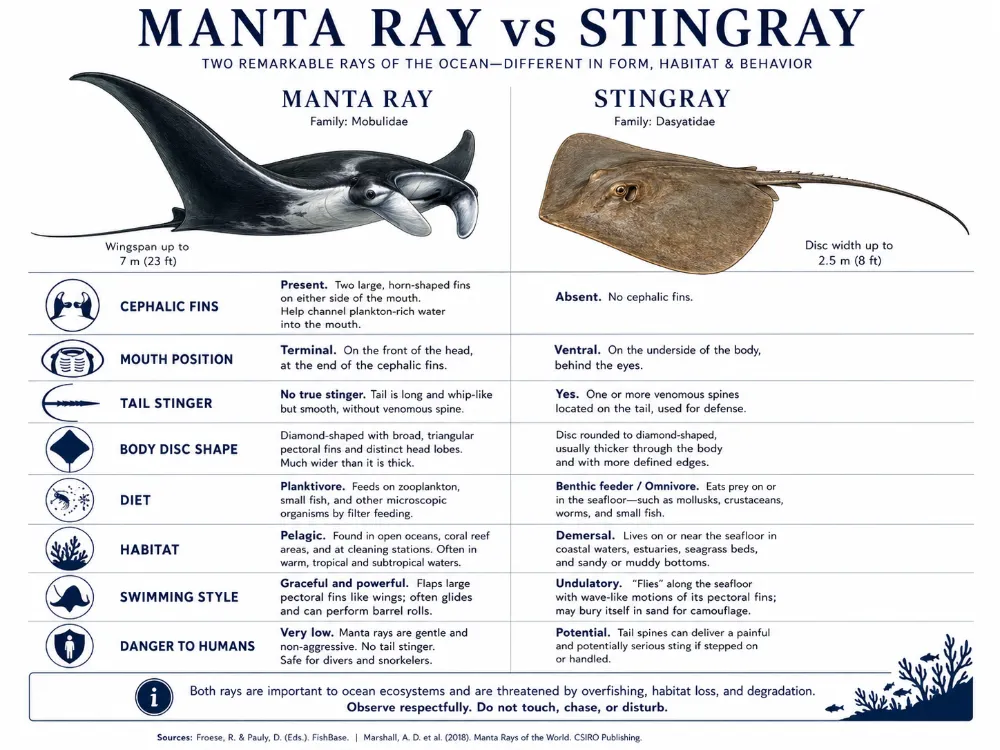
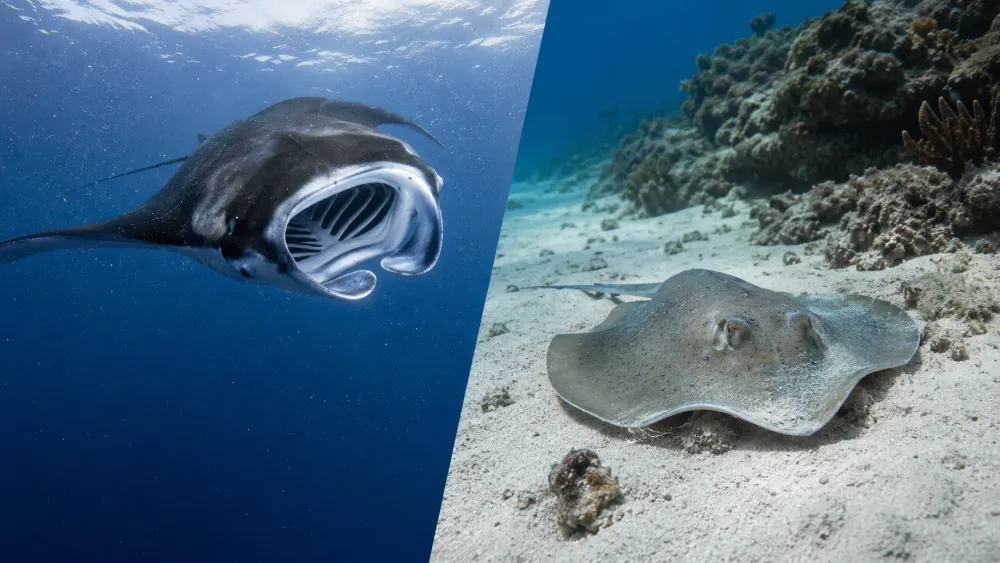
Manta rays have a broad, diamond-like body with long, triangular pectoral fins that move like wings. Their body is built for efficient swimming in open water. From above, a manta ray often looks like a large dark kite or flying blanket moving through the sea.
Stingrays usually have flatter, more bottom-oriented bodies. Some are round, some are diamond-shaped, and others are oval or disc-shaped. Their eyes are on top of the body, while the mouth and gill openings are underneath. This body plan helps them rest on the seafloor and feed on animals hidden in sand or mud.
A quick visual rule is this: manta rays look like large open-water flyers, while many stingrays look like flattened seafloor gliders.
Tail and Stinger Differences
The tail is one of the most important differences between manta rays and stingrays. Manta rays have long, whip-like tails, but they do not have a functional venomous stinger. This means a manta ray cannot sting a person the way a stingray can.
Many stingrays have one or more sharp, serrated, venomous spines on the tail. These spines can cause painful injuries if the ray is stepped on or handled. Stingrays usually do not chase or attack people. Most stingray injuries happen when someone accidentally steps on a hidden ray in shallow water.
This is why beach safety advice often recommends the “stingray shuffle”: sliding your feet through the sand instead of stepping straight down. The movement gives buried stingrays time to swim away.
Cephalic Fins and Head Features
Manta rays have a special feature that stingrays lack: cephalic fins. These are flexible, horn-like structures near the mouth. When a manta ray is feeding, it unfurls these fins to channel plankton-rich water toward the mouth.
Stingrays do not have cephalic fins. Their head and mouth are usually adapted for bottom feeding. Many stingrays use strong jaws, crushing tooth plates, or suction to capture animals buried in sand or hiding along the seafloor.
If you see a large ray with rolled “horns” near its mouth, it is likely a manta ray or a close mobula ray relative, not a typical stingray.
Size Differences
Manta rays are usually much larger than most stingrays. The giant oceanic manta ray can reach an impressive wingspan of around 7 meters, making it one of the largest rays alive today. Reef manta rays are smaller but still very large compared with most coastal rays.
Stingrays vary enormously in size. Some small species are only the size of a dinner plate. Larger stingrays, such as some freshwater stingrays or large marine species, can be impressively broad and heavy. However, the average stingray seen in shallow coastal waters is usually much smaller than an adult manta ray.
In simple terms: manta rays are generally giant ocean gliders, while stingrays range from small bottom dwellers to large seafloor predators.
Diet and Feeding Style
Manta rays are filter feeders. They eat plankton, tiny crustaceans, fish eggs, and other small drifting organisms. They do not chew large prey. Instead, they swim through dense patches of plankton and filter food from the water using specialized structures inside the mouth.
Stingrays are usually bottom feeders. They often eat worms, mollusks, shrimp, crabs, small fish, and other animals living in or near the sediment. Some crush hard-shelled prey with strong dental plates. Others use suction to pull prey from the sand.
Their feeding strategies show their ecological difference clearly. Manta rays feed in the water column. Stingrays usually feed on or near the seafloor.
Habitat and Distribution
Manta rays are mostly found in warm tropical and subtropical oceans. They may be seen around coral reefs, offshore islands, seamounts, cleaning stations, and plankton-rich open water. Some travel long distances, following seasonal food availability or ocean currents.
Stingrays occupy a wider range of habitats. Many live in shallow coastal water, sandy bays, lagoons, coral reefs, estuaries, and mudflats. Some species can even live in freshwater rivers. Because “stingray” refers to many species, their habitat range is much broader than that of manta rays.
Manta rays are strongly associated with open-water swimming and reef cleaning stations. Stingrays are more often associated with the seafloor.
Swimming and Movement
Manta rays swim by slowly flapping their large pectoral fins like wings. Their movement is smooth, graceful, and bird-like. They may glide through open water, circle feeding areas, or perform looping movements when plankton is dense.
Stingrays also swim using their pectoral fins, but many stay close to the bottom. Some move with wave-like ripples along the edges of the body, while others flap more like underwater wings. Many stingrays spend long periods resting or partly buried in sand.
The manta ray is built for long, efficient cruising. The stingray is usually better adapted for bottom life, camouflage, and sudden escape.
Behavior Around Humans
Manta rays are often curious but gentle around divers and snorkelers. In places where they are accustomed to people, they may swim calmly near humans. However, they should never be touched, chased, grabbed, or blocked. Their protective mucus coating can be damaged by contact.
Stingrays are also not naturally aggressive toward humans. Most prefer to flee or remain hidden. The danger comes from accidental contact. A stingray lying under sand may whip its tail upward if stepped on, causing a painful puncture wound.
Neither animal should be treated as a toy or attraction. Both deserve space and respect in the wild.
Are Manta Rays Dangerous?
Manta rays are not considered dangerous to humans. They do not have venomous tail spines, and they do not bite people as prey. Their diet is based on tiny plankton, not large animals.
The main risk around manta rays is accidental disturbance. A swimmer or diver who gets too close may stress the animal or interrupt feeding and cleaning behavior. The best way to observe manta rays is to remain calm, keep distance, and let the animal choose whether to approach.
Are Stingrays Dangerous?
Stingrays can be dangerous if handled, stepped on, or threatened, but they are not aggressive hunters of humans. Their venomous tail spine is used for defense. A stingray sting can be extremely painful and may require medical attention.
Most stingray injuries occur in shallow water when someone accidentally steps on a ray hidden under sand. To reduce the risk, people in stingray habitats should move carefully, shuffle their feet, and avoid grabbing or cornering rays.
Predators and Defense
Manta rays rely mostly on size, speed, and open-water movement for protection. Large sharks and orcas may prey on manta rays, especially young or injured individuals. Mantas may escape by fast swimming, diving, or maneuvering away from danger.
Stingrays rely on camouflage, hiding, and their defensive tail spine. Many bury themselves in sand so only the eyes and spiracles are visible. Predators of stingrays include sharks, large fish, marine mammals, and sometimes humans.
Both animals are vulnerable when young, and both depend on suitable marine habitats to survive.
Reproduction and Young
Manta rays reproduce slowly. Females give birth to live young, usually one pup at a time after a long pregnancy. A newborn manta ray is already a strong swimmer and looks like a miniature version of the adult. Because manta rays produce few young, their populations can recover slowly from overfishing or habitat pressure.
Many stingrays also give birth to live young, although details vary by species. Some produce several pups at once. The young are usually born fully formed and able to swim soon after birth. Like manta rays, many stingrays have slower reproduction than small bony fish, which can make them vulnerable to heavy fishing pressure.
Intelligence and Sensory Abilities
Manta rays are often considered among the more intelligent fish. They have large brains for fish and show complex behaviors such as social interaction, repeated visits to cleaning stations, and coordinated feeding movements. Individual manta rays can sometimes be identified by unique spot patterns on the underside.
Stingrays also have impressive senses. Like sharks and other rays, they can detect weak electrical signals from prey hidden in sand. This ability, called electroreception, helps them locate animals that are buried or hard to see.
Both manta rays and stingrays are more complex than they may appear at first glance.
Conservation Differences
Manta rays face serious conservation challenges. Because they grow slowly and produce few offspring, they are vulnerable to fishing pressure. They may be caught accidentally as bycatch or targeted in some regions. Boat strikes, entanglement, pollution, and disturbance at important feeding or cleaning sites can also affect them.
Stingray conservation status varies widely because there are many stingray species. Some are common and widespread, while others are threatened by overfishing, habitat loss, coastal development, river pollution, and the aquarium trade. Freshwater stingrays can be especially vulnerable when river systems are altered.
Protecting both groups requires healthy oceans, responsible fishing, reduced bycatch, and respect for their habitats.
How to Tell a Manta Ray from a Stingray Quickly
Look at the tail: manta rays lack a functional venomous stinger; many stingrays have a barbed tail spine.
Look at the head: manta rays have cephalic fins near the mouth; stingrays do not.
Look at the size: manta rays are usually much larger than most stingrays.
Look at the habitat: manta rays often swim in open water; stingrays usually stay near the seafloor.
Look at the diet: manta rays filter plankton; stingrays hunt bottom-dwelling animals.
Look at the body: manta rays look like huge oceanic wings; stingrays often look flatter and more disc-like.
Manta Ray vs Stingray: Final Comparison
The manta ray and the stingray are both rays, but they represent different lifestyles. The manta ray is a large, graceful filter feeder built for open-water swimming. It has cephalic fins, a wide mouth, and no functional venomous stinger. The stingray is usually a bottom-dwelling feeder with a flatter body and, in many species, a defensive tail spine.
If the question is which animal is more dangerous to humans, the answer is usually the stingray, but only when it is stepped on or threatened. If the question is which animal is larger and more oceanic, the answer is the manta ray. Both animals are important marine species and should be observed with care and respect.
FAQs About Manta Rays vs Stingrays
Are manta rays a type of stingray?
Manta rays are rays, but they are not typical stingrays. They belong to the mobula ray group and lack the functional venomous tail barb that gives stingrays their common name.
Can manta rays sting you?
No. Manta rays do not have a functional venomous stinger on the tail. They are generally harmless to humans and feed on tiny plankton rather than large prey.
Can stingrays kill humans?
Stingray deaths are very rare, but a sting can be serious depending on the location of the wound, the size of the ray, and whether medical care is available. Most stings are defensive injuries caused when a ray is stepped on or handled.
Which is bigger, a manta ray or a stingray?
Manta rays are usually much bigger than most stingrays. Giant oceanic manta rays can reach about 7 meters across, while many stingrays are far smaller. However, some large stingray species can also be impressively wide and heavy.
What do manta rays eat?
Manta rays eat plankton, tiny crustaceans, fish eggs, and other small drifting organisms. They filter food from seawater while swimming with their mouths open.
What do stingrays eat?
Most stingrays eat animals from the seafloor, including worms, shrimp, crabs, clams, snails, and small fish. Some crush hard-shelled prey with strong tooth plates.
Why do manta rays have horns?
The “horns” are cephalic fins. Manta rays use them to guide plankton-rich water into the mouth while feeding. When rolled up, these fins give manta rays a horned appearance.
Why do stingrays bury themselves in sand?
Many stingrays bury themselves for camouflage and protection. This helps them hide from predators and sometimes ambush or avoid detection by prey.
Are manta rays friendly?
Manta rays are often calm and curious around divers, but they are wild animals, not pets. The safest and most respectful approach is to keep distance, avoid touching them, and let them move naturally.
How can you avoid being stung by a stingray?
In shallow sandy areas where stingrays live, shuffle your feet instead of stepping down sharply. This gives hidden rays a chance to swim away before accidental contact occurs.