Anatolian Shepherds and Kangals are closely related livestock guardian dogs from Turkey, but they are not always treated the same way. The Anatolian Shepherd is often a broader Western breed label for Turkish guardian dogs, while the Kangal is usually a more specific type associated with the Kangal region and a classic fawn coat with a black mask. Both are powerful, independent, protective dogs bred to guard livestock, not casual pets.

Anatolian Shepherd vs Kangal Quick Answer
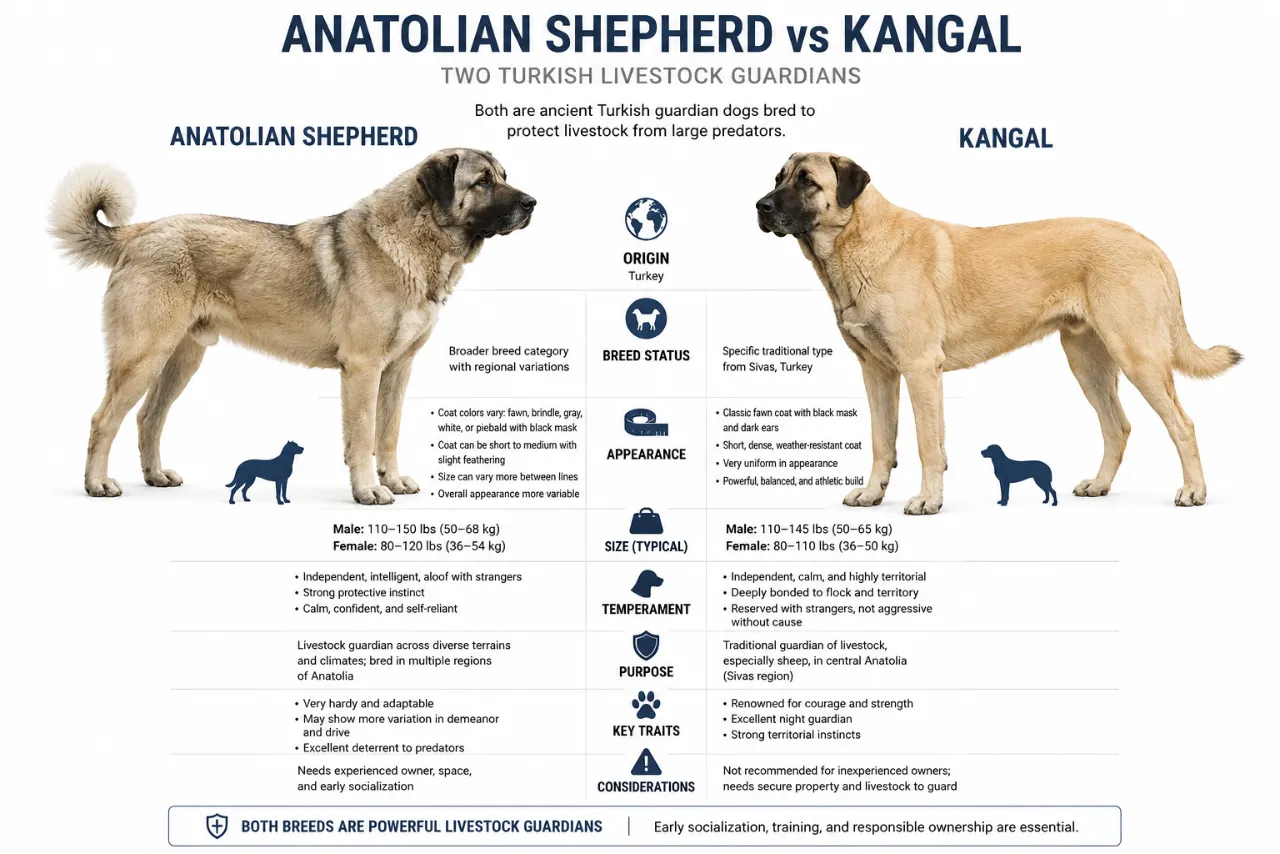
The main difference is breed definition. “Anatolian Shepherd” is often used as a broad term for large Turkish livestock guardian dogs developed from regional working types. “Kangal” usually refers to a more specific Turkish guardian type known for a short dense coat, fawn or dun coloring, black mask, strong body, calm confidence, and livestock protection ability. In everyday comparison, Kangals are often considered more standardized, while Anatolian Shepherds may vary more in color, coat, and structure.
Anatolian Shepherd vs Kangal Summary Table
| Feature | Anatolian Shepherd | Kangal |
|---|---|---|
| Basic identity | Large Turkish livestock guardian dog; often a broad Western breed label | Specific Turkish livestock guardian type associated with Kangal, Sivas |
| Original purpose | Guarding sheep, goats, farms, and rural property | Guarding livestock against wolves, jackals, stray dogs, and predators |
| Breed definition | Can be broader and more variable depending on registry and region | Usually more specific and traditional in type |
| Typical build | Large, powerful, athletic, sometimes more varied in frame | Large, muscular, balanced, often slightly more uniform in appearance |
| Coat color | Can appear in several colors and patterns depending on line | Usually fawn, dun, or grayish-fawn with a black mask |
| Coat length | Short to medium, sometimes variable | Usually short, dense, weather-resistant double coat |
| Temperament | Independent, protective, serious, territorial, loyal | Calm, confident, watchful, protective, independent |
| Trainability | Intelligent but independent; not obedience-focused like a shepherd herding dog | Intelligent but independent; bred to make decisions without constant commands |
| Energy level | Moderate to high working stamina, usually calm when mature | Moderate working stamina, often calm and efficient when mature |
| Best environment | Rural land, farms, livestock homes, experienced owners | Rural land, livestock guardian work, experienced owners |
| Not ideal for | Small apartments, inexperienced owners, chaotic urban homes | Small apartments, casual pet homes, owners wanting easy obedience |
| Quick clue | More variation in coat color and body type | Classic fawn coat, black mask, traditional guardian outline |
What Is an Anatolian Shepherd?
The Anatolian Shepherd is a large livestock guardian dog associated with Turkey’s Anatolian region. In many Western countries, the name has been used for powerful Turkish guardian dogs that protect flocks, farms, and rural property. These dogs were not developed to herd sheep in the way Border Collies or German Shepherds do. Their job is to live near livestock, watch for danger, and confront threats when necessary.
Anatolian Shepherds are usually independent, calm when mature, deeply loyal to their family or flock, and naturally suspicious of unfamiliar animals or people. They are not usually eager-to-please obedience dogs. Instead, they were bred to make their own decisions in wide open rural landscapes where a human shepherd might not be close enough to give commands.
The term “Anatolian Shepherd” can be broad. Depending on country, kennel club, breeder, and working tradition, it may include dogs that look somewhat different from one another. Some may resemble Kangals closely, while others may show different coat colors, body shapes, or regional Turkish guardian influence.
What Is a Kangal?
The Kangal, often called the Kangal Shepherd Dog or Kangal Dog, is a Turkish livestock guardian type strongly associated with the Kangal district in Sivas Province. It is famous for guarding sheep and goats against predators such as wolves, jackals, stray dogs, and other threats.
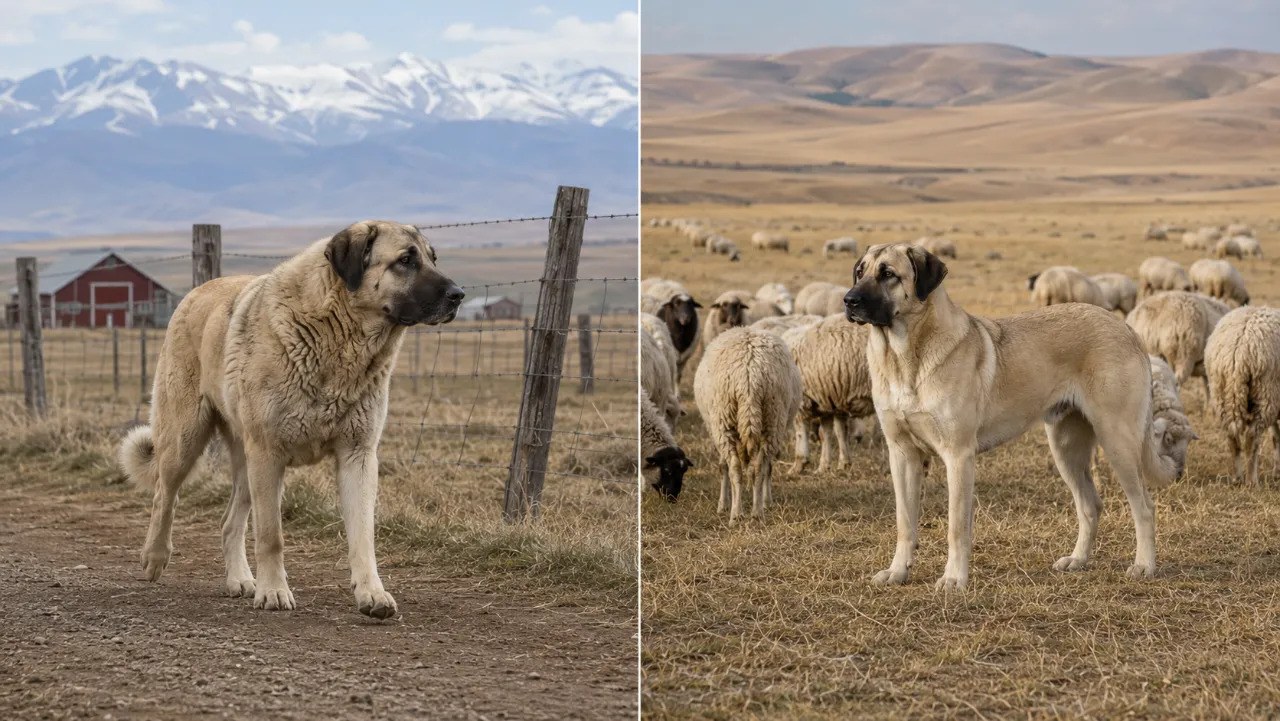
A classic Kangal has a short dense coat, a fawn or dun body color, a black mask, dark ears, a strong head, a deep chest, and a powerful but athletic frame. The dog is usually calm, alert, serious, and confident. It should not be nervous, hyperactive, or randomly aggressive. A good Kangal watches, assesses, warns, and acts when needed.
Kangals are highly valued in Turkey and by livestock guardian dog enthusiasts around the world. They are admired for their courage, endurance, protective instinct, and ability to work independently with animals.
Are Anatolian Shepherds and Kangals the Same Breed?
This depends on who you ask and which registry or country you are talking about. In some Western contexts, “Anatolian Shepherd” has historically been used as a broader breed name that included dogs similar to Kangals and other Turkish guardian types. In Turkish and breed-specialist contexts, the Kangal is often treated as a more specific and distinct traditional type.
For a pet owner or animal website reader, the most practical explanation is:
Anatolian Shepherd: often a broader label for Turkish livestock guardian dogs.
Kangal: usually a more specific Turkish guardian type with a classic fawn coat and black mask.
Because breed naming can vary by country and registry, two dogs labeled differently may still be closely related. The difference is often about classification, breeding tradition, and standardization rather than a simple “completely unrelated breeds” answer.
Quick Visual Difference
The easiest visual clue is coat color and uniformity. A Kangal usually has a short fawn, dun, or grayish-fawn coat with a black mask and dark ears. An Anatolian Shepherd may look very similar, but the label is often used for dogs with more variation in coat color and markings.
Kangal: fawn or dun coat, black mask, dark ears, short dense coat, balanced guardian build.
Anatolian Shepherd: may be fawn with black mask, but can also appear in other colors and patterns depending on line.
Kangal: often more standardized in traditional appearance.
Anatolian Shepherd: often more variable in Western usage.
Origin and Working History
Both dogs come from a long tradition of livestock guardian dogs in Turkey. These dogs were developed in harsh rural environments where livestock needed protection from predators and thieves. Their value came from survival ability, judgment, loyalty to the flock, and courage under pressure.
The Anatolian Shepherd name became widely known outside Turkey, especially in English-speaking countries. It was used for large Turkish guardian dogs exported and developed through Western breeding programs. Because these dogs came from a land with many regional guardian types, the Anatolian Shepherd label often became broad.
The Kangal is more closely associated with a specific regional identity. It is often linked to central Turkey, especially Sivas. Kangal supporters usually emphasize traditional type, working ability, fawn coat, black mask, and preservation of the dog’s Turkish heritage.
Size and Body Build
Both Anatolian Shepherds and Kangals are large, powerful dogs. Males are usually larger and heavier than females. These are not small or medium companion dogs; they are giant livestock guardians with serious physical strength.
An Anatolian Shepherd may vary more in size and structure depending on its line. Some are tall and lean; others are heavier and more massive. The body should still be athletic enough for long patrols and quick movement when needed.
A Kangal is often described as powerful but not overly bulky. It should be large, muscular, balanced, and capable of covering ground efficiently. A correct working Kangal is not just a heavy dog; it is a functional guardian built for endurance, speed, and confrontation when necessary.
Head, Face, and Expression
Anatolian Shepherds usually have a strong head, broad skull, powerful muzzle, and serious expression. Because the breed label can be broad, head shape may vary between lines. Some have heavier heads, while others look more moderate.
Kangals typically have a strong but balanced head, a dark mask, dark ears, and a calm, watchful expression. Their face should not look overly wrinkled, overly mastiff-like, or narrow and weak. The black mask is one of the most recognizable features.
The expression of both breeds should suggest confidence and awareness. These dogs are not supposed to look frantic or constantly excited. Their natural style is watchful, controlled, and serious.
Coat and Color Differences
Coat color is one of the clearest practical differences. Anatolian Shepherds may appear in a wider range of colors depending on registry and line, including fawn, brindle, white, pinto, gray, or other guardian-dog patterns. Not every Anatolian Shepherd has the classic Kangal look.
Kangals are usually expected to have a fawn, dun, or grayish-fawn coat with a black mask and dark ears. The coat is short, dense, and weather-resistant. This classic appearance is strongly associated with the traditional Kangal identity.
If the dog is fawn with a black mask, it could be either a Kangal or an Anatolian Shepherd depending on pedigree and registry. If the dog has a very different color pattern, it is more likely to be labeled Anatolian Shepherd than Kangal.
Temperament and Personality
Both breeds are independent, protective, loyal, and serious. They are not usually playful, social, stranger-loving dogs in the way Labrador Retrievers or Golden Retrievers are. They were bred to guard, not to greet everyone happily.
An Anatolian Shepherd is often deeply bonded to its family or flock but suspicious of unfamiliar people and animals. It may be calm indoors or around trusted animals, then become highly alert when something changes in its environment.
A Kangal is often described as calm, steady, and confident. A good Kangal should not waste energy on unnecessary aggression. It should observe carefully, warn when needed, and act decisively if a real threat appears.
Both require owners who understand guardian behavior. Their protectiveness is not something to encourage recklessly; it must be managed with structure, socialization, and secure handling.
Livestock Guardian Style
Anatolian Shepherds and Kangals are livestock guardian dogs, not herding dogs. A herding dog moves livestock. A livestock guardian dog protects livestock. This difference is important.
These dogs may patrol fences, rest among sheep or goats, watch the horizon, bark at unfamiliar movement, mark territory, and physically confront predators if needed. They work by bonding with the flock and treating it as something to protect.
Kangals are especially famous for guardian work in open landscapes where predators may threaten sheep. Anatolian Shepherds can also be excellent guardians, especially when bred from working lines and raised correctly with livestock.
The best working dog is not just the biggest dog. It is the dog with correct temperament, early livestock exposure, stable nerves, good judgment, and proper management.
Training Differences
Both breeds are intelligent, but they are not obedience specialists. A Border Collie asks, “What should I do next?” A Kangal or Anatolian Shepherd often asks, “Is this necessary?” That independent thinking is useful for a livestock guardian, but it can frustrate owners who expect instant obedience.
Training should begin early and focus on manners, handling, leash control, recall foundations, calm behavior around visitors, livestock boundaries, and respect for fences. Positive, consistent training works better than force. Harsh methods can create distrust or defensive behavior.
Neither breed should be trained to be more aggressive. They already have natural guardian instincts. The goal is control, confidence, and good judgment, not creating a dangerous dog.
Exercise and Space Needs
These dogs need space, but they do not necessarily need constant high-speed exercise. Mature livestock guardians are often calm and energy-efficient. They may spend long periods resting, watching, and patrolling rather than running nonstop.
However, they are not suitable for cramped homes without secure outdoor access. They need room to move, a job or meaningful routine, and strong fencing. A bored guardian dog in a small yard may bark excessively, dig, patrol obsessively, or become frustrated.
Rural homes, farms, ranches, and large fenced properties are usually better fits than small apartments or busy urban neighborhoods.
Barking and Territorial Behavior
Barking is normal for both Anatolian Shepherds and Kangals. Barking is part of how livestock guardian dogs warn predators, alert owners, and mark territory. This can be useful on a farm but difficult in a suburban neighborhood.
These dogs may bark at strangers, dogs passing the property, coyotes, vehicles, wildlife, nighttime sounds, or anything they consider unusual. Training can reduce unnecessary barking, but it will not remove the instinct completely.
Anyone considering either breed should be realistic: if you cannot tolerate guardian barking, these breeds are probably not suitable.
Family Life and Children
Anatolian Shepherds and Kangals can be deeply loyal to their families, including children they know. However, they are large, powerful dogs with strong protective instincts. They must be supervised around children and visitors.
A common risk is misunderstanding normal play. A guardian dog may misread rough play between children as a threat and intervene. This is one reason careful management is essential when visitors, children, or unfamiliar dogs are present.
These dogs are not ideal for casual family homes that have frequent guests, open doors, small unfenced yards, or owners who cannot manage a strong protective breed.
Other Dogs and Pets
Both breeds can live with other animals when raised and managed properly, especially livestock they are bonded to. However, they may be dominant or defensive with unfamiliar dogs. Same-sex aggression can occur, especially between mature dogs.
They may tolerate cats, poultry, or small animals if raised with them, but this is not guaranteed. Their guardian instinct does not automatically make them safe with every animal. Early exposure, supervision, and secure management are important.
With livestock, the dog must be introduced carefully. A young dog should not simply be placed with animals and expected to understand everything immediately. Good livestock guardian behavior develops through genetics, early experience, and correct management.
Are They Good for First-Time Dog Owners?
For most first-time dog owners, neither the Anatolian Shepherd nor the Kangal is a good choice. These breeds are large, independent, territorial, and physically powerful. Mistakes in training, fencing, socialization, or management can become serious.
A first-time owner with rural land, livestock experience, mentor support, and serious dedication may succeed. But a first-time owner looking for a big family pet or impressive guard dog should choose a different breed.
These dogs are best for people who understand livestock guardians, have secure property, and respect independent working breeds.
Apartment and City Living
Anatolian Shepherds and Kangals are generally poor choices for apartment life. Their size, barking, territorial instincts, need for outdoor space, and suspicion of strangers can create major problems in dense housing.
Elevators, hallways, dog parks, delivery people, neighbors, and constant urban stimulation may be stressful for these dogs. A dog bred to guard land may struggle when it has no clear territory or job.
Some individual dogs may adapt better than others, especially older, calmer dogs, but as a general rule, these are not city-apartment breeds.
Grooming and Shedding
Both breeds have weather-resistant double coats and shed seasonally. Regular brushing helps remove loose undercoat, reduce shedding, and keep the skin healthy.
Anatolian Shepherd coat care depends on coat length and type. Some have shorter coats, while others may have slightly longer or thicker coats. Kangals usually have a short dense coat that is practical for outdoor work.
Basic care includes brushing, nail trimming, ear checks, dental care, parasite prevention, and checking the body for burrs, ticks, wounds, or skin irritation after outdoor work.
Health Considerations
Like many large breeds, Anatolian Shepherds and Kangals may be prone to hip dysplasia, elbow problems, bloat risk, joint stress, and injuries related to size and activity. Responsible breeding and proper growth management are important.
Large guardian puppies should not be overfed or forced into intense exercise too young. Rapid growth and excess weight can stress developing joints. A balanced diet, lean body condition, and veterinary guidance are important during puppyhood.
Good breeders should select for sound structure, stable temperament, working ability, and health rather than simply producing oversized dogs.
Bite Force Claims and Myths
Kangals are often described online as having one of the strongest bite forces of any dog. These claims are popular, but exact bite-force numbers for dog breeds are often repeated without strong scientific measurement. They should be treated cautiously.
What matters more in real life is not a dramatic number. Both Kangals and Anatolian Shepherds are powerful dogs with strong jaws, heavy bodies, and serious guardian instincts. They must be handled responsibly regardless of bite-force claims.
Responsible ownership focuses on prevention, secure containment, socialization, and control, not on celebrating how dangerous a dog could be.
Legal and Insurance Issues
Large guardian breeds may be affected by local laws, housing rules, insurance policies, livestock regulations, and liability concerns. Even where they are legal, owners may face restrictions if the dog is involved in a bite, escapes, or threatens neighbors’ animals.
Because these dogs are protective and powerful, owners should check local rules before bringing one home. Secure fencing, warning signs where appropriate, responsible handling, and liability awareness are important.
In rural areas, livestock guardian dogs may be accepted as working animals. In suburban or urban areas, the same behaviors may cause legal and neighbor problems.
Common Misidentifications
Many people use the names Anatolian Shepherd and Kangal interchangeably. Others insist they are completely separate. The reality is more nuanced because breed naming depends on region, registry, history, and breeding tradition.
Another common mistake is identifying a Kangal only by size. A very large dog is not automatically a Kangal. Coat color, mask, body type, pedigree, working background, and breeder records all matter.
Some mixed livestock guardian dogs may look like Anatolians or Kangals. Without reliable pedigree or background, visual identification is only an educated guess.
How to Identify One in a Photo
When looking at a photo, use several clues together:
Check coat color: classic fawn or dun with black mask suggests Kangal type.
Check color variation: brindle, pinto, white, or unusual patterns may suggest Anatolian Shepherd or mixed guardian ancestry.
Check the build: both should be large, athletic, and powerful rather than overly heavy or sluggish.
Check the face: a dark mask and dark ears are classic Kangal clues.
Check the setting: livestock guardian context may support either breed.
Check pedigree: photos alone cannot confirm breed identity with certainty.
Which Dog Is Better for Livestock?
Both can be excellent livestock guardian dogs when bred and raised for that purpose. A working Kangal from proven guardian lines may be outstanding with sheep and goats. A working Anatolian Shepherd from strong guardian lines may also be excellent.
The better livestock dog depends less on the label and more on the individual dog’s genetics, upbringing, livestock exposure, temperament, and management. A poorly bred or poorly raised Kangal may fail as a guardian. A well-bred Anatolian Shepherd may be exceptional.
For livestock work, choose from proven working lines and get guidance from experienced livestock guardian dog handlers.
Which Dog Is Better as a Family Guardian?
Neither breed should be chosen only as a family guard dog. They are naturally protective, but that does not make them easy household protection dogs. Their independence, size, barking, territorial behavior, and suspicion of strangers can become difficult without the right environment.
An Anatolian Shepherd may offer slightly more variation in temperament depending on line, while a Kangal may be more strongly tied to traditional guardian traits. But both need experienced handling.
For most families without livestock or rural property, a less independent guardian breed or a well-trained companion breed may be more practical.
Which Dog Is Right for You?
Choose an Anatolian Shepherd if you want a powerful livestock guardian and are prepared for a dog that may vary more in appearance and line background. This may be a good choice for experienced rural owners who value independent protection and can evaluate breeders carefully.
Choose a Kangal if you want a more specific traditional Turkish guardian type with the classic fawn coat, black mask, calm confidence, and serious livestock guardian heritage. This is best for experienced owners with land, secure fencing, and a real guardian role.
Do not choose either breed if you want an easy pet, apartment dog, dog-park dog, or obedience-focused companion. These are working guardians with serious instincts.
Final Comparison
The Anatolian Shepherd and Kangal are closely related Turkish livestock guardian dogs with overlapping history and purpose. The Anatolian Shepherd is often a broader Western breed label with more variation in appearance, while the Kangal is usually a more specific traditional Turkish type known for a fawn coat, black mask, calm confidence, and livestock protection ability.
Both are powerful, independent, protective dogs bred to guard animals and land. They are not casual pets for inexperienced owners. In the right rural home, either can be a remarkable guardian. In the wrong home, their size, barking, independence, and territorial instincts can become serious problems.
Related Dog Comparisons
Kangal vs Great Pyrenees
Anatolian Shepherd vs Great Pyrenees
Kangal vs Caucasian Shepherd
Great Pyrenees vs Maremma Sheepdog
Tibetan Mastiff vs Caucasian Shepherd
German Shepherd vs Belgian Malinois
FAQs About Anatolian Shepherd vs Kangal
Is an Anatolian Shepherd the same as a Kangal?
They are closely related, and the names are sometimes used differently by different registries and countries. In general, Anatolian Shepherd is often a broader label, while Kangal usually refers to a more specific traditional Turkish livestock guardian type.
What is the main difference between an Anatolian Shepherd and a Kangal?
The main difference is breed definition and appearance. Kangals are usually more specific in type, often fawn or dun with a black mask. Anatolian Shepherds may show more variation in coat color, structure, and line background.
Which is bigger, Anatolian Shepherd or Kangal?
Both are large dogs, and size overlaps. Some Anatolian Shepherds may be taller or heavier, while some Kangals may be very powerful and athletic. Individual genetics and breeding line matter more than the name alone.
Which is more protective?
Both are highly protective livestock guardian dogs. A Kangal is famous for calm, serious flock protection, while Anatolian Shepherds can also be strong guardians. The individual dog’s breeding and upbringing matter greatly.
Are Kangals good family dogs?
Kangals can be loyal to their families, but they are not easy family pets. They are large, independent, territorial livestock guardians that need space, secure fencing, socialization, and experienced handling.
Are Anatolian Shepherds good with children?
They can be good with children they know when properly raised and supervised. However, because they are large and protective, they must be carefully managed around visitors, rough play, and unfamiliar children.
Can Anatolian Shepherds or Kangals live in apartments?
Usually no. These breeds are much better suited to rural homes, farms, ranches, or large securely fenced properties. Their barking, size, and guardian instincts make apartment life difficult.
Are Kangals aggressive?
A well-bred Kangal should be calm, confident, and protective rather than randomly aggressive. However, it is a serious guardian dog and can be dangerous if poorly bred, poorly socialized, badly managed, or placed in the wrong environment.
Do Anatolian Shepherds and Kangals bark a lot?
Yes, they can bark frequently, especially at night or when they detect movement, animals, people, or unusual sounds. Barking is part of their livestock guardian behavior.
Which breed is better for first-time owners?
Neither is ideal for first-time owners. Both require experience with large independent dogs, secure fencing, early socialization, and realistic expectations about guardian behavior.