A Staffy and a pitbull are closely related bull-type dogs, but they are not always the same thing. “Staffy” usually means Staffordshire Bull Terrier, a compact British breed. “Pitbull” is often a broader label that may refer to the American Pit Bull Terrier, American Staffordshire Terrier, American Bully, Staffordshire Bull Terrier, or mixed bull-type dogs. The biggest difference is that Staffy is usually a specific breed, while pitbull is often a category.
Staffy vs Pitbull Quick Answer
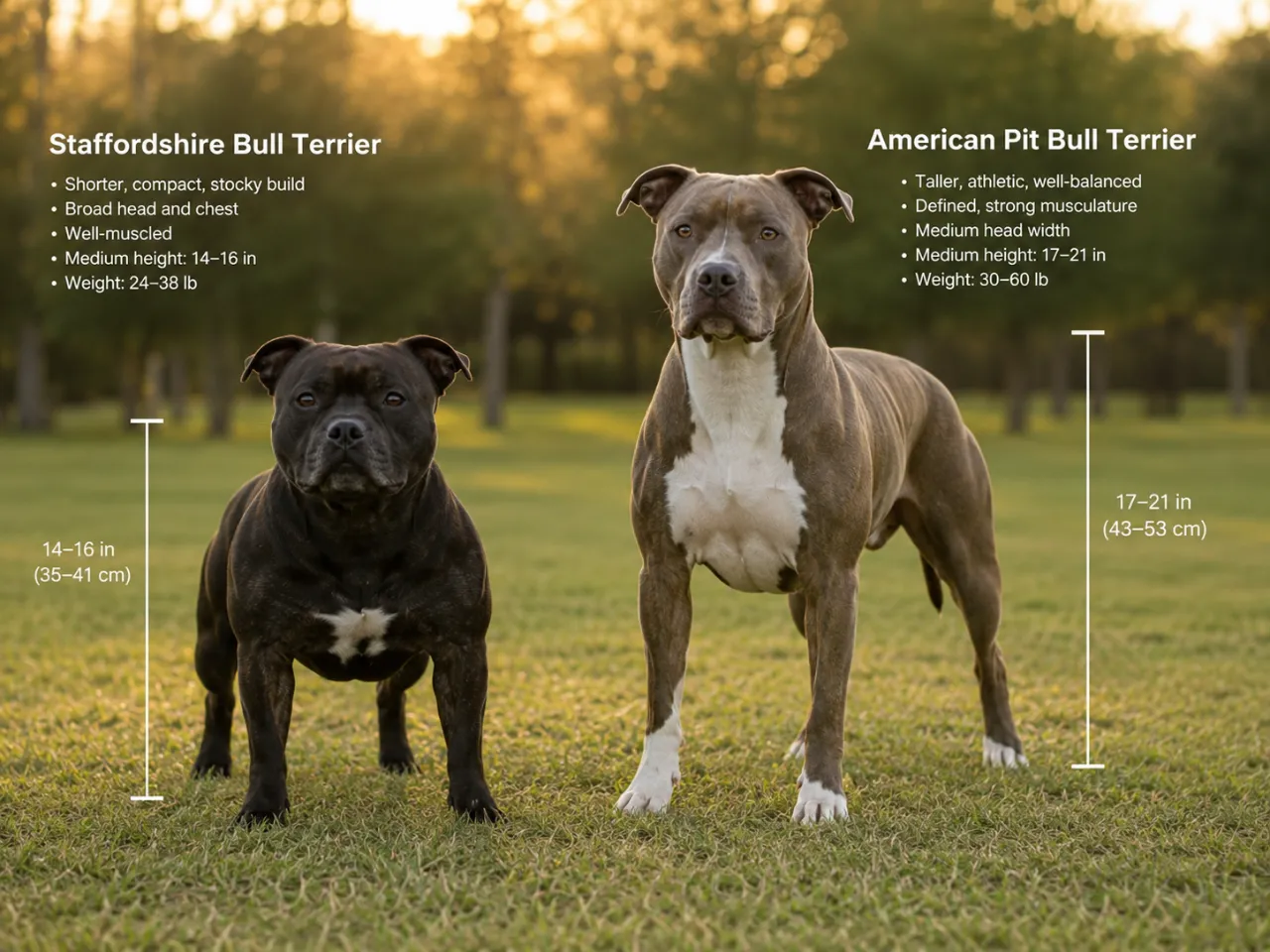
The easiest way to compare them is by breed identity and size. A Staffy, or Staffordshire Bull Terrier, is usually shorter, stockier, and more compact. A pitbull-type dog, especially the American Pit Bull Terrier, is usually taller, longer-legged, and more athletic. Both can be affectionate, energetic, people-oriented dogs, but both need responsible ownership, early training, socialization, exercise, and safe management.
Staffy vs Pitbull Summary Table
| Feature | Staffy | Pitbull / Pit Bull-Type Dog |
|---|---|---|
| Common meaning | Usually Staffordshire Bull Terrier | Often American Pit Bull Terrier or a broad bull-type category |
| Breed status | A specific recognized breed | Often an informal label, not always one exact breed |
| Origin | England | Mainly United States, depending on the breed meant |
| Typical height | About 14–16 inches at the shoulder | Often about 17–21 inches, depending on breed or mix |
| Typical weight | About 24–38 lb | Often about 30–70 lb, depending on type |
| Body shape | Short, compact, muscular, low to the ground | Taller, longer-legged, athletic, muscular |
| Head shape | Broad skull, strong cheeks, shorter muzzle | Broad head, often longer muzzle, more varied structure |
| Coat | Short, smooth, easy-care coat | Usually short and smooth, but varies by type |
| Temperament | Affectionate, playful, bold, people-loving, strong-willed | Loyal, athletic, energetic, people-oriented, variable by breeding |
| Exercise needs | Moderate to high | Moderate to very high |
| Training needs | High; needs structure and impulse control | High; needs structure, leash manners, and socialization |
| Best fit | Active owners wanting a compact, affectionate companion | Active owners wanting a larger athletic bull-type dog |
| Quick clue | Shorter, stockier, more compact | Taller, longer-legged, more athletic |
What Is a Staffy?
A Staffy is usually a Staffordshire Bull Terrier. This is a recognized British breed with a compact body, broad head, strong muscles, short smooth coat, and confident personality. Staffies are often small enough to be considered medium-small dogs, but they are very powerful for their size.
The Staffordshire Bull Terrier developed from old bull-and-terrier dogs in England. Today, a well-bred and well-raised Staffy is often known for being affectionate, playful, bold, and strongly attached to people. Many Staffies enjoy family life, toys, training games, walks, and close human companionship.
However, the Staffy is not a low-effort dog. It is strong, energetic, and determined. It needs training, daily exercise, socialization, and an owner who can manage a muscular terrier-type dog responsibly.
What Is a Pitbull?
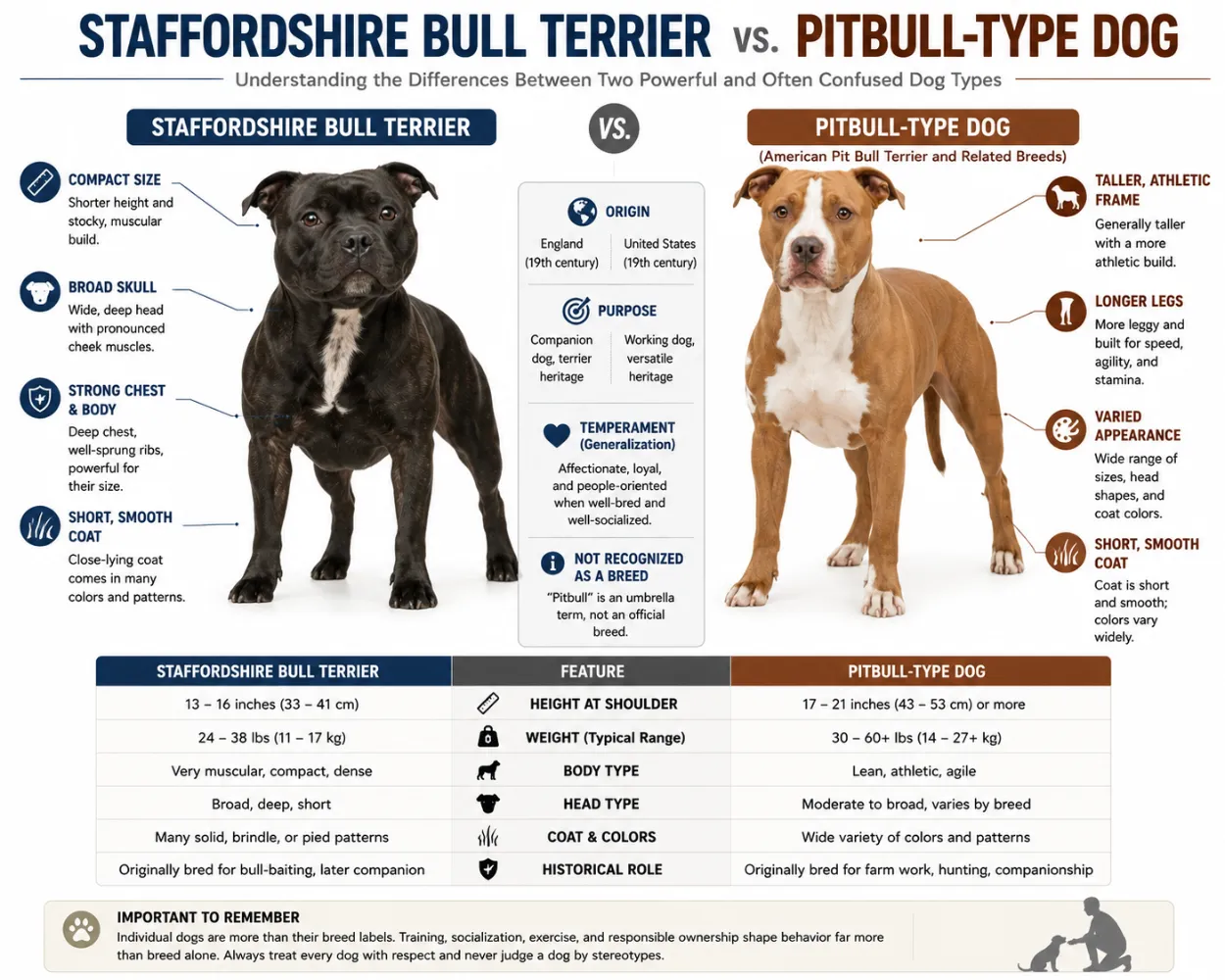
“Pitbull” or “pit bull” is not always a precise breed name. In everyday language, it may refer to the American Pit Bull Terrier, American Staffordshire Terrier, Staffordshire Bull Terrier, American Bully, or mixed dogs with a similar broad-headed, muscular appearance.
When most people compare “Staffy vs pitbull,” they usually mean Staffordshire Bull Terrier vs American Pit Bull Terrier. In that comparison, the American Pit Bull Terrier is usually taller, longer-legged, and more athletic than the Staffy.
This is why the word “pitbull” can be confusing. A Staffy is usually one specific breed. A pitbull may be a specific American Pit Bull Terrier, or it may be a general label for several related bull-type dogs.
Staffy vs Pitbull: The Main Difference
The main difference is that “Staffy” usually refers to the Staffordshire Bull Terrier, while “pitbull” is often a broader term. If the comparison is between a Staffordshire Bull Terrier and an American Pit Bull Terrier, the Staffy is usually shorter, stockier, and more compact, while the pitbull is usually taller, leaner, and more athletic.
A simple rule is:
Staffy: specific British breed, compact body, shorter height.
Pitbull: often broader American bull-type label, usually taller and more variable.
Quick Visual Difference
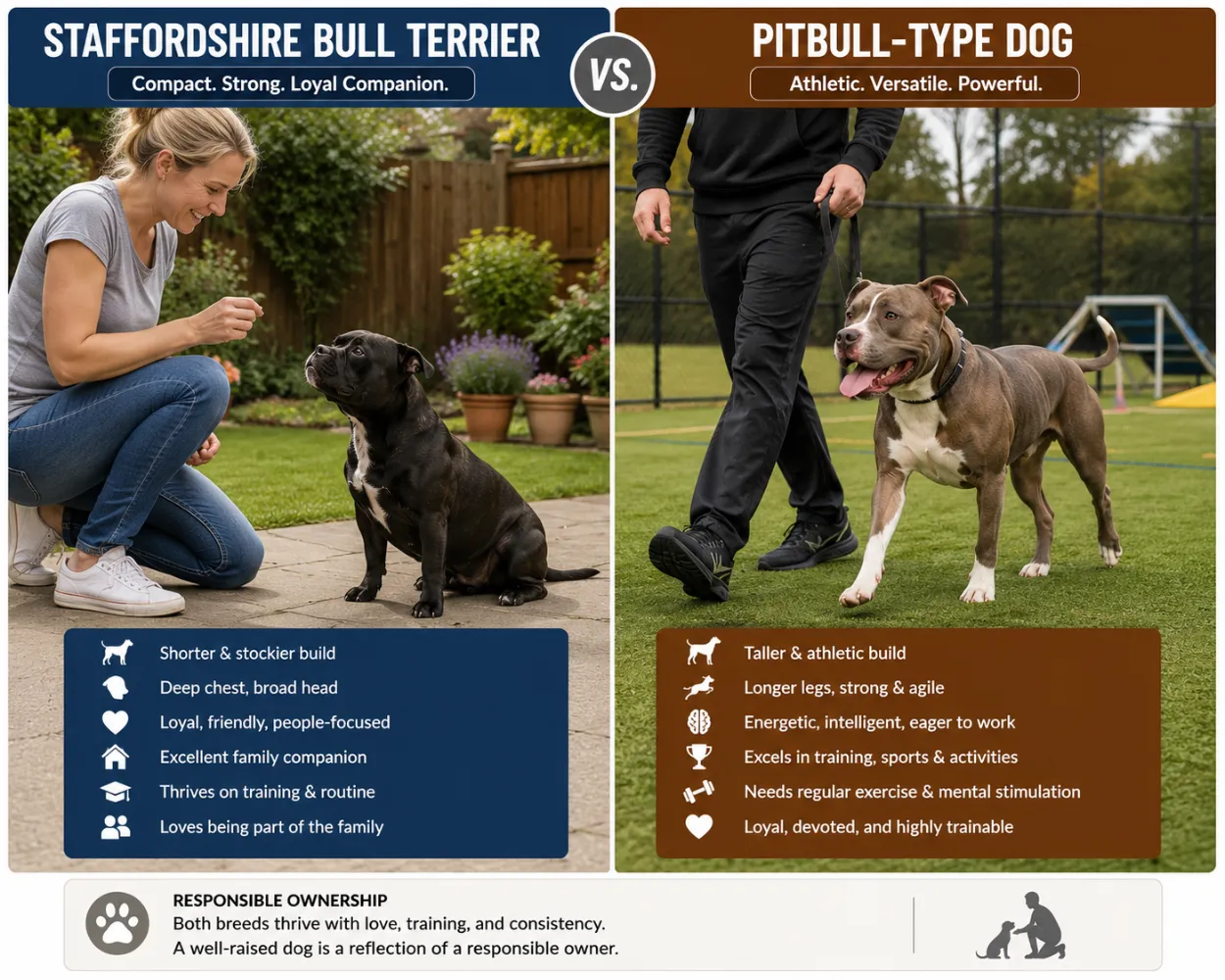
The fastest visual clue is body proportion. A Staffy usually looks low, compact, and dense. A pitbull-type dog usually looks taller, more balanced, and more athletic.
Staffy: broad head, short powerful body, strong chest, shorter legs.
Pitbull: longer legs, more athletic frame, broader variation in size and shape.
Staffy: often looks like a compact power dog.
Pitbull: often looks like a medium-sized athletic working dog.
Origin and History
The Staffy developed in England from old bull-and-terrier ancestry. These dogs combined bulldog-like strength with terrier determination. Over time, the Staffordshire Bull Terrier became a distinct breed with a smaller, compact frame and a strong companion-dog identity.
The American Pit Bull Terrier developed mainly in the United States from similar bull-and-terrier roots. American lines often emphasized athleticism, stamina, agility, and working ability. This produced a dog that is generally taller and more athletic than the Staffordshire Bull Terrier.
The two dogs share historical roots, but they developed in different countries and were shaped by different breeding traditions.
Size and Weight
The Staffy is usually smaller. Most Staffordshire Bull Terriers are about 14–16 inches tall and weigh roughly 24–38 pounds. They are short, solid, and muscular, with a surprising amount of strength in a compact body.
Pitbull-type dogs are usually larger, especially if the word refers to the American Pit Bull Terrier or American Staffordshire Terrier. Many are about 17–21 inches tall and may weigh about 30–70 pounds depending on sex, line, and individual build.
So if the dog is short, broad, and very compact, it may be a Staffy. If it is taller, longer-legged, and more athletic, it is more likely a pitbull-type dog.
Body Shape and Build
A Staffy has a compact, muscular, low-to-the-ground build. The chest is broad, the neck is strong, and the body looks dense and powerful. Staffies often look heavier than they are because of their muscle and body proportions.
A pitbull-type dog usually has a more athletic outline. The legs are often longer, the waist may be more tucked, and the body may look more suited for running, jumping, and endurance. A well-built American Pit Bull Terrier should look athletic rather than overly bulky.
The Staffy is the compact strength dog. The pitbull is usually the taller athletic bull-type dog.
Head, Face, and Expression
Staffies usually have a broad skull, strong cheek muscles, short muzzle, and expressive face. Their head is one of their most recognizable features. Many Staffies have a cheerful, open expression that matches their people-loving personality.
Pitbull-type dogs also have broad heads, but the exact shape varies. An American Pit Bull Terrier often has a somewhat longer muzzle and more athletic head shape than a Staffy. An American Staffordshire Terrier may look heavier-headed, while an American Bully may look much broader and more exaggerated.
Head shape can help, but it should not be the only clue. Mixed-breed dogs can make visual identification difficult.
Coat and Colors
Both Staffies and pitbull-type dogs usually have short, smooth coats. Their grooming needs are generally simple compared with long-haired breeds.
Staffies can appear in colors such as red, fawn, white, black, blue, brindle, or combinations with white. Pitbull-type dogs also come in many colors, including black, blue, fawn, red, brindle, brown, white, and mixed patterns.
Coat color is not a reliable way to tell them apart because there is a lot of overlap. A blue dog is not automatically a Staffy, and a brindle dog is not automatically a pitbull.
Temperament and Personality
A well-bred Staffy is often affectionate, bold, playful, and people-focused. Many Staffies love attention and want to be close to their owners. They can be silly, enthusiastic, and emotionally expressive. They are also strong-willed terriers, so they need clear rules and consistent training.
Pitbull-type dogs are often loyal, energetic, and people-oriented. Many are affectionate and playful with their families. However, because “pitbull” can describe several breeds and mixes, temperament varies widely. Some are calm and gentle, while others are intense, athletic, or high-drive.
For both dogs, behavior depends on genetics, socialization, training, health, environment, and owner responsibility. Breed label alone does not predict the whole dog.
Are Staffies and Pitbulls Aggressive?
No dog should be judged by a simple label. Staffies and pitbull-type dogs can be friendly, affectionate, and stable when responsibly bred, trained, and managed. However, they are strong, determined dogs, so poor handling can create serious problems.
Some individuals may be dog-selective, meaning they like some dogs but not others. This is not unusual in terrier and bull-type breeds. Owners should avoid careless dog-park situations, uncontrolled greetings, and rough play with unfamiliar dogs.
The safest approach is responsible management: early socialization, leash control, obedience training, supervision, secure fencing, and respect for each individual dog’s limits.
Energy Level and Exercise Needs
Staffies are energetic dogs. Their small size can fool people into thinking they are easy apartment pets, but they need daily walks, play, training, chewing outlets, and mental stimulation. A bored Staffy may chew, dig, jump, bark, or become pushy.
Pitbull-type dogs often need even more exercise, especially athletic American Pit Bull Terrier lines. They may enjoy running, hiking, fetch, tug, flirt pole games, obedience, weight-pull sports, agility-style activities, and scent games.
Both dogs need more than physical exercise. Mental work is also important. Training games, food puzzles, impulse-control exercises, and structured play help keep them balanced.
Training and Socialization
Both Staffies and pitbull-type dogs can be very trainable. They are often intelligent, food-motivated, toy-motivated, and eager to interact with people. However, they are also powerful and determined, so training should begin early.
Important skills include loose-leash walking, recall, sit, stay, leave it, drop it, calm greetings, crate comfort, handling tolerance, and settling indoors. Because these dogs are strong, leash manners and impulse control are especially important.
Reward-based training works well. Harsh training is not necessary and may create fear, frustration, or conflict. These dogs usually respond best to structure, consistency, fairness, and clear communication.
Family Life and Children
Staffies can be excellent family companions in the right home. Many are affectionate with children and enjoy being part of family life. However, they are strong and enthusiastic, so interactions with small children should always be supervised.
Pitbull-type dogs can also be loving family dogs when properly raised and matched to the household. Many are gentle with their families, but their strength means they need training and supervision around children.
Children should be taught to respect dogs. They should not pull ears, climb on dogs, disturb sleeping dogs, take food, or tease dogs with toys. Even friendly dogs need boundaries.
Dog Sociability
Dog sociability varies widely in both Staffies and pitbull-type dogs. Some are friendly with many dogs. Some prefer a few known dog friends. Some are not suitable for dog parks or multi-dog homes.
This does not mean the dog is “bad.” It means owners should understand the individual animal. Controlled introductions, parallel walks, supervision, and calm handling are safer than throwing unfamiliar dogs together.
Many Staffies and pitbull-type dogs do best with structured socialization rather than chaotic off-leash dog groups.
Prey Drive and Small Pets
Both Staffies and pitbull-type dogs may have prey drive. They may chase cats, rabbits, squirrels, birds, or small pets. Some can live peacefully with cats if raised carefully, while others are not safe around small animals.
Small pets such as guinea pigs, rabbits, hamsters, birds, and ferrets should never be left loose with a powerful terrier-type dog. Management is part of responsible ownership.
Apartment Living
A Staffy may adapt well to apartment living because of its smaller size, but only if it receives enough exercise and training. A bored Staffy in an apartment can become noisy, destructive, or restless.
A pitbull-type dog can also live in an apartment, especially a calm adult with good training. However, size, energy level, lease rules, insurance restrictions, and local laws must be considered.
For both dogs, the owner’s routine matters more than the size of the home. Daily walks, training, enrichment, and calm indoor habits are essential.
Grooming and Shedding
Both dogs have short coats that are easy to groom. Weekly brushing can remove loose hair and keep the coat healthy. Bathing should be done as needed, not too often, because over-bathing may dry the skin.
Skin care is important because many bull-type dogs can be prone to allergies or sensitive skin. Itching, paw licking, ear infections, redness, hot spots, or recurring rashes should be discussed with a veterinarian.
Regular nail trimming, dental care, ear checks, and weight management are important for both breeds.
Health Considerations
Staffies may be prone to skin allergies, hip or elbow problems, certain eye conditions, and some inherited metabolic or neurological conditions in specific lines. Responsible breeders should health test and breed for stable temperament as well as structure.
Pitbull-type dogs may also face skin allergies, hip dysplasia, knee problems, heart conditions, thyroid issues, and other health concerns depending on breed and ancestry. Mixed dogs can inherit risks from several backgrounds.
For both, good care includes veterinary checkups, healthy weight, quality diet, exercise, parasite prevention, dental care, and early treatment of skin or joint problems.
Legal and Insurance Issues
One practical issue with Staffies and pitbull-type dogs is breed-specific legislation. Some regions restrict or ban certain bull-type breeds. Some landlords, housing associations, airlines, and insurance companies may also have rules about these dogs.
Because “pitbull” is often used broadly, dogs may be judged by appearance rather than verified breed. Staffies may also be included in restrictions in some places.
Before getting a Staffy or pitbull-type dog, owners should check local laws, rental agreements, homeowners insurance, travel rules, and public-space regulations.
Common Misidentifications
Many people call any short-haired muscular dog a pitbull. This is often inaccurate. Boxers, American Bulldogs, Staffordshire Bull Terriers, American Staffordshire Terriers, Cane Corso mixes, Labrador mixes, and other dogs can all be mislabeled.
Staffies are also frequently mistaken for pitbulls because they share ancestry and body traits. A true Staffordshire Bull Terrier is usually much shorter and more compact than an American Pit Bull Terrier.
Visual identification is not always reliable, especially with mixed-breed dogs. Pedigree records or DNA testing may help, but even DNA results can vary depending on database quality.
Staffy vs American Staffy vs Pitbull
These names are often confused:
| Term | Usually Means | Quick Note |
|---|---|---|
| Staffy | Staffordshire Bull Terrier | Smaller, compact British breed |
| American Staffy / AmStaff | American Staffordshire Terrier | Larger American breed, often included under pitbull-type labels |
| Pitbull | Often American Pit Bull Terrier or broad bull-type category | Informal label; meaning varies by region |
In the United Kingdom and Australia, “Staffy” usually means Staffordshire Bull Terrier. In some American conversations, people may confuse “Staffy” with American Staffordshire Terrier, so context matters.
How to Identify One in a Photo
When looking at a photo, use several clues together:
Check height: a shorter, compact dog may be a Staffy.
Check leg length: a taller, longer-legged dog may be a pitbull-type dog.
Check body shape: Staffies are usually stockier and lower to the ground.
Check head shape: Staffies often have broad heads, strong cheeks, and shorter muzzles.
Check total build: pitbull-type dogs often look more athletic and balanced.
Check records: photos alone cannot always confirm breed identity.
Which Dog Is Better for First-Time Owners?
A Staffy may be more manageable for some first-time owners because it is smaller, but that does not mean it is easy. Staffies are strong, energetic, and determined. They need training, exercise, and socialization.
A pitbull-type dog can also be a good first dog if the individual is stable, well-matched, and properly trained. However, a large, high-drive, under-trained pitbull-type dog can be difficult for beginners.
For first-time owners, the best choice depends on the individual dog’s age, temperament, energy level, training history, and the owner’s commitment.
Which Dog Is More Affectionate?
Both can be extremely affectionate. Staffies are often famous for being people-loving, cuddly, and emotionally expressive. Many enjoy leaning into their owners, playing with toys, and being part of daily family life.
Pitbull-type dogs are also often very human-focused. Many love attention, play, training, and physical closeness. Some are energetic clowns, while others are calm and gentle adults.
Affection depends more on the individual dog than the label. A well-socialized Staffy or pitbull-type dog can be deeply loving in the right home.
Which Dog Is Stronger?
For its size, the Staffy is extremely strong. It has dense muscle, a broad chest, and a powerful build. However, many pitbull-type dogs are larger and heavier, so they often have more total physical power.
Strength should never be the main reason to choose a dog. Strong dogs need better training, not less. Leash manners, recall, calm greetings, and impulse control are essential.
Which Dog Is Right for You?
Choose a Staffy if you want a smaller, compact, affectionate, energetic dog and you are ready for terrier determination, daily exercise, and training. A Staffy can be a great fit for active owners who want a people-loving companion in a strong but smaller package.
Choose a pitbull-type dog if you want a larger, athletic, muscular companion and are prepared for training, exercise, possible legal issues, and responsible management. Because “pitbull” can mean different things, choose based on the individual dog rather than the label alone.
Do not choose either dog for intimidation, status, or protection image. These dogs need responsible homes, not owners who want them to look threatening.
Final Comparison
The Staffy and the pitbull are closely related in history and appearance, but they are not always the same. A Staffy usually means a Staffordshire Bull Terrier: short, compact, muscular, affectionate, and bold. Pitbull is often a broader term for American Pit Bull Terriers, American Staffordshire Terriers, and similar bull-type dogs, which are usually taller and more athletic.
Both can be loving companions in the right home. Both can become difficult in the wrong home. The best approach is to look beyond stereotypes and focus on the individual dog’s temperament, training, health, legal status, and lifestyle fit.
Related Dog Comparisons
Staffordshire Bull Terrier vs American Staffordshire Terrier
American Bully vs Pitbull
American Staffordshire Terrier vs Pitbull
Boxer vs Pitbull
Bulldog vs Pitbull
Rottweiler vs Pitbull
FAQs About Staffy vs Pitbull
Is a Staffy a pitbull?
It depends on how the word pitbull is being used. A Staffy usually means Staffordshire Bull Terrier, which is a specific breed. Some people include Staffies under the broad “pit bull-type” category, while others use pitbull mainly for the American Pit Bull Terrier.
What is the main difference between a Staffy and a pitbull?
A Staffy is usually smaller, shorter, and more compact. A pitbull-type dog, especially an American Pit Bull Terrier, is usually taller, longer-legged, and more athletic. Staffy is usually a specific breed, while pitbull is often a broader label.
Which is bigger, a Staffy or a pitbull?
Most pitbull-type dogs are bigger than Staffordshire Bull Terriers. Staffies are usually about 14–16 inches tall, while American Pit Bull Terriers and American Staffordshire Terriers are often taller and heavier.
Are Staffies good family dogs?
Yes, Staffies can be excellent family dogs in responsible homes. They are often affectionate and people-oriented, but they need training, exercise, socialization, and supervision around children because they are strong and energetic.
Are pitbulls good family dogs?
Many pitbull-type dogs are loving family companions when well-bred, trained, and socialized. However, because the term includes several breeds and mixes, temperament varies. The individual dog should always be evaluated carefully.
Are Staffies more aggressive than pitbulls?
No simple breed label can answer that. Behavior depends on genetics, socialization, training, health, environment, and management. Both Staffies and pitbull-type dogs need responsible ownership and safe handling.
Can Staffies and pitbulls live with other dogs?
Some can live happily with other dogs, while others are dog-selective. Careful introductions, supervision, training, and realistic management are important. Not every individual is suitable for dog parks or multi-dog homes.
Which is better for apartments?
A Staffy may be easier in an apartment because it is smaller, but both can adapt if they receive enough exercise, training, and enrichment. Landlord rules, insurance, local laws, barking, and daily activity needs should all be considered.
Do Staffies and pitbulls need a lot of exercise?
Yes. Both need daily exercise and mental stimulation. Staffies need walks, play, and training. Pitbull-type dogs may need even more athletic activity depending on their size, age, and drive.
How can I tell if my dog is a Staffy or pitbull?
Look at size, body shape, leg length, head shape, and breed records. A short, compact, muscular dog may be a Staffy. A taller, longer-legged, athletic dog may be a pitbull-type dog. For mixed dogs, visual identification is not always reliable.