Border Collies and Australian Shepherds are both highly intelligent herding dogs, but they are not the same breed. Border Collies are usually more intense, more work-focused, and famous for their “eye” when herding sheep. Australian Shepherds are often slightly stockier, more people-oriented, and commonly associated with ranch work, cattle, and versatile farm tasks. Both need daily exercise, training, mental stimulation, and an owner who enjoys active dogs.
Border Collie vs Australian Shepherd Quick Answer
The Border Collie is usually the better choice for someone who wants an extremely focused, high-drive working or sport dog. The Australian Shepherd is often a better fit for active families who want a smart, energetic companion with a slightly more outgoing and adaptable personality. However, neither breed is a low-maintenance pet. Both can become anxious, destructive, or reactive if they do not get enough exercise, training, and purpose.
Border Collie vs Australian Shepherd Summary Table
| Feature | Border Collie | Australian Shepherd |
|---|---|---|
| Breed group | Herding dog | Herding dog |
| Origin | Border region between Scotland and England | Developed mainly in the United States as a ranch dog |
| Typical size | Medium, usually lean and athletic | Medium, often slightly heavier and stockier |
| Typical weight | About 30–55 lb | About 40–65 lb |
| Body shape | Lighter, more agile, built for fast turns and intense focus | More muscular and compact, built for versatile ranch work |
| Herding style | Often uses strong “eye,” crouching posture, and precise control | More upright, often looser-eyed, pushier, and versatile with livestock |
| Energy level | Extremely high | Very high |
| Trainability | Exceptionally trainable, very sensitive and fast-learning | Highly trainable, eager, clever, and often more outgoing |
| Temperament | Focused, intense, sensitive, work-driven | Energetic, loyal, playful, often more social and protective |
| Coat | Rough or smooth coat; many colors, often black and white | Medium-length double coat; often merle, tri-color, red, or black |
| Tail | Usually has a natural long tail | May have a natural bobtail, long tail, or docked tail depending on region and law |
| Best for | Herding, agility, obedience, disc, flyball, advanced training, active handlers | Ranch work, agility, obedience, hiking, active families, dog sports |
| Not ideal for | Inactive homes, owners who dislike training, chaotic households without structure | Inactive homes, very sedentary owners, people wanting a calm couch dog |
| Quick identification clue | Lean body, intense stare, often black-and-white, very focused movement | Stockier build, merle or tri-color coat common, often bobtail or fluffy tail |
What Is a Border Collie?
The Border Collie is a herding dog developed around the borderlands of Scotland and England. It is widely regarded as one of the most intelligent and trainable dog breeds in the world. Border Collies were bred to control sheep across open hills, fields, and rough rural landscapes, often working at a distance from the shepherd.
The breed is famous for its intense focus, quick response to commands, and distinctive herding style. Many Border Collies use a strong “eye,” meaning they control livestock with a fixed stare, low posture, and subtle body pressure. This makes them extremely effective sheepdogs, but it also means they need mental work. A bored Border Collie may invent its own jobs, such as chasing shadows, cars, children, bicycles, or household objects.
What Is an Australian Shepherd?
The Australian Shepherd, often called the Aussie, is a herding dog developed mainly in the United States, despite its name. The breed became strongly associated with American ranching, rodeo culture, and versatile livestock work. Aussies were bred to be active, tough, intelligent, and useful around farms and ranches.
Australian Shepherds are known for their colorful coats, expressive eyes, strong loyalty, and energetic personality. They are often slightly more muscular and stocky than Border Collies. Many Aussies are excellent with horses, cattle, sheep, goats, and family life, but they are still demanding working dogs. A good Aussie is playful and affectionate, but it also needs structure, exercise, and training.
Quick Visual Difference
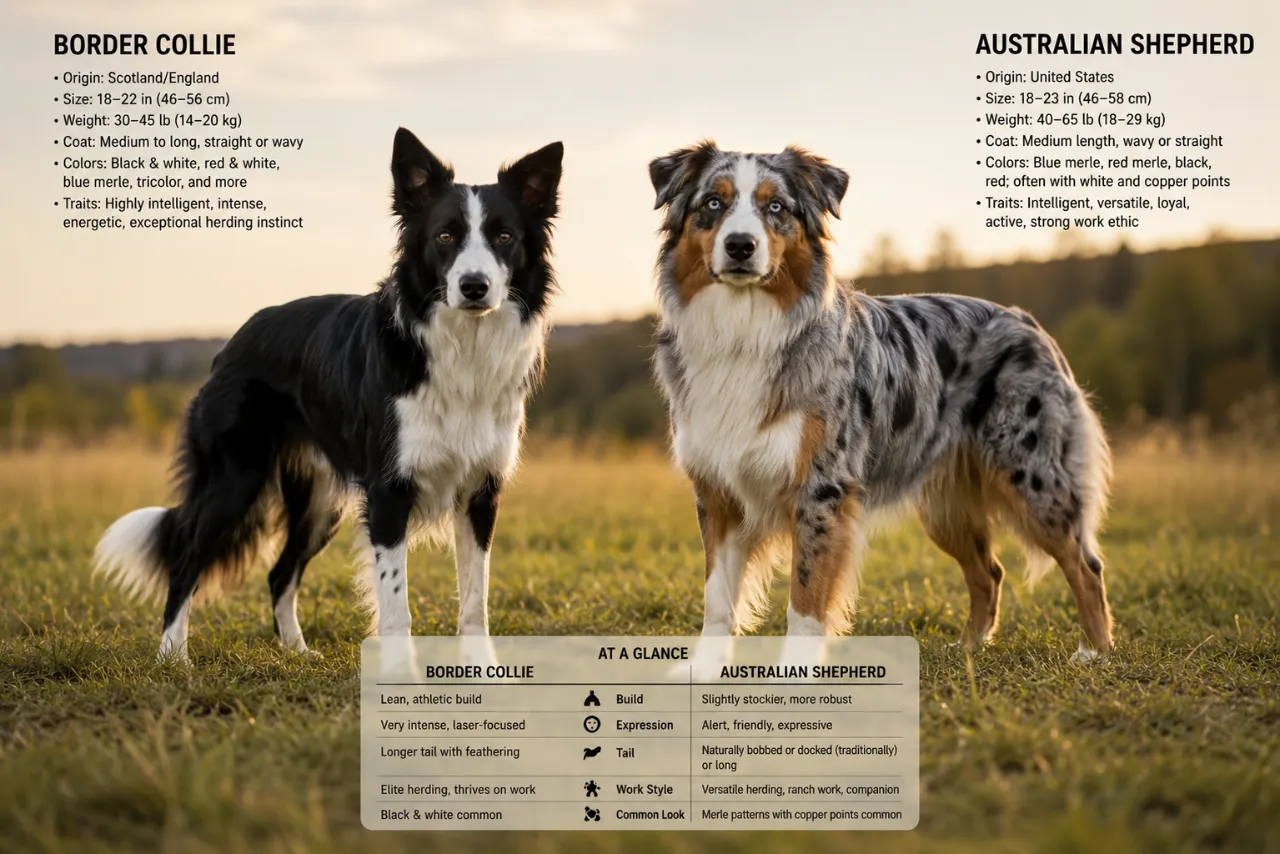
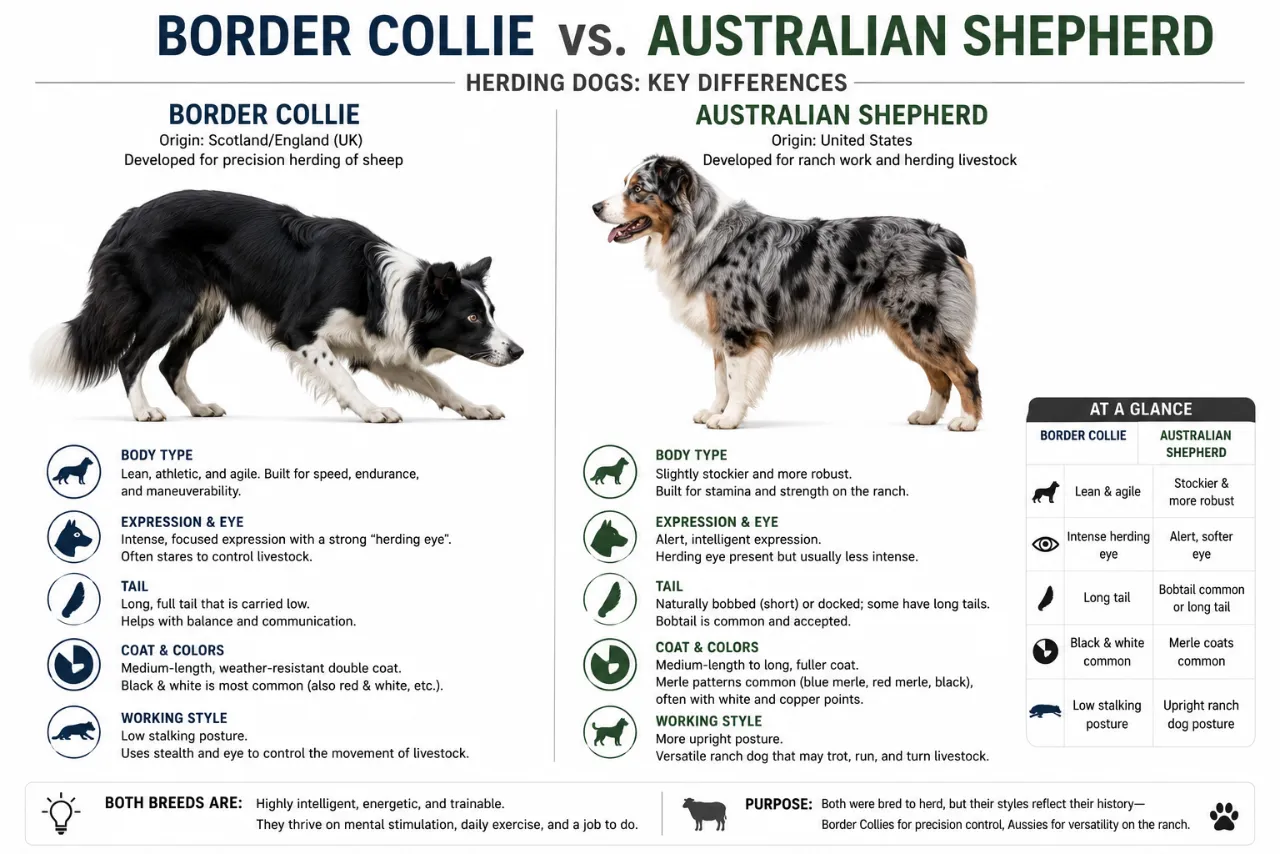
The easiest visual difference is body build and coat style. A Border Collie often looks leaner, lighter, and more sharply focused. An Australian Shepherd often looks stockier, fluffier, and more compact. Aussies are also famous for merle coats and blue or mixed-color eyes, although Border Collies can also have merle coats and blue eyes.
Border Collie: leaner body, intense expression, often black and white, usually long tail.
Australian Shepherd: slightly stockier body, colorful coat, merle pattern common, tail may be bobbed, docked, or long.
Border Collie: often moves low and fast, especially when herding.
Australian Shepherd: often moves with more upright, confident ranch-dog style.
Origin and Breed History
The Border Collie comes from the working sheepdog tradition of the British Isles. Its development focused heavily on performance rather than appearance. Shepherds needed dogs that could gather sheep, respond to whistles or commands, work at long distances, and make precise decisions in open country.
The Australian Shepherd developed mainly in North America, especially in western ranching environments. Its name may be connected to sheep, shepherds, or dogs associated with Australian sheep imports, but the modern Aussie is largely an American ranch breed. It became valued for versatility, stamina, trainability, and ability to work different livestock.
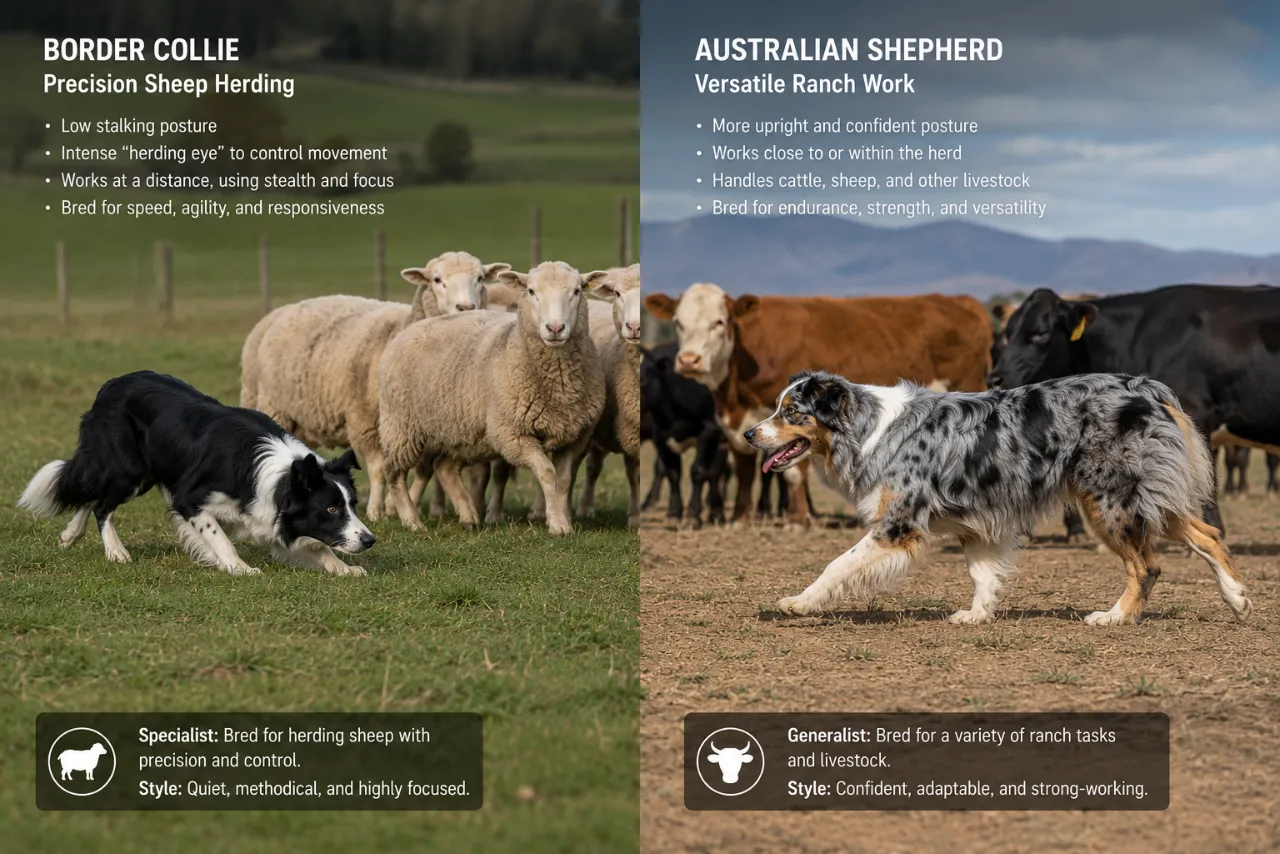
In simple terms, the Border Collie is the precision sheep specialist, while the Australian Shepherd is the versatile ranch worker.
Size and Body Build
Both breeds are medium-sized dogs, but they often feel different in build. Border Collies are usually lighter, leaner, and more flexible. Their bodies are designed for speed, sudden turns, low stalking movement, and quick response. They often look like athletes built for sharp control and endurance.
Australian Shepherds are often slightly heavier and more muscular. They can be agile and fast, but they tend to look more compact and sturdy. Their bodies suit ranch work, where a dog may need to move livestock, work around horses, and handle varied terrain.
The difference is not extreme, but it is noticeable: Border Collies often look more like distance runners and agility specialists, while Aussies often look more like rugged all-purpose athletes.
Coat Colors and Markings
Border Collies are often black and white, but the breed comes in many colors, including red, blue merle, red merle, sable, tricolor, brindle, lilac, and other patterns. They may have rough coats, smooth coats, or coats between the two. Working Border Collies can vary greatly in appearance because ability has historically been more important than a single show-ring look.
Australian Shepherds are especially known for blue merle, red merle, black tricolor, and red tricolor coats. Their coats are usually medium length with feathering on the legs, chest, and tail area. Their eyes may be brown, blue, amber, or mixed, and some Aussies have striking heterochromia, where each eye is a different color or one eye has more than one color.
Merle coloring is common in Aussies but not exclusive to them. A merle dog is not automatically an Australian Shepherd.
Tail Differences
Border Collies usually have a natural long tail carried low when relaxed and raised during movement or excitement. The tail helps with balance during fast turns, herding work, and athletic movement.
Australian Shepherds may have a natural bobtail, a natural long tail, or a docked tail depending on genetics, breeding practices, local laws, and individual history. In some countries, tail docking is restricted or banned, so more Aussies are seen with natural long tails.
If a dog has a short tail and an Aussie-like coat, it may be an Australian Shepherd, but tail length alone should not be used as the only identification clue.
Temperament and Personality
Border Collies are often described as intense, sensitive, alert, and extremely focused. They tend to bond closely with their people and may become highly tuned to small movements, voice changes, and routines. This sensitivity makes them brilliant training partners, but it can also make them prone to stress in chaotic or under-stimulating homes.
Australian Shepherds are also intelligent and energetic, but many are slightly more outgoing, bouncy, and socially expressive. They often have a strong sense of loyalty and may be protective or watchful around strangers. Aussies can be playful family dogs, but they still need rules, exercise, and training to prevent overexcitement or pushy behavior.
A simple comparison is: Border Collies are often more intense and work-obsessed; Australian Shepherds are often more playful, social, and protective.
Intelligence and Trainability
Both breeds are extremely trainable, but they learn in slightly different ways. Border Collies often learn very quickly and may anticipate what the handler wants before the command is fully given. This makes them outstanding in agility, obedience, herding trials, tricks, disc sports, and advanced training.
Australian Shepherds are also highly trainable and often eager to work with people. They may be slightly more independent or pushy than some Border Collies, but they are still very responsive dogs. Aussies often do well in obedience, rally, agility, herding, scent work, therapy roles, and active companion homes.
The challenge with both breeds is not teaching them enough. It is teaching them clearly, consistently, and calmly so their intelligence does not turn into frustration or bad habits.
Energy Level and Exercise Needs
Border Collies have one of the highest energy and mental-stimulation needs of any dog breed. A simple walk around the block is usually not enough. They often need running, training, problem-solving, play, controlled herding outlets, agility, fetch, hiking, or structured work.
Australian Shepherds are also high-energy dogs. They need daily physical activity and mental engagement. Many Aussies enjoy hiking, running, training games, trick work, agility, and interactive play. They may settle more easily than some Border Collies, but this varies greatly by individual line and upbringing.
For both breeds, mental exercise matters as much as physical exercise. A tired body with an unstimulated brain can still produce a frustrated dog.
Herding Style
Border Collies are famous for a strong-eyed herding style. They may lower their bodies, stare intensely, move in arcs around livestock, and control animals through pressure and precision. This style is especially effective with sheep.
Australian Shepherds often herd with a more upright, loose-eyed style. They may be more forceful and versatile, especially around cattle or mixed farm tasks. Some Aussies use bark, body pressure, and close work more than a typical strong-eyed Border Collie.
This herding difference explains many personality differences. Border Collies often feel like precision instruments, while Aussies often feel like rugged all-purpose ranch partners.
Family Life and Children
Both breeds can live successfully with families, but only when their needs are understood. Border Collies may be affectionate and loyal, but they can be sensitive to noise, fast movement, and unpredictable handling. Some may try to herd children by staring, circling, barking, or nipping at heels.
Australian Shepherds can be excellent family dogs for active homes. They are often playful and affectionate, but they may also herd children, guard the home, or become overexcited during rough play. Early training and supervision are important.
Neither breed should be chosen only because it is beautiful or smart. Both need families willing to train, exercise, supervise, and provide structure.
Which Breed Is Better for First-Time Dog Owners?
An Australian Shepherd is often easier for some first-time owners than a Border Collie, but this is not always true. Many Aussies are still very demanding. A first-time owner who is active, patient, and committed to training may succeed with either breed, especially with a well-bred puppy from thoughtful lines.
Border Collies can be more challenging because of their intensity, sensitivity, and need for mental work. They often notice everything, learn patterns quickly, and may become obsessive without the right outlets.
For most casual pet homes, a lower-drive individual or a different breed may be a better match than either a Border Collie or an Australian Shepherd.
Apartment Living
Both breeds can live in apartments only if their exercise and mental needs are met. The size of the home matters less than the owner’s daily routine. A Border Collie in an apartment with a highly active trainer may do better than a Border Collie in a large yard with no interaction.
However, apartment living can be difficult because both breeds may bark, react to hallway sounds, become bored, or struggle without enough off-leash exercise and training. Aussies may be more vocal and watchful, while Border Collies may become visually fixated on movement outside windows.
A yard is helpful, but it is not a substitute for training, walks, games, and human engagement.
Grooming and Shedding
Border Collies shed moderately to heavily depending on coat type and season. Rough-coated Border Collies need regular brushing to prevent tangles behind the ears, under the legs, and around the tail. Smooth-coated Border Collies may be easier to maintain but still shed.
Australian Shepherds also shed and have a medium-length double coat that needs regular brushing. Their feathering can collect burrs, mud, and loose hair. During seasonal shedding, Aussies may release a lot of undercoat.
Neither breed is hypoallergenic. Both need routine brushing, nail trimming, dental care, ear checks, and bathing as needed.
Health Considerations
Both breeds can be healthy, athletic dogs, but responsible breeding and routine veterinary care are important. Border Collies may be associated with conditions such as hip dysplasia, epilepsy, eye disorders, deafness in some lines, and certain inherited genetic diseases.
Australian Shepherds may be associated with hip and elbow dysplasia, eye disorders, epilepsy, autoimmune issues, and drug sensitivity linked to the MDR1 gene mutation. Not every Aussie has this mutation, but owners should know about it and discuss testing or medication safety with a veterinarian.
Merle-to-merle breeding can increase the risk of serious eye and hearing problems in both breeds. Ethical breeders avoid risky pairings and perform appropriate health testing.
Border Collie vs Australian Shepherd as Working Dogs
For precision sheep herding, the Border Collie is often considered unmatched. Its ability to work quietly, respond to subtle commands, and control sheep from a distance is legendary. This is why Border Collies dominate many sheepdog trials.
For versatile ranch work, Australian Shepherds are highly valued. They may handle sheep, cattle, goats, and general farm tasks with confidence. Their slightly more forceful and adaptable working style can be useful in varied livestock environments.
The better working dog depends on the job. For fine sheep control, many handlers prefer Border Collies. For all-around ranch work, many prefer Aussies.
Border Collie vs Australian Shepherd in Dog Sports
Both breeds are outstanding in dog sports. Border Collies often dominate agility, flyball, disc dog competitions, obedience, and advanced trick training because they are fast, precise, and intensely handler-focused.
Australian Shepherds also perform very well in agility, rally, obedience, herding, scent work, dock diving, and active performance homes. They may bring more bounce and personality, while Border Collies often bring unmatched intensity and speed.
If you want a sport dog, both breeds are excellent. The real question is whether you prefer the Border Collie’s sharp precision or the Aussie’s energetic versatility.
Which Dog Is More Affectionate?
Australian Shepherds are often more openly affectionate and people-oriented, especially with their families. Many Aussies enjoy leaning, following their owners, playing, and participating in family life. They can also be protective and watchful.
Border Collies can also be deeply affectionate, but their affection may be quieter or more focused. Some Border Collies prefer working with their person over cuddling on the couch. Others are very loving but still mentally intense.
Individual personality matters more than breed stereotypes. A calm Border Collie may be more cuddly than a high-drive Aussie, and a shy Aussie may be less outgoing than a social Border Collie.
Which Breed Barks More?
Both breeds can bark, especially when bored, excited, frustrated, or under-trained. Australian Shepherds are often more vocal because many were bred to be alert ranch dogs. They may bark to warn, herd, or express excitement.
Border Collies may bark during work, play, frustration, or when they are overstimulated by movement. Some Border Collies are quieter than Aussies, but others become very noisy if they lack outlets.
Good training, enough exercise, and calm routines are important for reducing problem barking in both breeds.
Common Misidentifications
Border Collies and Australian Shepherds are often confused because both are medium-sized herding dogs with similar colors. Merle Border Collies may be mistaken for Aussies, and black-and-white Aussies may be mistaken for Border Collies.
To identify them, look at the full picture. Border Collies often have a leaner body, longer tail, more intense expression, and lower herding posture. Aussies often have a stockier build, fuller coat, more common merle pattern, and sometimes a bobtail.
Mixed-breed dogs can make identification even harder. Many “Border Collie vs Aussie” guesses are actually about dogs with ancestry from both breeds.
How to Identify One in a Photo
When looking at a photo, use several clues together:
Check the body: lean and light often suggests Border Collie; stockier and more compact often suggests Aussie.
Check the tail: long tail often suggests Border Collie; bobtail or docked tail may suggest Aussie.
Check the coat: merle with copper points is very common in Aussies, but not exclusive to them.
Check the expression: intense stare and crouching posture often suggest Border Collie.
Check the movement: low, stalking, precise movement suggests Border Collie; upright, pushy ranch-dog movement may suggest Aussie.
Check the context: sheepdog trial work often suggests Border Collie; western ranch or rodeo imagery often suggests Aussie.
Which Breed Is Better for You?
Choose a Border Collie if you want a highly focused, extremely trainable dog and you are ready to provide serious mental work. This breed may be best for handlers interested in herding, agility, advanced obedience, disc sports, or structured daily training.
Choose an Australian Shepherd if you want a smart, active, loyal dog with a slightly more rugged and social ranch-dog personality. Aussies may be better for active families who enjoy hiking, training, outdoor activities, and daily interaction.
Do not choose either breed if you want a low-energy dog that is content with minimal training. Beauty and intelligence are not enough. These dogs need time, structure, and purpose.
Final Comparison
The Border Collie and Australian Shepherd are two of the most talented herding breeds in the world. The Border Collie is usually more intense, precise, and work-focused, with a legendary ability to control sheep through eye, movement, and responsiveness. The Australian Shepherd is usually stockier, more versatile, more outgoing, and strongly connected to ranch life.
Both breeds can be wonderful companions, but only in the right home. A Border Collie is often best for people who love training and structured activity. An Australian Shepherd is often best for active owners who want a playful, loyal, athletic dog with a strong personality. Either way, these are dogs for people who want to do things with their dog, not just own one.
Related Dog Comparisons
Australian Shepherd vs Mini Australian Shepherd
Border Collie vs Rough Collie
Australian Shepherd vs Blue Heeler
Border Collie vs German Shepherd
Sheltie vs Border Collie
Corgi vs Australian Shepherd
FAQs About Border Collie vs Australian Shepherd
Is a Border Collie smarter than an Australian Shepherd?
Border Collies are often ranked among the most intelligent dog breeds and are famous for extremely fast learning. Australian Shepherds are also highly intelligent. The difference is less about “smart vs not smart” and more about style: Border Collies are often more intense and precise, while Aussies are often more versatile and outgoing.
Which is more energetic, a Border Collie or an Australian Shepherd?
Both are high-energy breeds, but Border Collies are often considered even more intense and mentally demanding. Australian Shepherds are also very active and need daily exercise, training, and enrichment.
Which breed is better for families?
Australian Shepherds are often a little easier for active families because many are playful, affectionate, and social. Border Collies can also be excellent family dogs, but they may be more sensitive and more likely to become overstimulated by fast-moving children if not trained and managed well.
Are Border Collies and Australian Shepherds good apartment dogs?
They can live in apartments only with committed owners who provide enough exercise and mental work every day. Without training and activity, both breeds may bark, become restless, or develop behavior problems.
Which breed is easier to train?
Both are very trainable. Border Collies may learn faster and respond to subtle cues, but they can also be more sensitive. Australian Shepherds are eager and clever, but some can be more stubborn, vocal, or pushy.
Do Australian Shepherds shed more than Border Collies?
Both breeds shed. Australian Shepherds often have a thicker medium-length double coat with feathering, while Border Collies may have rough or smooth coats. Grooming needs vary by coat type and season.
Can Border Collies and Australian Shepherds be left alone all day?
Neither breed is ideal for being left alone all day without exercise, training, or enrichment. Both are people-oriented working dogs that can become bored, anxious, or destructive if ignored for long periods.
Which breed is better for dog sports?
Both are excellent. Border Collies often dominate agility, flyball, disc, and obedience because of their speed and precision. Australian Shepherds also perform very well and may be especially appealing to owners who want a versatile, playful sport dog.