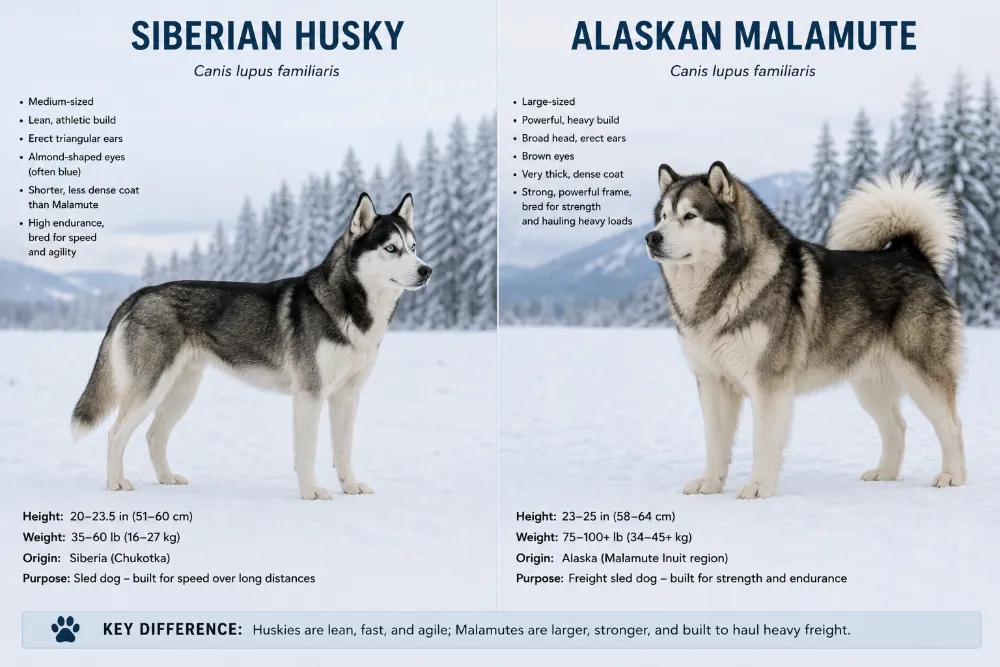
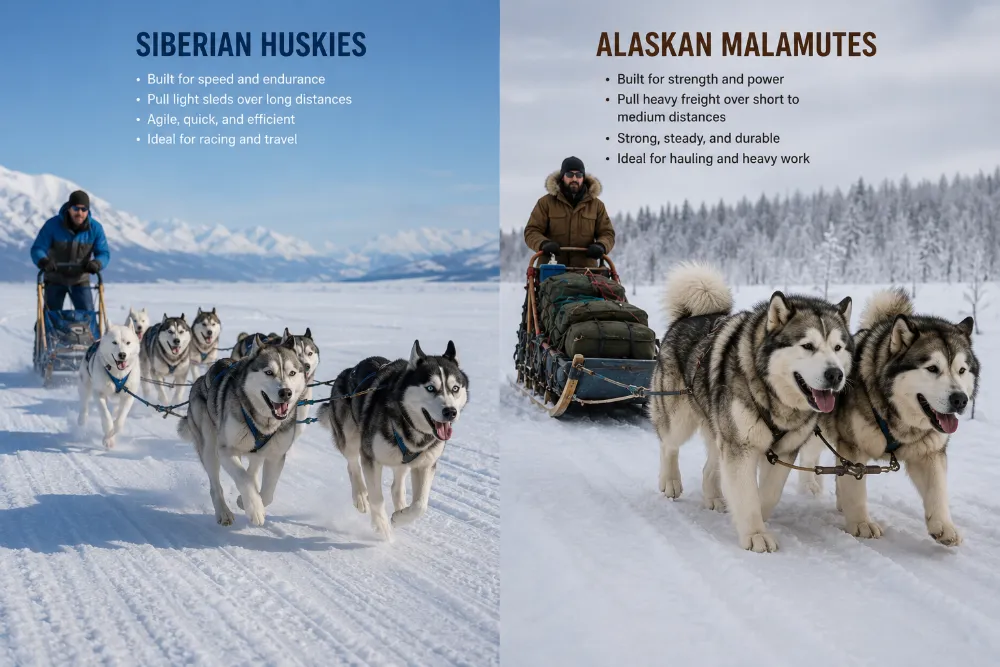
Huskies and Malamutes are both northern sled dogs, but they were bred for different jobs. The Siberian Husky is usually smaller, faster, more agile, and built for pulling light loads over long distances. The Alaskan Malamute is larger, stronger, heavier-boned, and bred to pull heavy freight. In simple terms: Huskies are endurance racers; Malamutes are powerful haulers.
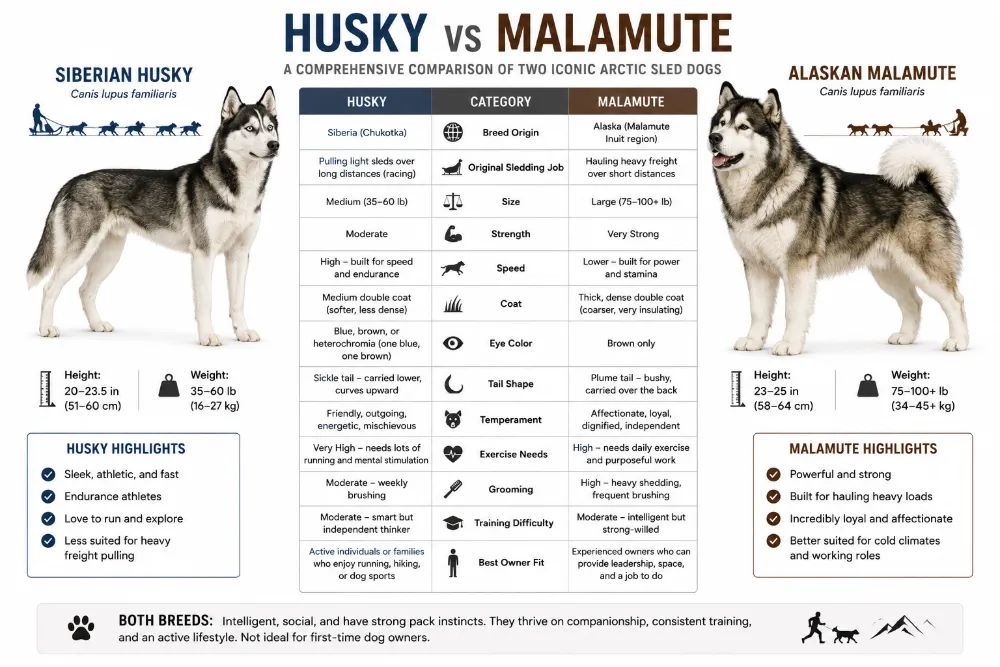
Quick Comparison Table
| Feature | Siberian Husky | Alaskan Malamute |
|---|---|---|
| Breed type | Northern sled dog | Northern sled dog |
| Original purpose | Pulling light sleds quickly over long distances | Pulling heavy loads over snow and ice |
| Typical size | Medium-sized | Large and powerful |
| Body build | Lighter, leaner, more athletic | Heavier, broader, more muscular |
| Speed | Usually faster | Slower but stronger |
| Strength | Strong for its size | Much stronger pulling power |
| Coat | Dense double coat | Very dense double coat, often thicker and heavier |
| Eye color | Brown, blue, or one of each | Usually brown; blue eyes are not typical for purebred Malamutes |
| Temperament | Energetic, playful, vocal, social, independent | Affectionate, powerful, loyal, dignified, independent |
| Training difficulty | Intelligent but often stubborn and easily distracted | Intelligent but strong-willed and physically powerful |
| Best for | Active owners who want a lighter, energetic running companion | Experienced owners who can manage a large, strong working dog |
What Is a Husky?
The word “husky” can refer to several northern sled-type dogs, but in most pet and breed comparisons, it usually means the Siberian Husky. The Siberian Husky is a medium-sized working dog originally developed by the Chukchi people of northeastern Asia for sled pulling, endurance travel, and companionship in cold climates.
Siberian Huskies are known for their athletic bodies, thick double coats, upright ears, curled or sickle-shaped tails, and expressive faces. They are often famous for blue eyes, although many Huskies have brown eyes, amber eyes, or one blue and one brown eye.
Huskies are energetic, social, playful, and often very vocal. They may howl, “talk,” whine, or make dramatic sounds when excited. They are not usually natural guard dogs because many are friendly toward strangers, but they are alert, intelligent, and full of personality.
What Is an Alaskan Malamute?
The Alaskan Malamute is a large, powerful northern working dog developed by the Mahlemut people of Alaska. Unlike the Siberian Husky, which was bred more for speed and endurance with lighter loads, the Malamute was bred for strength, heavy hauling, and survival in harsh Arctic conditions.
Malamutes have broad heads, deep chests, heavy bones, strong legs, thick double coats, and a powerful body. Their expression is often warm and wolf-like, but they are domestic dogs, not wolves. They are affectionate with family, dignified, and strong-willed.
A Malamute is not simply a “big Husky.” It is a separate breed with a different working history, body structure, and personality profile. It is usually heavier, stronger, and more physically demanding to manage than a Siberian Husky.
The Main Difference Between Husky and Malamute
The main difference is original job. Siberian Huskies were bred to pull lighter sleds over long distances with speed and efficiency. Alaskan Malamutes were bred to pull heavy loads with strength and endurance.
This difference shaped their bodies. Huskies are lighter and more agile. Malamutes are larger and more muscular. A Husky looks built for movement and speed. A Malamute looks built for power and heavy work.
The easiest rule is: Husky equals fast endurance sled dog; Malamute equals strong freight-pulling sled dog.
Size and Weight
Alaskan Malamutes are usually much larger than Siberian Huskies. A Siberian Husky is a medium-sized dog with a lean athletic frame. It is strong, but not extremely heavy.
An Alaskan Malamute is a large dog with a broader chest, heavier bones, larger paws, and more body mass. Even a moderate-sized Malamute often looks more powerful than a large Husky.
If the dog looks compact, fast, and lighter on its feet, it is more likely a Husky. If it looks broad, heavy, and built like a powerful freight dog, it is more likely a Malamute.
Body Shape and Build
The Siberian Husky has a balanced, athletic build. Its body is not too heavy, which allows it to move efficiently over long distances. The legs are strong but not massive, and the body is built for smooth, repeated movement.
The Alaskan Malamute has a stronger and more substantial build. It has a deeper chest, heavier shoulders, thicker neck, and more powerful limbs. It was designed to pull weight rather than race at high speed.
This physical difference is one of the most reliable clues. Huskies often look like runners. Malamutes look like weightlifters.
Face, Ears, and Expression
Both breeds have upright triangular ears, almond-shaped eyes, thick fur, and northern-dog facial features. However, Malamutes usually have broader heads and heavier muzzles, while Huskies often have a more refined and fox-like or wolf-like face.
Husky faces can look very expressive and mischievous. Their eye colors vary widely, and blue eyes are common in the breed. Heterochromia, where each eye is a different color, is also seen in Huskies.
Malamutes typically have brown eyes. Blue eyes are not considered typical for purebred Alaskan Malamutes. Their expression is often softer, heavier, and more dignified than the sharper, more animated Husky expression.
Tail Differences
Both breeds can carry their tails over the back, but the tail shape and carriage often differ. Huskies commonly have a sickle-shaped tail that may curve over the back when alert but does not always form a tight curl.
Malamutes usually have a plume-like tail carried over the back in a proud curve. Because the Malamute is heavier and fluffier, the tail may look thicker and more dramatic.
Tail carriage alone is not enough for identification, but combined with size, body shape, and head structure, it can help.
Coat and Shedding
Both Huskies and Malamutes have thick double coats. The undercoat provides insulation, while the outer coat helps protect against snow, wind, and cold. These coats were shaped by harsh northern climates.
Huskies shed heavily, especially during seasonal coat blowing. During these periods, large amounts of undercoat come loose and require frequent brushing.
Malamutes also shed heavily, and because they are larger and often have a heavier coat, the amount of fur can be even more dramatic. Neither breed is low-shedding, and neither is ideal for people who want a low-maintenance coat.
Color and Markings
Siberian Huskies come in many colors and patterns, including black and white, gray and white, red and white, sable, agouti, and solid or mostly white. Their facial masks can vary greatly, which adds to their expressive look.
Alaskan Malamutes also come in several colors, including gray and white, black and white, sable and white, red and white, seal and white, and solid white. They often have white markings on the face, chest, legs, and underside.
Because coat colors overlap, color alone is not a reliable way to tell them apart. Body size and structure are much more useful.
Temperament and Personality
Siberian Huskies are often energetic, playful, social, and mischievous. They usually enjoy people and other dogs, but they can be independent and stubborn. Many Huskies are escape artists that dig, jump, squeeze, or climb if bored or under-exercised.
Alaskan Malamutes are affectionate, loyal, and often deeply attached to their families. They may be calmer indoors than Huskies when mature, but they are also stronger and more physically powerful. Many Malamutes have a dominant or strong-willed personality and need confident, consistent handling.
Both breeds are intelligent, but neither is naturally obedient in the way some herding or sporting breeds may be. They were bred to think, pull, travel, and work in demanding conditions, not simply wait for commands.
Energy and Exercise Needs
Both breeds need serious exercise, but the style differs slightly. Huskies often need running, long walks, hiking, pulling sports, structured play, and mental stimulation. A bored Husky can become loud, destructive, or escape-prone.
Malamutes also need exercise, but they are more about strength and endurance than speed. They may enjoy hiking, backpacking, pulling carts, sledding, weight-pulling sports, and long steady activity.
Neither breed is suitable for a lifestyle with little exercise. They need daily movement, training, enrichment, and secure outdoor management.
Training Differences
Huskies are intelligent but famously independent. They learn quickly, but they may decide that a command is optional if it is not rewarding. Recall training can be especially challenging because many Huskies have strong prey drive and a desire to run.
Malamutes are also intelligent and independent, but their size makes training even more important. A poorly trained Malamute can pull hard, ignore commands, guard resources, or overpower a handler. Early socialization and leash training are essential.
Both breeds respond best to positive reinforcement, consistency, patience, and clear boundaries. Harsh training can damage trust and may worsen behavior.
Vocal Behavior
Huskies are famous for being vocal. They may howl, yodel, whine, bark, “talk,” or make dramatic sounds that seem almost conversational. Many Husky owners love this trait, but it can be difficult in apartments or noise-sensitive neighborhoods.
Malamutes can also be vocal, especially through howling or “woo-woo” sounds. However, Huskies are often considered more consistently talkative and dramatic.
If you want a very quiet dog, neither breed is a perfect choice. Both can be loud when bored, excited, lonely, or under-stimulated.
Prey Drive and Other Pets
Both Huskies and Malamutes can have strong prey drive. They may chase cats, rabbits, squirrels, chickens, or other small animals. Early socialization can help, but instinct should never be ignored.
Huskies are often fast and agile chasers. Malamutes are powerful and determined. Either breed can be risky around small pets if not carefully managed.
Homes with cats or small animals need secure separation, supervised introductions, and realistic expectations. Some individuals live peacefully with cats they were raised with, but many should not be trusted unsupervised with small animals.
Guarding and Protection
Neither breed is usually an ideal guard dog. Huskies are often friendly with strangers and may greet visitors happily. Their wolf-like appearance may deter some people, but their temperament is often social rather than protective.
Malamutes may be more imposing because of their size, and some can be more reserved or protective than Huskies. However, they were not primarily bred as guard dogs. They are working sled dogs, not specialized protection breeds.
Both breeds can alert their owners to activity, but choosing one for serious guarding is usually not appropriate.
Cold Weather and Hot Weather
Both Huskies and Malamutes are cold-weather dogs. Their double coats protect them in snow, wind, and freezing temperatures. They often enjoy winter conditions that many other dogs dislike.
Hot weather is more challenging. These breeds can overheat if exercised heavily in warm or humid conditions. Owners in hot climates must provide shade, cool water, air conditioning, careful exercise timing, and heat safety.
Never shave a Husky or Malamute as a simple heat solution. Their double coat helps regulate temperature and protect the skin. Instead, use proper brushing, cooling strategies, and limited heat exposure.
Grooming Needs
Both breeds require regular brushing. During normal periods, brushing several times a week may help control loose fur. During seasonal shedding, daily brushing may be necessary.
Bathing should be occasional and not excessive, because too much bathing can dry the skin. Nails should be trimmed, ears checked, and teeth cleaned regularly.
Malamutes may require more grooming time simply because they are larger and have more coat mass. Huskies are not easy-care dogs either, especially during coat-blowing season.
Health Concerns
Siberian Huskies can be prone to certain eye conditions, hip issues, and other breed-associated health concerns. Responsible breeders screen breeding dogs and avoid producing puppies from unhealthy lines.
Alaskan Malamutes can be prone to hip dysplasia, inherited polyneuropathy, eye conditions, hypothyroidism, and other health concerns. Their larger size also means joint health and weight control are especially important.
For both breeds, good nutrition, exercise, healthy weight, veterinary care, and responsible breeding are essential. Buyers should seek health-tested breeders or work with reputable rescues.
Living Space and Home Suitability
A Husky can live in a home or apartment only if exercise, training, and mental stimulation are excellent. Without enough activity, a Husky may howl, dig, chew, escape, or become destructive.
A Malamute usually needs more space and stronger physical management because of its size and power. A secure yard is helpful, but a yard alone is not enough. Malamutes need interaction, walks, training, and purpose.
Both breeds need secure fencing. They should not be left loose in unfenced areas because their prey drive, curiosity, and running instincts can lead them far from home.
Which Breed Is Better for Families?
Both breeds can be loving family dogs when well-bred, well-trained, and properly supervised. Huskies are playful and social, while Malamutes are affectionate and often deeply bonded with family.
However, both can be too energetic or strong for very young children without supervision. Malamutes, in particular, may accidentally knock over small children simply because of their size and strength.
Families should focus less on appearance and more on lifestyle. These breeds need time, exercise, grooming, training, and secure management every day.
Which Breed Is Easier for Beginners?
Neither breed is the easiest choice for first-time dog owners. Huskies can be difficult because they are energetic, independent, vocal, and escape-prone. Malamutes can be difficult because they are large, strong, stubborn, and require experienced handling.
If choosing between the two, some first-time owners may find a Husky physically easier to manage because it is smaller. However, that does not mean Huskies are easy. They can be extremely challenging if under-exercised.
Malamutes are often better suited to owners who already understand large working breeds and can manage strength, training, and boundaries.
Common Myths About Huskies and Malamutes
Myth: Malamutes are just giant Huskies
This is false. Malamutes and Huskies are separate breeds with different histories, body structures, and working purposes.
Myth: Huskies are part wolf
This is misleading. Siberian Huskies may look wolf-like, but they are domestic dogs. Their behavior, breeding history, and relationship with humans are those of a dog breed, not a wild wolf.
Myth: Malamutes are aggressive
This is too simplistic. Malamutes can be strong-willed and may show same-sex dog aggression or prey drive, but a well-bred, well-socialized Malamute can be affectionate and stable.
Myth: Blue eyes mean the dog is a Husky
Blue eyes are common in Huskies, but eye color alone is not enough for breed identification. Malamutes usually have brown eyes, and blue eyes are not typical for purebred Malamutes.
Myth: These dogs do fine without much exercise because they sleep indoors
This is false. Both breeds are working dogs with high physical and mental needs. Without enough activity, behavior problems are common.
Simple Identification Checklist
| Question | Likely Husky | Likely Malamute |
|---|---|---|
| Is the dog medium or large? | Medium-sized | Large and heavy |
| Does it look like a runner or a hauler? | Runner: lean, agile, fast | Hauler: broad, powerful, muscular |
| Eye color | May be blue, brown, amber, or mixed | Usually brown |
| Head shape | More refined and lighter | Broader and heavier |
| Tail | Sickle-shaped, often carried over back | Thick plume carried over the back |
| Best working description | Light sled endurance dog | Heavy freight sled dog |
| Best owner fit | Active owner who can handle energy and escape behavior | Experienced owner who can manage strength and size |
Final Verdict: Husky vs Malamute
The Siberian Husky and Alaskan Malamute are both beautiful northern working dogs, but they are not the same breed. The Husky is lighter, faster, more agile, and often more vocal. The Malamute is larger, stronger, heavier, and built for pulling heavy loads.
The best choice depends on lifestyle, not looks. A Husky may suit an active owner who wants a medium-sized, energetic, social sled dog. A Malamute may suit an experienced owner who can manage a large, powerful, affectionate working dog. Both need exercise, grooming, training, secure fencing, and owners who understand northern breeds.
FAQs About Huskies and Malamutes
Is a Husky the same as a Malamute?
No. The Siberian Husky and Alaskan Malamute are separate breeds. Both are northern sled dogs, but Huskies were bred more for speed and endurance, while Malamutes were bred for strength and heavy hauling.
Which is bigger, a Husky or a Malamute?
The Alaskan Malamute is usually much bigger and heavier than the Siberian Husky. Malamutes have broader bodies, heavier bones, and more pulling power.
Which is stronger, a Husky or a Malamute?
The Malamute is stronger. It was bred to pull heavy loads, while the Husky was bred to pull lighter loads over long distances more quickly.
Which is faster, a Husky or a Malamute?
The Husky is usually faster and more agile. Malamutes are powerful but not built for the same speed.
Do Huskies and Malamutes both shed a lot?
Yes. Both breeds shed heavily and have dense double coats. Seasonal coat blowing can produce large amounts of loose fur.
Can Malamutes have blue eyes?
Purebred Alaskan Malamutes typically have brown eyes. Blue eyes are common in Siberian Huskies but are not typical for Malamutes.
Are Huskies easier than Malamutes?
Not necessarily. Huskies are smaller but often very energetic, vocal, and escape-prone. Malamutes are larger and stronger, which can make them harder to physically manage. Both are challenging breeds.
Are Huskies or Malamutes good with children?
Both can be good family dogs with training, socialization, and supervision. However, their energy and strength mean interactions with young children should always be monitored.
Can Huskies and Malamutes live in hot climates?
They can live in warmer areas only with careful heat management, shade, cool water, indoor cooling, and limited exercise during hot weather. They are naturally cold-weather breeds.
Which breed is better for first-time owners?
Neither is ideal for inexperienced owners who want an easy dog. A Husky may be physically easier because it is smaller, but both breeds need active, consistent, knowledgeable care.